Rencana belajar Anda · Lanjut · Tinjau →
Speaking pronunciation — five self-checks
DiperkenalkanPosisi tersimpan Anda tetap berada di browser ini. Melanjutkan tidak menyelesaikan pelajaran atau menjawab pertanyaannya.
 24:16
IELTS Speaking: Pertukaran, giliran panjang, dan pelafalan
Lembar kerja asli memperkenalkan empat kriteria. Kelancaran dan koherensi berkaitan dengan melanjutkan pada pace yang berguna dengan ide yang terhubung. Kosakata mencakup pencarian…
Narasi bahasa Inggris · takarir bahasa Inggris dan 中文 yang dapat dipilih
In this lesson
| English | Makna |
|---|---|
| sound/saʊnd/ | |
| pronunciation/prəˌnʌnsɪˈeɪʃn/ | The way a word or speech sound is spoken. |
| stress/stres/ | Extra prominence given to a syllable or word through features such as loudness, length or pitch. |
| ending/ˈendɪŋ/ |
Make "yesterday" audible
-
Record "I walk to class" and "I walked to class." Can you hear the difference? On paper the -ed is obvious; in speech, that one sound carries the whole timeline.
-
Speaking is marked on four equal criteria, and pronunciation is one of them — a full quarter of your Speaking band. You can improve it with specific practice; you don't need to copy a British or American accent.
-
What counts is whether a listener understands you easily. Learners with the same first language don't all have the same difficulties, so use these five checks to find your priorities.
A dictionary can show stress marks; it cannot lift your tongue for you.
Pronunciation is one of how many Speaking criteria?
Kesulitan 2/5 · 140 koin + bonus kecil pada penyelesaian pertama hari ini
Four equally weighted criteria: Fluency and coherence, Lexical resource, Grammatical range and accuracy, and Pronunciation.
1. Final consonants
- Some English word endings and consonant groups may be new to you. Record yourself and listen: do desk / des or helped / help sound the same? If so, practise that pair inside a sentence.
- Say cat, cats, cap, caps, cast, casts slowly, then use one pair in a short sentence. Final sounds don't need a loud "pop" every time — just make the word recognisable, without adding an extra vowel (desk-uh).
Why can a missing final consonant change what a listener understands?
Kesulitan 1/5 · 100 koin + bonus kecil pada penyelesaian pertama hari ini
Some final sounds mark tense, plural or possession. If they cannot be heard, those distinctions may become unclear.
2. -ed and -s endings are grammar too
- If a listener can't hear the ending, they may miss the tense or whether you mean one or many. (There's no fixed penalty for one sound — the examiner judges your whole performance.)
- -ed has three sounds: walked /t/, lived /d/, needed /ɪd/. After /t/ or /d/ → /ɪd/; after other voiceless sounds → /t/; after other voiced sounds → /d/. It's the last sound that matters, not the last letter. -s works the same way: cats /s/, dogs /z/, buses /ɪz/. Practise: walk / walked, live / lived, need / needed, cat / cats, dog / dogs.
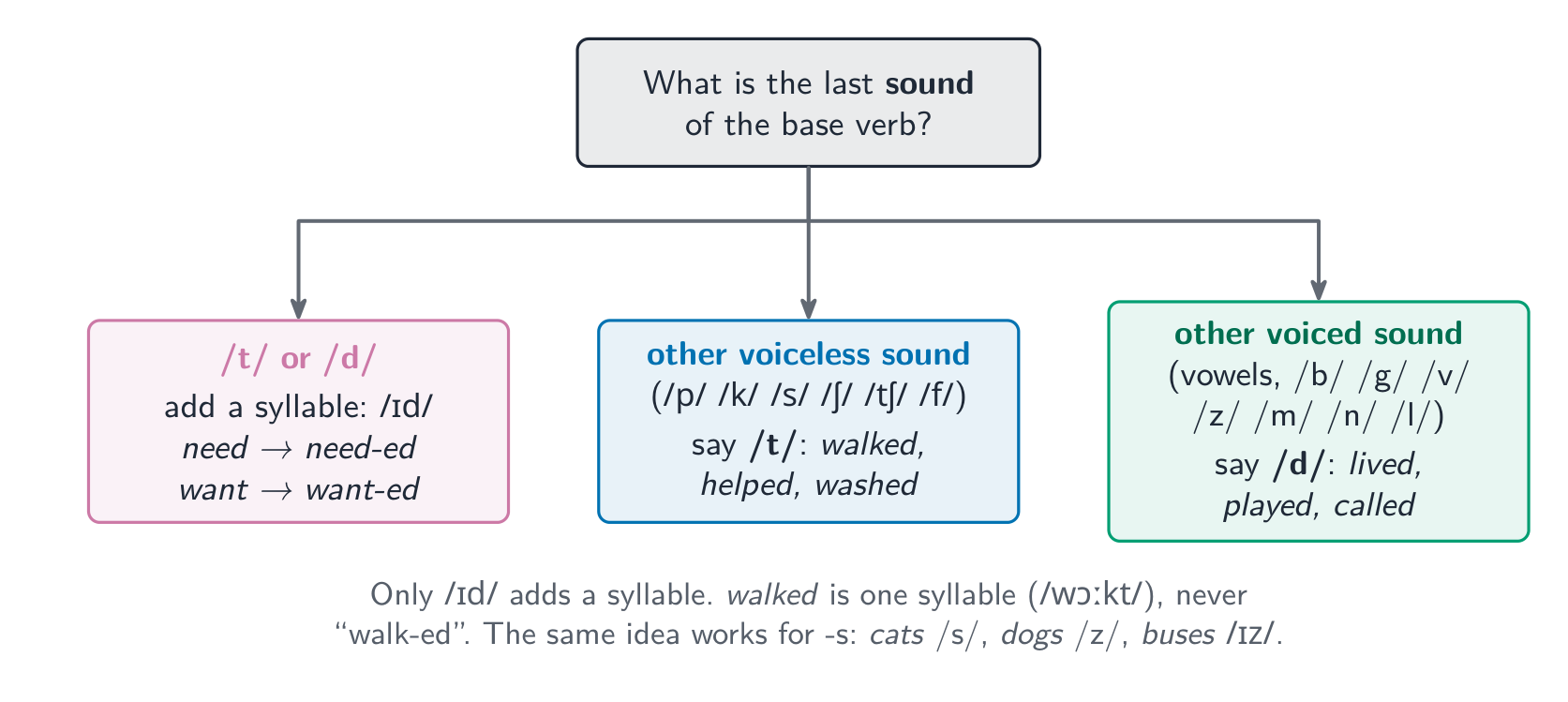
How is the -ed ending said?
After /t/ or /d/ → /ɪd/; after other voiceless sounds → /t/; after other voiced sounds → /d/. The last sound matters, not the last letter.
Match each word to the sound its -ed ending makes.
Kesulitan 2/5 · 140 koin + bonus kecil pada penyelesaian pertama hari ini
In these regular past forms, bases ending in /t/ or /d/ take /ɪd/ (needed). Other voiceless base sounds take /t/ (walked), and other voiced sounds take /d/ (lived). Use the base’s final sound, not its last written letter.
3. Sound pairs you might merge
- /θ/ and /ð/ — think, this: tongue tip lightly between the teeth. /v/ and /w/ — if very and wary sound alike, touch your top teeth lightly to your lower lip for /v/.
- /l/, /n/, /r/ at the start of a word — light / night, read / lead. /iː/ and /ɪ/ — sheep / ship, feel / fill: the vowel quality changes, not just the length, so check with real audio. Choose one or two pairs a listener actually finds unclear; leave the rest for later.
4. Word stress
- Long English words have one main stressed syllable, and the wrong stress can make a word hard to recognise even when every sound is right. phoTOgraphy / PHOtograph / photoGRAPHic. eCONomy / ecoNOMic. deVELop (not DEvelop).
- Stress moves when you add an ending, so learn each form separately. The IPA lines in this site's vocabulary lists mark stress with ˈ.
Where is the stress in 'photography'?
Kesulitan 1/5 · 100 koin + bonus kecil pada penyelesaian pertama hari ini
phoTOgraphy. Compare PHOtograph and photoGRAPHic: related words can move the main stress.
5. Sentence stress and intonation
- English usually stresses the words that carry meaning — nouns, main verbs, adjectives — and says the small words more quietly: I'd LIKE to GO to the LIbrary. Stress shows the listener what matters.
- In a list, the voice often rises on each item and falls on the last. Many statements fall; yes/no questions often rise. Record two minutes of speech and listen for one feature at a time. If you can't hear a difference, ask a teacher or a friend.
Speaking with flat, even stress on every word makes you easier to understand.
Kesulitan 1/5 · 100 koin + bonus kecil pada penyelesaian pertama hari ini
No. Prominence and natural pauses help listeners follow your meaning; giving every word identical stress can make that harder.
One sound can carry the timeline
- "I walk to class" versus "I walked to class": the final /t/ is the only signal that it was in the past.
- Record both, then use each in a new answer about today and about yesterday. If the ending disappears when you speak freely, practise it again in a short phrase.
- Read-aloud check (a Part 1 answer to "What did you do last weekend?"; CAPITALS show stressed syllables): I STAYED at HOME on SATurday and FInally CLEANED my ROOM. On SUNday I PLAYED BASketball with two FRIENDS, and we WATCHED a FILM afterwards. Record it, then listen: can you hear /d/ in stayed, cleaned, played, /t/ in watched, and /z/ in friends?
- Knowing that walked ends in /t/ isn't the same as saying it. Check with a recording or a listener.
- Find your own difficult sounds, practise them in real sentences, and check with recordings.
Checked on 2 October 2026: IELTS Speaking format. Sound practice: British Council Sounds Right.
Match the distinctions in this worked case.
Kesulitan 2/5 · 140 koin + bonus kecil pada penyelesaian pertama hari ini
Record the pair, then use each in a fresh reply about today or yesterday. If the ending disappears outside rehearsal, return to it inside a short phrase.
What evidence can show whether your final /t/ is audible?
Kesulitan 1/5 · 100 koin + bonus kecil pada penyelesaian pertama hari ini
Compare “I walk to class” and “I walked to class”. The final sound in walked signals the past in this pair; a listener needs the full sentence to interpret the time. Record the pair, then use each in a fresh reply about today or yesterday. If the ending disappears outside rehearsal, return to it inside a short phrase.