Rencana belajar Anda · Lanjut · Tinjau →
幸亏 (luckily / thanks to)
DiperkenalkanPosisi tersimpan Anda tetap berada di browser ini. Melanjutkan tidak menyelesaikan pelajaran atau menjawab pertanyaannya.
Lucky you brought it
- Your friend reminded you to take an umbrella. An hour later it poured with rain.
- luckily幸亏you你remind提醒me我to bring带umbrella伞,otherwise不然me我would就to get soaked淋湿(completed / change)了。 — "Luckily you reminded me to bring an umbrella, or I'd have got soaked."
- Goal: point to the lucky fact that saved you with luckily幸亏, and say what would have happened with otherwise不然 / otherwise要不然.
luckily幸亏 …,otherwise不然 …
- luckily幸亏 (xìngkuī) = "luckily, thanks to". It marks the fact that stopped something bad; it usually starts the sentence.
- The second clause says what would have happened without it: otherwise不然 / otherwise要不然 / otherwise否则 … would就 ….
luckily幸亏you你remind提醒me我,otherwise不然I我would就forget忘了。
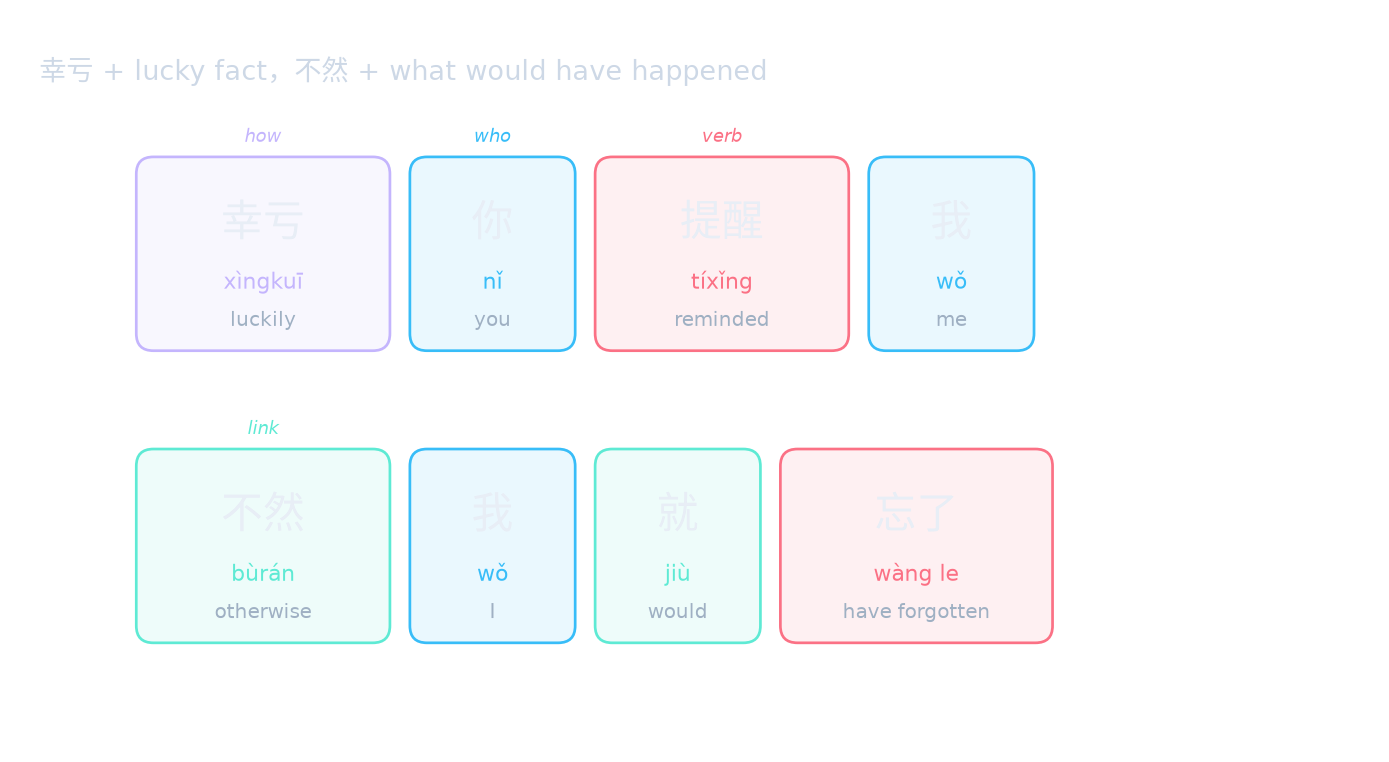
Complete: “Luckily you reminded me, otherwise I would have forgotten.” 幸亏你提醒我,____我就忘了。
Kesulitan 1/5 · 100 koin + bonus kecil pada penyelesaian pertama hari ini
The second clause says what would have happened without the lucky fact.
luckily幸亏 … ,only then才 …
- With only then才, the second clause says what the lucky fact made possible: luckily幸亏he他drive开车take送me我,me我only then才to keep up with赶上(completed / change)了the plane飞机。 — "Luckily he drove me, so I made the plane (only because of that)."
- luckily幸亏 can also go after the subject: we / us我们luckily幸亏early早to set off出发(completed / change)了。 — "Luckily we set off early."
luckily幸亏he他drive开车take送me我,I我only then才caught赶上了the plane飞机。
Build: “Luckily he drove me, so I caught the plane.”
Kesulitan 3/5 · 200 koin + bonus kecil pada penyelesaian pertama hari ini
幸亏 …,才 … = only thanks to that.
Only for a lucky escape
- luckily幸亏 needs a bad result that was avoided: ✓ luckily幸亏to bring带(completed / change)了umbrella伞,otherwise不然would就to get soaked淋湿(completed / change)了。 For plain good news with no danger, use degree / adjective linker很lucky幸运: ✓ me我degree / adjective linker很lucky幸运,抽到(completed / change)了first prize一等奖。 — "I was lucky and won first prize." ✗ luckily幸亏me我抽到(completed / change)了first prize一等奖.
- luckily幸亏 is an adverb, not a verb or adjective: ✗ me我degree / adjective linker很luckily幸亏.
Which sentence uses 幸亏 correctly?
Kesulitan 1/5 · 100 koin + bonus kecil pada penyelesaian pertama hari ini
幸亏 marks a lucky fact that stopped something bad (迟到).
You won a prize in a lucky draw. There was no danger. Which fits?
Kesulitan 1/5 · 100 koin + bonus kecil pada penyelesaian pertama hari ini
For plain good luck with no danger avoided, use 很幸运.
luckily幸亏, fortunately幸好 and good好at / in在
- fortunately幸好 means the same and swaps freely: fortunately幸好you你remind提醒me我 = luckily幸亏you你remind提醒me我.
- good好at / in在 points to one good point in a bad situation: (literary) to rain雨很大,good好at / in在we / us我们to bring带(completed / change)了umbrella伞。 — "The rain was heavy, but at least we had umbrellas."
幸好 can replace 幸亏 in 幸亏你提醒我.
Kesulitan 1/5 · 100 koin + bonus kecil pada penyelesaian pertama hari ini
幸好 and 幸亏 swap freely.
Recap
- luckily幸亏 + lucky fact,otherwise不然 / otherwise要不然 + (would就) bad result = luckily …, otherwise ….
- luckily幸亏 …,only then才 … = only thanks to that …. Not for plain good news (use degree / adjective linker很lucky幸运).
Read the full reference: HSK 5 grammar — Adverbs.
Tell a friend about a near problem: you almost missed an exam, but your alarm went off just in time. Use 幸亏 … 不然 ….
Your answer need not copy the model. A partner or teacher must hear the spoken response to comment on pronunciation.