Rencana belajar Anda · Lanjut · Tinjau →
Advanced 还 … 呢
DiperkenalkanPosisi tersimpan Anda tetap berada di browser ini. Melanjutkan tidak menyelesaikan pelajaran atau menjawab pertanyaannya.
 12:09
HSK 5 Tata Bahasa 2: Adverbia — Fokus dan Penilaian
Kelompok masih berada di kantor. Jam menunjukkan pukul sebelas empat puluh, lebih lambat dari rencana siapa pun. Satu teman sebaya menyebut dirinya sebagai editor yang teliti, namun judul pada naskahnya…
Penjelasan bahasa Inggris + contoh Mandarin · caption mengikuti teks yang diucapkan
In this lesson
Someone is sleeping next door
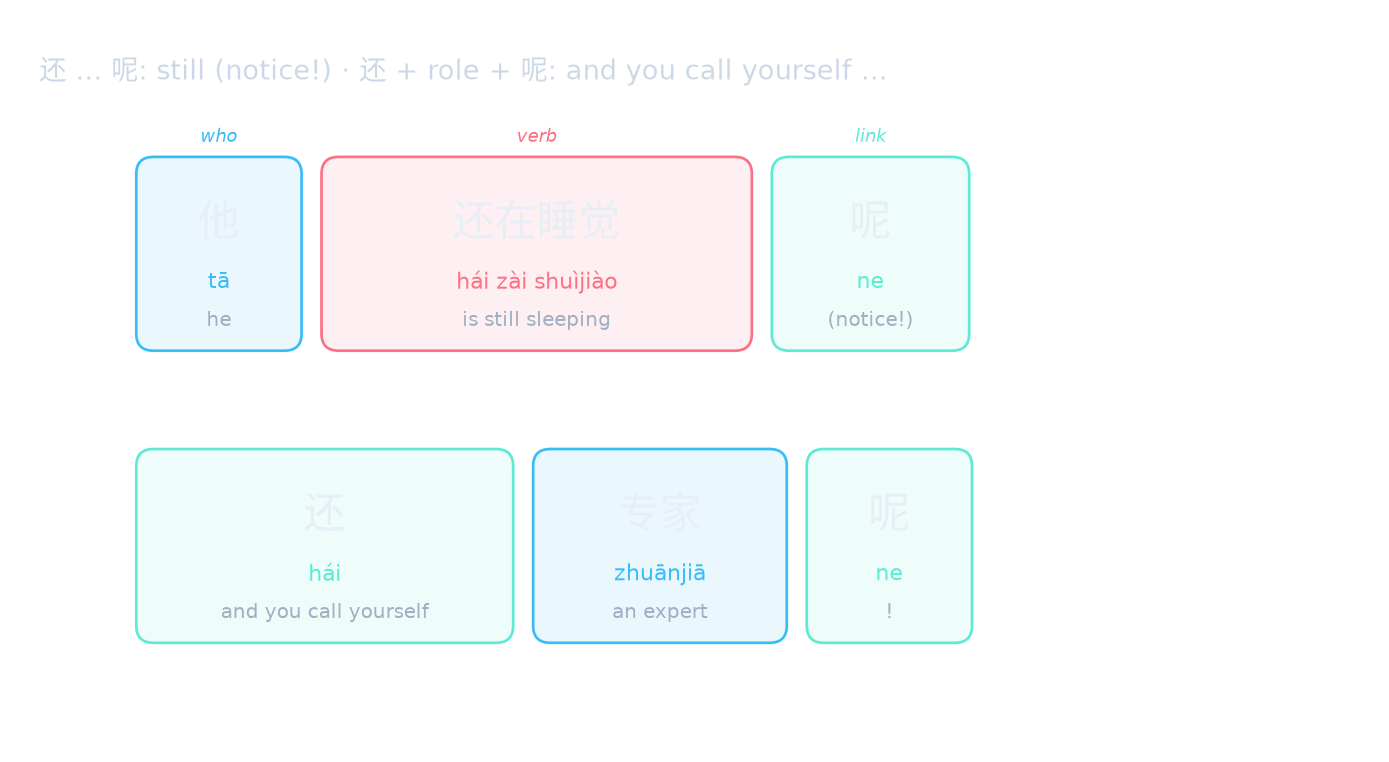
- Your friend is talking loudly. You say: more quietly小声点,he / him他still还(ongoing action)在sleep睡觉(attention / emphasis)呢。 — "Keep your voice down, he's still sleeping."
- The same frame still还…(attention / emphasis)呢 has a second, sharp use: still还expert专家(attention / emphasis)呢! — "And you call yourself an expert!"
- Goal: use still还…(attention / emphasis)呢 to point out that a state still continues, and recognise still还 + role + (attention / emphasis)呢 as criticism.
1 · still还 + state + (attention / emphasis)呢 = still … (you know)
- Subject + still还 + verb / adjective + (attention / emphasis)呢: still还 says the state continues; (attention / emphasis)呢 at the end says "notice this".
- time时间still还early早(attention / emphasis)呢,don't别worry着急。 — "It's still early, you know. No need to rush." Without (attention / emphasis)呢 (he / him他still还(ongoing action)在sleep睡觉) it is a plain fact; with (attention / emphasis)呢 it is a reminder to the listener.
time时间still还early早呢,don't别worry着急。
Your friend wants to leave the party at 8 p.m. Reassure them: 时间____早呢,别着急。
Kesulitan 1/5 · 100 koin + bonus kecil pada penyelesaian pertama hari ini
还 + adjective + 呢 = still …, you know.
In 时间还早呢, 呢 makes the sentence a question.
Kesulitan 1/5 · 100 koin + bonus kecil pada penyelesaian pertama hari ini
呢 here asks the listener to notice the situation. The question would be 时间还早吗?
2 · still还 + role + (attention / emphasis)呢 = and you call yourself …!
- still还 + noun (a role) + (attention / emphasis)呢: the person does not act like the role they claim. It is criticism, not a joke.
- still还expert专家(attention / emphasis)呢,even连this这个even都not不to understand懂。 — "And you call yourself an expert! You don't even understand this." still还teacher老师(attention / emphasis)呢,oneself自己even都写错(completed / change)了。 — "Some teacher! She wrote it wrong herself."
A "maths teacher" can't add 15 and 27. A student whispers 还数学老师呢. What does the student mean?
Kesulitan 1/5 · 100 koin + bonus kecil pada penyelesaian pertama hari ini
还 + role + 呢 criticises someone for not acting like the role.
Which still还…(attention / emphasis)呢?
- After still还 comes a verb or adjective → "still": he / him他still还(ongoing action)在sleep睡觉(attention / emphasis)呢. After still还 comes a role noun → criticism: still还expert专家(attention / emphasis)呢.
- (attention / emphasis)呢 here is not a question word and not a past tense. ✓ he / him他still还(ongoing action)在sleep睡觉(attention / emphasis)呢。 (a reminder) ✓ he / him他still还(ongoing action)在sleep睡觉(yes/no ?)吗? — "Is he still sleeping?" (a real question)
Keadaan berkelanjutan atau evaluasi ironis?
Bedakan makna dalam contoh kontekstual lengkap, bukan hanya benar secara mekanis atau tolak frasa terisolasi.
Match each sentence to what it does.
Kesulitan 2/5 · 140 koin + bonus kecil pada penyelesaian pertama hari ini
Look at what follows 还 and how the sentence ends.
Build the reminder: “Keep your voice down, he's still sleeping.”
Kesulitan 3/5 · 200 koin + bonus kecil pada penyelesaian pertama hari ini
Subject + 还 + verb + 呢.
Recap
- still还 + verb / adjective + (attention / emphasis)呢 = still …, you know (a reminder): time时间still还early早(attention / emphasis)呢.
- still还 + role + (attention / emphasis)呢 = and you call yourself a …! (criticism): still还expert专家(attention / emphasis)呢.
Read the full reference: HSK 5 grammar — Adverbs.
Your friend is talking loudly at 7 a.m. and your roommate is asleep. Ask your friend to be quiet and give the reason with 还…呢. Then tell them there is no hurry because it is still early.
Your answer need not copy the model. A partner or teacher must hear the spoken response to comment on pronunciation.