Rencana belajar Anda · Lanjut · Tinjau →
Pernyataan + 吗 (konfirmasi ya/tidak)
DiperkenalkanPosisi tersimpan Anda tetap berada di browser ini. Melanjutkan tidak menyelesaikan pelajaran atau menjawab pertanyaannya.
 3:32
HSK 4 Tata Bahasa 08: Partikel
Tiga partikel, tiga fungsi. 吗 dapat membungkus pertanyaan yang sudah memiliki kata tanya; 吧 yang digandakan membangun dilema; 的 di akhir mengukuhkan keyakinan. Setiap partikel…
Penjelasan bahasa Inggris + contoh Mandarin · caption mengikuti teks yang diucapkan
In this lesson
Checking what you heard
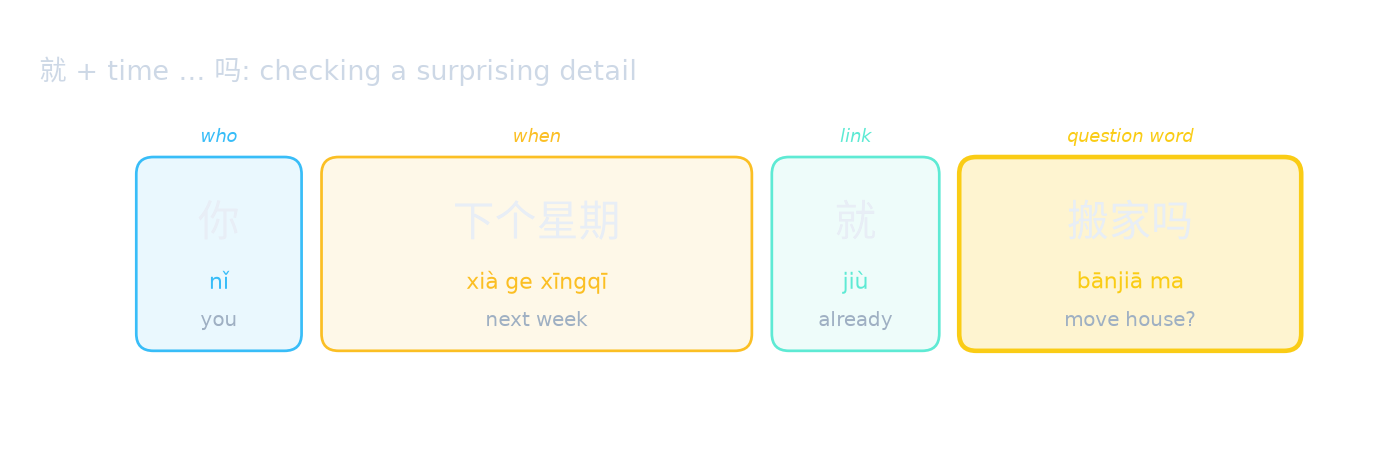
- Your friend mentions she's moving next week, and you can't quite believe it.
- you你next week下个星期then / just就to move house搬家(yes/no ?)吗? — "You're moving as soon as next week?"
- Goal: turn a statement into a yes/no question that checks what you think: statement + (yes/no ?)吗.
Statement + (yes/no ?)吗? = yes/no question
- Add (yes/no ?)吗 to the end of a statement to make it a yes/no question; word order does not change.
- he他is是a teacher老师。→ he他is是a teacher老师(yes/no ?)吗? — "Is he a teacher?"
he他is是a teacher老师吗?
Make a question: “Are you a student?” 你是学生____?
Kesulitan 1/5 · 100 koin + bonus kecil pada penyelesaian pertama hari ini
Statement + 吗.
Checking and confirming
- With a rising, surprised tone, (yes/no ?)吗 checks what you heard: you你not不to go去(yes/no ?)吗? — "You're not going?"
- A negative (yes/no ?)吗 question often expects "yes" or shows surprise: you你not不tired累(yes/no ?)吗? — "Aren't you tired?"
you你not不tired累吗?
Build: “Aren't you tired?”
Kesulitan 3/5 · 200 koin + bonus kecil pada penyelesaian pertama hari ini
Negative statement + 吗.
One question form at a time
- No (yes/no ?)吗 after a question word: you你to go去where哪儿?, not you你to go去where哪儿(yes/no ?)吗? (unless it means "anywhere").
- No (yes/no ?)吗 after A-not-A: you你to go去not不to go去?, not you你to go去not不to go去(yes/no ?)吗?
Which question is correct?
Kesulitan 1/5 · 100 koin + bonus kecil pada penyelesaian pertama hari ini
Only a plain statement takes 吗.
Answering a negative question
- Q: you你not不like it喜欢(yes/no ?)吗? A: right对,I我not不like it喜欢 — "Right, I don't." / not不,I我like it喜欢 — "No, I do."
- right对 agrees with the statement inside the question, which can feel the opposite of English.
right对,I我don't不like it喜欢。
Q: 你不饿吗? You are not hungry. What do you say?
Kesulitan 1/5 · 100 koin + bonus kecil pada penyelesaian pertama hari ini
对 agrees with the negative statement “you're not hungry”.
Recap
- Statement + (yes/no ?)吗? = yes/no question; word order stays the same.
- Not with question words or A-not-A. For negative questions, right对 agrees with the negative statement.
Read the full reference: HSK 4 grammar — Particles.
Your friend mentions she's moving next week, and you can't quite believe it. Close the examples. Say a Mandarin response, then write it in Chinese. Explain briefly in English what the lesson’s pattern adds. Compare with the model, then change one detail and try again.
This is supported productive practice. Compare meaning and structure; your answer need not copy the model. A partner or teacher must hear the spoken response to comment on pronunciation.