Rencana belajar Anda · Lanjut · Tinjau →
忽然 vs 突然 (suddenly)
DiperkenalkanPosisi tersimpan Anda tetap berada di browser ini. Melanjutkan tidak menyelesaikan pelajaran atau menjawab pertanyaannya.
The lights went out
- You are having dinner with your family. In the middle of the meal, everything goes dark.
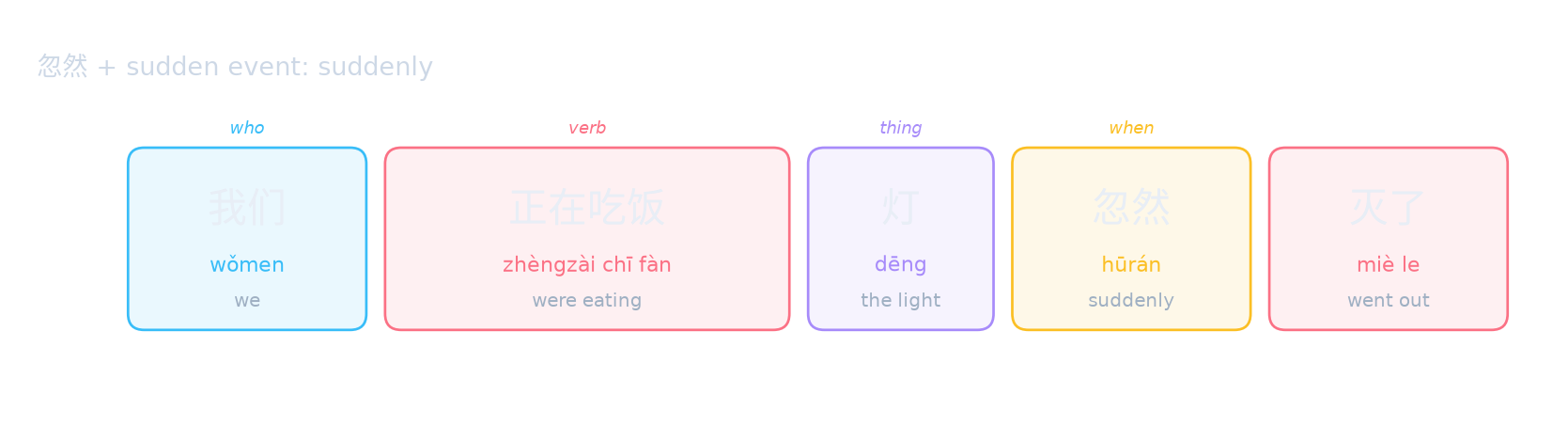
- we我们were正在eating吃饭,the light灯suddenly忽然went out灭(completed / change)了。 — "We were having dinner when suddenly the lights went out."
- Goal: tell about something sudden with suddenly忽然 or sudden突然, and use sudden突然 as an adjective too.
suddenly忽然 / sudden突然 + event
- suddenly忽然 (hūrán) and sudden突然 (tūrán) both mean "suddenly". They go before the verb, or before the subject at the start: suddenly忽然,outside外面down / next; to fall (rain), get off下to rise / (start to)起(completed / change)了heavy rain大雨。 — "Suddenly it started pouring outside."
- As adverbs they usually swap: the light灯suddenly忽然went out灭(completed / change)了 = the light灯sudden突然went out灭(completed / change)了.
we我们were正在eating吃饭,the light灯suddenly忽然went out灭了。
Complete: “We were having dinner when suddenly the lights went out.” 我们正在吃饭,灯____灭了。
Kesulitan 1/5 · 100 koin + bonus kecil pada penyelesaian pertama hari ini
Both 忽然 and 突然 work as adverbs.
Build: “Suddenly it started pouring outside.”
Kesulitan 3/5 · 200 koin + bonus kecil pada penyelesaian pertama hari ini
忽然 can start the sentence.
sudden突然 is also an adjective
- sudden突然 can describe a thing: this这个news消息too太sudden突然(completed / change)了。 — "This news is so sudden."
- It can take degree / adjective linker很 or come before a noun: degree / adjective linker很sudden突然, sudden突然(modifier / structural particle)的change / to change变化 — "a sudden change".
this这个news消息too太sudden突然了。
suddenly忽然 is only an adverb
- suddenly忽然 can't take degree / adjective linker很 / too太: ✗ too太suddenly忽然(completed / change)了 ✓ too太sudden突然(completed / change)了. Before a noun, the usual word is sudden突然: sudden突然(modifier / structural particle)的change / to change变化.
- To tell what happened suddenly, both work: ✓ he / him他sudden突然 / suddenly忽然to cry哭(completed / change)了。 — "He suddenly started crying."
“This news is so sudden.” Which is right?
Kesulitan 1/5 · 100 koin + bonus kecil pada penyelesaian pertama hari ini
Only 突然 is also an adjective that can take 太 / 很.
“a sudden change” — which is the usual way to say it?
Kesulitan 1/5 · 100 koin + bonus kecil pada penyelesaian pertama hari ini
Before a noun, 突然的 is the usual choice.
suddenly忽然, sudden突然 or right away马上?
- suddenly忽然 / sudden突然 = suddenly, without warning (you didn't expect it).
- right away马上 = right away, very soon (it's about timing, not surprise): I / me我right away马上then / just就to come来。 — "I'll be right there."
马上 means "suddenly".
Kesulitan 1/5 · 100 koin + bonus kecil pada penyelesaian pertama hari ini
马上 = right away, very soon. Suddenly is 忽然 / 突然.
Recap
- suddenly忽然 / sudden突然 + verb = suddenly (they swap as adverbs).
- Only sudden突然 is also an adjective: too太sudden突然(completed / change)了, sudden突然(modifier / structural particle)的change / to change变化.
Read the full reference: HSK 4 grammar — Adverbs.
Tell a short story in two sentences: you were walking home when something unexpected happened. Use 忽然 once and 突然 as an adjective once.
Your answer need not copy the model. A partner or teacher must hear the spoken response to comment on pronunciation.