Three ways to read
Diperkenalkan 22:40
GAC002 Bahasa Inggris Akademik I: Keterampilan Membaca dan Menulis
GAC zero zero dua mengembangkan keterampilan membaca dan menulis melalui komunikasi, budaya, rekreasi, perjalanan, makhluk hidup dan teknologi. Keterampilan tersebut meliputi…
Narasi bahasa Inggris · takarir bahasa Inggris dan 中文 yang dapat dipilih
Dalam pelajaran ini
| English | Makna |
|---|---|
| skimming/ˈskɪmɪŋ/ | membaca skimming |
| scanning/ˈskænɪŋ/ | reading quickly to find one specific detail such as a date or name |
| close reading/kləʊs ˈriːdɪŋ/ | membaca mendalam |
| topic sentence/ˈtɒpɪk ˈsentəns/ | kalimat topik |
A promise of super-fast reading, 1959
- In 1959 Evelyn Wood, a teacher from Utah, opened her "Reading Dynamics" course and promised readers speeds of thousands of words a minute. In 2016 a review of the research led by Keith Rayner found that most skilled readers read about 200–400 words a minute, and that speed-reading methods trade away understanding.
- No single speed is best. Good readers change their method with their purpose: skimming 略读, scanning 寻读 or close reading 精读.
The 2016 research review found that very fast reading keeps full understanding.
Kesulitan 1/5 · 100 koin + bonus kecil pada penyelesaian pertama hari ini
Speed trades away understanding.
Skimming for the main idea
- Read the title, headings, first and last paragraphs, and the first sentence of each paragraph.
- That first sentence is often the topic sentence 主题句: it states what the paragraph is about.
Where is the topic sentence most often found?
Kesulitan 1/5 · 100 koin + bonus kecil pada penyelesaian pertama hari ini
It states what the paragraph is about.
Scanning for one detail
- Decide exactly what you need — a date, a name, a number — and move your eyes quickly until you find it.
- Then stop and read the sentence around it, so you know what the detail refers to.
After scanning finds a detail, you should read the sentence around it.
Kesulitan 1/5 · 100 koin + bonus kecil pada penyelesaian pertama hari ini
To know what it refers to.
Close reading
- Read every word, slowly, when the detail matters: instructions, exam questions, rules, contracts.
- Underline what each sentence asks you to do, and check words you do not know.
Match each purpose to the reading method.
Kesulitan 2/5 · 140 koin + bonus kecil pada penyelesaian pertama hari ini
Purpose decides method.
Worked example: two dates in one email
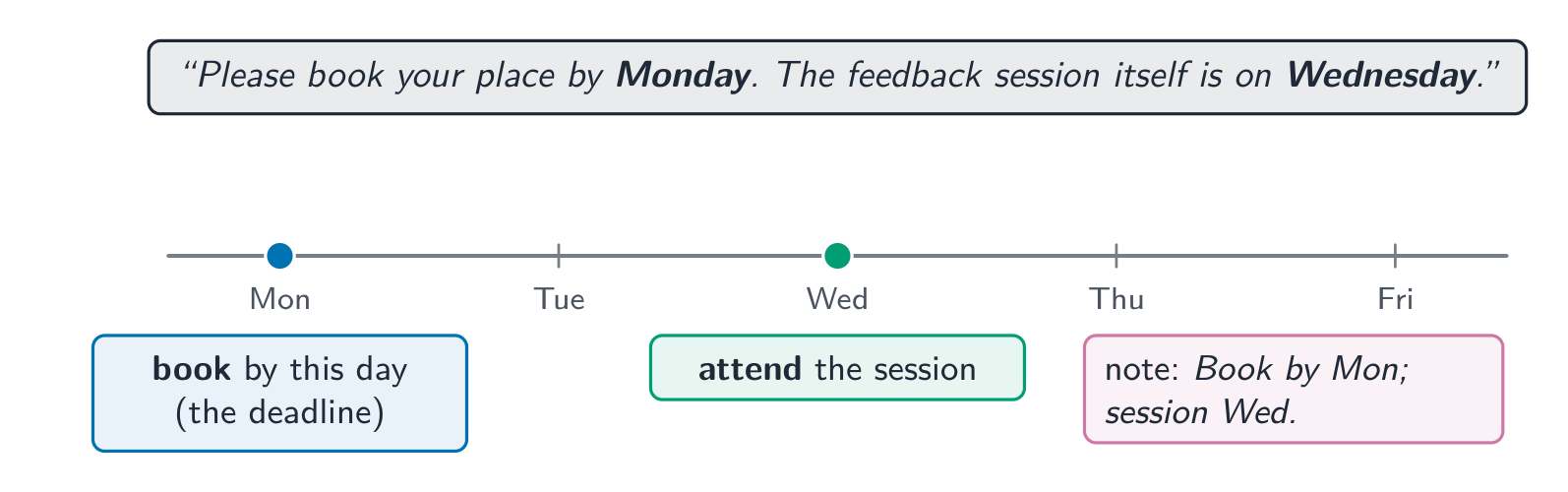
"Please book your place by Monday. The feedback session itself is on Wednesday."
- Scanning for "date" finds Monday first — but Monday is the booking deadline.
- Close reading links each date with its action: book → Monday; attend → Wednesday.
- Correct note: "Book by Mon; session Wed."
In the example email, what happens on Wednesday?
Kesulitan 1/5 · 100 koin + bonus kecil pada penyelesaian pertama hari ini
Monday is the deadline.
Combine the methods
- For an exam text: skim for the main idea (1–2 minutes), scan for the line a question points to, then close-read that part.
- Underline key words in the question before scanning.
Put the exam reading steps in order.
Kesulitan 3/5 · 200 koin + bonus kecil pada penyelesaian pertama hari ini
Broad, then narrow.
A date without its action is a trap. Copying "Monday" alone can send you, or a classmate, to the wrong event. Always note what happens on that date.
Writing down a date without its action is enough.
Kesulitan 1/5 · 100 koin + bonus kecil pada penyelesaian pertama hari ini
It can send you to the wrong event.
Skim headings and topic sentences for the main idea, scan for a specific detail, and close-read when detail matters. Always link a found detail with the words around it.
Read: "Essays must be submitted online by Friday 17:00. Late essays lose 5% per day. Feedback will be returned on 3 March." Write a three-line note with each date or time and its action.
Action with date.