Gas exchange surfaces and cell membranes
DiperkenalkanEvery breath crosses two thin layers
- An oxygen molecule in your lungs reaches your blood by crossing just two cells: the wall of an alveolus and the wall of a capillary. The whole trip is under $1\ \mu\text{m}$.
- Every gas exchange surface is built to make diffusion fast. Every cell is wrapped in a membrane that decides what gets in and out. This lesson covers both.
Fick's law: what makes diffusion fast
- Rate of diffusion $\propto \dfrac{\text{surface area} \times \text{difference in concentration}}{\text{thickness of the surface}}$.
- So a good surface has a large surface area, a steep concentration gradient (kept up by blood flow and ventilation) and a short diffusion distance.
| Feature of the lungs | Which part of Fick's law |
|---|---|
| about 300 million alveoli | large surface area |
| alveolus and capillary walls one cell thick (squamous cells) | short diffusion distance |
| dense capillary network; breathing renews the air | steep concentration gradient kept up |
Which features increase the rate of diffusion across a gas exchange surface?
Kesulitan 2/5 · 140 koin + bonus kecil pada penyelesaian pertama hari ini
These are the three terms of Fick's law. A thick surface makes the diffusion distance longer, so diffusion is slower.
Size and surface area to volume ratio
- A small organism has a large surface area to volume ratio, so diffusion through its surface is enough (a tadpole even uses its skin).
- A larger animal has a smaller ratio: its surface is too small for its volume. It needs a special exchange surface (lungs, gills) and a transport system.
Calculate the surface area to volume ratio of a cube with 2 cm sides. Give the answer as a number (ratio to 1).
Kesulitan 2/5 · 140 koin + bonus kecil pada penyelesaian pertama hari ini
Luas permukaan $= 6 \times 2^2 = 24$ cm²; volume $= 2^3 = 8$ cm³; ratio $= 24 \div 8 = 3:1$. A 1 cm cube has $6:1$, so bigger objects have smaller ratios.
The fluid mosaic model
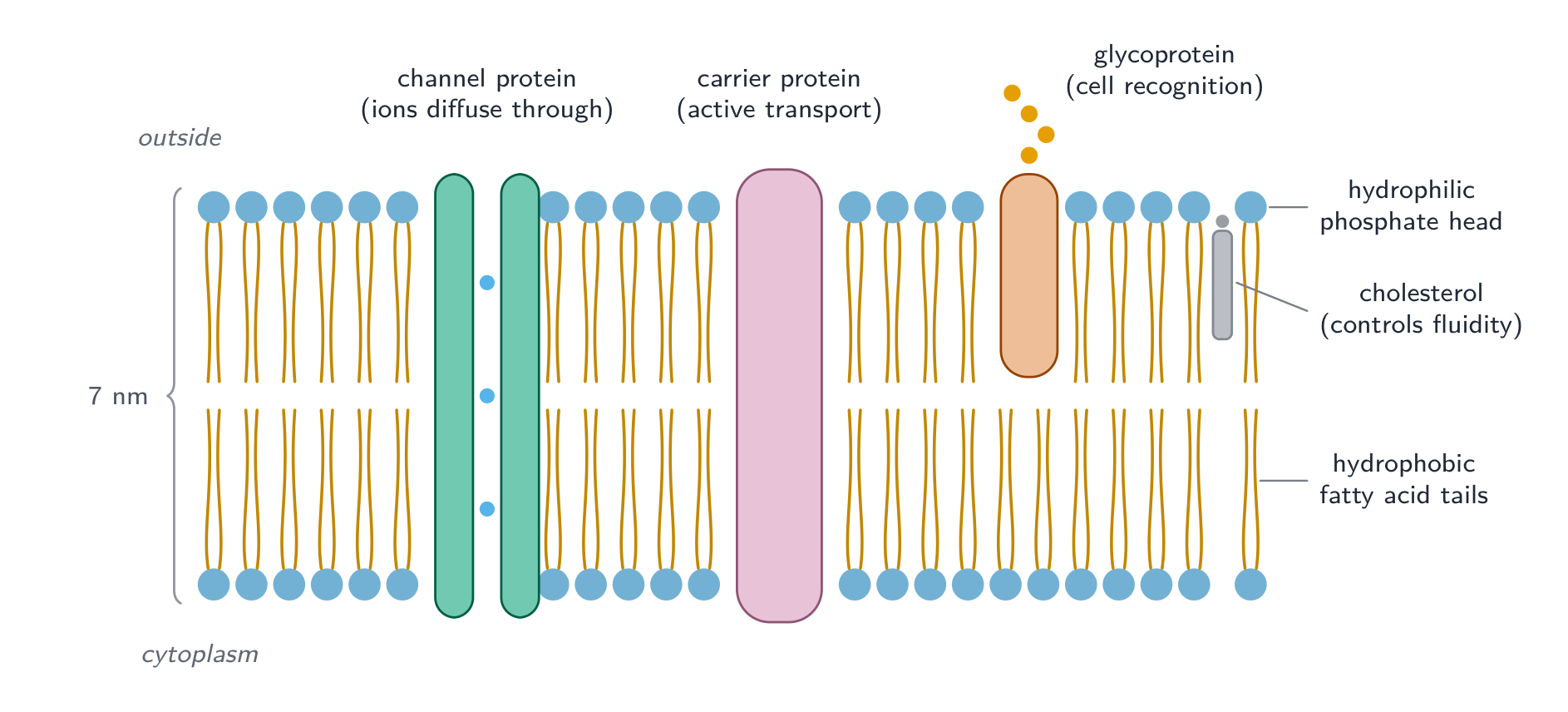
- A cell membrane is a phospholipid bilayer. The hydrophilic phosphate heads face the water on each side; the hydrophobic fatty acid tails point inwards, away from water.
- Proteins float in it like tiles in a mosaic, and the phospholipids can move sideways, so the membrane is fluid: the fluid mosaic model.
What each part does
| Part | Job |
|---|---|
| hydrophobic core (tails) | stops ions and large polar molecules diffusing through |
| channel protein | water-filled pore: ions diffuse through (facilitated diffusion) |
| carrier protein | changes shape to move molecules across (facilitated diffusion or active transport) |
| glycoprotein / glycolipid | cell recognition, receptors for hormones |
| cholesterol | regulates fluidity and stability |
- Trap: the phosphate heads are polar, so they are not what stops polar molecules. The barrier is the non-polar core.
Match each membrane part to its job.
Kesulitan 2/5 · 140 koin + bonus kecil pada penyelesaian pertama hari ini
The barrier is the non-polar core; proteins provide the controlled ways through.
Cholesterol and fluidity
- Cholesterol sits among the tails: its small polar OH group lies next to the phosphate heads, and its non-polar rings lie among the tails.
- As temperature rises, a membrane becomes more fluid. Cholesterol evens this out: at low temperatures it keeps the membrane more fluid; at high temperatures it makes it less fluid than a membrane without cholesterol.
At low temperatures, a membrane with cholesterol is less fluid than one without cholesterol.
Kesulitan 1/5 · 100 koin + bonus kecil pada penyelesaian pertama hari ini
At low temperatures cholesterol keeps the membrane more fluid. At high temperatures it is the reverse. Cholesterol narrows the range of fluidity.
Worked example: comparing membranes
Percentage of the membrane's mass:
| Protein | Lipid | Carbohydrate | |
|---|---|---|---|
| A | 49 | 43 | 8 |
| B | 54 | 42 | 4 |
| C | 75 | 25 | 0 |
- Ratio protein : lipid in A $= 49 \div 43 = 1.14 : 1$ (divide both by the second number).
- Similarities: all contain protein and lipid, and all have more protein than lipid.
- Differences: C has no carbohydrate; A has the most ($8\%$). C has the most protein and the least lipid. A "compare" answer needs both, with numbers.
Membrane B has 54% protein and 42% lipid. Calculate the protein to lipid ratio as x to 1, to 2 decimal places. Give x.
Kesulitan 2/5 · 140 koin + bonus kecil pada penyelesaian pertama hari ini
$54 \div 42 = 1.2857$, so the ratio is $1.29:1$.
Core practical: beetroot and membrane permeability
- Cut equal beetroot cylinders, rinse them, and put each in water at a different temperature (or in different ethanol concentrations) for the same time.
- Higher temperature makes the membrane more permeable: proteins denature and the bilayer becomes more fluid, so more red betalain pigment leaks out. Measure it with a colorimeter (absorbance).
Why does more pigment leak from beetroot at 70 °C than at 30 °C?
Kesulitan 1/5 · 100 koin + bonus kecil pada penyelesaian pertama hari ini
Heat disrupts the membrane, not the pigment. Proteins lose their shape, leaving gaps, and the phospholipids move more.
Explain how the alveoli are adapted for efficient gas exchange. (3 marks)
Each mark is one term of Fick's law, linked to a real feature.
Fick's law: fast diffusion needs a large area, a steep gradient and a thin surface. A membrane is a phospholipid bilayer with proteins (fluid mosaic): the hydrophobic core blocks ions and polar molecules, channels and carriers let them through, glycoproteins act in recognition and cholesterol regulates fluidity. Heat makes membranes leakier, which the beetroot practical measures.