Skip to content · ⁨Lompat ke konten⁩
Subjects · ⁨Materi⁩

English Grammar · A1 · ⁨Tata Bahasa Bahasa Inggris · A1⁩

  • 1 The verb to be · ⁨Kata kerja to be⁩
    1.1

    am / is / are

    English

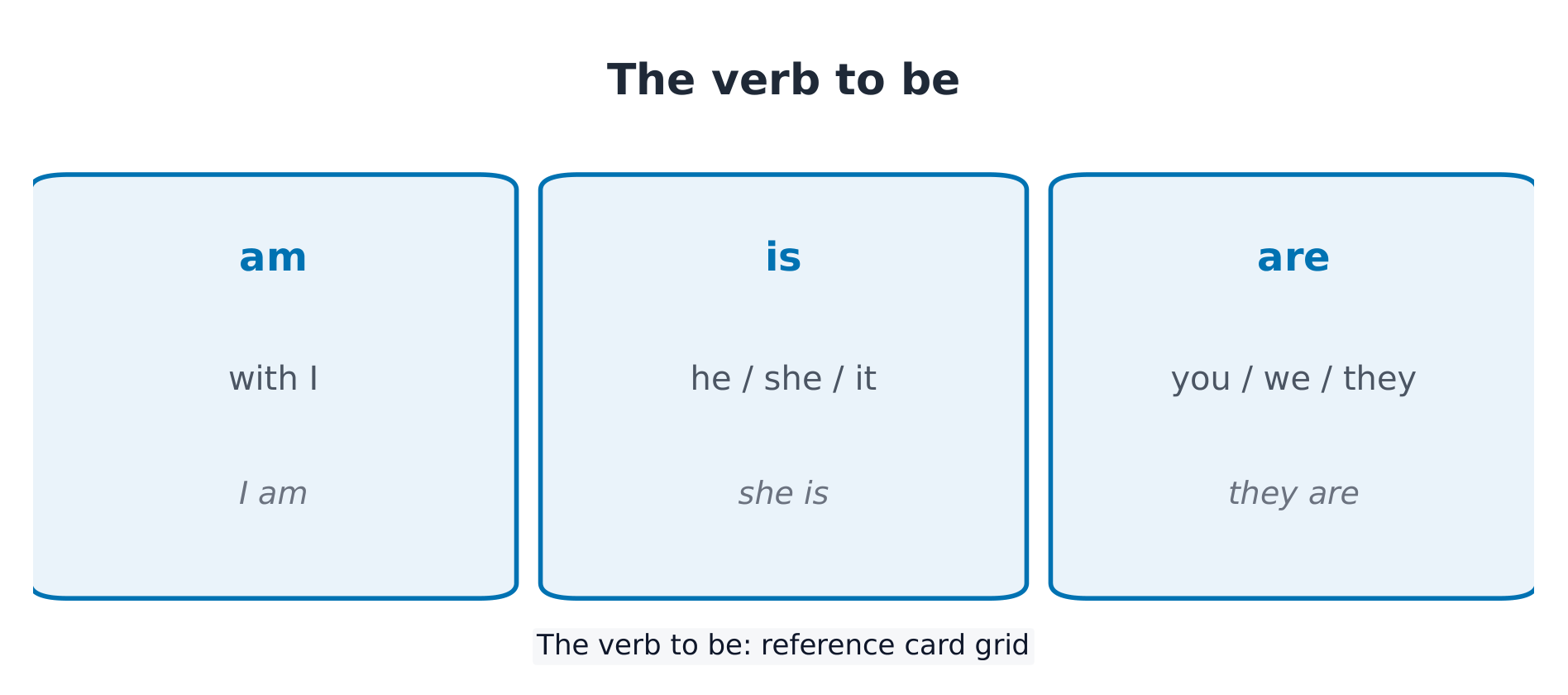
    The verb "to be" means "is / am / are." It changes according to the subject and has three forms:

    • I → am
    • he / she / it → is
    • you / we / they → are

    我I 是am 一名a 学生student.

    I am a student.

    她She 是is 开心happy.

    She is happy.

    他们They (是)are 来自from 中国China.

    They are from China.

    Note: Common spoken contractions: I'm, you're, he's, she's, it's, we're, they're.

    Bahasa Indonesia
    Kata kerja to be: am / is / are berubah sesuai subjek

    Kata kerja to be (to be) berarti "adalah / berada". Kata kerja ini berubah sesuai subjek, memiliki tiga bentuk:

    • I → am
    • he / she / it → is
    • you / we / they → are

    我I 是am 一名a 学生student.

    Saya adalah seorang siswa.

    她She 是is 开心happy.

    Dia sangat senang.

    他们They (是)are 来自from 中国China.

    Mereka berasal dari Tiongkok.

    Perhatian: Singkatan umum digunakan dalam percakapan: I'm, you're, he's, she's, it's, we're, they're.
    1.2

    Negasi dan Pertanyaan

    English

    Negation: Add not after the be verb (often contracted).

    他He 不是is not 一名a 老师teacher.

    He is not a teacher. (= He isn't a teacher.)

    Interrogative: Place the be verb before the subject.

    (是吗)Are 你you 准备好ready?

    Are you ready?

    Short answers: Yes, I am. / No, I'm not.

    Note: Negative contractions: is not → isn't, are not → aren't; but am not is only contracted to I'm not (there is no ~~amn't~~).

    Common Errors

    • ❌ ~~He busy.~~ → ✓ He is busy. — In Chinese, "He is very busy" can exist without a verb, but an English sentence must have a verb. Use be to link when the predicative is an adjective or noun and there are no other verbs in the sentence (He is busy); do not add be if the sentence already contains an ordinary verb (I go to school).
    • ❌ ~~I am go to school.~~ → ✓ I go to school. — Do not use be and ordinary verbs together; "go" alone suffices for "to go."
    • ❌ ~~They is my friends.~~ → ✓ They are my friends. — Plural subjects (you / we / they) take are.
    • ❌ ~~I am agree.~~ → ✓ I agree. — agree is itself a verb; do not add am before it.
    • ❌ ~~Are you ready? — Yes, I'm.~~ → ✓ Yes, I am. — Contractions cannot be used at the end of affirmative short answers (say Yes, I am); however, negative short answers typically end with a negative contraction (No, he isn't / No, I can't; first person is No, I'm not, as there is no amn't).
    Bahasa Indonesia

    Kalimat negatif: Tambahkan not setelah kata kerja to be (sering disingkat).

    他He 不是is not 一名a 老师teacher.

    Dia bukan guru. (= He isn't a teacher.)

    Kalimat tanya: Pindahkan kata kerja to be ke depan subjek.

    (是吗)Are 你you 准备好ready?

    Apakah kamu sudah siap?

    Jawaban singkat:Yes, I am. / No, I'm not.

    Perhatian: Singkatan kalimat negatif: is not → isn't, are not → aren't; namun am not hanya disingkat menjadi I'm not (tidak ada ~~amn't~~).

    Kesalahan Umum

    • ❌ ~~He busy.~~ → ✓ He is busy. — Dalam bahasa Mandarin "dia sibuk" bisa tanpa kata kerja, tetapi kalimat bahasa Inggris harus memiliki kata kerja. Ketika predikat berupa kata sifat atau kata benda, dan tidak ada kata kerja lain dalam kalimat, gunakan be untuk menghubungkannya (He is busy); jika dalam kalimat sudah terdapat kata kerja biasa, jangan tambahkan be (I go to school).
    • ❌ ~~I am go to school.~~ → ✓ I go to school. — 'be' dan kata kerja biasa tidak boleh digabungkan; "pergi" cukup menggunakan go.
    • ❌ ~~They is my friends.~~ → ✓ They are my friends. — Subjek jamak (you / we / they) menggunakan are.
    • ❌ ~~I am agree.~~ → ✓ I agree. — agree (setuju) sendiri adalah kata kerja, jangan tambahkan am di depannya.
    • ❌ ~~Are you ready? — Yes, I'm.~~ → ✓ Yes, I am. — Pada akhir jawaban singkat positif tidak boleh menggunakan singkatan (katakan Yes, I am); namun pada jawaban singkat negatif biasanya diakhiri dengan singkatan negatif (No, he isn't / No, I can't; orang pertama adalah No, I'm not, karena tidak ada amn't).
  • 2 Subject pronouns · ⁨Kata ganti subjek⁩
    2.1

    I, you, he, she, it, we, they

    English

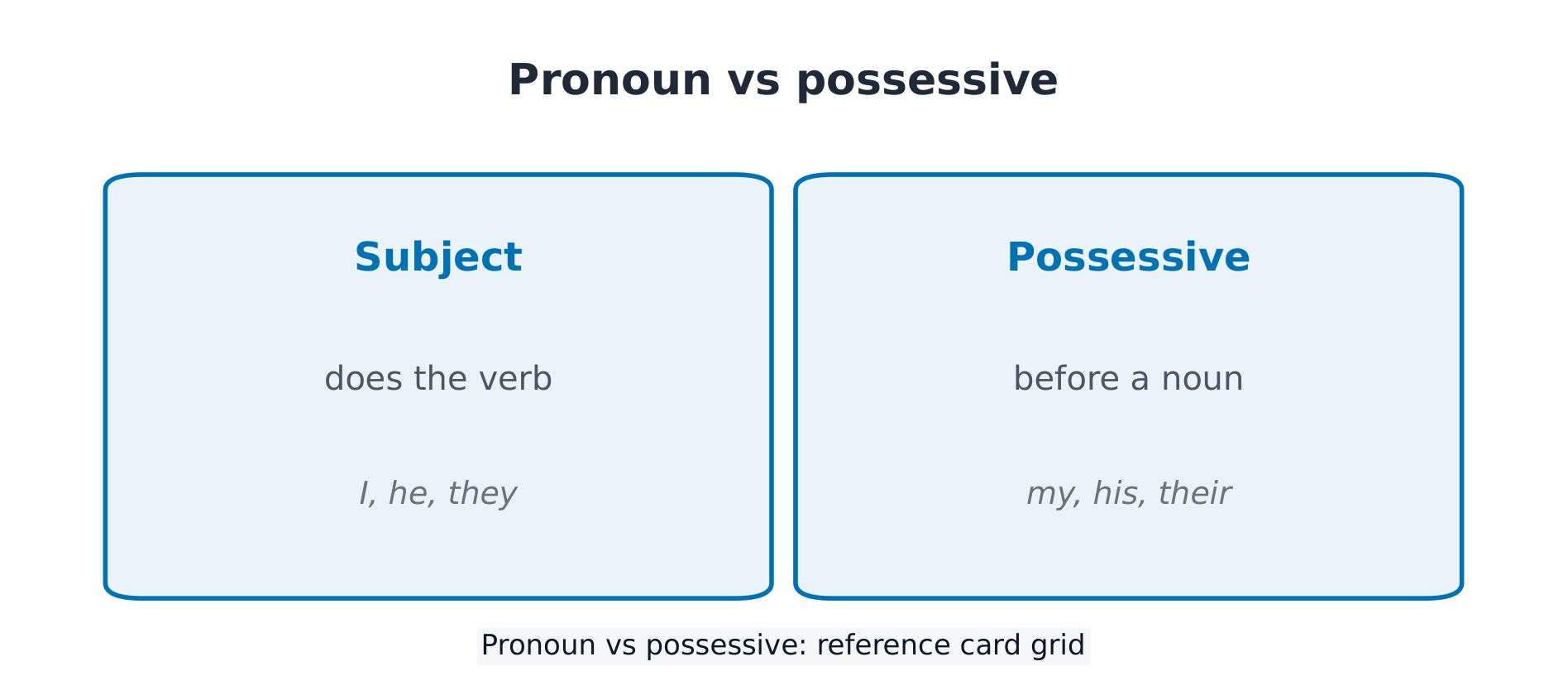
    Subject pronouns replace the subject and are placed before the verb:

    • I(I), you(you), he(he), she(she)
    • it(it), we(we), they(they)

    他He 是is 我的my 哥哥brother.

    He is my brother.

    我们We 喜欢like 音乐music.

    We like music.

    Key Usage Points:

    • I is always capitalized, regardless of its position in the sentence.
    • Things and animals commonly use it: This is my bag. It is new.(This is my bag. It is new.)*
    • Plural people or things both use they: The books are here. They are mine.(The books are here. They are mine.)*

    Note: Subject pronouns are followed by verbs; do not confuse them with object pronouns (me, him, her...) which will be learned later.

    Common Errors

    • ❌ ~~My mother is a doctor. He is very kind.~~ → ✓ She is very kind. — In colloquial Chinese, "he/she" sounds identical, but in English, he and she must be clearly distinguished.
    • ❌ ~~Me am a student.~~ → ✓ I am a student. — Use I for the subject, not me.
    • ❌ ~~My friend he is tall.~~ → ✓ My friend is tall. — The subject needs to be mentioned only once; avoid repeating "noun + pronoun" (the Chinese habit of saying "my friend he..." does not apply in English).
    • ❌ ~~Is raining.~~ → ✓ It is raining. — English sentences must have a subject; weather, time, and dates begin with it.
    Bahasa Indonesia
    Pronomina Subjek dan Kepemilikan

    Kata ganti subjek (subject pronouns) digunakan untuk menggantikan subjek, diletakkan sebelum kata kerja:

    • I(saya), you(kamu/kalian), he(dia-laki), she(dia-perempuan)
    • it(ia/benda mati), we(kami/kita), they(mereka/benda jamak)

    他He 是is 我的my 哥哥brother.

    Dia adalah kakak laki-laki saya.

    我们We 喜欢like 音乐music.

    Kami menyukai musik.

    Poin Penggunaan:

    • I selalu diawali huruf kapital, di mana pun dalam kalimat.
    • Benda mati dan hewan sering menggunakan it: This is my bag. It is new. (Ini tas saya. Itu baru.)
    • Orang atau benda jamak semuanya menggunakan they: The books are here. They are mine. (Buku-buku ada di sini. Mereka milikku.)

    Perhatian setelah kata ganti subjek diikuti oleh kata kerja; jangan bingung dengan kata ganti objek yang akan dipelajari kemudian (me, him, her...).

    Kesalahan Umum

    • ❌ ~~My mother is a doctor. He is very kind.~~ → ✓ She is very kind. — Dalam percakapan lisan bahasa Mandarin "dia" (laki/perempuan) terdengar sama, tetapi dalam bahasa Inggris he/she harus dibedakan dengan jelas.
    • ❌ ~~Me am a student.~~ → ✓ I am a student. — Sebagai subjek gunakan I, bukan me.
    • ❌ ~~My friend he is tall.~~ → ✓ My friend is tall. — Subjek hanya perlu disebutkan sekali, jangan ulangi dengan pola "kata benda + kata ganti" (kebiasaan bahasa Mandarin "temanku dia tinggi" tidak bisa diterjemahkan langsung ke bahasa Inggris).
    • ❌ ~~Is raining.~~ → ✓ It is raining. — Kalimat bahasa Inggris wajib memiliki subjek; cuaca, waktu, dan tanggal dimulai dengan it.
  • 3 Possessive adjectives · ⁨Kata sifat kepemilikan⁩
    3.1

    my, your, his, her, our, their

    English

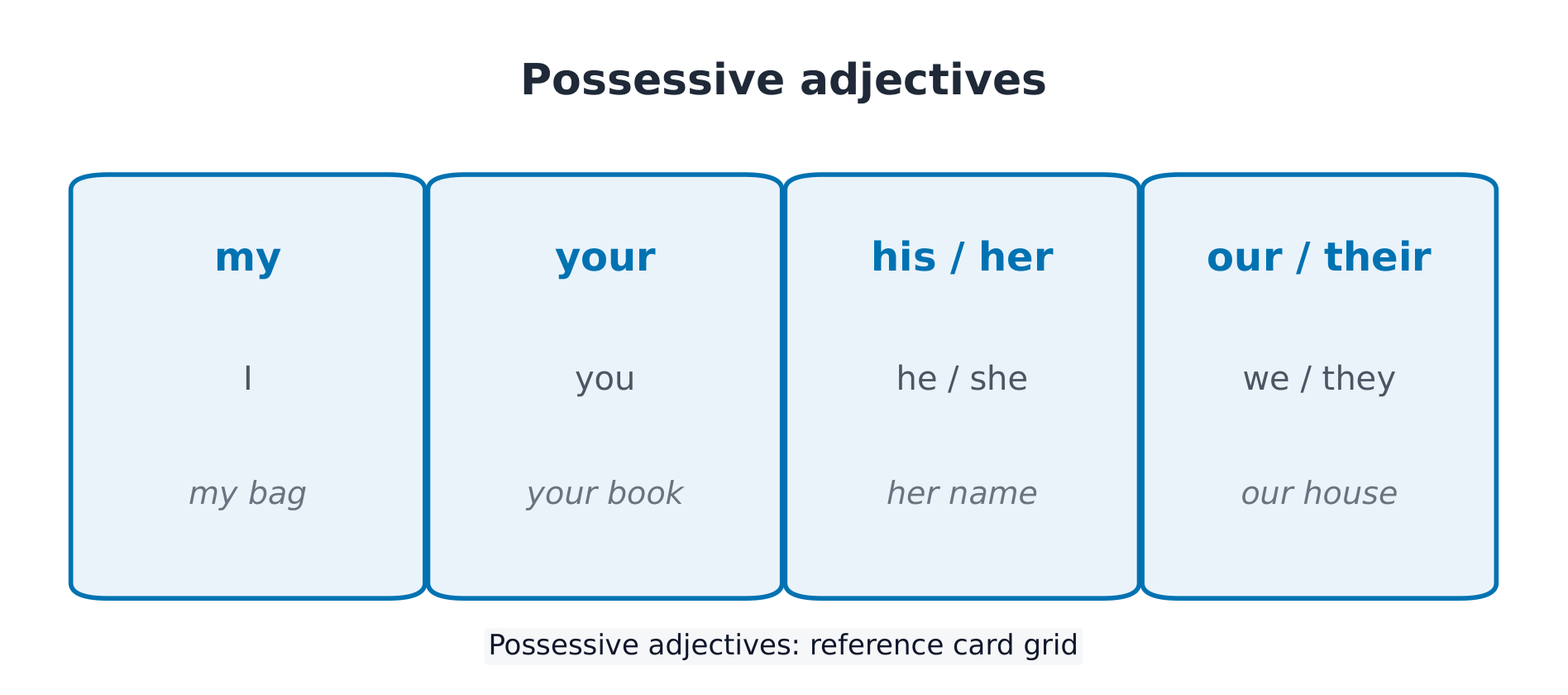
    Possessive adjectives indicate "whose" and are placed before the noun:

    • I → my(my), you → your(your), he → his(his)
    • she → her(her), it → its(its), we → our(our), they → their(their)

    这This 是is 我的my 包bag.

    This is my bag.

    她的Her 名字name 是is 露西Lucy.

    Her name is Lucy.

    Key Usage Points:

    • Possessive adjectives are always followed by a noun: my book, their house.
    • They do not change with noun number: my book, my books(my remains unchanged).

    Note: Be careful to distinguish its (its, no apostrophe) and it's (= it is). For example: The dog wags its tail.(The dog wags its tail.)*

    Common Errors

    • ❌ ~~This is she book.~~ → ✓ This is her book. — A possessive form must precede a noun: he → his, she → her.
    • ❌ ~~He is me friend.~~ → ✓ He is my friend. — The possessive form of I is my.
    • ❌ ~~The dog wags it's tail.~~ → ✓ …wags its tail. — it's = it is; "its" (possessive) has no apostrophe.
    • ❌ ~~Their is a park near here.~~ → ✓ There is a park near here. — their (their) and there (there/here) sound identical; do not mix them up in writing.
    Bahasa Indonesia
    Kata sapaan kepemilikan: my / your / his / her

    Kata sapaan kepemilikan (possessive adjectives) menunjukkan "milik siapa", diletakkan sebelum kata benda:

    • I → my(saya), you → your(kamu), he → his(dia-laki)
    • she → her(dia-perempuan), it → its(ia), we → our(kami), they → their(mereka)

    这This 是is 我的my 包bag.

    Ini adalah tas saya.

    她的Her 名字name 是is 露西Lucy.

    Nama dia Lucy.

    Poin Penggunaan:

    • Setelah kata sapaan kepemilikan wajib diikuti kata benda: my book, their house.
    • Ia tidak berubah sesuai tunggal atau jamaknya: my book, my books (my tetap).

    Perhatian hati-hati membedakan its (miliknya, tanpa tanda petik) dan it's (= it is). Contoh: The dog wags its tail. (Anjing itu mengibaskan ekornya.)

    Kesalahan Umum

    • ❌ ~~This is she book.~~ → ✓ This is her book. — Sebelum kata benda harus menggunakan bentuk kepemilikan: he → his, she → her.
    • ❌ ~~He is me friend.~~ → ✓ He is my friend. — Bentuk kepemilikan dari I adalah my.
    • ❌ ~~The dog wags it's tail.~~ → ✓ …wags its tail. — it's = it is; "miliknya" adalah its, tanpa tanda petik.
    • ❌ ~~Their is a park near here.~~ → ✓ There is a park near here. — their (milik mereka) dan there (ada/daerah itu) bunyinya sama, jangan tertukar saat menulis.
  • 4 this, that, these, those
    4.1

    this dan that

    English

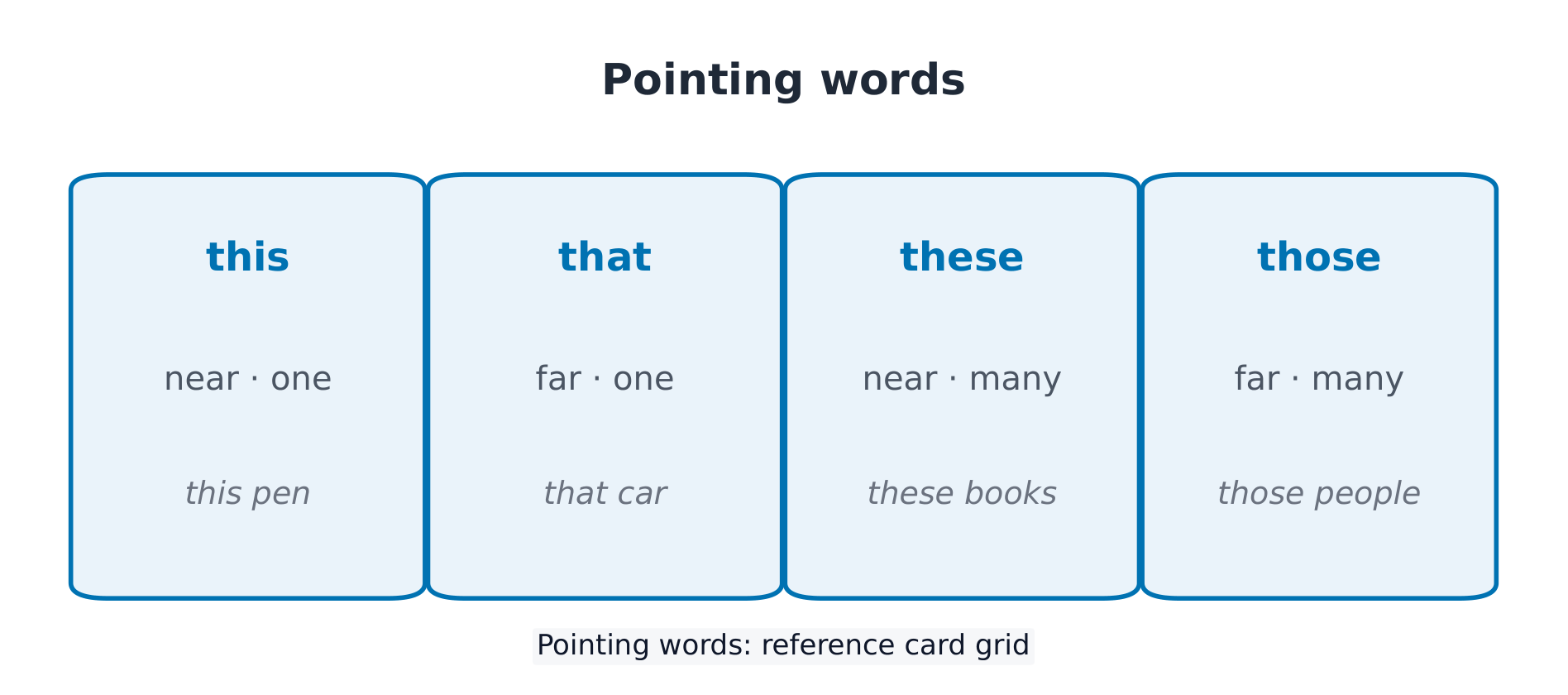
    Demonstratives point out "which one." Use this and that for singular:

    • this(this): Close to the speaker.
    • that(that): Far from the speaker.

    这This 是is 我的my 手机phone.

    This is my phone. (Close)

    那That 是is 你的your 车car.

    That is your car. (Far)

    Bahasa Indonesia
    Tunjuk dekat/jauh × Tunggal/Jamak: this / that / these / those

    Kata penunjuk (demonstratives) menunjukkan "yang mana". Untuk tunggal gunakan this dan that:

    • this(ini): dekat dengan pembicara.
    • that(itu): jauh dari pembicara.

    这This 是is 我的my 手机phone.

    Ini adalah ponselku. (dekat)

    那That 是is 你的your 车car.

    Itu adalah mobilmu. (jauh)

    4.2

    these dan those

    English

    Use these and those for plural:

    • these(these): Close. those(those): Far.

    这些These 是are 我的my 书books.

    These are my books.

    那些Those 是are 她的her 朋友friends.

    Those are her friends.

    Contrastive Memory:

    • Near → this (singular) / these (plural).
    • Far → that (singular) / those (plural).

    Note: These / those are followed by plural nouns: these books, not ~~these book~~.

    Common Errors

    • ❌ ~~these book~~ → ✓ these books — Plural nouns must follow these / those.
    • ❌ ~~This books are mine.~~ → ✓ These books are mine. — If the noun is plural, the demonstrative must also be plural.
    • ❌ When introducing yourself on the phone, say ~~I am Tom.~~ → ✓ This is Tom. — In English, introduce yourself on the phone using this is.
    • Remember pairs: Near this / these are often used with here; far that / those are often used with there.
    Bahasa Indonesia

    Untuk jamak gunakan these dan those:

    • these(ini): dekat. those(itu): jauh.

    这些These 是are 我的my 书books.

    Ini adalah buku-buku saya.

    那些Those 是are 她的her 朋友friends.

    Itu adalah teman-temannya.

    Perbandingan Mengingat:

    • Dekat → this(tunggal)/ these(jamak).
    • Jauh → that(tunggal)/ those(jamak).

    Perhatian setelah these/those diikuti kata benda jamak: these books, bukan ~~these book~~.

    Kesalahan Umum

    • ❌ ~~these book~~ → ✓ these books — Setelah these/those wajib diikuti kata benda jamak.
    • ❌ ~~This books are mine.~~ → ✓ These books are mine. — Jika kata benda jamak, kata penunjuk juga harus menggunakan bentuk jamak.
    • ❌ Saat berbicara telepon bilang ~~I am Tom.~~ → ✓ This is Tom. — Dalam bahasa Inggris untuk memperkenalkan diri lewat telepon menggunakan this is.
    • Ingat pasangan: this/these (dekat) sering digunakan bersama here, whereas that/those (jauh) sering digunakan bersama there.
  • 5 a, an and plurals · ⁨a, an dan kata jamak⁩
    5.1

    a dan an

    English

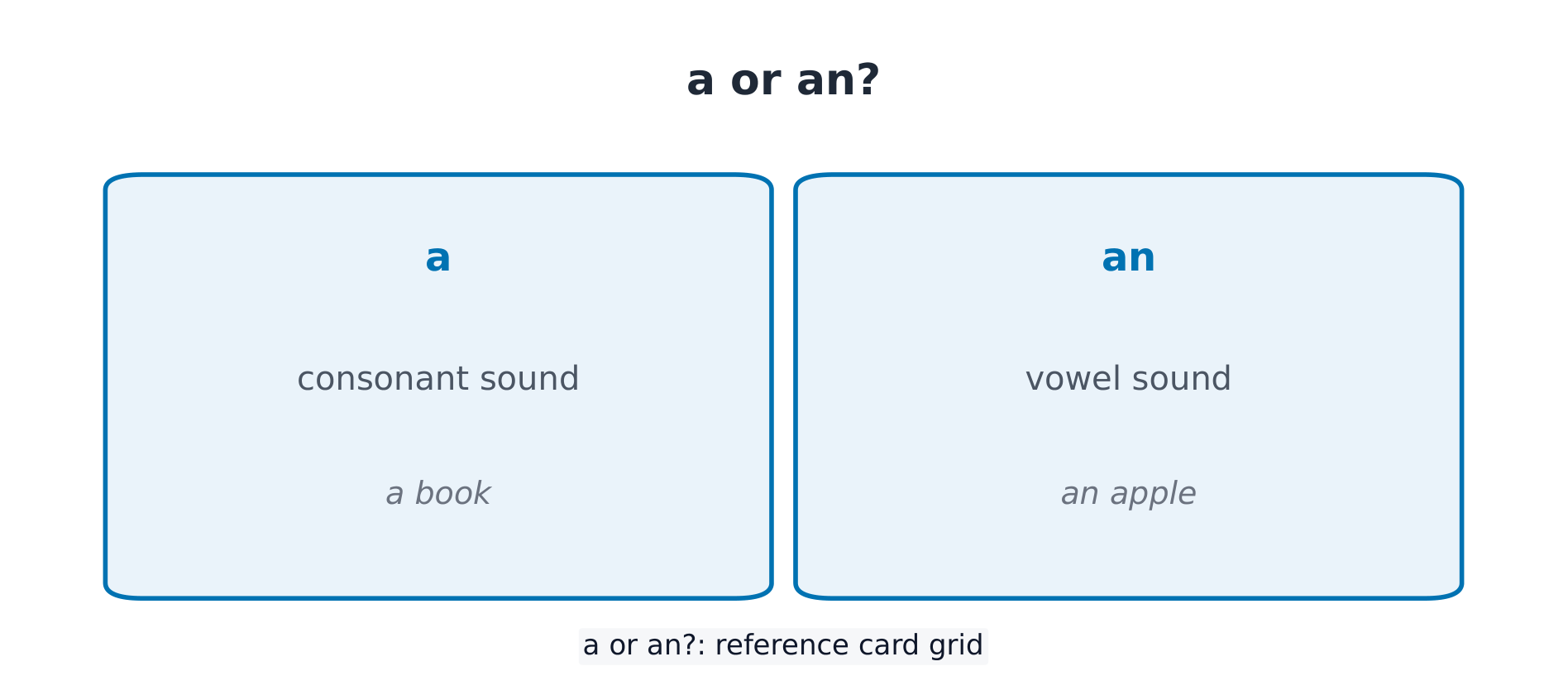
    a and an mean "one" and are used before singular countable nouns. How to choose depends on pronunciation:

    • a + consonant sound: a book, a dog, a cat.
    • an + vowel sound: an apple, an egg, an orange.

    我I 有have 一个a 笔pen.

    I have a pen.

    她She 吃eats 一个an 苹果apple.

    She eats an apple.

    Note: Look at the sound, not the letter: an hour (h is silent), a university (pronounced "yu-").

    Bahasa Indonesia
    a/an: lihat pengucapan (konsonan vs vokal)

    a dan an berarti "satu", digunakan sebelum kata benda tunggal dapat dihitung. Bagaimana memilihnya, lihat pengucapannya:

    • a + bunyi konsonan: a book, a dog, a cat.
    • an + bunyi vokal: an apple, an egg, an orange.

    我I 有have 一个a 笔pen.

    Saya memiliki sebuah pena.

    她She 吃eats 一个an 苹果apple.

    Dia makan sebuah apel.

    Perhatian lihat bunyi bukan huruf: an hour (h tidak terucap), a university (dibaca "yu-").

    5.2

    Kata Benda Jamak

    English

    To indicate "more than one," use the plural form of the noun, usually adding -s:

    • Generally add -s: book → books, car → cars.
    • Words ending in -s / -sh / -ch / -x add -es: bus → buses, box → boxes.
    • Consonant + y ending: change y to i and add -es: baby → babies, city → cities.

    我I 有have 两two 猫cats.

    I have two cats.

    Irregular plurals (must memorize):

    • man → men, woman → women, child → children.
    • foot → feet, tooth → teeth, person → people.

    Note: Do not use a / an before plural nouns: ~~a books~~ ✗ → books / two books ✓.

    Common Errors

    • ❌ ~~I have dog.~~ → ✓ I have a dog. — In Chinese you can say "I have dogs," but singular countable nouns in English must have a / an (or my, the, etc.) before them.
    • ❌ ~~an university~~ → ✓ a university; ❌ ~~a hour~~ → ✓ an hour — Look at pronunciation, not spelling: university starts with a consonant sound /j/, and h is silent in hour.
    • ❌ ~~two book~~ → ✓ two books — Chinese nouns do not change for plurality, but nouns after numbers in English require -s; this is easily forgotten.
    • ❌ ~~three childs~~ → ✓ three children — Irregular plurals must be memorized separately: men, women, children, feet, teeth, people.
    • ❌ ~~a people~~ → ✓ a person (one person) / people (many people) — people is inherently plural.
    Bahasa Indonesia

    Saat menyatakan "lebih dari satu", kata benda menggunakan jamak, biasanya ditambahkan -s:

    • Umumnya tambah -s: book → books, car → cars.
    • Berakhir dengan -s / -sh / -ch / -x, tambah -es: bus → buses, box → boxes.
    • Konsonan + y berakhiran, y berubah menjadi i lalu tambah -es: baby → babies, city → cities.

    我I 有have 两two 猫cats.

    Saya memiliki dua ekor kucing.

    Jamak Tidak Beraturan (harus hafal):

    • man → men, woman → women, child → children.
    • foot → feet, tooth → teeth, person → people.

    Perhatian sebelum kata benda jamak jangan tambahkan a/an: ~~a books~~ ✗ → books / two books ✓.

    Kesalahan Umum

    • ❌ ~~I have dog.~~ → ✓ I have a dog. — Dalam bahasa Mandarin bisa bilang "saya punya anjing", tetapi dalam bahasa Inggris sebelum kata benda tunggal dapat counted harus ada a/an (atau my, the, dll.).
    • ❌ ~~an university~~ → ✓ a university; ❌ ~~a hour~~ → ✓ an hour — Lihat pengucapan bukan huruf: university diawali bunyi konsonan /j/, h pada hour tidak terucap.
    • ❌ ~~two book~~ → ✓ two books — Kata benda bahasa Mandarin tidak memiliki perubahan jamak, tetapi kata benda setelah angka dalam bahasa Inggris harus ditambah -s, ini yang paling mudah dilupakan.
    • ❌ ~~three childs~~ → ✓ three children — Jamak tidak beraturan harus hafal secara terpisah: men, women, children, feet, teeth, people.
    • ❌ ~~a people~~ → ✓ a person(satu orang)/ people(banyak orang) — people sendiri sudah merupakan bentuk jamak.
  • 6 there is and there are · ⁨there is dan there are⁩
    6.1

    Tunggal dan Jamak

    English

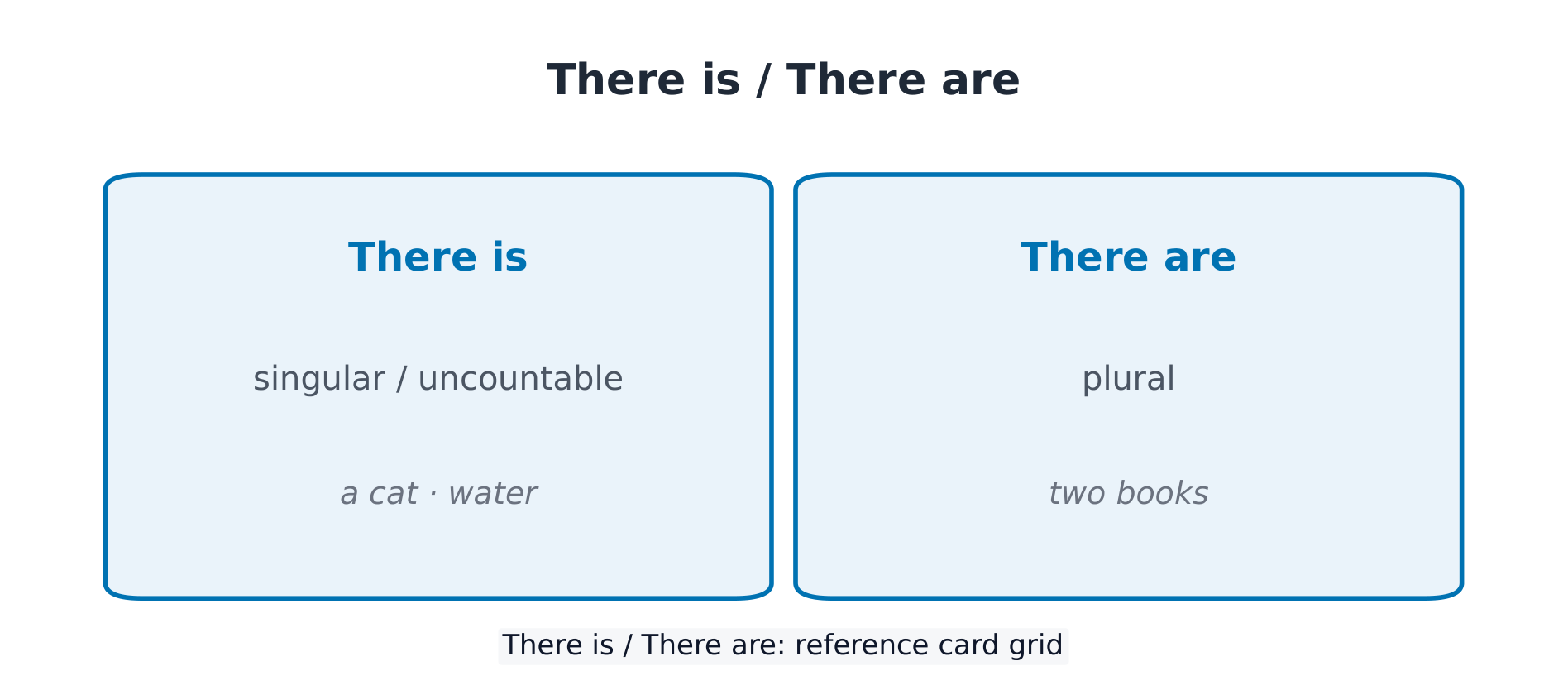
    there is / there are means "there exists" (something exists somewhere).

    • There is + singular / uncountable noun: There is a book.
    • There are + plural noun: There are two books.

    (有)There 有is 一只a 猫cat 在on (冠词)the 沙发上sofa.

    There is a cat on the sofa.

    (有)There 有are 三three 书books 在on (冠词)the 桌上desk.

    There are three books on the table.

    Note: In spoken English, there is is often contracted to there's: There's a problem.

    Bahasa Indonesia
    There is(tunggal)/ There are(jamak)

    there is / there are digunakan untuk menyatakan "ada" (ketika ada sesuatu di suatu tempat).

    • There is + kata benda tunggal / tidak dapat dihitung: There is a book.
    • There are + kata benda jamak: There are two books.

    (有)There 有is 一只a 猫cat 在on (冠词)the 沙发上sofa.

    Ada seekor kucing di sofa.

    (有)There 有are 三three 书books 在on (冠词)the 桌上desk.

    Ada tiga buku di atas meja.

    Perhatian Dalam percakapan, there is sering disingkat menjadi there's: There's a problem.

    6.2

    Negasi dan Pertanyaan

    English

    Negative: there is not / there are not (contracted as there isn't / there aren't).

    (有)There 没有isn't 任何any 牛奶milk.

    There is no milk left.

    Question: Move is / are to the front of there.

    (有吗)Is (有)there 一家a 银行bank 附近near 这里here?

    Is there a bank nearby?

    Short answer: Yes, there is. / No, there isn't.

    Note: Use any frequently in negative / question sentences: Is there any water? (Is there any water?)

    Common Errors

    • ❌ ~~Here has many people.~~ → ✓ There are many people here. — The "have" in the Chinese "There are many people here" indicates existence; use there is / there are in English, do not translate literally as have.
    • ❌ ~~There have a book on the desk.~~ → ✓ There is a book on the desk. — Use is / are after there; there have does not exist.
    • ❌ ~~There is two cats.~~ → ✓ There are two cats. — If the following noun is plural, use are.
    • ❌ ~~There are a milk.~~ → ✓ There is some milk. — milk is uncountable: use there is + some, do not use a.
    Bahasa Indonesia

    Bentuk negatif: there is not / there are not (disingkat: there isn't / there aren't).

    (有)There 没有isn't 任何any 牛奶milk.

    Sudah tidak ada susu lagi.

    Kalimat tanya: Pindahkan is / are ke sebelum kata there.

    (有吗)Is (有)there 一家a 银行bank 附近near 这里here?

    Apakah ada bank di sekitar sini?

    Jawaban singkat: Yes, there is. / No, there isn't.

    Perhatian Dalam kalimat negatif atau tanya, sering digunakan any: Is there any water? (Apakah ada air?)

    Kesalahan Umum

    • ❌ ~~Here has many people.~~ → ✓ There are many people here. — Kata "ada" dalam bahasa Mandarin "这里有很多人" menunjukkan eksistensi, dalam bahasa Inggris menggunakan there is / there are, tidak boleh diterjemahkan langsung menjadi have.
    • ❌ ~~There have a book on the desk.~~ → ✓ There is a book on the desk. — Setelah there gunakan is / are, tidak ada struktur "there have" seperti itu.
    • ❌ ~~There is two cats.~~ → ✓ There are two cats. — Karena kata benda setelahnya adalah bentuk jamak, gunakan are.
    • ❌ ~~There are a milk.~~ → ✓ There is some milk. — Milk tidak dapat dihitung: gunakan there is + some, jangan gunakan a.
  • 7 have got
    7.1

    have got / has got

    English

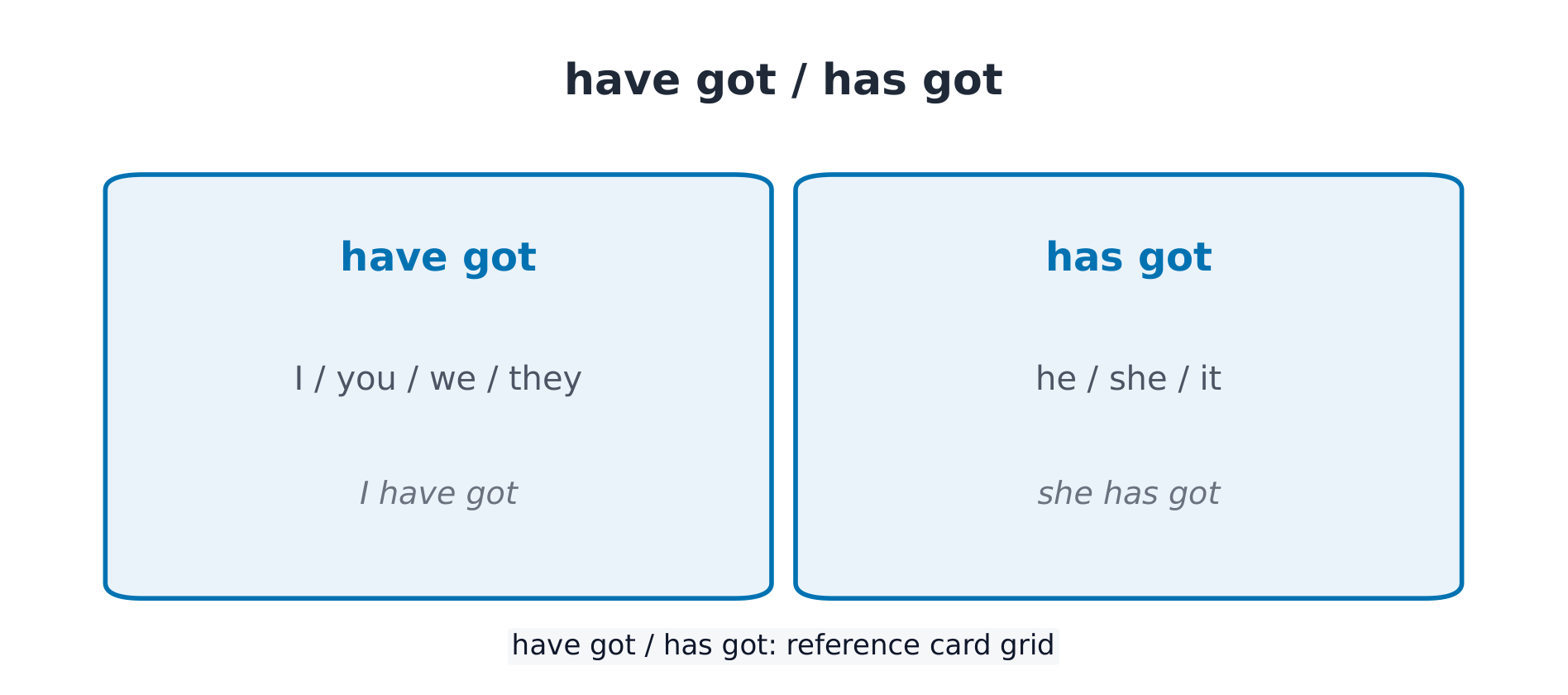
    have got means "to possess" (= have), common in British English.

    • I / you / we / they → have got
    • he / she / it → has got

    我I 有have got 一个a 兄弟brother.

    I have a brother. (= I have a brother.)

    她She 有has got 蓝色blue 眼睛eyes.

    She has blue eyes.

    Note: Often contracted in spoken language: I've got, she's got, they've got. Same meaning as have / has.

    Bahasa Indonesia
    have got / has got

    have got digunakan untuk menyatakan "memiliki" (= have), sangat umum dalam bahasa Inggris Britania Raya.

    • I / you / we / they → have got
    • he / she / it → has got

    我I 有have got 一个a 兄弟brother.

    Saya punya seorang saudara laki-laki. (= I have a brother.)

    她She 有has got 蓝色blue 眼睛eyes.

    Dia memiliki sepasang mata biru.

    Perhatian Dalam percakapan sering disingkat: I've got, she's got, they've got. Maknanya sama dengan have / has.

    7.2

    Negasi dan Pertanyaan

    English

    Negative: haven't got / hasn't got.

    他He 没有hasn't got 一辆a 车car.

    He doesn't have a car.

    Question: Move Have / Has to the front of the subject.

    (有吗)Have 你you 有got 一支a 笔pen?

    Do you have a pen?

    Short answer: Yes, I have. / No, I haven't.

    Note: have got is mostly used for current possession; for past or habits, use regular have / had.

    Common Errors

    • ❌ ~~She have got long hair.~~ → ✓ She has got long hair. — Use has got for he / she / it.
    • ❌ ~~I have got not a car.~~ → ✓ I haven't got a car. — Place not after have / has, then contract.
    • ❌ ~~Do you have got a pen?~~ → ✓ Have you got a pen? / Do you have a pen? — Both question forms are correct, but never mix them.
    • ❌ ~~Yes, I have got.~~ → ✓ Yes, I have. — Short answers end at have / has, without got.
    Bahasa Indonesia

    Bentuk negatif: haven't got / hasn't got.

    他He 没有hasn't got 一辆a 车car.

    Dia tidak memiliki mobil.

    Kalimat tanya: Pindahkan Have / Has ke depan subjek.

    (有吗)Have 你you 有got 一支a 笔pen?

    Apakah kamu memiliki pena?

    Jawaban singkat: Yes, I have. / No, I haven't.

    Perhatian have got lebih sering digunakan untuk kondisi "memiliki" pada saat ini; jika membicarakan masa lalu atau kebiasaan, tetap gunakan have / had biasa.

    Kesalahan Umum

    • ❌ ~~She have got long hair.~~ → ✓ She has got long hair. — Gunakan has got untuk he / she / it.
    • ❌ ~~I have got not a car.~~ → ✓ I haven't got a car. — Letakkan not setelah have / has, lalu disingkat.
    • ❌ ~~Do you have got a pen?~~ → ✓ Have you got a pen? / Do you have a pen? — Kedua cara bertanya ini benar, tetapi tidak boleh dicampur menjadi satu kalimat.
    • ❌ ~~Yes, I have got.~~ → ✓ Yes, I have. — Jawaban singkat cukup sampai have / has, tidak perlu menambahkan got.
  • 8 Present simple · ⁨Simple present⁩
    8.1

    Kebiasaan dan Orang Ketiga -s

    English

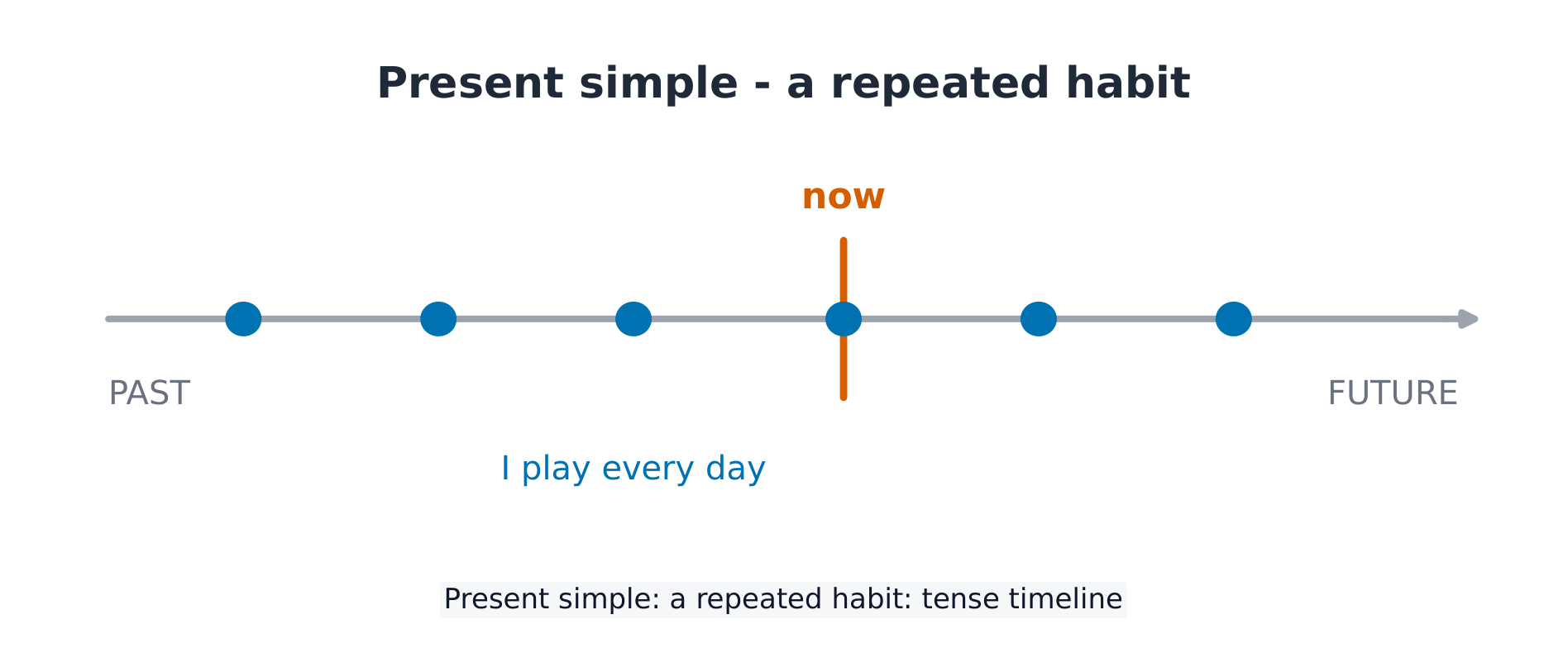
    Present simple (present simple) describes habits and facts. The base form is the infinitive (base verb).

    我I 喜欢like 茶tea.

    I like tea.

    When the subject is he / she / it, add -s to the verb:

    他He 踢plays 足球football.

    He plays football.

    Spelling rules:

    • Generally add -s: like → likes.
    • Words ending in -s / -sh / -ch / -x / -o add -es: go → goes, watch → watches.
    • Consonant + y ending: change y to i and add -es: study → studies.

    Note: Only he / she / it take -s; I / you / we / they use the base form: They like tea.

    Bahasa Indonesia
    Simple Present: Kebiasaan berulang

    Present Simple (Simple Present) digunakan untuk membicarakan kebiasaan dan fakta. Bentuk dasarnya adalah kata kerja dasar.

    我I 喜欢like 茶tea.

    Saya suka teh.

    Ketika subjeknya adalah he / she / it, tambahkan -s pada kata kerja:

    他He 踢plays 足球football.

    Dia bermain sepak bola.

    Ejaan:

    • Umumnya tambah -s: like → likes.
    • Berakhiran -s / -sh / -ch / -x / -o, tambah -es: go → goes, watch → watches.
    • Konsonan + y, huruf y berubah menjadi i lalu tambah -es: study → studies.

    Perhatian Hanya he / she / it yang ditambah -s; I / you / we / they menggunakan bentuk dasar: They like tea.

    8.2

    Negasi dan Pertanyaan

    English

    For negatives and questions, use auxiliary verbs do / does (does for he / she / it).

    Negative: Subject + don't / doesn't + base verb.

    我I 不don't 喜欢like 咖啡coffee.

    I don't like coffee.

    Question: Do / Does + Subject + base verb ?

    (助动词)Does 她she 住live 这里here?

    Does she live here?

    Note: When using do / does, the verb returns to its base form (no -s): ~~Does she lives~~ ✗ → Does she live ✓.

    Common Errors

    • ❌ ~~He go to school by bus.~~ → ✓ He goes to school by bus. — Forgetting to add -s in third person singular is the most frequent error; check your work afterwards.
    • ❌ ~~She doesn't likes coffee.~~ → ✓ She doesn't like coffee. — When using does / doesn't, the verb returns to its base form.
    • ❌ ~~I very like English.~~ → ✓ I like English very much. — "Very much" in Chinese cannot be translated literally; very cannot directly modify a verb.
    • ❌ ~~You like tea?~~ → ✓ Do you like tea? — Questions must start with do / does; rising intonation alone is insufficient.
    Bahasa Indonesia
    Kebiasaan sehari-hari: I have breakfast every morning.

    Untuk kalimat negatif dan tanya gunakan kata bantu do / does (he / she / it menggunakan does).

    Negatif: Subjek + don't / doesn't + kata kerja dasar.

    我I 不don't 喜欢like 咖啡coffee.

    Saya tidak suka kopi.

    Tanya: Do / Does + Subjek + kata kerja dasar ?

    (助动词)Does 她she 住live 这里here?

    Dia tinggal di sini?

    Perhatian Jika menggunakan do / does, kata kerja kembali ke bentuk dasar (tidak tambah -s): ~~Does she lives~~ ✗ → Does she live ✓.

    Kesalahan Umum

    • ❌ ~~He go to school by bus.~~ → ✓ He goes to school by bus. — Lupa menambah -s pada orang ketiga tunggal adalah kesalahan paling sering terjadi, pastikan memeriksa kembali setelah menulis.
    • ❌ ~~She doesn't likes coffee.~~ → ✓ She doesn't like coffee. — Setelah menggunakan does / doesn't, kata kerja harus kembali ke bentuk dasar.
    • ❌ ~~I very like English.~~ → ✓ I like English very much. — "Sangat suka" dalam bahasa Mandarin tidak bisa diterjemahkan secara harfiah; very tidak bisa memodifikasi kata kerja secara langsung.
    • ❌ ~~You like tea?~~ → ✓ Do you like tea? — Kalimat tanya harus diawali dengan do / does, tidak bisa hanya mengandalkan nada suara yang naik.
  • 9 can
    9.1

    Kemampuan dan Permintaan

    English

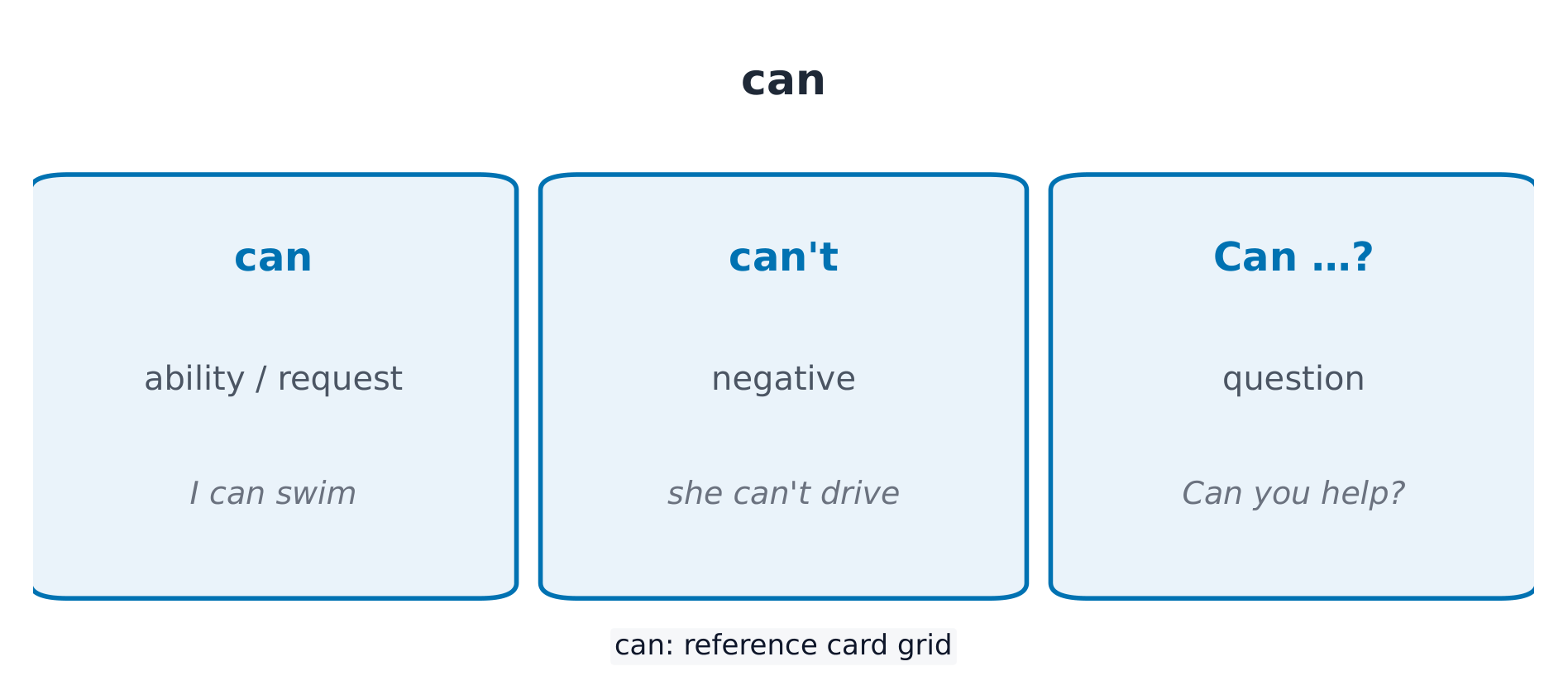
    can expresses ability ("know how to / be able to") or is used for requests. It is followed by the base form of the verb, and remains the same for all persons.

    我I 会can 游泳swim.

    I can swim.

    能Can 你you 帮help 我me?

    Can you help me?

    Note: Use the base form after can: ~~can to swim~~ ✗, ~~can swims~~ ✗ → can swim ✓.

    Bahasa Indonesia
    can: kemampuan, negatif, tanya

    can digunakan untuk menyatakan kemampuan ("bisa / dapat") atau untuk membuat permintaan. Diikuti oleh kata kerja dasar, sama untuk semua subjek.

    我I 会can 游泳swim.

    Saya bisa berenang.

    能Can 你you 帮help 我me?

    Bisakah kamu membantuku?

    Perhatian Setelah can gunakan bentuk dasar: ~~can to swim~~ ✗、~~can swims~~ ✗ → can swim ✓.

    9.2

    Negasi dan Pertanyaan

    English

    Negative: cannot (abbreviation can't) + base form of the verb.

    她She 不会can't 开车drive.

    She cannot drive.

    Question: Place Can before the subject.

    能Can 他he 做饭cook?

    Can he cook?

    Short answer: Yes, I can. / No, I can't.

    Note: can has no -s and does not use do/does: ask directly with Can he…?, not ~~Does he can…?~~

    Common Errors

    • ❌ ~~She cans drive.~~ → ✓ She can drive. — can has no third-person singular -s; it is the same for all persons.
    • ❌ ~~I don't can swim.~~ → ✓ I can't swim. — The negative of can is formed directly with not (can't), without using don't.
    • ❌ ~~He can sings very good.~~ → ✓ He can sing very well. — Use the base form of the verb after can; use the adverb well to modify a verb, not good.
    • ❌ ~~You can help me?~~ → ✓ Can you help me? — When making a request, place can before the subject.
    Bahasa Indonesia

    Negatif: cannot (disingkat can't) + kata kerja dasar.

    她She 不会can't 开车drive.

    Dia tidak bisa mengemudi.

    Tanya: Pindahkan Can ke depan subjek.

    能Can 他he 做饭cook?

    Apakah dia bisa memasak?

    Jawaban singkat: Yes, I can. / No, I can't.

    Perhatian can tidak memiliki -s, tidak menggunakan do/does: Tanya langsung dengan Can he…?, bukan ~~Does he can…?~~

    Kesalahan Umum

    • ❌ ~~She cans drive.~~ → ✓ She can drive. — Can tidak memiliki -s orang ketiga, bentuknya sama untuk semua subjek.
    • ❌ ~~I don't can swim.~~ → ✓ I can't swim. — Negatif dari can langsung ditambahkan not (can't), tidak perlu don't.
    • ❌ ~~He can sings very good.~~ → ✓ He can sing very well. — Setelah can gunakan kata kerja dasar; untuk memodifikasi kata kerja gunakan adverb well, bukan good.
    • ❌ ~~You can help me?~~ → ✓ Can you help me? — Saat meminta bantuan, pindahkan can ke depan subjek.
  • 10 Imperatives · ⁨Imperatif⁩
    10.1

    Perintah dan Instruksi

    English

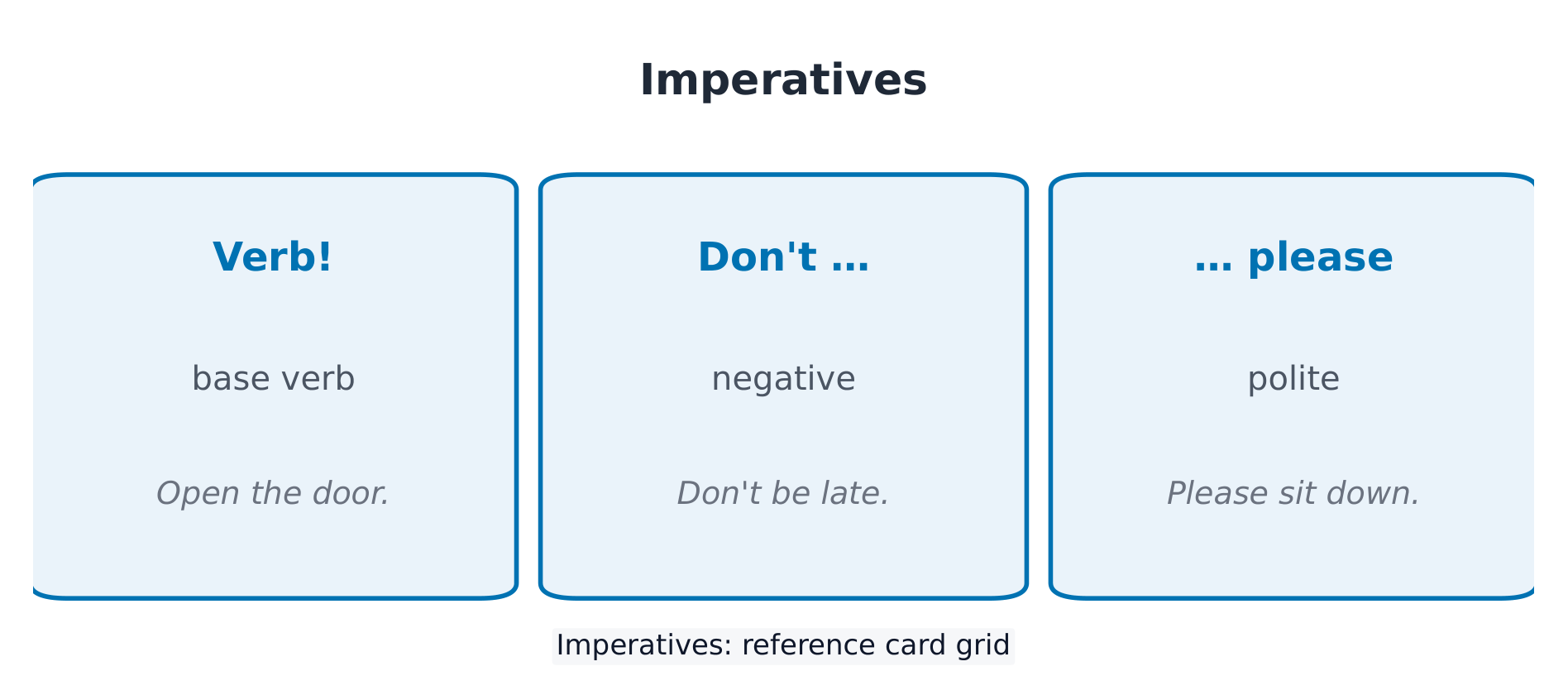
    Imperatives are used to give commands, provide instructions, or make requests. Start directly with the base form of the verb, without a subject.

    打开Open (冠词)the 门door 请, please.

    Please open the door.

    坐Sit 下down.

    Sit down.

    Negative: Add Don't at the beginning.

    不要Don't (是)be 迟到late.

    Don't be late.

    Key Usage Points:

    • Add please to be more polite: Please come in.
    • Also used for directions and instructions: Turn left. Mix the eggs.

    Note: Do not write a subject in imperatives: ~~You open the door~~ (for a command) → Open the door.

    Common Errors

    • ❌ ~~Please open door.~~ → ✓ Please open the door. — Articles must still be included in imperatives.
    • ❌ ~~Don't to touch it.~~ → ✓ Don't touch it. — Follow don't directly with the base form of the verb; do not add to.
    • ❌ ~~No talk in class!~~ → ✓ Don't talk in class! / No talking! — To prohibit an action, use don't + base form; after no, use -ing or a noun.
    • ❌ ~~You sit down!~~ → ✓ Sit down, please. — Adding you to a command sounds angry; add please for politeness, or change to Can you…?
    Bahasa Indonesia
    Kalimat Imperatif: Perintah, negasi, permintaan

    Kalimat perintah (Imperatives) digunakan untuk memberikan perintah, memberi instruksi, atau membuat permintaan. Dimulai langsung dengan kata kerja dasar, tanpa subjek.

    打开Open (冠词)the 门door 请, please.

    Tolong buka pintunya.

    坐Sit 下down.

    Duduklah.

    Negatif: Tambahkan Don't di depannya.

    不要Don't (是)be 迟到late.

    Jangan terlambat.

    Poin Penggunaan:

    • Menambahkan please membuatnya lebih sopan: Please come in. (Silakan masuk.)
    • Juga digunakan untuk petunjuk arah atau instruksi: Turn left. (Belok kiri.) Mix the eggs. (Aduk telurnya.)

    Perhatian Kalimat perintah tidak menuliskan subjek: ~~You open the door~~ (saat memberi perintah) → Open the door.

    Kesalahan Umum

    • ❌ ~~Please open door.~~ → ✓ Please open the door. — Artikel tetap tidak boleh dihilangkan dalam kalimat perintah.
    • ❌ ~~Don't to touch it.~~ → ✓ Don't touch it. — Setelah don't langsung diikuti kata kerja dasar, jangan tambah to.
    • ❌ ~~No talk in class!~~ → ✓ Don't talk in class! / No talking! — Untuk melarang melakukan sesuatu gunakan don't + bentuk dasar; setelah no gunakan -ing atau kata benda.
    • ❌ ~~You sit down!~~ → ✓ Sit down, please. — Memberikan perintah dengan menambahkan you terdengar sangat marah; jika ingin sopan tambahkan please, atau ubah menjadi pertanyaan Can you…?
  • 11 Question words · ⁨Kata tanya⁩
    11.1

    what, where, who

    English

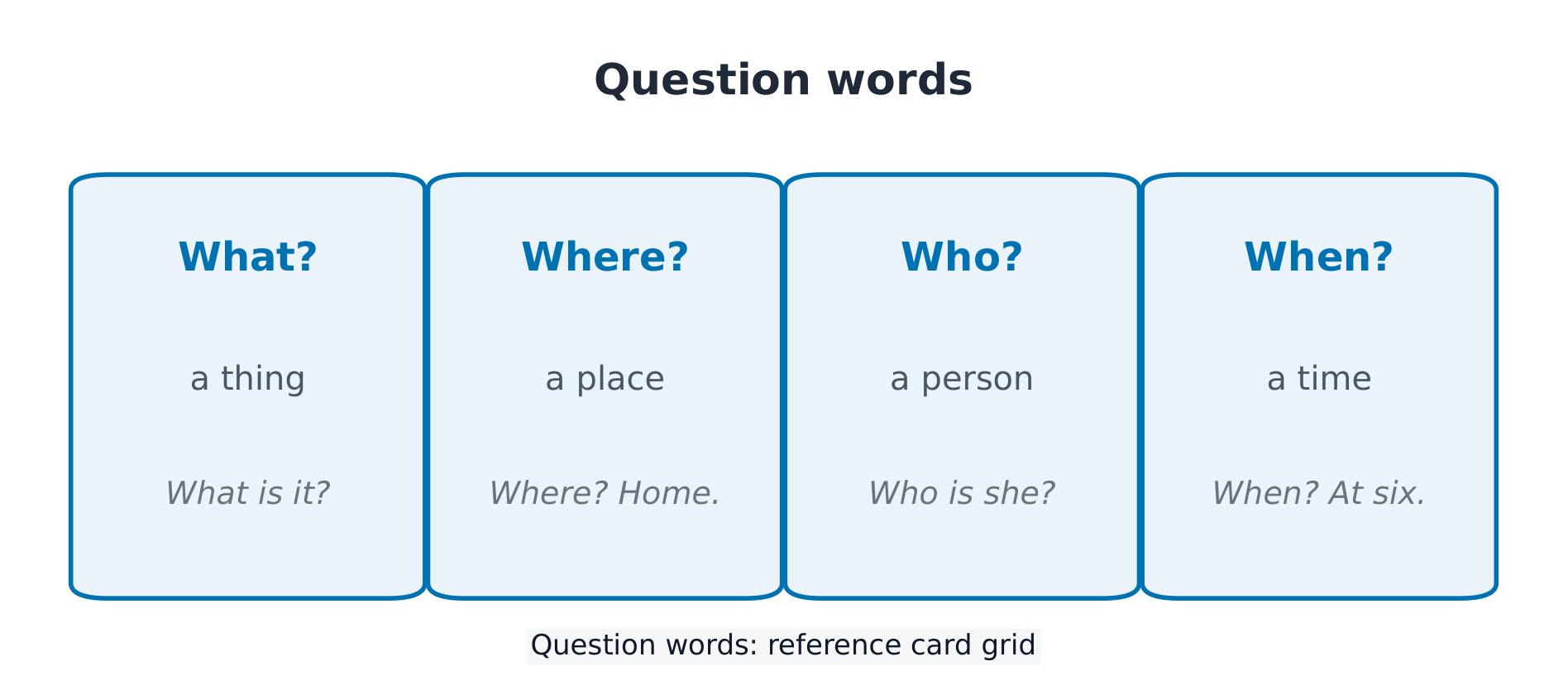
    Question words are placed at the beginning of a question to ask for specific information.

    • what (what), where (where), who (who)

    什么What 是is 你的your 名字name?

    What's your name?

    哪里Where (助动词)do 你you 住live?

    Where do you live?

    谁Who 是is 那个that 男人man?

    Who is that man?

    Note: A be verb or auxiliary do/does often follows the question word: Where do you work?

    Bahasa Indonesia
    Kata Tanya: Menanyakan benda/tempat/orang/waktu

    Kata tanya (question words) diletakkan di awal kalimat tanya, digunakan untuk menanyakan informasi spesifik.

    • what(apa), where(di mana), who(siapa)

    什么What 是is 你的your 名字name?

    Siapa namamu?

    哪里Where (助动词)do 你you 住live?

    Di mana kamu tinggal?

    谁Who 是is 那个that 男人man?

    Siapakah pria itu?

    Perhatian Setelah kata tanya sering diikuti oleh kata kerja be atau助动词 do / does: Where do you work?

    11.2

    when, why, how

    English
    • when (when), why (why), how (how / in what way)

    什么时候When 是is (冠词)the 派对party?

    When is the party?

    为什么Why (是)are 你you 难过sad?

    Why are you sad?

    怎么How (助动词)do 你you 拼写spell 它it?

    How do you spell this?

    Note: how can also combine with adjectives to ask about degree: How old are you? How much is it?

    Common Errors

    • ❌ ~~Where you live?~~ → ✓ Where do you live? — After the question word, you still need do/does or be; you cannot follow directly with the subject.
    • ❌ ~~What means this word?~~ → ✓ What does this word mean? — mean is an ordinary verb: question word + does + subject + base form.
    • ❌ ~~Why you are late?~~ → ✓ Why are you late? — When there is a be verb in the sentence, move be before the subject.
    • ❌ ~~How to spell it?~~ → ✓ How do you spell it? — A literal translation of "How to spell?" loses the subject and auxiliary verb; these must be added.
    Bahasa Indonesia
    • when(kapan), why(mengapa), how(bagaimana / cara)

    什么时候When 是is (冠词)the 派对party?

    Partainya kapan?

    为什么Why (是)are 你you 难过sad?

    Mengapa kamu sedih?

    怎么How (助动词)do 你you 拼写spell 它it?

    Bagaimana cara mengeja ini?

    Perhatian How juga bisa dipasangkan dengan adjektiva untuk menanyakan tingkat: How old are you?(Berapa umurmu?) How much is it?(Berapa harganya?)

    Kesalahan Umum

    • ❌ ~~Where you live?~~ → ✓ Where do you live? — Setelah kata tanya harus ada do / does atau be, tidak boleh langsung diikuti subjek.
    • ❌ ~~What means this word?~~ → ✓ What does this word mean? — mean adalah kata kerja biasa: kata tanya + does + subjek + bentuk dasar.
    • ❌ ~~Why you are late?~~ → ✓ Why are you late? — Jika dalam kalimat terdapat kata kerja be, pindahkan be ke depan subjek.
    • ❌ ~~How to spell it?~~ → ✓ How do you spell it? — Terjemahan harfiah "bagaimana mengeja?" akan menghilangkan subjek dan助动词, sehingga perlu dilengkapi.
  • 12 Prepositions of place · ⁨Preposisi tempat⁩
    12.1

    in, on, under

    English

    Prepositions of place indicate where something is located.

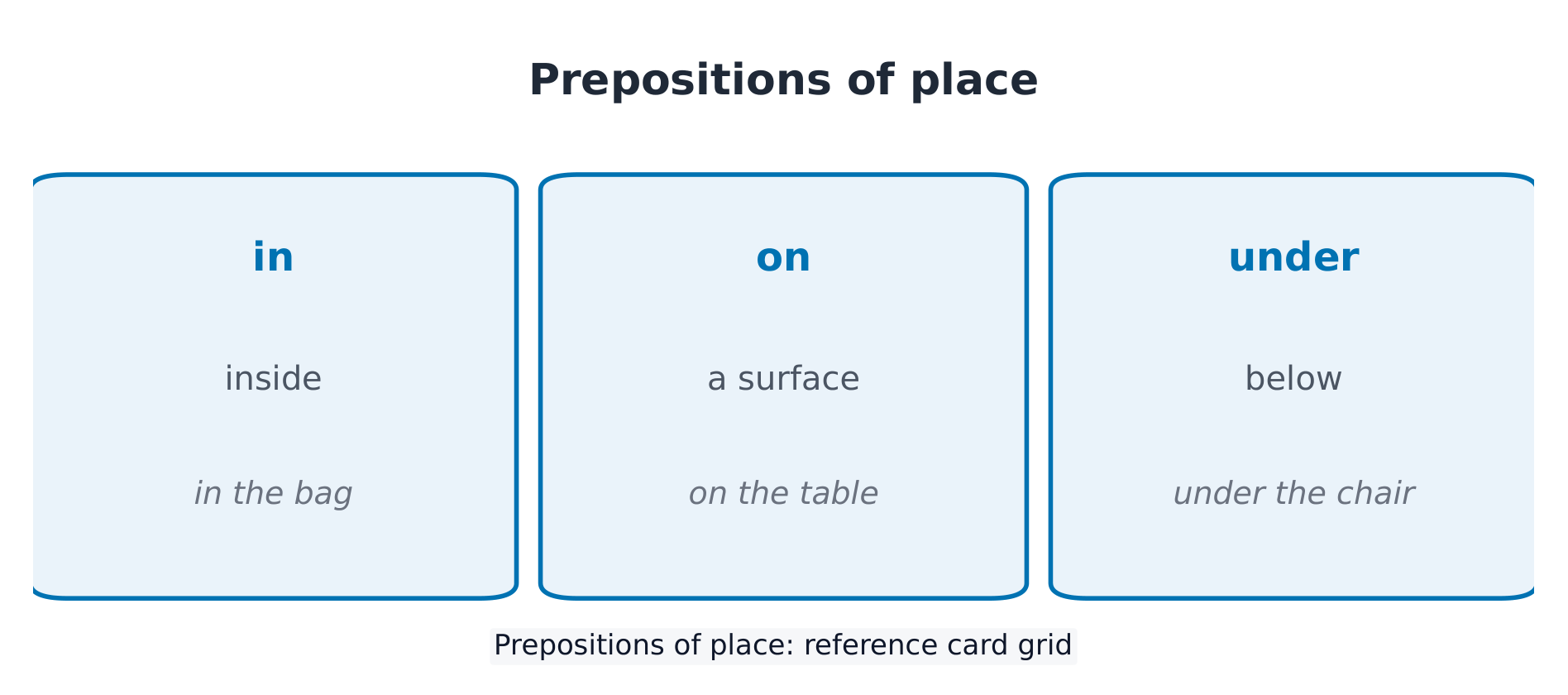
    • in (inside...), on (on top of... / surface), under (below...)

    (冠词)The 钥匙keys 在are 在...里in (冠词)the 包里bag.

    The key is in the bag.

    (冠词)The 书book 在is 在...上on (冠词)the 桌上table.

    The book is on the table.

    (冠词)The 猫cat 在is 在...下under (冠词)the 椅子下chair.

    The cat is under the chair.

    Bahasa Indonesia
    Preposisi tempat: in / on / under

    Preposisi tempat (prepositions of place) menjelaskan di mana sesuatu berada.

    • in(di dalam...), on(di atas... / permukaan), under(di bawah...)

    (冠词)The 钥匙keys 在are 在...里in (冠词)the 包里bag.

    Kuncinya ada di dalam tas.

    (冠词)The 书book 在is 在...上on (冠词)the 桌上table.

    Bukunya ada di atas meja.

    (冠词)The 猫cat 在is 在...下under (冠词)the 椅子下chair.

    Kucingnya ada di bawah kursi.

    12.2

    next to, between, behind

    English
    • next to (beside...), between (between...), behind (behind...), in front of (in front of...)

    (冠词)The 商店shop 在is 旁边next to (冠词)the 银行bank.

    The shop is next to the bank.

    她She 坐sits 之间between 汤姆Tom 和and 萨姆Sam.

    She sits between Tom and Sam.

    Note: between means "between two," and is usually followed by A and B: between the door and the window.

    Common Errors

    • ❌ ~~The picture is in the wall.~~ → ✓ The picture is on the wall. — Hanging "on" the wall involves surface contact, so use on.
    • ❌ ~~I read it on the book.~~ → ✓ ...in the book. — Content "inside" a book uses in; people in photos also use in the photo.
    • ❌ ~~The shop is next the bank.~~ → ✓ next to the bank — next to is two words; to cannot be omitted.
    • ❌ ~~between the door with the window~~ → ✓ between the door and the window — between takes the fixed collocation A and B.
    Bahasa Indonesia
    • next to(di samping...), between(di antara...), behind(di belakang...), in front of(di depan...)

    (冠词)The 商店shop 在is 旁边next to (冠词)the 银行bank.

    Toko itu berada di samping bank.

    她She 坐sits 之间between 汤姆Tom 和and 萨姆Sam.

    Dia duduk di antara Tom dan Sam.

    Perhatian Between berarti "di antara dua", biasanya diikuti A and B: between the door and the window.

    Kesalahan Umum

    • ❌ ~~The picture is in the wall.~~ → ✓ The picture is on the wall. — Gambar yang digantung di dinding "atas" adalah kontak permukaan, gunakan on.
    • ❌ ~~I read it on the book.~~ → ✓ ...in the book. — Isi buku "dalam" menggunakan in; orang di dalam foto juga menggunakan in the photo.
    • ❌ ~~The shop is next the bank.~~ → ✓ next to the bank — next to terdiri dari dua kata, to tidak boleh dihilangkan.
    • ❌ ~~between the door with the window~~ → ✓ between the door and the window — between memiliki pola tetap A and B.

Log in or create account · ⁨Masuk atau buat akun⁩

IGCSE, A-Level & AP