The Create Performance Task (guided) · Tugas Buat Kinerja (terpandu)
The Create Performance Task
- The Create Performance Task is a small program you design and build yourself.
- For the real AP exam you submit it (your code, a video, and written answers) through the AP Digital Portfolio.
- Important: the real task is graded by AP, not by this site. This lesson only helps you practice and structure it.
Tugas Performa Create
- Tugas Performa Create adalah program kecil yang Anda rancang dan bangun sendiri.
- Untuk ujian AP sungguhan, serahkan melalui AP Digital Portfolio (kode Anda, video, dan jawaban tertulis).
- Penting: tugas sungguhan dinilai oleh AP, bukan oleh situs ini. Pelajaran ini hanya membantu Anda berlatih dan menyusunnya.
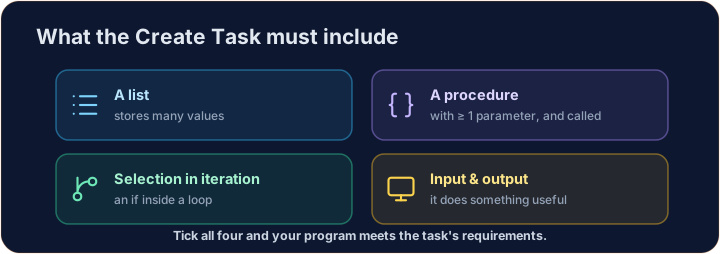
What your program must include
- A list (or other collection) that stores many values together.
- A procedure (a function) that takes at least one parameter, and that you call in your code.
- An algorithm with selection (
if) inside iteration (a loop). - Some input and some output so the program does something useful.
Apa yang harus ada dalam program Anda
- Sebuah daftar (atau koleksi lainnya) yang menyimpan banyak nilai bersama-sama.
- Sebuah prosedur (fungsi) yang menerima setidaknya satu parameter, dan yang Anda panggil dalam kode Anda.
- Sebuah algoritma dengan seleksi (
if) di dalam iterasi (perulangan). - Beberapa input dan beberapa output sehingga program melakukan sesuatu yang berguna.
Pick a small idea
- Keep it simple: you only need to show the skills above, not build a huge app.
- Good ideas: grade a list of scores, total a shopping list, sort students into teams, count words.
- Choose data you understand, so you can explain it later.
Pilih ide kecil
- Tetap sederhana: Anda hanya perlu menunjukkan keterampilan di atas, bukan membuat aplikasi raksasa.
- Ide bagus: nilai daftar skor, total daftar belanja, susun siswa ke dalam tim, hitung kata.
- Pilih data yang Anda pahami, sehingga Anda bisa menjelaskannya nanti.
A starter scaffold
- The program below has all the required parts. Read the comments to find each one.
- It uses a fixed list so it runs the same every time (no live typing needed here).
- Run it, then change the data and rules to make it your own.
Rangka kerja awal
- Program di bawah ini memiliki semua bagian yang diperlukan. Bacalah komentar untuk menemukan masing-masing.
- Ini menggunakan daftar tetap sehingga berjalan sama setiap kali (tidak perlu pengetikan langsung di sini).
- Jalankan, lalu ubah data dan aturan untuk membuatnya menjadi milik Anda sendiri.
# 1) A LIST that stores many values
scores = [72, 95, 58, 88, 40, 67]

# 2) A PROCEDURE with a PARAMETER, that returns a result
def grade_for(score):
    # selection inside the procedure: choose a letter for one score
    if score >= 90:
        return "A"
    elif score >= 70:
        return "B"
    elif score >= 50:
        return "C"
    else:
        return "F"

# 3) An ALGORITHM: SELECTION (if) INSIDE ITERATION (for loop)
pass_count = 0
for s in scores:                 # iteration: visit every score
    letter = grade_for(s)        # call the procedure with a parameter
    if letter != "F":            # selection: is this a pass?
        pass_count = pass_count + 1
    print(f"score {s} -> grade {letter}")   # output

# More output: a summary
print(f"{pass_count} out of {len(scores)} passed")
Make it your own
- Change the list to your own data (and try a different length).
- Change the procedure: new rule, new parameter name, or return something else.
- Change the algorithm: count something new, or keep only items that pass the
if. - Add input if you like, for example
input("Enter a name: ").
Buatlah menjadi milik Anda sendiri
- Ubah daftar menjadi data Anda sendiri (dan coba panjang yang berbeda).
- Ubah prosedur: aturan baru, nama parameter baru, atau kembalikan hal lain.
- Ubah algoritma: hitung hal baru, atau simpan hanya item yang lolos
if. - Tambahkan input jika ingin, misalnya
input("Enter a name: ").
Written-response prompts
- Answer these about your own program (this is the kind of writing the real task asks for):
- Purpose: What does your program do, and why is it useful?
- List: What does your list store, and how does using one list (instead of many separate variables) make the program simpler to manage?
Pertanyaan respons tertulis
- Jawablah pertanyaan-pertanyaan ini tentang program Anda sendiri (ini adalah jenis penulisan yang diminta dalam tugas sungguhan):
- Tujuan: Apa yang dilakukan program Anda, dan mengapa itu berguna?
- Daftar: Apa yang disimpan daftar Anda, dan bagaimana penggunaan satu daftar (daripada banyak variabel terpisah) membuat program lebih mudah dikelola?
More written-response prompts
- Procedure & parameter: Name your procedure. What is its parameter, and what does the procedure do with it? What does it return?
- Algorithm: Describe the algorithm inside your loop in your own words. Point to where it uses selection (
if) and where it uses iteration (the loop), and say why both are needed.
Pertanyaan respons tertulis tambahan
- Prosedur & parameter: Sebutkan nama prosedur Anda. Apa parameternya, dan apa yang dilakukan prosedur dengan parameternya? Apa yang dikembalikannya?
- Algoritma: Jelaskan algoritma di dalam loop Anda dengan kata-kata Anda sendiri. Tunjukkan di mana ia menggunakan seleksi (
if) dan di mana ia menggunakan iterasi (loop), dan katakan mengapa keduanya dibutuhkan.
Rubric checklist
- Tick each item once your program has it:
Daftar periksa rubrik
- Centang setiap item setelah program Anda memilikinya:
[ ] A list (or collection) is used in the program
[ ] A procedure is defined WITH at least one parameter
[ ] That procedure is CALLED somewhere in the program
[ ] The procedure does real work (not empty)
[ ] An algorithm uses selection (if) INSIDE iteration (a loop)
[ ] The program has input and/or output
[ ] I can explain every part in my own words
You can do this
- Start small, run it often, and fix one thing at a time.
- When every box above is ticked, you have the structure the Create Task needs.
- Remember: practice here first, then submit the real task through the AP Digital Portfolio.
Anda bisa melakukannya
- Mulailah dari yang kecil, jalankan sering, dan perbaiki satu hal sekaligus.
- Ketika semua kotak di atas dicentang, Anda memiliki struktur yang dibutuhkan Tugas Create.
- Ingat: berlatihlah di sini terlebih dahulu, kemudian serahkan tugas sungguhan melalui AP Digital Portfolio.
Common mistakes
- Plan the program's purpose first, then build in small tested pieces.
- Be ready to explain what each part of your code does.
Kesalahan umum
- Rencanakan tujuan program terlebih dahulu, lalu bangun dalam potongan kecil yang teruji.
- Siapkan diri untuk menjelaskan apa yang dilakukan setiap bagian kode Anda.
Now you try
- A warm-up: assemble the required parts once, using the scaffold's example data.
- Press Check answer to confirm every required part is there.
Sekarang Anda coba
- Panas awal: rakit bagian-bagian yang diperlukan sekali, menggunakan data contoh dari kerangka.
- Tekan Periksa jawaban untuk mengonfirmasi bahwa setiap bagian yang diperlukan ada di sana.
A warm-up that uses the scaffold's example data. (1) Keep the list scores. (2) Define grade_for(score) (one parameter) returning "A"/"B"/"C"/"F" by the rules above (>= 90, >= 70, >= 50, else "F"). (3) With selection (if) inside a loop over scores, count how many pass (grade is not "F") into pass_count. (4) print a summary line. · Pemanasan yang menggunakan data contoh dari scaffold. (1) Pertahankan daftar scores. (2) Definisikan grade_for(score) (satu parameter) yang mengembalikan "A"/"B"/"C"/"F" berdasarkan aturan di atas (>= 90, >= 70, >= 50, selain itu "F"). (3) Dengan seleksi (if) di dalam perulangan atas scores, hitung berapa banyak yang lulus (nilai bukan "F") ke dalam pass_count. (4) print baris ringkasan.
Click Run to see the output here. · Klik Jalankan untuk melihat output di sini.
The Create task also needs an algorithm you built yourself. Write top_score(scores) that returns the highest value using a loop — start with the first score, then compare each one. Do not use the built-in max. Then print the result. · Tugas Buat juga memerlukan algoritma yang Anda buat sendiri. Tulis top_score(scores) yang mengembalikan nilai tertinggi menggunakan perulangan — mulai dengan skor pertama, lalu bandingkan setiap skor. Jangan gunakan fungsi bawaan max. Kemudian print hasilnya.
Click Run to see the output here. · Klik Jalankan untuk melihat output di sini.