Two degrees of freedom: modes and the frame
הוצג| English | משמעות |
|---|---|
| mode shape | The pattern of relative motion of a system when it vibrates at one natural frequency. |
| eigenvalue problem | The equation (K − ω²M)φ = 0 whose solutions give a system's natural frequencies and mode shapes. |
| natural frequency/ˈnætʃərəl ˈfriːkwənsi/ | A frequency of free undamped oscillation; the angular natural frequency of an ideal mass-spring system is the square root of stiffness divided by mass. |
| mode superposition | Writing a multi-degree-of-freedom response as a sum of independent single-mode responses. |
Two masses, two frequencies
- The pump sits on mounts, and the mounts sit on a steel frame on the floor. Two masses and two springs give two natural frequencies, and either can be in the wrong place.
- Newton's law for each mass gives $\mathbf M\ddot{\mathbf x} + \mathbf C\dot{\mathbf x} + \mathbf K\mathbf x = \mathbf F$.
The eigenvalue problem
- Try $\mathbf x = \mathbf u\sin\omega t$ without damping: $(\mathbf K - \omega^2\mathbf M)\mathbf u = 0$. This eigenvalue problem gives a natural frequency for each root and a mode shape for each vector.
- Mode shapes are orthogonal through $\mathbf M$ and $\mathbf K$, so mode superposition splits the coupled equations into one single-degree equation per mode.
The pump on its frame
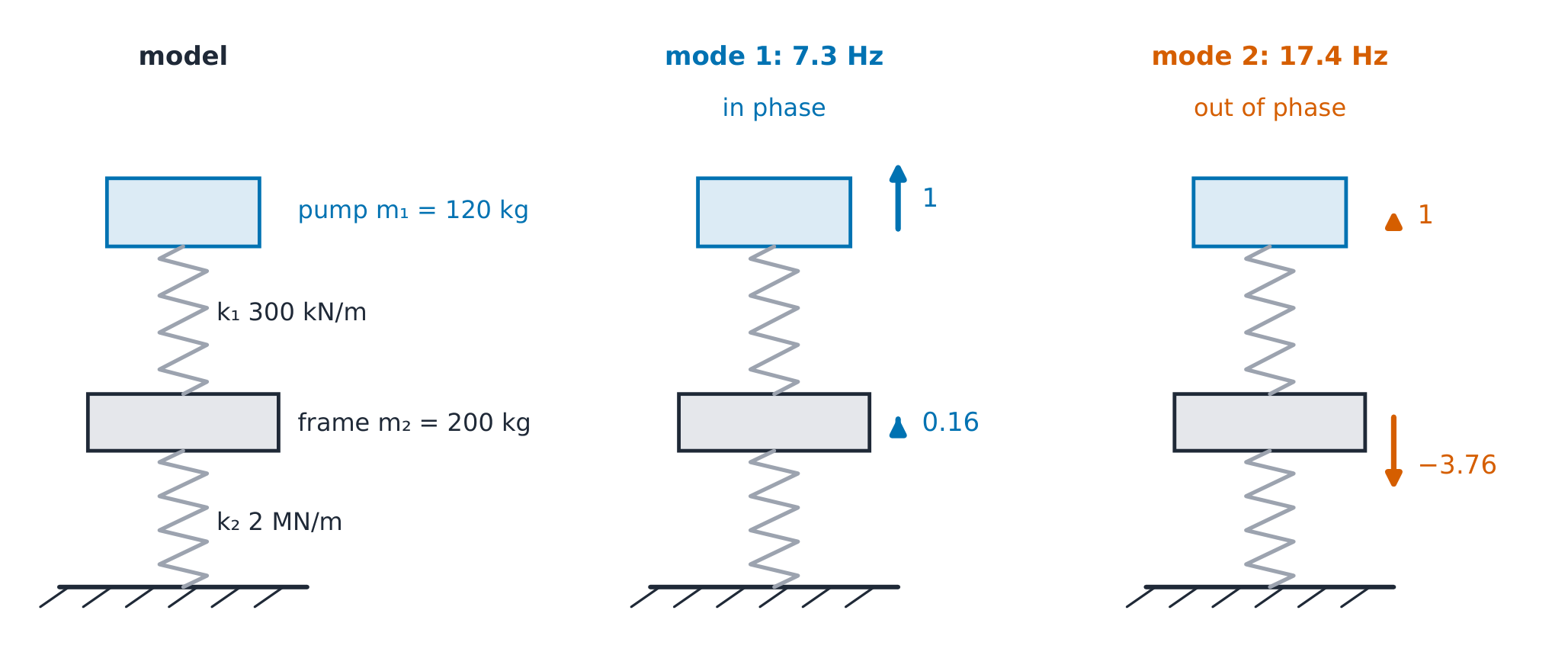
- $m_1 = 120$ kg on 300 kN/m mounts; $m_2 = 200$ kg frame on 2 MN/m feet.
- $\det(\mathbf K - \omega^2\mathbf M) = 0$: mode 1 at $\mathbf{7.30}$ Hz with $\mathbf u_1 = (1, 0.160)$, pump and frame in phase.
- Mode 2 at $\mathbf{17.4}$ Hz with $\mathbf u_2 = (1, -3.76)$, the frame bouncing against the pump. The frame lowers the first frequency from 7.96 to 7.30 Hz.
Which mode is it?
Match each description to the mode or quantity it describes.
First natural frequency of the pump on its frame (two decimals, Hz)?
רמת קושי 2/5 · 140 מטבעות + בונוס קטן בהשלמה הראשונה היום
45.8 rad/s over 2 pi.
Second natural frequency (one decimal, Hz)?
רמת קושי 2/5 · 140 מטבעות + בונוס קטן בהשלמה הראשונה היום
109.1 rad/s over 2 pi.
K22 for mounts 300 kN/m and feet 2000 kN/m (kN/m)?
רמת קושי 2/5 · 140 מטבעות + בונוס קטן בהשלמה הראשונה היום
Both springs act on the frame.
In mode 2 the pump and frame move:
רמת קושי 1/5 · 100 מטבעות + בונוס קטן בהשלמה הראשונה היום
The second entry of u2 is negative.
The response at 24 Hz
- Solving $(\mathbf K - \omega^2\mathbf M)\mathbf X = (27.3, 0)$ at 150.8 rad/s: the pump moves $\mathbf{11.4}$ µm, the frame $\mathbf{1.5}$ µm, and the floor feels $k_2X_2 = \mathbf{3.0}$ N.
- 24 Hz is above both modes, so the result is close to the single-mass estimate. A stiffer, lighter frame with mode 2 near 24 Hz would raise the floor force sharply.
Floor force with k2 = 2 MN/m and X2 = 1.5 micrometres (one decimal, N)?
רמת קושי 2/5 · 140 מטבעות + בונוס קטן בהשלמה הראשונה היום
k2 X2.
Check the modes are orthogonal
- Mode shapes must satisfy $\mathbf u_1^T\mathbf M\mathbf u_2 = 0$. Here $120 \times 1 \times 1 + 200 \times 0.160 \times (-3.76) = 120 - 120.3 \approx 0$.
- A non-zero result means an arithmetic slip in the modes. This one-line check catches it before any response is computed from them.
A 6 kg absorber tuned to 150.8 rad/s: spring stiffness (one decimal, kN/m)?
רמת קושי 2/5 · 140 מטבעות + בונוס קטן בהשלמה הראשונה היום
$6 \times 150.8^2 = 136\,444$ N/m.
Worked example: a tuned absorber
- Hang a small mass on a spring from the pump, tuned to the 24 Hz drive: $k_a/m_a = 150.8^2$. With $m_a = 6$ kg, $k_a = \mathbf{136.4}$ kN/m.
- At exactly 24 Hz the absorber's spring pushes back on the pump with the whole 27.3 N, so the pump stands still and the absorber swings $27.3/136\,400 = \mathbf{0.20}$ mm. It works only at its tuned speed.
That absorber cancelling a 27.3 N force: its amplitude (two decimals, mm)?
רמת קושי 2/5 · 140 מטבעות + בונוס קטן בהשלמה הראשונה היום
$27.3/136\,444 = 2.0 \times 10^{-4}$ m.
A tuned absorber protects the pump at any running speed.
רמת קושי 1/5 · 100 מטבעות + בונוס קטן בהשלמה הראשונה היום
It cancels motion only at its tuned frequency, and it adds two new resonances either side of it.
Three matrix slips
- The wrong sign on the coupling terms. Off-diagonal stiffness is negative.
- A scaled mode shape treated as a new mode. Only the ratio matters.
- Checking only the lowest mode. Every mode must clear the running speed.
It is enough to check only the lowest mode against the running speed.
רמת קושי 1/5 · 100 מטבעות + בונוס קטן בהשלמה הראשונה היום
A higher mode can sit at the running speed.
Recap
- $\det(\mathbf K - \omega^2\mathbf M) = 0$: 7.30 Hz and 17.4 Hz.
- Modes $(1, 0.160)$ in phase and $(1, -3.76)$ out of phase.
- At 24 Hz: 11.4 µm, 1.5 µm and 3.0 N to the floor.