Transmission lines
הוצג| English | משמעות |
|---|---|
| telegrapher equations | משוואות הטלוגרף |
| characteristic impedance | The ratio of voltage to current for a wave travelling along a transmission line. |
| reflection coefficient/rɪˈflekʃn ˌkəʊɪˈfɪʃənt/ | reflection coefficient |
When a cable stops being a wire
- Two boards are joined by 40 cm of coax carrying a 3 GHz signal. At that frequency the cable is six wavelengths long.
- Voltage is no longer the same along it: waves travel down, and reflect back from any mismatch. This lesson treats the cable as a transmission line.
A 10 cm PCB trace carrying a 1 kHz signal must be treated as a transmission line.
רמת קושי 1/5 · 100 מטבעות + בונוס קטן בהשלמה הראשונה היום
At 1 kHz the wavelength is about 150 km in the board; 10 cm is a tiny fraction of it, so the voltage is effectively the same all along the trace.
The telegrapher equations
- Model the line as inductance $L'$ and capacitance $C'$ per metre. The telegrapher equations 电报方程 are $\dfrac{\partial v}{\partial x} = -L'\dfrac{\partial i}{\partial t}$ and $\dfrac{\partial i}{\partial x} = -C'\dfrac{\partial v}{\partial t}$.
- Combine them and a wave equation appears, with speed $v_{p} = \dfrac{1}{\sqrt{L'C'}}$.
A line has L' = 400 nH/m and C' = 100 pF/m. Its wave speed is
רמת קושי 1/5 · 100 מטבעות + בונוס קטן בהשלמה הראשונה היום
$\dfrac{1}{\sqrt{400 \times 10^{-9} \times 100 \times 10^{-12}}} = \dfrac{1}{\sqrt{4 \times 10^{-17}}} = 1.58 \times 10^{8}$ m/s.
Characteristic impedance
- A wave travelling one way has voltage and current in a fixed ratio, the characteristic impedance 特性阻抗 $Z_{0} = \sqrt{\dfrac{L'}{C'}}$.
- $Z_{0}$ is a ratio, not a resistor: a lossless 50 Ω line dissipates nothing.
That same line (400 nH/m, 100 pF/m). What is Z₀, in ohms?
רמת קושי 2/5 · 140 מטבעות + בונוס קטן בהשלמה הראשונה היום
$\sqrt{\dfrac{400 \times 10^{-9}}{100 \times 10^{-12}}} = \sqrt{4000} = 63.2\,\Omega$.
Worked example: a real coax
- $L' = 250\,\dfrac{\text{nH}}{\text{m}}$, $C' = 100\,\dfrac{\text{pF}}{\text{m}}$: $Z_{0} = \sqrt{\dfrac{250 \times 10^{-9}}{100 \times 10^{-12}}} = 50\,\Omega$.
- $v_{p} = \dfrac{1}{\sqrt{250 \times 10^{-9} \times 100 \times 10^{-12}}} = 2 \times 10^{8}\,\dfrac{\text{m}}{\text{s}}$, or $0.67c$. At 3 GHz, $\lambda = 6.7\,\text{cm}$, so 40 cm is six wavelengths.
A coax with v_p = 2 × 10⁸ m/s carries 1 GHz. What is the wavelength on the cable, in cm?
רמת קושי 2/5 · 140 מטבעות + בונוס קטן בהשלמה הראשונה היום
$\lambda = \dfrac{v_{p}}{f} = \dfrac{2 \times 10^{8}}{10^{9}} = 0.2$ m, a third shorter than the 30 cm in free space.
Reflections at the load
- Where the line meets a load $Z_{L}$, part of the wave reflects. The reflection coefficient 反射系数 is $\Gamma = \dfrac{Z_{L} - Z_{0}}{Z_{L} + Z_{0}}$.
- A matched load ($Z_{L} = Z_{0}$) gives $\Gamma = 0$: no reflection. A short gives $\Gamma = -1$; an open gives $\Gamma = +1$.
A 50 Ω line ends in a 150 Ω load. The reflection coefficient is
רמת קושי 1/5 · 100 מטבעות + בונוס קטן בהשלמה הראשונה היום
$\Gamma = \dfrac{150 - 50}{150 + 50} = \dfrac{100}{200} = 0.5$. Half of the incident voltage comes back, in the same polarity.
Worked example: a step into an open end
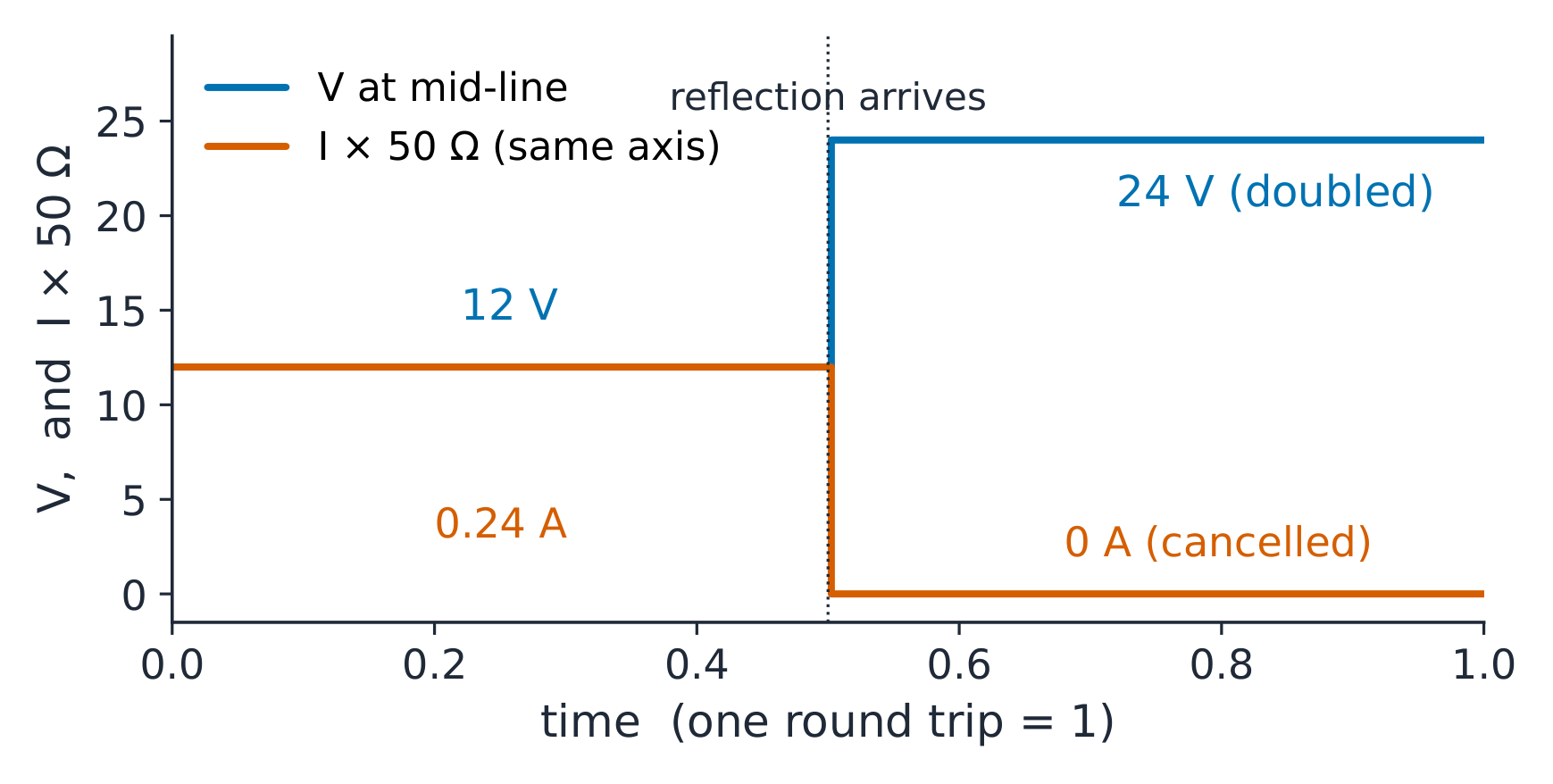
- A 12 V step enters the 50 Ω line: the wave carries 12 V and $\dfrac{12}{50} = 0.24\,\text{A}$. At the open end, $\Gamma = +1$.
- The reflected 12 V adds to make 24 V at the load, and the reflected $-0.24\,\text{A}$ cancels the current. An open end draws no current, as it must.
Match each load to its reflection coefficient.
רמת קושי 2/5 · 140 מטבעות + בונוס קטן בהשלמה הראשונה היום
$\Gamma = \dfrac{Z_{L} - Z_{0}}{Z_{L} + Z_{0}}$ in each case.
Three common slips
- $Z_{0}$ as a resistance. It is the voltage-to-current ratio of one travelling wave.
- $\lambda$ from $c$. Use $v_{p}$: in coax it is about a third slower than $c$.
- Forgetting the source end. A mismatched source reflects the returning wave again; the bounce diagram must include it.
A 12 V step travels down a 50 Ω line into a short. At the short, the voltage and current settle to
רמת קושי 1/5 · 100 מטבעות + בונוס קטן בהשלמה הראשונה היום
$\Gamma = -1$: the reflected −12 V cancels the voltage, and the reflected current adds, $0.24 + 0.24 = 0.48$ A.
Recap
- $Z_{0} = \sqrt{\dfrac{L'}{C'}}$ and $v_{p} = \dfrac{1}{\sqrt{L'C'}}$.
- $\Gamma = \dfrac{Z_{L} - Z_{0}}{Z_{L} + Z_{0}}$: an open doubles the voltage, a short cancels it.
- A line longer than about a tenth of a wavelength must be treated as a line.