Laplace transforms
הוצג| English | משמעות |
|---|---|
| Laplace transform | A transform that turns differential equations in time into algebra in the variable s. |
| partial fractions/ˈpɑːʃl ˈfrækʃnz/ | Simpler rational expressions whose sum equals a given rational expression. |
| poles/pəʊlz/ | poles |
Three storage elements, three equations
- Solving one differential equation by hand is fine. A circuit with three capacitors and inductors gives three coupled ones, and the hand method stops scaling.
- The Laplace transform turns every derivative into a multiplication by $s$. Whole systems of differential equations become algebra.
The transform and its key pair
- The Laplace transform 拉普拉斯变换 is $F(s) = \mathcal{L}\{f(t)\} = \displaystyle\int_{0}^{\infty} f(t)\,e^{-st}\,dt$.
- The key pair: $\mathcal{L}\{e^{at}\} = \dfrac{1}{s - a}$, because $\displaystyle\int_{0}^{\infty} e^{-(s-a)t}\,dt = \dfrac{1}{s-a}$. With $a = 0$ it gives $\mathcal{L}\{1\} = \dfrac{1}{s}$.
Match each time function to its Laplace transform.
רמת קושי 2/5 · 140 מטבעות + בונוס קטן בהשלמה הראשונה היום
The first three come from the one key pair $\dfrac{1}{s-a}$; the last is the derivative rule.
Evaluate the Laplace transform of e^(−4t) at s = 1.
רמת קושי 2/5 · 140 מטבעות + בונוס קטן בהשלמה הראשונה היום
$\mathcal{L}\{e^{-4t}\} = \dfrac{1}{s+4}$, which is $\dfrac{1}{5} = 0.2$ at $s = 1$.
Derivatives become multiplication
- $\mathcal{L}\left\{\dfrac{dy}{dt}\right\} = sY - y(0)$: the initial condition enters the algebra directly.
- Applied twice: $\mathcal{L}\left\{\dfrac{d^{2}y}{dt^{2}}\right\} = s^{2}Y - s\,y(0) - y'(0)$.
What is the Laplace transform of dy/dt?
רמת קושי 1/5 · 100 מטבעות + בונוס קטן בהשלמה הראשונה היום
Integration by parts moves the derivative onto $e^{-st}$, and the boundary term at $t = 0$ survives as $-y(0)$. Forgetting it is the classic Laplace bug.
Partial fractions split the answer
- After solving for $Y(s)$, partial fractions 部分分式 break it into simple pieces, each of which matches a table entry.
- For distinct factors, $\dfrac{10}{s(s+2)} = \dfrac{A}{s} + \dfrac{B}{s+2}$. Cover up each factor in turn: $A = \dfrac{10}{0 + 2} = 5$ and $B = \dfrac{10}{-2} = -5$.
Write 6/(s(s + 3)) as A/s + B/(s + 3). What is A?
רמת קושי 2/5 · 140 מטבעות + בונוס קטן בהשלמה הראשונה היום
Cover up $s$ and set $s = 0$: $A = \dfrac{6}{0 + 3} = 2$. Likewise $B = \dfrac{6}{-3} = -2$.
A first-order equation, by transform
- $\dfrac{dy}{dt} + 2y = 10$, $y(0) = 1$ becomes $sY - 1 + 2Y = \dfrac{10}{s}$, so $Y = \dfrac{10}{s(s+2)} + \dfrac{1}{s+2} = \dfrac{5}{s} - \dfrac{4}{s+2}$.
- Inverting term by term: $y = 5 - 4e^{-2t}$, the same answer as the classical route. The initial condition was handled by bookkeeping, not at the end.
Poles predict the behaviour
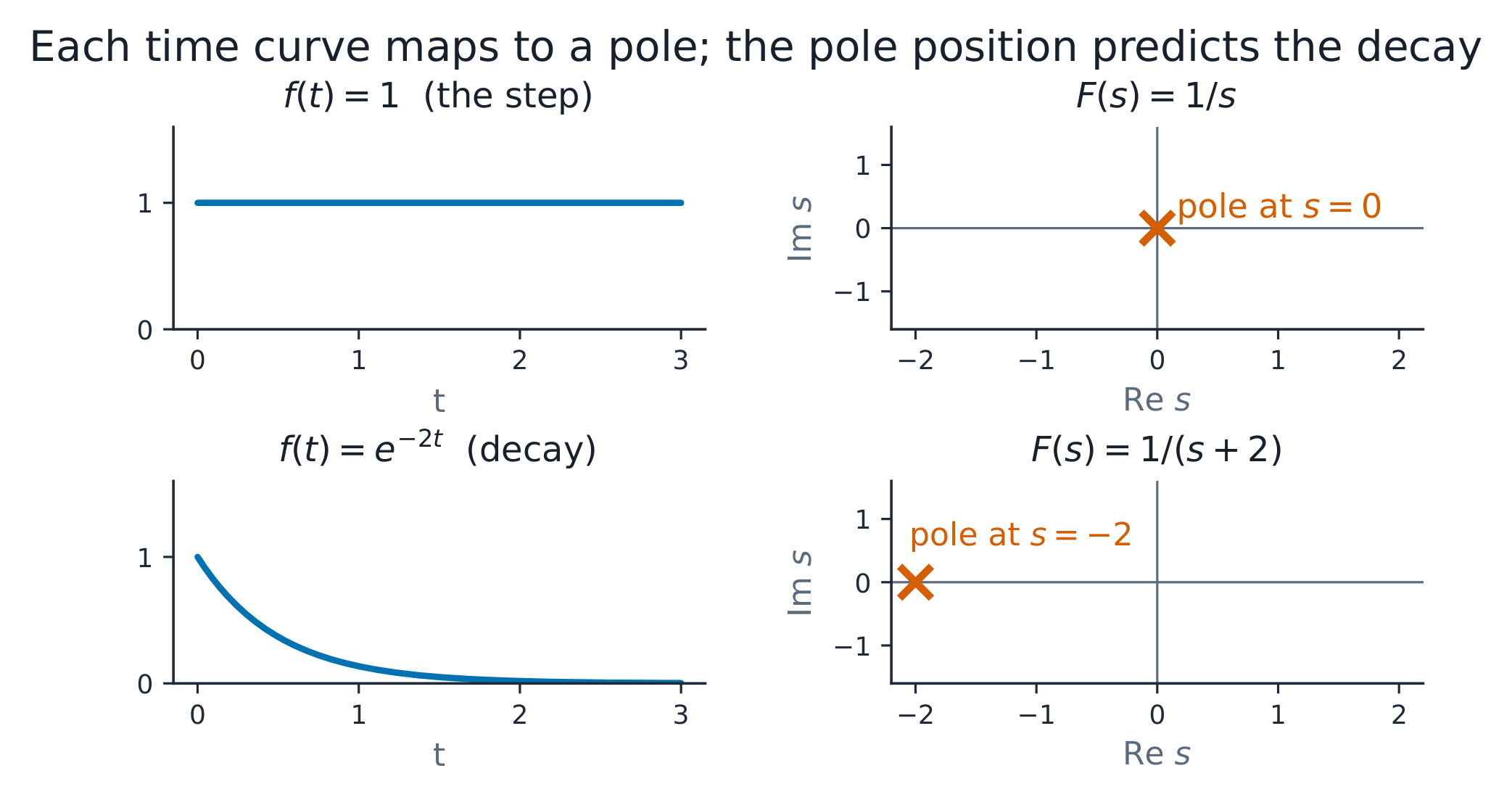
- The poles 极点 of $Y(s)$ are the values of $s$ that make its denominator zero. A pole at 0 gives a constant; a real pole at $-a$ gives $e^{-at}$; a complex pair gives an oscillation.
- Above, poles at $s = 0$ and $s = -2$ say "a constant plus a decay" before any inversion. A zero (numerator root) shapes the mix but does not create a term.
Y(s) has poles at s = 0 and s = −2. What shape is the response?
רמת קושי 1/5 · 100 מטבעות + בונוס קטן בהשלמה הראשונה היום
A pole at 0 gives a constant term; a real pole at $-a$ gives $e^{-at}$. A complex pair would mean oscillation.
A zero of Y(s), where the numerator is zero, adds its own decaying term to y(t).
רמת קושי 1/5 · 100 מטבעות + בונוס קטן בהשלמה הראשונה היום
Only poles create terms. Zeros change how much of each pole's term appears.
Second order: the poles are the decays
- $\dfrac{d^{2}y}{dt^{2}} + 3\dfrac{dy}{dt} + 2y = 0$, $y(0) = 1$, $y'(0) = 0$ gives $(s^{2} + 3s + 2)Y = s + 3$, so $Y = \dfrac{s+3}{(s+1)(s+2)} = \dfrac{2}{s+1} - \dfrac{1}{s+2}$.
- Then $y = 2e^{-t} - e^{-2t}$. The pole at −1 decays more slowly and owns the tail: the dominant-pole idea later courses reuse.
Checks: $y(0) = 2 - 1 = 1$ and $y'(0) = -2 + 2 = 0$. At $t = 1$: $y = 0.736 - 0.135 = 0.600$, and the $e^{-t}$ term already dominates.
Y(s) = (s + 3)/((s + 1)(s + 2)). Which pole gives the slowest-decaying term of y(t)?
רמת קושי 1/5 · 100 מטבעות + בונוס קטן בהשלמה הראשונה היום
$e^{-t}$ outlives $e^{-2t}$, so the pole nearer the origin owns the tail. In $y = 2e^{-t} - e^{-2t}$, at $t = 1$ the first term is 0.736 against 0.135.
Three common slips
- Dropping the initial terms. $\mathcal{L}\{y'\} = sY - y(0)$, not $sY$; the second derivative also needs $-s\,y(0) - y'(0)$.
- Inverting before splitting. $\dfrac{s+3}{(s+1)(s+2)}$ must become two simple fractions before any table lookup.
- Reading a zero as a pole. Only denominator roots create terms in $y(t)$.
Recap
- $\mathcal{L}\{e^{at}\} = \dfrac{1}{s-a}$, $\mathcal{L}\{1\} = \dfrac{1}{s}$, $\mathcal{L}\{y'\} = sY - y(0)$.
- Transform, solve for $Y$, split by partial fractions, invert term by term.
- Poles predict the shape: 0 → constant, $-a$ → decay, complex pair → oscillation.