Your learning plan · Continue · Review →
Write an Email — reader, purpose, register
הוצגהמיקום המנוהל נשמר בדפדפן הזה. המשך אינו משלים את השיעור או עונה על שאלותיו.
A replacement room must meet the workshop’s needs
-
A booking office can act on a clear request for tables and step-free access. It cannot infer those requirements from “we have a problem”.
-
Your goal: write a complete email that fulfils the situation’s jobs and fits its reader. Start with the Writing orientation and clear connected sentences. Identify reader, purpose and required details before drafting; length alone cannot make the message useful.
-
Answer each part of the situation. If it asks you to explain a problem and propose a solution, do both.
An email should tell the reader why you wrote before their second coffee.
An email that answers only one of the situation's two requests has fully addressed the purpose.
Difficulty 1/5 · 100 coins + a small bonus on first completion today
Clear sentences cannot supply a missing request. Check the scenario for every action it requires.
Four useful moves
- Make why you are writing clear early and give the relevant details. A greeting or brief context can come first. This is communication advice, not a rule that an examiner requires your purpose in a particular sentence.
- State a request when the situation needs one, then use an appropriate close. An information email can give the requested information without inventing another demand. These moves are a planning aid, not a compulsory four-sentence structure.
You write to a campus office to ask about a replacement room. After a suitable greeting, which first body sentence would orient the reader most usefully?
Difficulty 1/5 · 100 coins + a small bonus on first completion today
The second identifies the purpose and event. Background or thanks can fit elsewhere, but alone they leave the immediate issue unclear. Making the purpose clear early is a useful choice, not a compulsory sentence-position rule.
Match the reader
- To a tutor or an office: polite, with a clear request. Indirect forms are options: I was wondering whether, would it be possible to, I would be grateful if.
- To a classmate: direct and warm. Dear Sir or Madam is impersonal for a named classmate; it is a mismatch of reader and tone, not an ungrammatical salutation. Choose a level of formality that fits the reader and keep it consistent. A polite message can still make a direct request.
The situation names your classmate Sara. How should the email open?
Difficulty 1/5 · 100 coins + a small bonus on first completion today
You were given her name and she is a peer. 'Hi Sara' matches that reader; a generic formal salutation does not.
Two habits to drop
- A "maybe" that hides a definite no. If you already know you cannot attend, decline clearly and courteously.
- Burying the action. If you need a replacement room or a reply by Friday, state that request where the reader can find it.
You cannot join a classmate's project. Which reply is clearest in English?
Difficulty 1/5 · 100 coins + a small bonus on first completion today
If you already know you cannot join, a vague maybe leaves your classmate unable to plan. Decline clearly, give a reason and stay warm.
How to practise
- Write one email a day to a specified reader: a tutor, an office, a classmate. Then reread it as that person. Ask: can the reader tell what happened, what I need and how to respond? Then check accuracy and tone.
- Task description checked on 19 October 2026 against the ETS Writing overview. The examples and tasks here are original practice material, not ETS questions, rated responses or score predictions. The overview describes emails in academic or social situations; these lesson tasks add no official word minimum or test timer.
Worked example: a room that disappeared
Situation. Your student club booked Room 204 for a Saturday poster workshop. The booking office now says that a maintenance inspection will close the room. Write to the office: explain the workshop, request a room with tables and step-free access, and ask when the replacement can be confirmed.
Subject: Replacement room for Saturday workshop
Hello Booking Team,
Our student club's poster workshop is scheduled for Saturday in Room 204, but I understand the room will be closed for an inspection. We expect twelve participants and need tables for their materials as well as step-free access.
Could you suggest another available room with those features? If possible, please confirm it by Thursday afternoon so we can update the invitation.
Thank you for your help.
Best wishes,
Lin
The first sentence gives the purpose and the change. The second supplies the constraints; the next two sentences ask for a usable alternative and a reply time. The tone is polite without hiding the action. A room full of posters is a workshop; a room without tables is a very long-standing meeting.
In the workshop model, why does Lin mention twelve participants and step-free access?
Difficulty 1/5 · 100 coins + a small bonus on first completion today
A replacement must hold the group and be accessible. Those details let the reader act on the request.
An actionable request includes the missing constraint
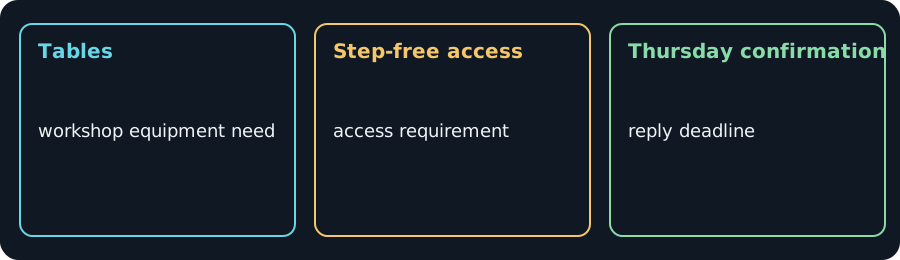
- The booking-office email already asks for tables, step-free access and confirmation by Thursday. If the office offers a room upstairs with no lift, that offer does not meet the access requirement.
- A useful follow-up says: “Thank you. We need step-free access because one participant cannot use stairs. Is a suitable ground-floor room available?” It names the unmet need without repeating the entire first email.

View this diagram at full size
- Politeness does not require hiding a definite requirement behind maybe. A direct constraint and a courteous request can appear together.
- Give purpose, necessary details and the requested action; check the message from the reader’s position.
- Try the transfer checks below before returning to the explanation. These are original self-checks, with no official score conversion.
Match the three distinctions from the worked case.
Difficulty 2/5 · 140 coins + a small bonus on first completion today
A useful follow-up says: “Thank you. We need step-free access because one participant cannot use stairs. Is a suitable ground-floor room available?” It names the unmet need without repeating the entire first email.
The office offers an inaccessible room. What should the follow-up clarify?
Difficulty 1/5 · 100 coins + a small bonus on first completion today
The booking-office email already asks for tables, step-free access and confirmation by Thursday. If the office offers a room upstairs with no lift, that offer does not meet the access requirement. A useful follow-up says: “Thank you. We need step-free access because one participant cannot use stairs. Is a suitable ground-floor room available?” It names the unmet need without repeating the entire first email.
Complete the worked-case label: Tables → ____. Use the phrase in the diagram.
Difficulty 1/5 · 100 coins + a small bonus on first completion today
Give purpose, necessary details and the requested action; check the message from the reader’s position.
Three purposes, different useful endings
- Information: “The project meeting is now in Lab 3 at two. Please bring your draft graph.” The purpose is usable arrangements, not a complaint. Request: “Could you check whether the projector can connect to my laptop?” Ask for an unknown fact rather than thanking the office for an approval it has not given.
- Definite refusal: “Thanks for inviting me, but I cannot join because I am working that evening.” A warm refusal can be clear. “Maybe” is helpful when the decision really is uncertain; it is misleading when you already know the answer is no. A polite email need not make the reader hire a detective.
Guided decisions: reader, job and missing detail
- For each situation, identify the reader and the job the message must do. Then compare the whole candidate sentence with that job: does it give the requested information, explain an effect or ask a practical question?
- Repair the actual omission. Repeating a date does not explain a consequence; a courteous greeting does not supply a missing arrangement. Keep proposed actions separate from decisions that have already been confirmed.
Original situation: You email a tutor about feedback on your report. The tutor knows your name but teaches several courses.
Which opening gives useful purpose and context?
Difficulty 1/5 · 100 coins + a small bonus on first completion today
The first identifies the report and the requested discussion. General background or thanks alone leaves the topic unclear. Add the relevant course work and question, rather than a long introduction.
Original situation: You need to tell a teammate that a confirmed project meeting moved from Room 2 to Room 8.
Which sentence supplies the change clearly?
Difficulty 1/5 · 100 coins + a small bonus on first completion today
The second distinguishes the new room, old room and unchanged time. The question turns a confirmed change into a new proposal. Report the decision as a decision.
Original situation: You already know that a work shift prevents you from joining a class trip.
Which reply avoids leaving the organiser with a false possibility?
Difficulty 1/5 · 100 coins + a small bonus on first completion today
The third is warm and definite. A maybe would obscure a decision already known. Use uncertainty only where it is real.
Original situation: A task asks you to explain a printer fault and its effect on tomorrow’s exhibition. Your draft says the printer stops after one page.
Which addition addresses the missing effect?
Difficulty 1/5 · 100 coins + a small bonus on first completion today
The first connects the fault with the event. Location may identify the machine but does not explain the effect; repeating the fault adds no consequence. Match the missing job.
Original situation: You ask a classmate you know to share notes from a session you missed.
Which request has a suitable tone?
Difficulty 1/5 · 100 coins + a small bonus on first completion today
The second is direct and considerate for a peer. The other choices are inflated or demanding. Politeness does not require distance from a person you know.
Original situation: You email an office to ask whether a lab is available on Friday; no booking is confirmed.
Which statement preserves the status?
Difficulty 1/5 · 100 coins + a small bonus on first completion today
The third asks for unknown information. The others invent confirmation. Check whether your sentence reports a fact or requests a decision.
Original situation: You must tell a new group member what to prepare and when to send it.
Which sentence covers both jobs?
Difficulty 1/5 · 100 coins + a small bonus on first completion today
The first defines an output and a deadline. A vague something does not specify the work; a meeting date alone does not state when the summary is due. Make the instruction usable.
Original situation: Your email says an event is on Thursday, but its closing asks readers to arrive on Friday. The event is definitely Thursday.
What needs revision?
Difficulty 1/5 · 100 coins + a small bonus on first completion today
The date conflict may send readers to the wrong event day. Correct all references before adding detail or formality. Factual consistency is part of clear communication.
Original situation: A classmate asked for information about a confirmed study session. You provide its room, time and materials.
Must the email also request a new decision?
Difficulty 1/5 · 100 coins + a small bonus on first completion today
An information email can finish after giving the needed details with a suitable close. Do not manufacture a request that the situation does not call for.
Original situation: A useful email begins “Hello Learning Support Team,” followed by a short reference to an earlier conversation, then a clear question.
Does the question’s position alone make it unacceptable?
Difficulty 1/5 · 100 coins + a small bonus on first completion today
The first reflects flexible, purposeful organisation. Sentence placement and a four-sentence plan are not universal requirements. Judge whether the reader can understand the issue promptly.
Fresh decisions without a sentence frame
- Use the unfamiliar situations below without reopening the worked room email. A sentence may be grammatical but still fail the specified task. Choose the option that does the requested job without inventing a promise or changing a known fact.
- These short decisions support planning and revision. They do not establish that you can sustain a complete email. Write the two messages that follow before opening their models, then revise your own wording rather than memorising a response. Drafts stay in the current page: copy them before leaving; only review events are saved.
Original situation: Your lab partner asked which columns to include in a results table. The group agreed on sample, mass and temperature.
Which reply supplies the agreed information?
Difficulty 1/5 · 100 coins + a small bonus on first completion today
The first answers the partner’s question with the confirmed columns. Praise does not identify them, and requesting new choices changes the agreed task. Supply the needed facts.
Original situation: You ask an academic adviser whether an appointment can be moved; no change has been approved.
Which sentence is accurate?
Difficulty 1/5 · 100 coins + a small bonus on first completion today
The third requests an unconfirmed change. The other options report approval that does not exist in the situation. Keep proposal and confirmation separate.
Original situation: A student club asks members to choose between two venues before it makes a booking.
Which update preserves that status?
Difficulty 1/5 · 100 coins + a small bonus on first completion today
The second describes the choice and when input is useful. A completed booking or past event would contradict the current stage. State both status and next action.
Original situation: You report a broken blind to the housing office and must explain its effect.
Which sentence gives a specific fault and effect?
Difficulty 1/5 · 100 coins + a small bonus on first completion today
The first identifies what fails and how it affects study. The general complaint leaves both vague; location alone cannot explain the effect. Describe observable detail.
Original situation: You missed the submission deadline for a seminar abstract. You want to ask whether late consideration is possible.
Which request avoids assuming acceptance?
Difficulty 1/5 · 100 coins + a small bonus on first completion today
The third asks about a possibility. The other messages invent acceptance. A late request should acknowledge uncertainty rather than announce an outcome.
Original situation: Your team asks whether you can meet on Sunday. You definitely cannot, but you are free on Monday afternoon.
Which reply supports planning?
Difficulty 1/5 · 100 coins + a small bonus on first completion today
The second is definite and gives an available alternative. The first contradicts itself; the good wish alone does not answer availability. Give a usable response.
Original situation: You understand the report grade but not one feedback comment, and want clarification from your tutor.
Which question matches that need?
Difficulty 1/5 · 100 coins + a small bonus on first completion today
The first identifies the comment and location. A grade demand changes the purpose; the broad accusation invents a judgement. Ask about the actual uncertainty.
Original situation: You need to return a library display board, but cannot reach the desk before it closes at five. You can arrive at six.
Which request explains the constraint and asks about an option?
Difficulty 1/5 · 100 coins + a small bonus on first completion today
The third states the timing problem and asks for an unknown arrangement. The first contradicts the closing time, and description alone does not solve the return issue. Make the constraint explicit.
Original situation: Your roommate needs to collect a parcel you are holding. The task asks you to state when and where you can hand it over.
Which sentence covers both?
Difficulty 1/5 · 100 coins + a small bonus on first completion today
The second supplies a location and a bounded time. Package size is another detail; later gives no usable appointment. State the requested arrangement.
Original situation: The internship office asks you to confirm your programme and availability. In this invented situation, you study biology and are free in July.
Which reply answers both?
Difficulty 1/5 · 100 coins + a small bonus on first completion today
The first gives both requested facts. Interest is relevant background but incomplete, and asking the office to identify your programme reverses the information flow. Answer the actual questions.
Original situation: A class announcement confirms that a workshop moved to Lab 5. Your update first says Lab 5 and later says “See you in the old Lab 1.”
What should revision do?
Difficulty 1/5 · 100 coins + a small bonus on first completion today
The third removes the contradiction. Praise cannot fix directions, and inventing a second booking creates another unsupported fact. Check repeated arrangements across the whole message.
Original situation: The student newspaper printed your club’s meeting as Wednesday, but the correct day is Tuesday. You have no evidence about how the error happened.
Which correction stays within the facts?
Difficulty 1/5 · 100 coins + a small bonus on first completion today
The second identifies the exact correction and requests an action. The alternatives invent intent or a general pattern from one error. Correct the fact without adding an unsupported accusation.
Original situation: A scholarship office asks which document is missing and when it can be supplied. You are waiting for a reference that will be ready on Friday.
Which reply covers both?
Difficulty 1/5 · 100 coins + a small bonus on first completion today
The first names the document and expected supply time. Enthusiasm or a general workload leaves the office without the requested status. Use an expectation, not a guarantee beyond the facts.
Original situation: Your club proposed a film night, but the room request is still pending. You update members.
Which sentence preserves that uncertainty?
Difficulty 1/5 · 100 coins + a small bonus on first completion today
The third distinguishes the request from approval and explains the next update. The alternatives announce a final decision prematurely. Keep plans and confirmed arrangements separate.
Original situation: You email a tutor to thank them for a diagram that helped you understand a method.
Which sentence makes the thanks specific without inventing a new demand?
Difficulty 1/5 · 100 coins + a small bonus on first completion today
The second identifies the helpful material and its benefit. General thanks is less developed; a guarantee changes the purpose and cannot be supported. Explain what mattered.
Original situation: You request a short extension from a course tutor after your laptop failed. The tutor has not agreed to change the deadline.
Which sentence makes a considerate, specific request?
Difficulty 1/5 · 100 coins + a small bonus on first completion today
The first gives a bounded proposal and relevant reason without assuming consent. The demand ignores the tutor’s decision; the thanks invents it. Ask clearly and leave the decision open.
Original situation: Your email says “Please send the thing to the place.” The reader has not discussed an item or destination with you.
Which revision supplies the needed references?
Difficulty 1/5 · 100 coins + a small bonus on first completion today
The third names the item and destination. Pronouns or usual place have no established reference here. Replace vague language with the information the reader lacks.
Original situation: You borrowed a classmate’s calculator and cannot return it at today’s class. You can bring it tomorrow.
Which message apologises and proposes a clear return?
Difficulty 1/5 · 100 coins + a small bonus on first completion today
The second acknowledges the problem and asks about a concrete handover. Description omits the return; the last option contradicts availability. Make the repair arrangement clear.
Original situation: A campus office offers an upstairs room for an event that needs step-free access. Its message says nothing about a lift.
Which follow-up checks the unmet information need?
Difficulty 1/5 · 100 coins + a small bonus on first completion today
The first asks for the missing access information. Upstairs alone proves neither that a lift exists nor that access is impossible. Request confirmation instead of guessing.
Original situation: You summarise a team plan. The task asks what work is needed and who will do each part. Your draft lists “survey, charts, introduction” with no names.
Which revision supplies the missing ownership?
Difficulty 1/5 · 100 coins + a small bonus on first completion today
The third assigns each task to an owner. A named greeting does not establish work responsibilities. Revise the information job, not only the appearance of the email.
Give a peer the information they need
- Original task: your classmate Leo missed a project meeting. Email him: summarise the agreed topic and division of work; explain his next task; give the deadline and a way to ask questions. Use consistent invented details, a suitable greeting and connected prose.
- Make Leo’s job identifiable. A friendly description of the meeting is not enough if he cannot tell what to produce or when. No new request for permission is necessary merely because the message is an email. The model is one possible answer, not a required length or an officially rated response.
Write a complete email to your classmate Leo, who missed a project meeting. Summarise the agreed topic and division of work; explain his next task; give the deadline and a way to ask questions. Invent consistent details. Draft before opening the model, then revise one vague or missing arrangement. Original practice: no official length, timer or score is assigned. Your draft stays in this page; copy it before leaving.
Compare what each sentence does, not whether it matches the model’s wording. Several complete messages can fulfil the situation. A self-review event records reflection; it is not an automatic judgement of writing correctness.
Ask an office for a workable arrangement
- Original task: you lead a campus repair café. The student activities office has confirmed your table booking, but its message does not mention electricity. Email the office: identify the event and booking; explain why electricity is needed; propose an arrangement and ask whether it can be approved. The office has not approved a power supply.
- Draft the complete email, then compare a weaker message with the improved model. Check all requested jobs before polishing vocabulary. Clear writing is useful; a longer synonym for electricity will not power the equipment.
Write a complete email to the student activities office. You lead a campus repair café. A table booking is confirmed, but no electricity supply is approved. Identify the event and booking; explain why electricity is needed; propose an arrangement and ask whether it can be approved. Use consistent invented details. Draft before opening the weaker/improved comparison, then revise one weakness. Original practice: no official length, timer or score is assigned. Your draft stays in this page; copy it before leaving.
Use the comparison to check task coverage, specificity and certainty. The model is not an ETS-rated answer, and ticking a checklist cannot establish a score. If a reader could not identify the request, revise the relevant sentence before recording your self-review.
Transfer the method to a different purpose
- Now move from booking problems to correction and thanks. Identify the reader’s actual information need. Do not force the workshop request pattern onto a message that simply supplies corrected facts or acknowledges useful help.
- After the checks, write a short email correcting an arrangement in a message you invented. State both the corrected fact and what the reader should do with it. Compare with a partner if available; a synthetic lesson check cannot stand in for an observed reader’s response.
Original situation: You emailed a new club member that orientation starts at nine. The organiser confirms ten is correct, with the same room.
Which correction is most useful?
Difficulty 1/5 · 100 coins + a small bonus on first completion today
The second identifies the changed fact, retains the unchanged room and tells the reader which arrangement to use. Vagueness or a new proposal would obscure a confirmed correction.
Original situation: A classmate helped you practise your presentation. You want to thank them and explain a useful change you made.
Which email sentence fulfils both jobs?
Difficulty 1/5 · 100 coins + a small bonus on first completion today
The first gives thanks, identifies the help and explains its effect. A demand changes the purpose; an unnamed change leaves the contribution unclear. Transfer the method to appreciation rather than requests.
Return later and revise from memory
- On another day, try the review checks before looking at models. Recall purpose, required jobs, reader and factual consistency. A saved “reviewed” event records your reflection, not a claim that the email is correct.
- Reopen one of your drafts and improve one vague sentence or unsupported certainty. Next, try an unfamiliar email in Writing practice or revisit sentence construction if unclear grammar prevents the reader from understanding the message. No official score follows from these lesson answers.
Original situation: A draft has an appropriate greeting, a brief reminder of a previous discussion and an early clear purpose. It answers all requested jobs.
Should it be rejected solely because the purpose is not its first sentence?
Difficulty 1/5 · 100 coins + a small bonus on first completion today
The third retrieves the flexible principle: useful context and a greeting may precede the purpose. Judge clear, relevant communication and coverage, not an invented position rule.
Original situation: You write to tell a peer the confirmed topic, meeting time and assigned work they requested. Your email includes each fact and a suitable close.
Is a new request required to complete this information email?
Difficulty 1/5 · 100 coins + a small bonus on first completion today
The second recalls that purpose varies. Keep the requested information and close appropriately; do not add a demand or remove needed facts merely to follow a template.