Your learning plan · Continue · Review →
The three parts, and what each one is testing
הוצגהמיקום המנוהל נשמר בדפדפן הזה. המשך אינו משלים את השיעור או עונה על שאלותיו.
A personal habit is not yet a community explanation
-
Outcome: answer the question’s scope, develop a relevant connection and respond to a changed follow-up. Start with Speaking format. This unit adds familiar-answer and broader-discussion practice; use 0503 for deeper long turns. Written choices cannot demonstrate spoken performance.
-
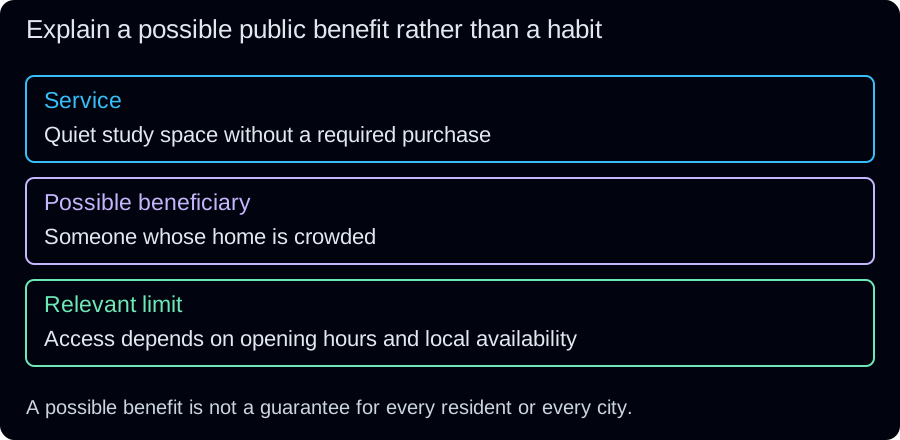
Original question: “Why might cities keep public libraries?” “I use one on Mondays” supplies a habit. “Libraries can provide quiet study space without requiring a purchase; that may help people whose homes are crowded” develops a possible public benefit.
-
The reason connects a service to a beneficiary. It does not prove that every library solves every learning problem. Your Monday visit is useful evidence about you, but it cannot conduct a census of the whole city.

'Do you like cooking?' Which answer stays on topic and provides more language to assess?
Difficulty 1/5 · 100 coins + a small bonus on first completion today
Answer plus a relevant reason or example develops the response naturally. A one-word reply gives little language to assess; a long speech may be interrupted.
Part 1 develops familiar information naturally
- For “Do you like cooking?”, “Yes, I cook most evenings because I enjoy choosing the ingredients” answers and develops a familiar preference. A one-word reply gives little language to assess; a catalogue of every dish may lose focus.
- Answer plus a relevant reason or example is one useful practice pattern, not an exact sentence-count rule. Choose tenses for your meaning: “I used to order meals, but now I cook” can naturally compare a past and present routine.
Part 2 needs connected development of one topic
- Use the one-minute preparation to plan the card’s points and explanation, then develop the long turn for up to two minutes. Relevant detail and a reason can extend a short account; unrelated filler does not address the card.
- A place description can include location, what you did and why it mattered. There is no compulsory four-paragraph shape for a spoken turn. The examiner may end it at the time limit and ask related follow-up questions.
Arrange one useful way to develop a Part 3 answer.
Difficulty 3/5 · 200 coins + a small bonus on first completion today
A view, reason, example and qualification can develop an answer. Adapt the shape to the question rather than reciting it.
Which fragments can introduce a tendency, condition or qualified comparison for you to develop? Choose all that apply.
Difficulty 2/5 · 140 coins + a small bonus on first completion today
The selected fragments qualify the claim in different ways. I do not know can express uncertainty, but alone gives no developed tendency, condition or comparison. No phrase by itself demonstrates the full range of a response.
Part 3 explains, compares or speculates
- For the library question, connect quiet space to people who might need it. If asked about limits, staffing or opening hours could qualify the benefit. Choose view, reason, example or qualification according to the actual question; all four moves are not compulsory in every answer.
- “It can help people with crowded homes” limits the claim to a possibility. “It depends on opening hours” identifies a condition to explain. A hedge should preserve your intended meaning rather than decorate every sentence or promise a higher score.
The Speaking test rewards more interesting opinions.
Difficulty 1/5 · 100 coins + a small bonus on first completion today
Examiners assess spoken English using four criteria, not the novelty of your opinion. Give a clear, relevant, developed answer.
Which sentence preserves a possible library benefit without making a universal claim?
Difficulty 1/5 · 100 coins + a small bonus on first completion today
Can and some preserve the possible benefit. The other options add unsupported guarantees or universal facts.
Clarify and paraphrase without losing the task
- If the question is unclear, a brief request such as “Sorry, do you mean…?” can help clarify the scope in discussion. If you did not hear it, ask for repetition. Then respond; repeated stock fillers cannot supply a missing reason.
- If “insulation” is unavailable, explain “the material in a wall that reduces heat loss”. If a tense mistake changes your timeline, correct it briefly and continue. These repairs help communicate meaning; no fixed number of repairs establishes a band.
Complete the repair phrase for a question you did not understand: 'Sorry, do you ___ …?'
Difficulty 1/5 · 100 coins + a small bonus on first completion today
If a question is unclear, ask briefly for clarification, then answer it. Repeated requests can interrupt the flow of the discussion.
You cannot recall insulation. Which paraphrase preserves the intended function?
Difficulty 1/5 · 100 coins + a small bonus on first completion today
The description conveys the material’s function. A familiar replacement noun that means something else would not repair the message.
Transfer the explanation to a different public service
- For “How could a park benefit a neighbourhood?”, connect a feature to a possible benefit: a safe path can support local walking, while opening hours or access affect who can use it. “I went there on Tuesday” alone does not explain the wider benefit.
- Format and criteria checked on 19 October 2026: official IELTS Speaking guide; additional reading: IDP Part 3 guidance. Our examples and text checks do not assess actual pronunciation or predict a score.

View the original question-scope case at full size
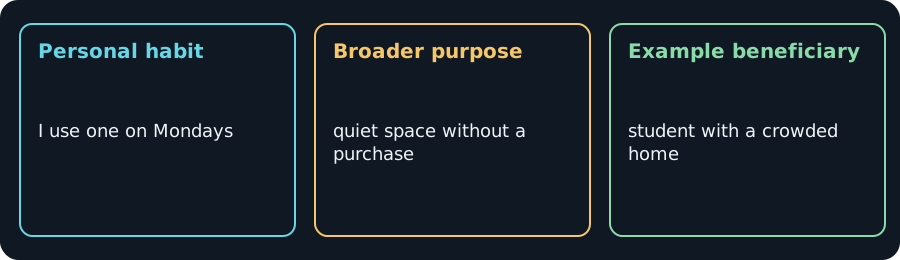
- Answer the scope asked, develop a relevant connection and qualify the claim when its meaning needs a limit.
Match the distinctions in this worked case.
Difficulty 2/5 · 140 coins + a small bonus on first completion today
Develop it: “Libraries give people a quiet study space without requiring them to buy anything. That can help students whose homes are crowded.” The example supports a broader reason.
Which reply best develops the wider purpose of libraries?
Difficulty 1/5 · 100 coins + a small bonus on first completion today
Question: “Why might cities keep public libraries?” Reply: “I use one on Mondays” is a relevant experience but not an explanation of the wider purpose. Develop it: “Libraries give people a quiet study space without requiring them to buy anything. That can help students whose homes are crowded.” The example supports a broader reason.
Which reply develops how a park could benefit a neighbourhood?
Difficulty 1/5 · 100 coins + a small bonus on first completion today
The path connects a feature to a possible benefit. Tuesday identifies one visit; the universal health claim goes beyond the reason.
Change the answer when the question changes
- Familiar routine: “What do you do after dinner?” “I usually walk with my sister because it gives us time to talk” develops personal information. A follow-up asks whether the routine has changed: “I used to watch television, but now I prefer a walk” addresses the comparison. Repeating the first answer would leave the change question unanswered.
- Broader comparison: “How might online and in-person lessons differ?” A paused video can support review; an in-person tutor may notice a mistake as it happens. Connect the comparison to a learner’s task. “Online is modern, so it is better for everyone” substitutes a label for that explanation. These are original possible examples, not measured findings.

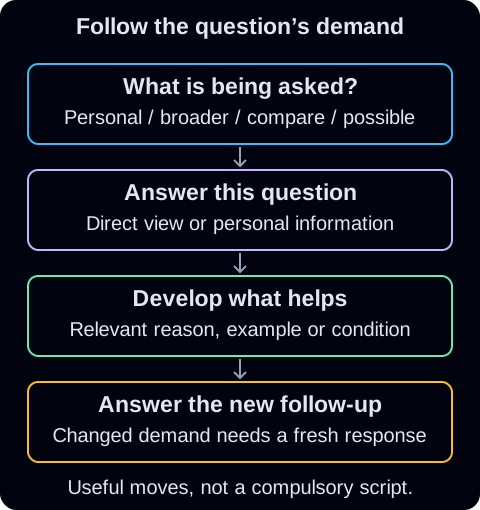
Use a cue to choose the response’s job
- Ten guided written decisions identify personal information, a wider purpose, comparison, speculation or clarification. Use the planning cue before choosing, then read the explanation. A relevant condition can refine a view; it does not automatically contradict the benefit you just explained.
- These are language-awareness checks, not recorded Speaking performances or official questions. A useful phrase needs a useful meaning behind it. “It depends” should not become a very small umbrella hiding an entire missing explanation.
Original familiar question: “What do you usually do after dinner?” Draft: “I walk.” Planning cue: develop your own routine with relevant information.
Decision: Which addition serves this question? Choose ONE answer.
Difficulty 1/5 · 100 coins + a small bonus on first completion today
The addition explains this speaker’s routine and a personal reason. It need not become a public policy speech or a fixed number of sentences.
Original familiar follow-up: “Has that routine changed since you were younger?” Previous reply: “I usually walk after dinner.” Planning cue: answer the change question rather than repeat the first answer.
Decision: Which response fits? Choose ONE answer.
Difficulty 1/5 · 100 coins + a small bonus on first completion today
The answer compares a past routine with the present. Repeating the original routine does not say whether it changed.
Original broader question: “Why might neighbourhoods provide shared gardens?” Draft: “I have a tomato plant.” Planning cue: connect a feature to a possible wider benefit.
Decision: Which development answers the broader question? Choose ONE answer.
Difficulty 1/5 · 100 coins + a small bonus on first completion today
The response connects shared space to a group who may benefit. A personal example can support that explanation, but the pot colour alone cannot supply it.
Original discussion question: “Would a free class suit everyone?” Draft: “It depends.” Planning cue: identify the condition and its effect.
Decision: Which addition develops that qualification? Choose ONE answer.
Difficulty 1/5 · 100 coins + a small bonus on first completion today
The timetable condition explains why free entry alone may not make a class accessible. A hedge is useful when its meaning is developed.
Original comparison: “How might learning to cook online differ from learning in person?” Planning cue: compare the same aspect on both sides.
Decision: Which response makes a useful comparison? Choose ONE answer.
Difficulty 1/5 · 100 coins + a small bonus on first completion today
The answer compares forms of support relevant to learning. It does not require pretending one method is better for every learner.
Original speculative question: “How might parks change in the future?” Planning cue: distinguish a possible development from an established prediction.
Decision: Which wording keeps the status clear? Choose ONE answer.
Difficulty 1/5 · 100 coins + a small bonus on first completion today
May and if introduce a possibility and a condition, not a measured forecast. Explain the link without inventing evidence or guaranteed dates.
Original discussion: “Why do some people prefer repairing objects?” Draft: “They may want to avoid replacing an item that still mostly works.” Planning cue: add a relevant consequence.
Decision: Which continuation develops the reason? Choose ONE answer.
Difficulty 1/5 · 100 coins + a small bonus on first completion today
The consequence explains the repair preference. It remains one possible reason rather than a universal motive.
Original Part 3 question uses “shared facilities”, and you are unsure what facilities means here. Planning cue: clarify the unclear scope briefly, then answer.
Decision: Which response is a useful repair? Choose ONE answer.
Difficulty 1/5 · 100 coins + a small bonus on first completion today
A brief clarification targets the term and lets the discussion continue. It is not a request for an examiner-supplied argument or an easier topic.
Original question: “Do you enjoy shopping for clothes?” Your actual preference is that you rarely enjoy it. Planning cue: answer honestly and develop relevant information.
Decision: Which response fits? Choose ONE answer.
Difficulty 1/5 · 100 coins + a small bonus on first completion today
A negative personal preference can be clearly developed. The exercise does not reward the novelty or enthusiasm of the opinion.
Original follow-up: “Could free classes create any difficulties?” You previously explained a possible benefit. Planning cue: address the new demand without treating qualification as contradiction.
Decision: Which reply fits? Choose ONE answer.
Difficulty 1/5 · 100 coins + a small bonus on first completion today
The follow-up asks about a difficulty and a possible response. A condition or limitation can refine a previous view without erasing its benefit.
Decide from fresh questions without the cue
- Ten independent written checks use different questions and draft fragments. Read the exact demand before deciding: why, who, change, compare and every can alter the answer’s job. Personal experience may illustrate a wider explanation, but is not proof of a universal pattern.
- Then practise actual responses below. Choosing a suitable sentence does not show that you can produce it in connected speech. No fixed sentence count, response duration or universal view–reason–example–qualification sequence is required here.
Original familiar question: “What kind of music do you listen to when you relax?” Draft: “Mostly quiet guitar music.”
Decision: Which addition develops the stated preference? Choose ONE answer.
Difficulty 1/5 · 100 coins + a small bonus on first completion today
A personal effect develops this preference. Industry analysis answers a different scope; repetition supplies little new information.
Original broader question: “Why might towns maintain public squares?” Draft: “I crossed the square on Monday.”
Decision: What would make the answer address the wider purpose? Choose ONE answer.
Difficulty 1/5 · 100 coins + a small bonus on first completion today
The wider purpose needs an explanation of what the shared space can enable. A personal visit may illustrate it, but does not alone explain that purpose.
Original follow-up: “Would the same arrangement work in a small village?” Previous answer concerned a large city’s late-night bus service.
Decision: Which response addresses the changed context? Choose ONE answer.
Difficulty 1/5 · 100 coins + a small bonus on first completion today
The changed place requires reconsidering needs and scale. The response gives a possible reason rather than inventing actual passenger data.
Original familiar question: “Do you prefer studying alone or with others?” You sometimes choose each for a different purpose.
Decision: Which reply preserves that preference clearly? Choose ONE answer.
Difficulty 1/5 · 100 coins + a small bonus on first completion today
The condition distinguishes activities and explains the preference without an unnecessary universal claim. Qualified answers need not be evasive.
Original comparison: “How can small local shops differ from large supermarkets?”
Decision: Which answer compares a relevant aspect on both sides? Choose ONE answer.
Difficulty 1/5 · 100 coins + a small bonus on first completion today
The answer compares service and range, with appropriately limited claims. The alternatives juxtapose details without an informative comparison.
Original discussion question: “What could make a public study room difficult to use?” Draft: “It depends on the hours.”
Decision: Which development explains the condition? Choose ONE answer.
Difficulty 1/5 · 100 coins + a small bonus on first completion today
The condition is linked to a group and an access problem. Naming the variable without its consequence leaves the explanation thin.
Original speculative question: “Could more people share tools in the future?”
Decision: Which response supports a possibility without claiming a forecast? Choose ONE answer.
Difficulty 1/5 · 100 coins + a small bonus on first completion today
The response explains conditions for a possible development. It does not turn one case into a measured trend or a certain future.
Original familiar follow-up: “Why did you stop taking the bus?” Previous answer said you now cycle to work.
Decision: Which reply addresses the requested reason? Choose ONE answer.
Difficulty 1/5 · 100 coins + a small bonus on first completion today
The workplace change explains the travel decision. Naming the current method again does not answer why it changed.
Original discussion question: “Should every community activity be offered online?” You think some activities need shared equipment or face-to-face practice.
Decision: Which answer expresses and develops that limit? Choose ONE answer.
Difficulty 1/5 · 100 coins + a small bonus on first completion today
The scope every requires considering whether the claim applies across activities. A relevant limit can support a qualified view without requiring a full counterargument template.
Original discussion follow-up: “Who might not benefit from that change?” You previously explained how digital booking could simplify access to a sports hall.
Decision: Which answer responds to the follow-up? Choose ONE answer.
Difficulty 1/5 · 100 coins + a small bonus on first completion today
The new question asks about a group who may be excluded. Addressing that group refines the earlier benefit rather than contradicting it.
Answer a familiar question, then its follow-up
- Record the first travel question before moving to the changed-routine follow-up. Develop your own situation; you may travel differently, work at home or have had no change. The models illustrate content choices rather than prescribe a lifestyle or a memorised reply.
- Stop and replay each recording before comparing with the written illustrations. The page records locally, uploads no audio and loses the audio on reload. If microphone access is unavailable, practise with your own recorder; the page cannot certify that external attempt. These fixed written questions do not simulate a live examiner or an exam clock.
Original familiar question 1: How do you usually travel from home to work, study or another regular activity?
Answer aloud before opening written guidance. Continue to the next activity afterwards for a fixed follow-up in the same context. Record, stop and play My recording, then compare content with the written guidance and actual speech with the checklist. This is self-paced recorded practice, not live examiner interaction or a timed exam simulation.
The pair shares one context. Its follow-up changes the response demand; it is not an additional independent topic or an automatically scored conversation.
Original familiar follow-up 2: Has the way you make that regular journey changed since you were younger?
Answer the first question before continuing to this fixed follow-up. Respond to its new demand rather than repeating the earlier reply. Record, stop and play My recording, then compare content with the written guidance and actual speech with the checklist. This is self-paced recorded practice, not live examiner interaction or a timed exam simulation.
The pair shares one context. Its follow-up changes the response demand; it is not an additional independent topic or an automatically scored conversation.
Explain a public benefit, then a practical difficulty
- The community-class pair moves from why offer free beginner classes? to what difficulties could arise and how might organisers respond? Develop the new demand. Repeating a benefit does not explain a difficulty; naming a problem alone does not supply a matched response.
- Keep possible effects and uncertain resources conditional. A proposed extra session needs available space and staff; a convenient booking app may need an alternative for people who cannot use it. A qualified answer can remain clear without claiming one arrangement suits everyone.
Original broader discussion 1: Why might community centres offer free beginner classes?
Answer aloud before opening written guidance. Continue to the next activity afterwards for a fixed follow-up in the same context. Record, stop and play My recording, then compare content with the written guidance and actual speech with the checklist. This is self-paced recorded practice, not live examiner interaction or a timed exam simulation.
The pair shares one context. Its follow-up changes the response demand; it is not an additional independent topic or an automatically scored conversation.
Original broader follow-up 2: What difficulties could those free classes face, and how might organisers respond?
Answer the first question before continuing to this fixed follow-up. Respond to its new demand rather than repeating the earlier reply. Record, stop and play My recording, then compare content with the written guidance and actual speech with the checklist. This is self-paced recorded practice, not live examiner interaction or a timed exam simulation.
The pair shares one context. Its follow-up changes the response demand; it is not an additional independent topic or an automatically scored conversation.
Compare support, then test a universal claim
- Compare learning a practical skill online and in person, then respond to whether online classes could replace all in-person practical teaching. Useful comparison connects similar aspects, such as feedback or access to equipment, rather than placing two unrelated details side by side.
- You may take a different view from the written model if you develop it and address the scope. Do not invent research to sound authoritative. Replay your own response for a confusing connection or audible feature, then record one repair; the written text cannot assess your sound.
Original comparison 1: How might learning a practical skill online differ from learning it in person?
Answer aloud before opening written guidance. Continue to the next activity afterwards for a fixed follow-up in the same context. Record, stop and play My recording, then compare content with the written guidance and actual speech with the checklist. This is self-paced recorded practice, not live examiner interaction or a timed exam simulation.
The pair shares one context. Its follow-up changes the response demand; it is not an additional independent topic or an automatically scored conversation.
Original comparison follow-up 2: Could online classes replace all in-person practical teaching?
Answer the first question before continuing to this fixed follow-up. Respond to its new demand rather than repeating the earlier reply. Record, stop and play My recording, then compare content with the written guidance and actual speech with the checklist. This is self-paced recorded practice, not live examiner interaction or a timed exam simulation.
The pair shares one context. Its follow-up changes the response demand; it is not an additional independent topic or an automatically scored conversation.
Return to a new personal question
- The transfer question asks what you like to do during a short break. Choose fresh personal information rather than continuing the public-policy discussion from the previous pair. A simple preference can be developed clearly without an impressive hobby.
- Record before opening the planning guidance. Then revise one thin connection or unclear phrase using actual audio. There is no complete speech to copy for this transfer; different routines can answer it well.
Original personal transfer: What do you like to do when you have a short break?
Respond aloud before opening the guidance. Record, stop, replay and choose one concrete revision. The page is self-paced practice with written questions, not an audio test or live examiner.
Fresh material requires choosing new content. Self-review completion does not establish a band or an independent listener’s judgement.
Revisit speculation on another day
- On another day, answer the new public-places question before reopening examples. Its premise is hypothetical. Explain a possible consequence or condition without treating it as a measured trend or a guaranteed forecast.
- Record, replay and revise one feature, then continue with audible clarity review. For a connected long-turn route, return to Part 2 production. Self-review completion does not establish a Speaking band or an independent listener’s judgement.
Format and criteria checked on 19 October 2026: official IELTS Speaking format. All new questions and written illustrations are originally authored local practice. No model voice, calibrated duration, live examiner interaction or automatic pronunciation score is supplied.
Original later discussion review: How might public places change if more people worked or studied from home?
Respond aloud before opening the guidance. Record, stop, replay and choose one concrete revision. The page is self-paced practice with written questions, not an audio test or live examiner.
Fresh material requires choosing new content. Self-review completion does not establish a band or an independent listener’s judgement.