Your learning plan · Continue · Review →
Multiple choice — evidence before intuition
הוצגהמיקום המנוהל נשמר בדפדפן הזה. המשך אינו משלים את השיעור או עונה על שאלותיו.
Two choices need two evidence checks
- Outcome: choose the requested number of options that answer the actual question, using accurate passage evidence and warranted inference. Start with Reading orientation. When asked for two options, judge each against the same question; a plausible pair can still contain one unsupported choice.
- Read the library trial below as a worked case. It reports a difference between rooms but leaves a competing explanation. Later practice introduces fresh passages, single-answer and choose-two decisions, feedback, transfer and review. These short cases do not provide a full Reading paper, timing calibration or IELTS band prediction.
This passage and every question below were written for this site. They are practice, not official IELTS material.
A district library tested whether adjustable window blinds could make its reading rooms more comfortable. For four weeks in late spring, staff measured the temperature at 3 p.m. in two west-facing rooms and asked visitors a short comfort question. Room A kept its fixed blinds; Room B received adjustable ones. Room B was, on average, 1.8°C cooler at the time of measurement. However, it also contained fewer computers, which give off heat. The survey responses varied from week to week and did not show a clear difference between the rooms. The managers postponed a decision to buy blinds for every branch. They planned a second trial in rooms with the same number of computers.
The passage reports an observation: B was cooler. It does not establish the cause of that difference. That distinction is the centre of this lesson.
The blinds could block sunlight, but they could not block bad inferences.
Which TWO details are stated in the library passage?
Difficulty 2/5 · 140 coins + a small bonus on first completion today
The computers and measured difference are stated. The purchase was postponed, and the survey did not establish a preference.
One answer: locate the decision line
- Question: Why did the managers plan another trial?
A. Visitors preferred the old blinds.
B. The first trial had no temperature measurements.
C. The two rooms differed in another way that might affect temperature.
D. The library could not find west-facing rooms.
- C is supported. The sentence beginning However names the fewer computers in Room B; the final sentence says the next rooms will have the same number. Those two lines explain the decision together. A invents a preference; B contradicts the measurements; D contradicts the description of both rooms.
Why did the managers want a second trial with the same number of computers in each room?
Difficulty 1/5 · 100 coins + a small bonus on first completion today
Fewer computers could also explain a cooler room. Matching computer counts helps isolate the possible effect of the blinds.
Eliminate without adding a story
- Contradicted: “No temperatures were measured” conflicts with the recorded 3 p.m. temperature. Unsupported: “Visitors preferred the old blinds” adds a preference the survey did not establish. For each option, identify what the source supports; do not rescue a guess with outside knowledge.
- Too strong: “The new blinds reduced temperature by 1.8°C” turns a difference between rooms into a proven effect of blinds. The computers were not matched. A supported inference can combine several lines without repeating one sentence. If the question asks for an inference or overall conclusion, reject an unsupported addition, not every conclusion that uses different wording. Use inference and supported conclusions for that distinction.
The first trial proves that adjustable blinds lowered the temperature by 1.8°C.
Difficulty 1/5 · 100 coins + a small bonus on first completion today
It observed a difference between rooms, not a proven effect of blinds. Room B also had fewer heat-producing computers.
Choose two: judge each option separately
- The official Academic Reading format says a multiple-choice question may ask for more than one answer. Read how many are required before you begin.
Which TWO statements does the passage directly support?
- Room B had fewer computers than Room A. Yes — the passage says so.
- Every visitor preferred Room B. No — the survey showed no clear difference.
- Room B was cooler at the measurement time. Yes — by an average of 1.8°C.
- All branches now have adjustable blinds. No — the purchase decision was postponed.
- Do not stop after finding the first correct option. Treat every option as a separate claim, then check that you selected exactly the requested number.
Match each tempting answer to its problem.
Difficulty 2/5 · 140 coins + a small bonus on first completion today
An option can fail by contradicting a line, inventing a fact, or turning a possible explanation into a certainty.
Take the method to a longer passage
- First read ONE, TWO or the number requested; identify what the question asks and locate the relevant evidence. Official multiple-choice questions follow information order in the text. Use that location aid without assuming that option order tells you which answer is right.
- Compare every option with the evidence and its qualifiers. Reject contradictions, unsupported additions and overstatements; allow a warranted inference when the question calls for one. Confirm that every selection answers this question, then check the required count. A true nearby detail can answer a different question.
Format rule checked on 19 October 2026 against IELTS Academic Reading.
Put the multiple-choice checks in a useful order.
Difficulty 3/5 · 200 coins + a small bonus on first completion today
A plausible option is not enough: it must be supported, answer this question, and fit the requested number of choices.
Judge two selected options independently
- Original mini-text: “Volunteers may attend a Thursday briefing or read the guide online. Only equipment users must complete the safety form.” A question asks for TWO preparation options available to all volunteers.
- The briefing and online guide fit. The safety form is required only for a subgroup; shared words about preparation do not make it an option for everyone.

View the original choose-two case at full size
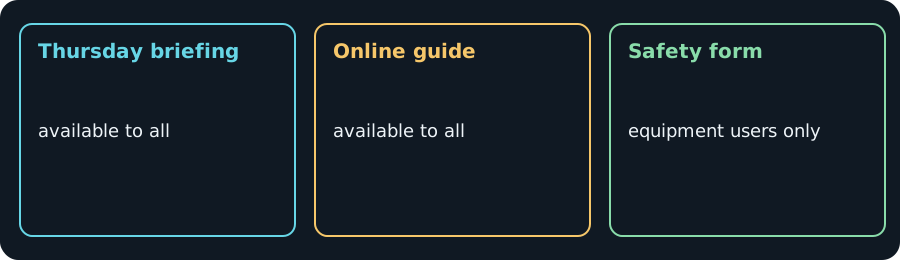
- Do not select a pair because the two choices sound good together. Test each against the same scope in the question.
- For choose-two tasks, establish two separate evidence matches and reject the scope-changing option.
- Apply the distinction to the transfer check below. These are original teaching cases, not official items or band predictions.
Match the distinctions in this worked case.
Difficulty 2/5 · 140 coins + a small bonus on first completion today
The briefing and online guide fit. The safety form is required only for a subgroup; shared words about preparation do not make it an option for everyone.
Which item is required only for equipment users?
Difficulty 1/5 · 100 coins + a small bonus on first completion today
Original mini-text: “Volunteers may attend a Thursday briefing or read the guide online. Only equipment users must complete the safety form.” A question asks for TWO preparation options available to all volunteers. The briefing and online guide fit. The safety form is required only for a subgroup; shared words about preparation do not make it an option for everyone.
Worked relevance: true does not always answer why
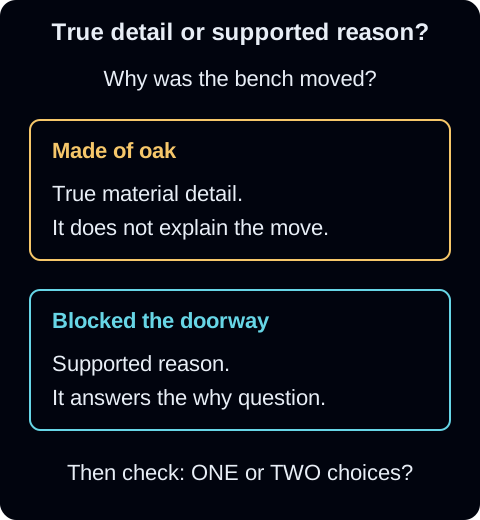
- Original passage: “Staff moved the bench because it blocked the doorway. The bench was made of oak.” Question: “Why was the bench moved?” Answer: it blocked the doorway. It was made of oak is true in the passage but identifies its material rather than explaining the move. Do not confuse a true statement with a relevant answer.
- For a choose-two question, apply the same stem to both selections. Evidence for one choice does not establish its partner. Here a why question needs a supported reason; a different question about material would require the oak detail. Your evidence check and question check must agree before you count selections.

Guided choices: support, relevance and count
- The next ten questions give a reading cue. Six ask for ONE answer; four ask for exactly TWO. Each supplies a complete original mini-passage and its own instruction. Select before checking and judge each option against both the evidence and the question’s relationship: reason, condition, result or scope.
- Feedback explains why the supported answer works and what each alternative changes. For an error, repair the exact issue: a different time, subgroup, unsupported cause, missing condition or a true detail answering the wrong question. The local choose-two checker expects the complete authored pair; this is not a claim about official partial-credit rules.
Original passage: The library moved its returns box indoors because rain had damaged books left in it. The opening hours stayed the same.
Question: Why was the returns box moved?
Instruction: Choose exactly ONE answer.
Reading cue: Find the cause attached to because.
Difficulty 1/5 · 100 coins + a small bonus on first completion today
Rain damage explains the move. Opening hours were unchanged, returns continued, and no café is mentioned. Locate the stated reason rather than inventing a reason that could sound practical.
Original passage: The bus company tested a lower fare on Saturday and kept the usual fare on Sunday. More passengers travelled on Saturday, but that day also had a town festival.
Question: What prevents the trial from isolating the effect of the fare?
Instruction: Choose exactly ONE answer.
Reading cue: Separate the observed count from its explanation.
Difficulty 1/5 · 100 coins + a small bonus on first completion today
The Saturday festival is a possible competing influence. No mid-Sunday fare change is reported, a lower Sunday count does not mean zero, and the festival is described only for Saturday. A measured difference does not by itself identify its cause.
Original passage: New volunteers may attend an induction talk or read the handbook. Volunteers who drive the minibus must also pass a driving check.
Question: Which TWO preparation options are available to every new volunteer?
Instruction: Choose exactly TWO answers. Judge each selected option against the same question.
Reading cue: Check whether each option applies to the whole group.
Difficulty 2/5 · 140 coins + a small bonus on first completion today
The talk and handbook are the two stated options for all new volunteers. The driving check applies only to drivers; driving is an activity, not a general preparation option. Permission to skip both is not stated. Keep every new volunteer as the scope.
Original passage: The museum planned to replace all its signs. After a small trial, it approved changes only to the entrance signs; other replacements remained undecided.
Question: What was approved after the trial?
Instruction: Choose exactly ONE answer.
Reading cue: Separate the original proposal from the later decision.
Difficulty 1/5 · 100 coins + a small bonus on first completion today
Only entrance-sign changes were approved. The all-sign plan was broader than the outcome; replacement does not imply permanent removal, and limited approval is not total cancellation. Follow the decision after the trial.
Original passage: Visitors may photograph the garden but must leave tripods at reception. Photography inside the house requires prior written permission.
Question: Which TWO statements are supported?
Instruction: Choose exactly TWO answers. Judge each selected option against the same question.
Reading cue: Keep the garden and house rules separate.
Difficulty 2/5 · 140 coins + a small bonus on first completion today
Garden photography is allowed and indoor photography needs prior written permission. Tripods must stay at reception. The permission requirement is not extended to garden photographs, and a verbal arrival request does not meet the stated written/advance condition.
Original passage: A repair workshop charges for replacement parts but not for advice. Customers bring their own damaged items; the workshop does not sell new products.
Question: What does the workshop charge customers for?
Instruction: Choose exactly ONE answer.
Reading cue: Find the object of charges for.
Difficulty 1/5 · 100 coins + a small bonus on first completion today
Replacement parts are charged. Advice is expressly free; bringing an item is required but no charge for doing so is stated. New products are not sold. Answer the payment question rather than selecting any true workshop detail.
Original passage: The team surveyed only visitors who arrived before noon. Its report explicitly excluded afternoon visitors from the findings.
Question: Which TWO conclusions are warranted?
Instruction: Choose exactly TWO answers. Judge each selected option against the same question.
Reading cue: Keep the population limit attached to the findings.
Difficulty 2/5 · 140 coins + a small bonus on first completion today
The sample covers morning arrivals, and the report excludes afternoon arrivals. It cannot establish every visitor’s opinion. Refusal and a morning/afternoon satisfaction comparison are not reported; absence from the sample is not evidence for either claim.
Original passage: The first machine was cheaper to buy but used more electricity. The second cost more initially and needed less electricity. The report did not compare total lifetime costs.
Question: What is the safest overall conclusion?
Instruction: Choose exactly ONE answer.
Reading cue: Combine the two costs without assuming the missing total.
Difficulty 1/5 · 100 coins + a small bonus on first completion today
The competing purchase/energy differences and absent lifetime comparison support the limited conclusion. Cheapest overall is not established, the second uses less electricity, and identical costs are not reported. A cautious inference can combine stated facts without inventing a final total.
Original passage: The notice gives two ways to renew a pass: use the website or visit the office. Telephone staff can explain the process but cannot renew passes.
Question: Which TWO actions can complete renewal?
Instruction: Choose exactly TWO answers. Judge each selected option against the same question.
Reading cue: Distinguish completing a process from receiving advice.
Difficulty 2/5 · 140 coins + a small bonus on first completion today
Website and office are renewal channels. Telephone explanations alone do not renew a pass, staff cannot renew by phone, and automatic renewal is not promised. Test the action completes renewal, not merely helps you understand it.
Original passage: The writer describes a village’s new footpath, then explains how volunteers maintain it. The final paragraph invites residents to join the next maintenance day.
Question: What is the purpose of the final paragraph?
Instruction: Choose exactly ONE answer.
Reading cue: Use the invitation as evidence for purpose.
Difficulty 1/5 · 100 coins + a small bonus on first completion today
The invitation supports participation in maintenance. Closure, a comparison with all towns and a claim about all roads are not stated. The question concerns the final paragraph’s purpose, not an invented whole-village history.
Independent practice: twenty fresh mini-passages
- Each question introduces a different original source and removes the reading cue. Twelve are single-answer questions; eight ask for two selections from five choices. Work from the source rather than remembered option positions. Inference, overall position and word meaning can require combining or interpreting evidence rather than copying a sentence.
- Preserve the source’s limits: proposed differs from completed; a component result differs from total performance; one group differs from all visitors. Spread the lesson across sessions if useful and choose your saved position deliberately on return. These short cases do not reproduce the length or timing of a complete Reading paper.
Original passage: A town moved its evening meeting from the hall to the school because the hall’s roof needed repairs. The meeting date and agenda were unchanged.
Question: Why was the meeting moved?
Instruction: Choose exactly ONE answer.
Difficulty 1/5 · 100 coins + a small bonus on first completion today
Roof repairs explain the move. The date and agenda stayed the same, no school request is reported, and moving a meeting does not mean ending public meetings. Match the stated reason to the why question.
Original passage: The old catalogue listed objects by donation date. The revised catalogue groups them by material, while retaining donation dates within each entry.
Question: What changed in the revised catalogue?
Instruction: Choose exactly ONE answer.
Difficulty 1/5 · 100 coins + a small bonus on first completion today
Grouping changed from donation date to material. Dates were retained; reorganising records does not change the objects’ materials, and a donor-identity change is not reported. Separate organisation of information from alteration of the objects.
Original passage: The canoe course supplies boats and life jackets. Participants must bring a towel. It runs only when river conditions permit; a booking does not guarantee that a session will take place.
Question: Which TWO statements are supported?
Instruction: Choose exactly TWO answers. Judge each selected option against the same question.
Difficulty 2/5 · 140 coins + a small bonus on first completion today
Life jackets are provided, and the river-condition limit means a booking does not guarantee delivery. Boats are supplied, towels must be brought, and guaranteed operation contradicts the notice. Check equipment and the operating condition separately.
Original passage: The author first explains why the old bridge attracted visitors. She then describes growing damage from heavy traffic and ends by discussing a proposed weight limit.
Question: What best describes the passage’s organisation?
Instruction: Choose exactly ONE answer.
Difficulty 1/5 · 100 coins + a small bonus on first completion today
The sequence is appeal, damage, proposed response. No rejected limit, absence of damage, building instructions, itinerary, existing ban or list of new bridges is described. Choose the organisation covering the whole described sequence.
Original passage: For the winter survey, researchers could reach only the sheltered shore. Their report says they cannot tell whether the exposed shore behaved in the same way.
Question: What can be inferred about the survey’s conclusions?
Instruction: Choose exactly ONE answer.
Difficulty 1/5 · 100 coins + a small bonus on first completion today
The restricted observations and explicit uncertainty limit generalisation. They do not prove a difference, establish an absence of winter effects or provide exposed-shore observations. A warranted inference preserves the report’s boundary instead of inventing a result.
Original passage: The theatre offers reduced-price seats to students with current identification. Other visitors pay the standard price. All visitors, including students, must book in advance.
Question: Which TWO requirements apply to students seeking reduced-price seats?
Instruction: Choose exactly TWO answers. Judge each selected option against the same question.
Difficulty 2/5 · 140 coins + a small bonus on first completion today
Students need current identification for the reduction and share the advance-booking requirement. Standard pricing applies to other visitors, students are not booking-exempt, and no telephone-only identification condition is stated. Combine the discount condition with the rule for all visitors.
Original passage: The device’s new battery lasted longer in the laboratory trial, but the trial used a single constant temperature. Outdoor trials across different temperatures are scheduled next.
Question: What remains untested in the reported trial?
Instruction: Choose exactly ONE answer.
Difficulty 1/5 · 100 coins + a small bonus on first completion today
Outdoor temperature variation remains for future trials. The laboratory trial and its longer-lasting result are reported, and constant temperature was part of that trial. Do not treat a scheduled test as a completed finding.
Original passage: The exhibition’s audio guide gives short descriptions of selected objects. Its printed catalogue includes those descriptions and longer background essays. Neither resource contains the curator’s interview.
Question: Which TWO statements are accurate?
Instruction: Choose exactly TWO answers. Judge each selected option against the same question.
Difficulty 2/5 · 140 coins + a small bonus on first completion today
The catalogue includes essays and neither resource contains the interview. Selected objects does not mean every object; short descriptions occur in both resources. The catalogue is not an interview-only publication. Keep the resource comparison and the shared absence distinct.
Original passage: The council installed brighter lamps along a path. More people used the path afterward, but a nearby car park also closed during the same period. The report does not separate these influences.
Question: What does the report establish?
Instruction: Choose exactly ONE answer.
Difficulty 1/5 · 100 coins + a small bonus on first completion today
Increased use is observed; the concurrent closure prevents isolating one influence in this report. Lamps alone overclaims, an open car park contradicts the source, and falling use reverses the result. Preserve observation without converting it into a proven cause.
Original passage: The magazine publishes a correction beside the original article online. In print, the correction appears in the following issue. It does not remove the original online article.
Question: How do the online and print corrections differ?
Instruction: Choose exactly ONE answer.
Difficulty 1/5 · 100 coins + a small bonus on first completion today
Online correction sits beside the original; print uses the next issue. Removal is explicitly denied, both editions acknowledge the error, and the print sequence is later rather than earlier. Answer the comparison rather than inventing concealment.
Original passage: The community kitchen accepts sealed dry-food packets and unopened tins. It cannot accept cooked meals because it has no chilled storage. Donors need not reserve a delivery slot.
Question: Which TWO donations meet the stated acceptance rules?
Instruction: Choose exactly TWO answers. Judge each selected option against the same question.
Difficulty 2/5 · 140 coins + a small bonus on first completion today
Sealed dry food and unopened tins meet the categories. Warm delivery does not create chilled storage, an opened tin fails unopened, and lack of a required slot does not override the ban on cooked meals. Check the donation condition independently of delivery booking.
Original passage: After testing three designs, the team chose the simplest handle because users could operate it with gloves. The chosen design was not the cheapest and did not receive the highest appearance rating.
Question: What determined the team’s choice?
Instruction: Choose exactly ONE answer.
Difficulty 1/5 · 100 coins + a small bonus on first completion today
Gloved operation is the stated reason. Cheapest and highest appearance rating are expressly denied, and three designs were tested. A positive detail about a design must match the actual selection criterion.
Original passage: The guide describes the tower as a useful landmark for walkers. It does not recommend entering the tower; the entrance is locked and there is no public viewing platform.
Question: What does useful mean in this context?
Instruction: Choose exactly ONE answer.
Difficulty 1/5 · 100 coins + a small bonus on first completion today
As a landmark, the tower helps navigation. Locked entry and no public platform defeat the indoor/platform readings; permission to climb is not given. Interpret the word through its stated role rather than adding a different use.
Original passage: The survey accepted responses from residents and non-resident visitors. It recorded residence status but did not ask respondents to give their names. Each person could respond only once.
Question: Which TWO details describe the survey?
Instruction: Choose exactly TWO answers. Judge each selected option against the same question.
Difficulty 2/5 · 140 coins + a small bonus on first completion today
Visitors could participate and names were not requested. Resident-only participation contradicts both groups, residence status was recorded, and only one response per person was allowed. Anonymous names do not imply that no other background information was collected.
Original passage: The train service will add a later departure if enough passengers register interest by Friday. Until that condition is met, the current timetable remains in force.
Question: What is the status of the later departure?
Instruction: Choose exactly ONE answer.
Difficulty 1/5 · 100 coins + a small bonus on first completion today
The extra departure depends on a stated condition. Current operation and unconditional introduction are not established; permanent rejection also goes beyond the source. Keep if attached to the proposal.
Original passage: The research note praises the new counting method for being quick. It also reports that closely packed objects were sometimes counted twice and recommends a manual check in those cases.
Question: What is the note’s overall position?
Instruction: Choose exactly ONE answer.
Difficulty 1/5 · 100 coins + a small bonus on first completion today
The note combines speed with a specific double-counting limit and response. Always accurate ignores the limit, too slow contradicts the praise, and rejecting every method is unsupported. Capture the balanced position rather than selecting one half of it.
Original passage: The archive displayed copies because the original letters could be damaged by prolonged light. The originals were retained in dark storage, and researchers could request supervised access.
Question: Which TWO conclusions are supported?
Instruction: Choose exactly TWO answers. Judge each selected option against the same question.
Difficulty 2/5 · 140 coins + a small bonus on first completion today
Retention follows from keeping originals in storage; supervised requests establish an access condition. Destruction contradicts retention, and unrestricted visitor handling is not established. Illegible handwriting is not the stated reason for using copies. Supported conclusions can combine the storage and access statements.
Original passage: The writer uses a small workshop as an example of how repairs can reduce waste. She notes that its success depended partly on volunteer expertise and says other towns would need to assess their own resources.
Question: Why does the writer mention volunteer expertise?
Instruction: Choose exactly ONE answer.
Difficulty 1/5 · 100 coins + a small bonus on first completion today
Expertise is a condition limiting easy generalisation to other towns. Identical resources conflicts with the need to assess local resources; no benefit and a ban on paid work are not stated. Link the example’s condition to the writer’s caution.
Original passage: The farm’s new packing line reduced the time spent sealing boxes. The report gives no figures for growing, sorting or transport time and makes no claim about total delivery speed.
Question: Which TWO statements stay within the evidence?
Instruction: Choose exactly TWO answers. Judge each selected option against the same question.
Difficulty 2/5 · 140 coins + a small bonus on first completion today
The measured improvement concerns sealing, while total delivery speed is not established. No growing or transport figures are given, and a change at one stage does not prove changes at all stages. Keep a component result separate from the complete process.
Original passage: The forest report describes recovery in the fenced area, where young trees were protected from grazing. It then notes that soil conditions differed outside the fence and calls for further comparisons.
Question: Which TWO statements reflect the report?
Instruction: Choose exactly TWO answers. Judge each selected option against the same question.
Difficulty 2/5 · 140 coins + a small bonus on first completion today
Recovery is reported, while differing soil and the request for comparisons limit the conclusion. A universal single-cause claim overstates, removing all fences is not proposed, and no survival conflicts with the reported recovery. Keep the positive result and its comparison limit together.
Transfer: one passage, three question focuses
- The museum-courtyard passage repeats for a question about the changed charge, a choose-two access question and a choose-two future-review question. The questions move through information order, but they remain one shared source, not three independent passages. Read the current stem before reusing a detail.
- Check the scope of a changed charge, distinguish facility access from the price of purchases, and keep a future decision separate from a completed change. Establish evidence for the current stem; information that settled one question may not settle the next.
Original passage: The museum made its courtyard free to enter but retained a ticket charge for indoor galleries. Courtyard visitors may use the café and benches; gallery entry still requires a ticket. Managers will review visitor counts after six months before deciding whether to extend free access indoors.
Question: Which access charge changed?
Instruction: Choose exactly ONE answer.
Difficulty 1/5 · 100 coins + a small bonus on first completion today
Only courtyard entry became free. Indoor galleries retain tickets, café use does not imply free purchases, and doubled prices are not reported. Locate the initial change before judging its scope.
Original passage: The museum made its courtyard free to enter but retained a ticket charge for indoor galleries. Courtyard visitors may use the café and benches; gallery entry still requires a ticket. Managers will review visitor counts after six months before deciding whether to extend free access indoors.
Question: Which TWO facilities are available to courtyard visitors without buying a gallery ticket?
Instruction: Choose exactly TWO answers. Judge each selected option against the same question.
Difficulty 2/5 · 140 coins + a small bonus on first completion today
Café and benches are explicitly available to courtyard visitors. Gallery tickets are still required; every exhibition is too broad and a private collection is not mentioned. Available café access does not mean that café purchases are free.
Original passage: The museum made its courtyard free to enter but retained a ticket charge for indoor galleries. Courtyard visitors may use the café and benches; gallery entry still requires a ticket. Managers will review visitor counts after six months before deciding whether to extend free access indoors.
Question: Which TWO statements accurately describe the proposed extension indoors?
Instruction: Choose exactly TWO answers. Judge each selected option against the same question.
Difficulty 2/5 · 140 coins + a small bonus on first completion today
The decision follows a six-month visitor-count review. Indoor free access is not yet in force, an unconditional guarantee is not given, and a future review is explicitly planned. This is the third question on one shared passage, not a third independent source.
Repair a pair with one valid choice
- The private task supplies a pair with one supported choice and one unsupported partner. Keep the valid selection, replace its partner and explain how the source addresses both free and available to all. Being useful does not establish either condition. Draft first, compare the model, then revise one exact scope or cost-evidence issue.
- The model offers another explanation, five criteria and a revision step. Your draft stays in this page; copy it before leaving. Recording comparison and revision is self-review, not automatic correctness, demonstrated proficiency or an IELTS score.
Original passage: The centre offers free evening talks and a free online guide to all visitors. Members may additionally borrow equipment after paying a deposit. The centre gives no information about free equipment loans.
Question: Which TWO resources are free and available to all visitors?
A reader chooses “the online guide” and “equipment loans”, arguing that both sound useful. Keep the valid selection, replace its unsupported partner, and explain why usefulness alone does not establish the question’s cost and audience conditions. Then revise one scope or cost-evidence issue after comparing the model. Draft first. Your draft stays in this page; copy it before leaving.
The pair is constrained by cost and audience; explanation wording can vary. This page records that you compared and revised, not an automatic assessment of your explanation or an IELTS score.
Later review: a requirement and a qualified pair
- After a break, try the new coastal-trail and exhibition notices without reopening the worked cases. Explain what the question requests and which evidence settles it. If your pair had one correct option, identify why its partner fails rather than treating the pair as partly justified overall.
- Continue with inference and supported conclusions for combining evidence accurately, or matching information for locating a specific detail across paragraphs. Use unfamiliar material to check the method; recalling the answer to an old case tests a different thing.
Original passage: The island centre sells maps at the desk and offers free route advice. Visitors must collect a permit before using the coastal trail; the permit charge is separate from the price of a map.
Question: What must a visitor obtain before using the coastal trail?
Instruction: Choose exactly ONE answer.
Difficulty 1/5 · 100 coins + a small bonus on first completion today
A permit is the required precondition for that trail. Maps are sold but not stated as required, route advice is free, and no guarantee about every route is given. Answer the requirement question rather than a nearby price detail.
Original passage: The exhibition runs from Tuesday to Saturday. School groups need advance booking, while individual visitors may buy tickets on arrival. Monday is reserved for maintenance.
Question: Which TWO statements follow the notice?
Instruction: Choose exactly TWO answers. Judge each selected option against the same question.
Difficulty 2/5 · 140 coins + a small bonus on first completion today
School groups need booking and individuals may buy on arrival. Monday is maintenance, not visitor opening; the group rule does not cover everyone; Saturday is included. Recover the subgroup and day limits before choosing the pair.
Answer this question with the requested number of choices
- Recap: read the stem and count, locate the evidence, preserve its time/condition/group/strength, and test every selection. A supported inference can be valid; a plausible story with no support is not. A true fact still needs to answer the current question. For a pair, establish two independent evidence matches.
- Source checked on 19 October 2026: official IELTS Reading task guidance. All passages, questions, models and the new map are originally authored teaching. Independent subject, language, rights and learner reviews remain pending. Completing local practice does not establish an official test result.