Your learning plan · Continue · Review →
非得 … 不可 (absolutely must)
הוצגהמיקום המנוהל נשמר בדפדפן הזה. המשך אינו משלים את השיעור או עונה על שאלותיו.
You have to see a doctor
- Your friend has had a fever for three days but refuses to see a doctor.
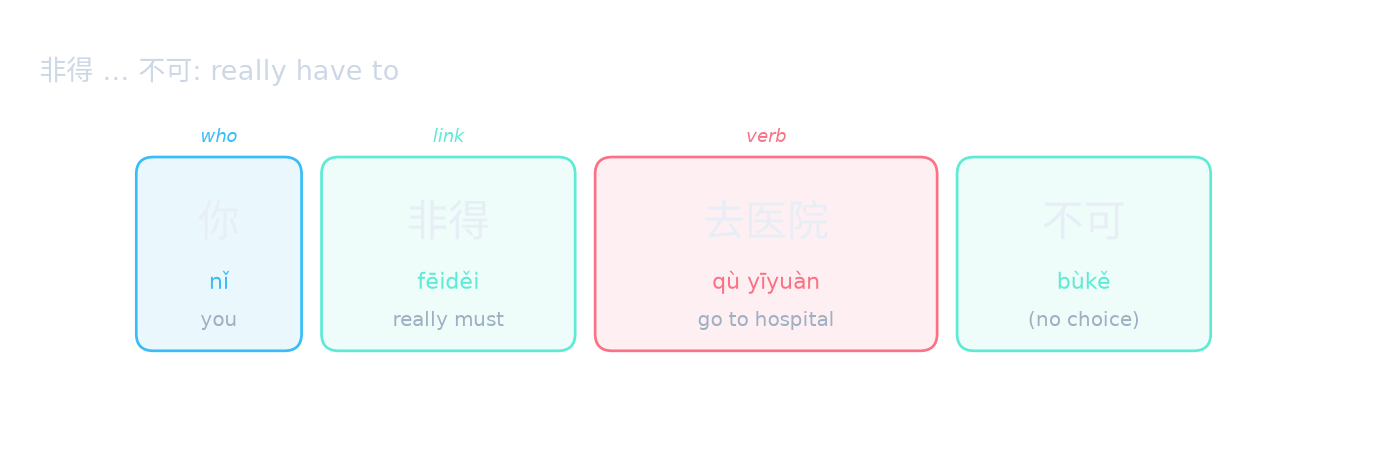
- you你to burn烧(degree marker)得so much这么(used to describe sb or sth…厉害,must非得go去hospital医院(absolutely)不可。 — "With a fever this bad, you absolutely have to go to hospital."
must非得 + verb (+ (absolutely)不可) = must, have to
- must非得 (fēi děi) = must, absolutely have to; (absolutely)不可 / won't do不行 can close the sentence for extra force.
- In speech, must非得 alone often works: you你must非得today今天go去(yes/no ?)吗?
you你must非得today今天go去吗?
Complete: “Do you really have to go today?” 你____今天去吗?
רמת קושי 1/5 · 100 מטבעות + בונוס קטן בהשלמה הראשונה היום
非得 = must (spoken).
Necessity and insistence
- Necessity: this这份report报告must非得today今天be handed in交(absolutely)不可。 — "This report absolutely must be handed in today."
- Insistence: he / him他must非得oneself自己to make做,who谁to help帮忙all / both都don't不要。 — "He insists on doing it himself and won't take help from anyone."
this这份report报告must非得today今天be handed in交(absolutely)不可。
Build: “This report must be handed in today.”
רמת קושי 3/5 · 200 מטבעות + בונוס קטן בהשלמה הראשונה היום
非得 + verb + 不可.
Read it fēi děi
- (degree marker)得 here is děi ("must"), not de.
- must非得 is spoken; in writing, to have to必须 is the neutral choice.
How is 得 read in 非得?
רמת קושי 1/5 · 100 מטבעות + בונוס קטן בהשלמה הראשונה היום
In 非得 (“must, have to”), 得 is read děi, as in 你得去. It is not the structural particle de or dé “obtain”.
must非得 versus (must)非…(absolutely)不可
- (must)非…(absolutely)不可 puts the verb in the middle: (must)非go去(absolutely)不可.
- must非得…((absolutely)不可) is the spoken variant with (degree marker)得: must非得go去 / must非得go去(absolutely)不可. Both are emphatic.
I我(must)非go去(must)不可。
非去不可 and 非得去 are both emphatic.
רמת קושי 1/5 · 100 מטבעות + בונוס קטן בהשלמה הראשונה היום
Both mean “absolutely must go”.
Recap
- must非得 (fēi děi) + verb (+ (absolutely)不可 / won't do不行) = absolutely must / insist on.
- Spoken; (must)非…(absolutely)不可 is the classic form; to have to必须 is neutral.
Read the full reference: HSK 6 grammar — Sentence patterns.
Your friend has had a fever for three days but refuses to see a doctor. Close the examples. Say a Mandarin response, then write it in Chinese. Explain briefly in English what the lesson’s pattern adds. Compare with the model, then change one detail and try again.
This is supported productive practice. Compare meaning and structure; your answer need not copy the model. A partner or teacher must hear the spoken response to comment on pronunciation.