תוכנית הלימודים שלך · המשך · סקירה →
单独 vs 独自 (alone, separately)
הוצגהמיקום השמור שלך נשמר בדפדפן זה. המשכה אינה מגמרת את השיעור או עונה על שאלותיו.
A word in private
- After class, the teacher asks you to stay for a few minutes.
- the teacher老师wants to想one-to-one单独with跟you你talk谈谈。 — "The teacher wants to talk with you one-to-one."
- Goal: say "alone, separately, one-to-one" with one-to-one单独, and choose between one-to-one单独 and by himself独自.
one-to-one单独 + verb
- one-to-one单独 (dāndú) = "alone, on its own, separately". It separates one person or thing from a group: one-to-one单独to talk (about)谈, one-to-one单独to live (somewhere)住, one-to-one单独to put / let go放.
- this这个suitcase箱子fairly / to compare比较heavy / important重,please; to invite请one-to-one单独to put / let go放。 — "This box is quite heavy; please put it separately."
the teacher老师wants to想one-to-one单独with跟you你talk谈谈。
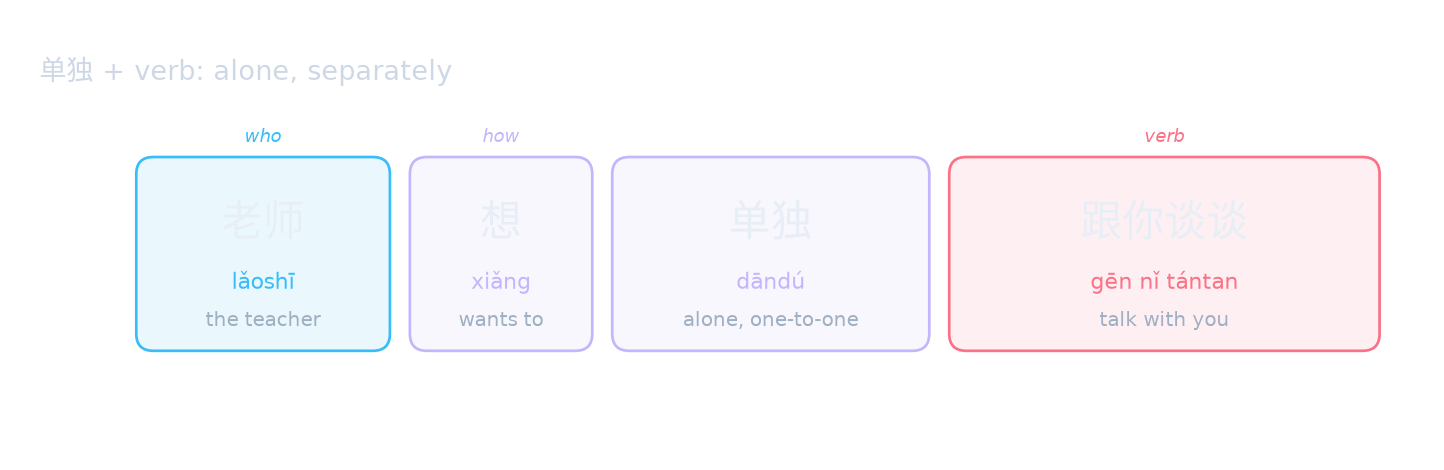
Complete: “The teacher wants to talk with you one-to-one.” 老师想____跟你谈谈。
רמת קושי 1/5 · 100 מטבעות + בונוס קטן בהשלמה הראשונה היום
One-to-one — 单独.
Build: “This box is quite heavy; please put it separately.”
רמת קושי 3/5 · 200 מטבעות + בונוס קטן בהשלמה הראשונה היום
单独 + verb.
by himself独自: by oneself
- by himself独自 (dúzì) = "by oneself, alone" — a person doing something without company: he他by himself独自一个人去(completed / change)了Tibet西藏。 — "He went to Tibet all by himself."
- by himself独自 describes someone acting without company; one-to-one单独 stresses a separate arrangement, for people or things.
he他by himself独自alone一个人went to去了Tibet西藏。
“He went to Tibet all by himself.” Which fits best?
רמת קושי 1/5 · 100 מטבעות + בונוס קטן בהשלמה הראשונה היום
A person by himself — 独自 (一个人).
独自 stresses doing something without company.
רמת קושי 1/5 · 100 מטבעות + בונוס קטן בהשלמה הראשונה היום
他独自一个人去了西藏 — no one went with him.
Things go with one-to-one单独
- To treat a thing separately, use one-to-one单独: ✓ 这道题we / us我们one-to-one单独to speak讲。 — "We'll go over this question separately." (he他by himself独自to speak讲(completed / change)了这道题 means he explained it alone — a different meaning.)
- one-to-one单独 often shows the speaker's arrangement (separately, one-to-one); by himself独自 often adds a feeling of being alone.
“We'll go over this question separately.” Which is right?
רמת קושי 1/5 · 100 מטבעות + בונוס קטן בהשלמה הראשונה היום
Treating a thing separately — 单独. (独自讲 would mean "explain it alone".)
one-to-one单独, by himself独自 and 一个person人
- one-to-one单独 = separately, one-to-one (people or things). by himself独自 = by oneself, without company (often a bit lonely).
- Everyday: 一个person人: I / me我一个人去。
Recap
- one-to-one单独 + verb = alone, separately, one-to-one: one-to-one单独to talk (about)谈, one-to-one单独to put / let go放.
- by himself独自 (一个person人) + verb = by oneself, without company.
Read the full reference: HSK 5 grammar — Adverbs.
Tell a friend about a trip or activity you did by yourself (独自), and something you asked to do separately (单独).
Your answer need not copy the model. A partner or teacher must hear the spoken response to comment on pronunciation.