Your learning plan · Continue · Review →
Contrast linkers
הוצגהמיקום המנוהל נשמר בדפדפן הזה. המשך אינו משלים את השיעור או עונה על שאלותיו.
Showing a meaningful contrast
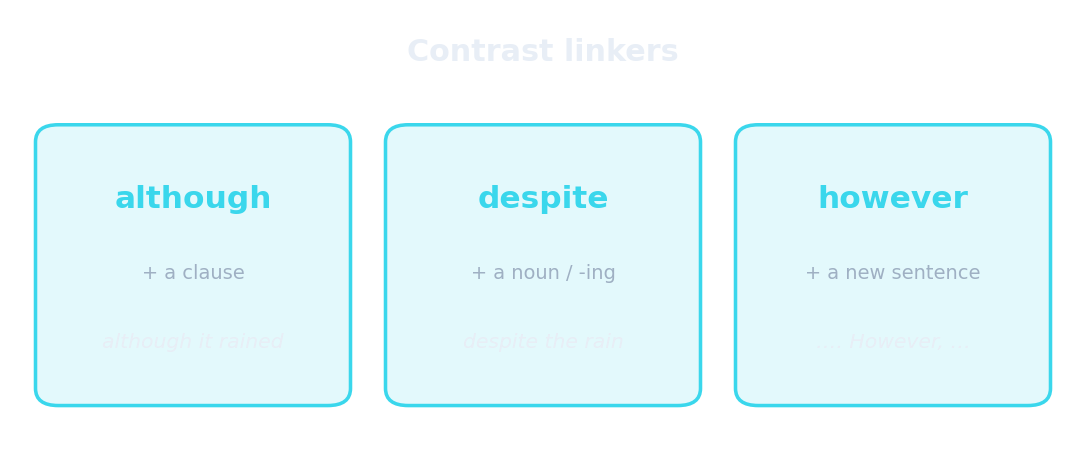
- Contrast can show that an outcome differs from an expectation: Although it was raining, we went out. The two facts need not be literal opposites.
- Outcome: express a contrast with an appropriate clause frame and punctuation, while keeping the original facts and people clear.
- Start with clause order. Starting check: is the rain a full clause? It is a noun phrase; it was raining is a full clause.
Although the forecast promised sunshine, my umbrella knew better.
although / though / even though
- These commonly introduce a full clause: Although it was raining, we went out. Even though emphasizes the unexpected contrast.
- Reduced clauses are also possible, especially in formal writing: Although tired, Jo kept working. Jo is the person who was tired; an overt subject and verb are not compulsory in every use.
- Though can also work at the end as a comment: It’s expensive, though. This differs from the opening subordinate-clause frame.
Choose: ___ it was raining, we went out. (followed by a full clause)
Difficulty 1/5 · 100 coins + a small bonus on first completion today
Although directly introduces the full clause it was raining in this option pair. Despite would need a noun/-ing construction or the added phrase the fact that. Although can also introduce reduced clauses in other examples.
Translate into English: 虽然在下雨,我们还是出门了。
Difficulty 3/5 · 200 coins + a small bonus on first completion today
The reference uses although + full clause. Despite the rain and despite the fact that it was raining can preserve the same contrast; different grammatical frames are valid.
despite / in spite of
- Use a noun phrase or an -ing construction directly after these expressions: Despite the rain, we went out. In spite of being tired, Jo kept working.
- A full clause can follow the fact that: Despite the fact that it was raining, we went out. Direct despite it was raining does not fit this standard pattern.
- Check the understood subject: Despite being tired, Jo helped Sam says Jo was tired. If you mean Sam, write Although Sam was tired, Jo helped him instead.
Complete: ___ the rain, we went out. (despite / although)
Difficulty 1/5 · 100 coins + a small bonus on first completion today
Before a noun (“the rain”), use “despite” / “in spite of”.
Is this correct? “Despite it was raining, we went out.”
Difficulty 1/5 · 100 coins + a small bonus on first completion today
Direct “despite it was raining” does not fit the standard pattern. Use “Despite the rain”, “Although it was raining”, or “Despite the fact that it was raining”. The last version legitimately contains a full clause after the fact that.
however / nevertheless
- These linking adverbs can begin a sentence: It was expensive. However, we bought it. A semicolon also works: It was expensive; however, we bought it.
- They can appear inside a clause: We did, however, buy it. They do not have to start a brand-new sentence.
- A comma alone does not normally join two independent clauses through however in standard writing. Use a full stop, a semicolon or another appropriate construction.
Which contrast pattern fits?
Recognise the contrast frames actually used here; these are examples, not exhaustive rules for every complement or adverb position.
Repair structure and meaning
- For one direct concession, use Although it rained, we went out rather than mechanically pairing although … but …. This does not ban but elsewhere in a longer sentence.
- Use despite the rain or in spite of the rain, not despite of the rain.
- Near miss: Despite being cancelled, we attended the meeting describes us as cancelled. If the meeting was cancelled, write Although the meeting was cancelled, we went to the venue. Do not repair grammar by claiming an event actually took place when the source says it did not.
Match these familiar example frames: although it rained; despite the rain; It rained. However, we went out; I like it, though. These show possible patterns, not every position or complement the linkers allow.
Difficulty 2/5 · 140 coins + a small bonus on first completion today
The supplied frames illustrate full-clause although, noun-phrase despite, sentence-initial however and final though. Also possible: although tired; despite the fact that it rained; and “We did, however, go out”.
Which sentence is correct?
Difficulty 1/5 · 100 coins + a small bonus on first completion today
Among these options, despite the rain has the valid noun-phrase frame. For the full clause use although it was raining or despite the fact that it was raining; do not add of directly to despite.
- Choose a frame for the information you have: full clause, reduced clause, noun phrase or -ing construction. Check who the description applies to.
- However can follow a full stop or semicolon or appear inside a clause; punctuation should preserve the clause boundaries.
- Later recall: take two new facts that contrast, express them in two different grammatical frames and explain one punctuation choice. Revisit the fresh tasks from memory, then use the proposal-writing unit to express a limitation without overstating evidence.
Usage checked 2026-10-20: Cambridge, although/though, despite/in spite of and contrast linkers. Local source checks; independent language, answer and learner review pending.
Write one sentence that shows a contrast, using “although” or “despite” correctly.
Difficulty 3/5 · 200 coins + a small bonus on first completion today
Example: “Although the test was hard, I passed.”
A note says, “Although tired, Ravi stayed to help Lena.” Which interpretation preserves the understood subject of tired?
Difficulty 1/5 · 100 coins + a small bonus on first completion today
The reduced opening clause describes Ravi, the subject of stayed. It does not establish whether Lena was tired. Although can introduce a reduced clause when the relation is clear. If you assigned tired to Lena, expand it to although Ravi was tired, then try another reduced-clause message.
Facts for a short English note: the repair was expensive, but the group chose to pay for it; Jo was tired but stayed to help. Write two sentences or two clearly punctuated lines: use however for the cost decision and although or despite for Jo’s situation. Preserve who was tired. Compare and revise one subject-reference or punctuation issue.
Compare the intended meaning and the relevant clause/form choices. Revise one supported issue; this local self-review does not award correctness or proficiency.