Your learning plan · Continue · Review →
Third and mixed conditionals
הוצגהמיקום המנוהל נשמר בדפדפן הזה. המשך אינו משלים את השיעור או עונה על שאלותיו.
Imagining a different past
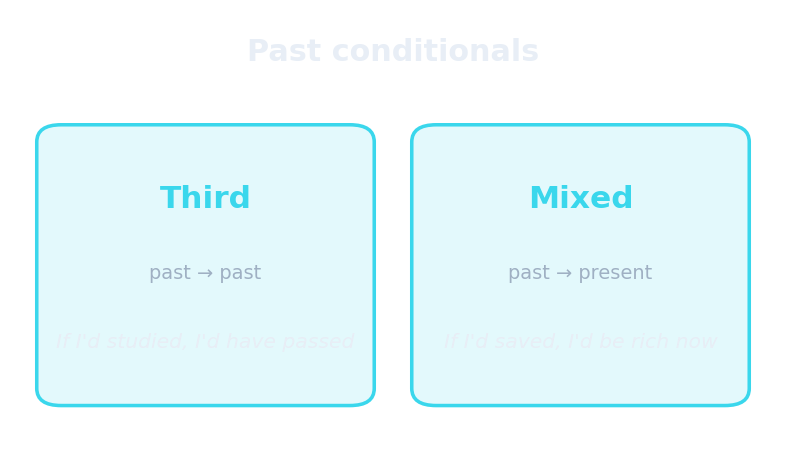
- A third-conditional pattern often imagines an alternative past condition and its past result. Context establishes the real history; the form is not an independent record of what happened.
- If I had studied, I would have passed presents a hypothetical link. In a regret context it commonly implies missed study and a missed result; it does not prove that study guarantees passing.
- Outcome: locate condition and result times and preserve the intended hypothetical claim. Start with open and remote conditions. Starting check: can a past condition have a result described as now? Yes — read both clauses.
- It often expresses regret or blame.
If I had left earlier, I would have spent more time waiting at the station.
Third conditional
If + past perfect, would have + past participle.- A common frame for a hypothetical past result. Do not turn every imagined result into a verified account of actual events.
- If they had left earlier, they would have caught the train.
Complete the third conditional: If I had studied, I ___ the exam.
Difficulty 1/5 · 100 coins + a small bonus on first completion today
Third conditional: If + past perfect, would HAVE + past participle.
Complete: If they had left earlier, they would have ___ (catch) the train.
Difficulty 1/5 · 100 coins + a small bonus on first completion today
would have + past participle: catch → caught.
Translate into English: 如果我当时学习了,就会通过考试了。
Difficulty 3/5 · 200 coins + a small bonus on first completion today
The reference imagines a past condition and past result. It is a hypothetical claim, not independent evidence of the actual exam history.
Mixed conditional
- One mixed pattern combines a hypothetical past condition with a present result.
If + past perfect, would + base verb.- If I had saved money, I would be rich now presents the result as present.
- Another mixed pattern combines an ongoing characteristic with a hypothetical past result: If I weren't afraid of heights, I would have joined yesterday's climb. Mixed conditionals are not limited to the first direction.
Third or mixed? Watch the result
Read condition and result together in these past-condition examples: a past result uses would have + participle; a present result is explicitly located now. Other mixed directions also occur.
Mixed (past cause → present result): “If I had saved money, I would be rich now.” Correct?
Difficulty 1/5 · 100 coins + a small bonus on first completion today
Yes — past perfect in the if-clause, “would + base verb” for the present result.
All conditionals at a glance
- A common zero pattern uses present + present for a general relationship. A common first pattern uses a present condition with a future result; other modal or imperative results also occur.
- A second-conditional pattern can imagine a remote present or future situation; its past form need not mean past time.
- A common third pattern uses a past-perfect condition and would have + participle for an imagined past result. Could have and might have allow other result meanings; the type name is not a certainty score.
Common mistakes
- For the standard hypothetical past condition practised here, use If I had known, I would have come. This is not a universal ban on would after every if: willingness and other meanings require their own context.
- For the intended completed result yesterday with would, repair If I had studied, I would pass yesterday to …I would have passed yesterday. Other modals can change the imagined result: might have passed is more tentative, not a guaranteed pass.
- Decode I'd: + past participle = had; + have + participle = would.
Match the supplied hypothetical conditions to the model results illustrated here. Read both halves; these are example pairings, not the only grammatical continuations.
Difficulty 2/5 · 140 coins + a small bonus on first completion today
The saved-money example links an imagined past condition to now; the study example gives a hypothetical past result; were-you gives hypothetical advice. Other mixed directions are possible, so classify the whole message.
Use the standard third-conditional past-condition frame: If she ___ the bus yesterday, she would have been on time.
Difficulty 1/5 · 100 coins + a small bonus on first completion today
Had caught supplies the requested hypothetical past condition. Read the result clause too: a continuing characteristic could combine with a past result in another mixed pattern, so the if-clause alone is not a universal classifier.
- Third conditional (unreal past): If + past perfect, would have + p.p.
- Mixed (past cause → present result): If + past perfect, would + base verb.
- Read both clauses and their reference times; the same past-perfect condition can lead to a past or present hypothetical result. Later recall: invent a missed booking and express one past result and one current result. Continue with wish and if only to compare regret with a conditional claim.
Usage guidance checked 2026-10-20: British Council, third and mixed conditionals. Local source checks; independent language, answer and learner review pending.
Think of a past regret. Write one third-conditional sentence (If + past perfect, would have + past participle).
Difficulty 3/5 · 200 coins + a small bonus on first completion today
Example: “If I had woken up earlier, I wouldn't have missed the bus.”
Three worked contrasts: read both sides
1. The same past condition, two result times
A learner imagines a different packing choice: If I had packed my walking shoes, I would have joined yesterday’s walk. Both the choice and result look back. Compare If I had packed my walking shoes, I would have suitable shoes here now. Here would have means possession at the present reference point; have is the main verb followed by an object, not automatically a perfect auxiliary followed by a participle. Read the full verb phrase and time expression before labelling it. A weak summary, Both results must be past because both contain would have, loses that distinction. The two imagined results also do not confirm an actual walk or an actual pair of shoes.
2. A continuing characteristic with a past result
Rae says, I work nights, and I worked nights throughout last month. If I didn’t work nights, I would have joined last Friday’s evening class. The condition imagines a different continuing work situation; the result concerns Friday. A weak reading, Rae changes her schedule today and therefore changes Friday, invents time travel. The continuing context, not the word order or a label, explains the relationship. Do not use this pattern to pretend a newly changed present fact caused a past event.
3. A hypothetical result is not a factual guarantee
If we had taken the earlier ferry, we might have reached the island before the storm presents a possible alternative. …we would have reached it presents that imagined result more strongly. Neither sentence is a passenger record or a general guarantee about ferries. A useful revision preserves the writer’s intended strength and checks available facts rather than silently upgrading might to would. The ferry timetable is allowed to be optimistic; your report still needs to be careful.
Use the guided decisions to identify the condition, the result and each reference time before choosing. Suggested study: two sessions of about 25 minutes, including drafting and revision. This is a planning allowance, not measured or official timing.
Read both times: ‘If Lina had charged the recorder last night, she would have recorded this morning’s interview.’ Which timeline is imagined?
Difficulty 1/5 · 100 coins + a small bonus on first completion today
Last night locates the condition; this morning’s interview locates the imagined completed result. Read the main clause as well as had charged. The sentence alone is not a recorder log.
Read both times: ‘If I had accepted the town-library job last year, I would live near the river now.’ What does now locate?
Difficulty 1/5 · 100 coins + a small bonus on first completion today
Had accepted imagines the earlier choice; would live and now describe the imagined current situation. Do not move now into the condition or turn the hypothetical move into a reported fact.
Ari says, ‘I am afraid of heights, and I was afraid yesterday too. If I weren’t afraid of heights, I would have joined yesterday’s tower visit.’ Which reading fits?
Difficulty 1/5 · 100 coins + a small bonus on first completion today
The first sentence explicitly makes the fear a continuing characteristic. Weren’t presents an alternative to that characteristic; would have joined locates the result yesterday. This does not claim that today can change yesterday.
Expand both contractions: ‘If I’d checked the address, I’d have found the studio.’ Which expansion preserves this sentence?
Difficulty 1/5 · 100 coins + a small bonus on first completion today
In I’d checked, checked follows had. In I’d have found, have follows would. Expand each clause separately; the same contraction need not stand for the same word twice.
Compare ‘If we had booked, we would have obtained a room’ and ‘If we had booked, we might have obtained a room.’ What changes?
Difficulty 1/5 · 100 coins + a small bonus on first completion today
Both conditions look back to booking, and both results look back to obtaining a room. Might changes the strength of the imagined result; it does not provide an actual reservation record.
Read the whole verb phrase: “If we had brought a spare key, we would have a way in now.” What does have do in the result clause?
Difficulty 1/5 · 100 coins + a small bonus on first completion today
Have is followed by the noun phrase a way in, not a past participle. Now locates the imagined result in the present. The words would have alone do not identify a perfect-modal frame or confirm actual possession. Check the following words and the reference time.
Independent interpretation and a two-time note
Read each fresh message as a whole. Keep stated facts separate from imagined alternatives, and distinguish clause order from condition/result direction. The writing task asks you to express past and current results without manufacturing an actual backup. Compare the meaning of your own wording, not just its resemblance to a formula.
‘If the council had planted shade trees ten years ago, this square would be cooler today.’ Which summary preserves the claim?
Difficulty 1/5 · 100 coins + a small bonus on first completion today
Ten years ago belongs to the imagined condition, today to the result. The sentence proposes a relationship; it is not itself a tree inventory or temperature measurement. Keep both reference times.
‘The musicians would have rehearsed in the hall on Monday if the caretaker had unlocked it.’ Which rewrite preserves the condition and result?
Difficulty 1/5 · 100 coins + a small bonus on first completion today
Moving the if-clause to the front preserves its role. The second choice reverses condition and result; the third replaces the past scenario with a future one. Clause order and logical direction are different issues.
A note says, ‘Had I kept the receipt, I could have requested a refund.’ What is the closest reading?
Difficulty 1/5 · 100 coins + a small bonus on first completion today
Had I kept is an inverted past-perfect condition, equivalent here to if I had kept. Could have concerns the opportunity to request, not confirmed payment. Preserve the limited result rather than upgrading request to successful refund.
‘Mina would have joined yesterday’s sunrise walk if she weren’t a night-shift worker; she works nights every week.’ Which part is the condition?
Difficulty 1/5 · 100 coins + a small bonus on first completion today
The weekly work statement establishes a continuing situation; weren’t imagines its alternative. The result concerns yesterday. Do not interpret the past-looking form by itself or invent a later shift change.
A colleague wrote, ‘If I had copied the map, I would know the route now.’ You must retain the imagined present knowledge. Which edit changes the meaning instead?
Difficulty 1/5 · 100 coins + a small bonus on first completion today
During yesterday’s trip replaces the present result with a past result. Reordering clauses or using had-inversion can preserve the present result. A grammatical edit is not necessarily a faithful one.
A report states, ‘The van arrived at nine. If it had arrived at eight, we might have finished loading before the rain.’ Which conclusion is supported?
Difficulty 1/5 · 100 coins + a small bonus on first completion today
The report gives an actual arrival at nine. Might have presents a possible alternative result, not a completion record or an all-day impossibility. Separate the stated event from the imagined scenario.
The archive closed at four yesterday. You arrived at five and could not enter. Which sentence imagines an earlier arrival and a past opportunity, without claiming you entered?
Difficulty 1/5 · 100 coins + a small bonus on first completion today
Had arrived and could have entered preserve the past alternative and opportunity. Tomorrow changes the task’s reference time; because plus entered converts the imagined scenario into a factual assertion that contradicts the supplied arrival.
‘If Chen had studied navigation, she would be teaching it this term.’ Which information is still absent from this sentence alone?
Difficulty 1/5 · 100 coins + a small bonus on first completion today
The sentence supplies the hypothetical times but is not an independent record of Chen’s actual biography. A reader may infer a contrast in an ordinary context; that is different from obtaining separate evidence. Do not label the grammatical times unknown.
A draft says, ‘If we had reserved the projector, we would present yesterday.’ You want an imagined completed presentation yesterday using would. Which repair matches?
Difficulty 1/5 · 100 coins + a small bonus on first completion today
Would have presented supplies the requested past result. Both tomorrow options change the time, even if they can be grammatical in another message. Repair the intended meaning as well as the verb form.
An editor changes ‘If I had practised, I might have won’ to ‘If I had practised, I would have won.’ What should the writer check?
Difficulty 1/5 · 100 coins + a small bonus on first completion today
Would presents the imagined result more strongly than might here. Neither sentence records a real win, and neither moves practice to the future. An editor must preserve uncertainty rather than only polish a familiar pattern.
‘If the team had chosen the smaller design, the kit would fit in this bag now.’ Which follow-up keeps the current result hypothetical?
Difficulty 1/5 · 100 coins + a small bonus on first completion today
Would fit belongs to the imagined alternative, not automatically to the actual kit. Checking the real size responds to the information gap. Do not invent a completed redesign or a packing result.
‘I don’t speak Estonian and never have. If I spoke Estonian, I would have understood yesterday’s announcement.’ Which interpretation fits both sentences?
Difficulty 1/5 · 100 coins + a small bonus on first completion today
The first sentence fixes the continuing lack of ability. The conditional imagines a different ability and yesterday’s result; it is not a time-travel claim or evidence of actual understanding. The past verb form spoke expresses the remote condition.
Friday: Dev did not save a local copy, and the online notes file disappeared. Today: Dev has no copy. Write a 3–4 sentence English note separating these actual facts from two imagined alternatives: an earlier saving choice with a past result, and the same earlier choice with a current result. You may use could or might if you intend a more tentative result. Compare, then revise one time or certainty problem; do not invent a real backup or assign blame.
Compare the actual facts, both clause times, modal strength and useful next action. This is written self-review, not automatic correctness, a speaking assessment or a proficiency result.
Transfer: keep the useful link, update the claim
Later information can make an old hypothetical result too broad. Decide what the past alternative would actually address and what remains a separate current problem. Then write a short English handoff with a relevant next action. A well-formed conditional does not excuse a false factual update.
An event note says, ‘If we had printed the passes, we would be ready now.’ A later update confirms a broken gate scanner, even for printed passes. Which revision best preserves the limited benefit of printing?
Difficulty 1/5 · 100 coins + a small bonus on first completion today
The new fault means having passes cannot simply be equated with readiness. The revised hypothetical result is limited to possession, and the real remaining obstacle is acknowledged. Do not attribute a scanner repair to printing.
A museum asks for a retrospective note. Facts: the group missed yesterday’s tour; a smaller group size might have allowed entry, but the guide’s capacity is unconfirmed. Which wording preserves that uncertainty?
Difficulty 1/5 · 100 coins + a small bonus on first completion today
Might have preserves a possible past result and the stated information gap. Certainly plus confirmed adds unsupported certainty; next week cannot be the past condition requested here. A useful revision names the missing check.
Yesterday: the workshop team did not send the room code, so visitors waited outside. Today: visitors have the code, but the projector is broken. Write a 3–4 sentence English handoff: acknowledge the stated missed action, imagine a more useful past action and past result, then give an accurate current update and next step. Do not imply that sending yesterday’s code would fix today’s projector. Compare and revise one mistaken time link or responsibility claim.
Compare the actual facts, both clause times, modal strength and useful next action. This is written self-review, not automatic correctness, a speaking assessment or a proficiency result.
Later retrieval and the next choice
On a later study day, try the two review messages before rereading the examples. Explain both clause times and the imagined result’s strength, then compare against the feedback. These familiar cards support retrieval; they are not a reserved assessment or proof of proficiency. Delayed-recall evidence requires an earlier successful attempt on an earlier session day. Continue with wishes and alternatives and check whether your next message concerns a fact, an unreal alternative or an open hope.
On Tuesday, Imani did not pack a charger. Today her battery is flat. Choose the sentence that imagines a different Tuesday choice with a result explicitly located today, without stating that the imagined result occurred.
Difficulty 1/5 · 100 coins + a small bonus on first completion today
The first result is explicitly current and tentative. The second imagines a past action instead; the because-clause asserts a packing fact contrary to the prompt. Recover the times before choosing a familiar form.
‘The delivery failed yesterday. If we had checked the address, it might have arrived.’ What is safe to say?
Difficulty 1/5 · 100 coins + a small bonus on first completion today
The first sentence supplies the actual failure; the second proposes a tentative alternative. Keep that distinction and do not generalise one imagined relationship into a guarantee. In a new message, preserve both time and certainty.