Evolution and speciation
הוצג 10:46
יחידה 4: אנרגיה, סביבה, מיקרוביולוגיה וחיסון
שדה חיטה חוסם אור שמש, מקבע פחמן, מזין שרשרת מזון - ומוותר על אנרגיה בכל שלב. יחידה זו עוקבת אחרי האנרגיה מפוטון עד למערכת אקולוגית…
קריינות באנגלית · כתוביות באנגלית ובסינית 中文 שאפשר להחליף ביניהן
בשיעור הזה
| English | משמעות |
|---|---|
| allele frequency/əˈliːl ˈfriːkwənsi/ | How common a particular allele is among all copies of that gene in a population. |
| Stabilising selection/ˈsteɪbəlaɪzɪŋ sɪˈlekʃn/ | |
| Directional selection/daɪˈrekʃənl sɪˈlekʃn/ | |
| Speciation/ˌspiːʃɪˈeɪʃn/ | The formation of new species when populations diverge until they can no longer interbreed. |
| Allopatric/ˌæləˈpætrɪk/ | |
| Sympatric/ˈsɪmpətrɪk/ |
Bacteria that antibiotics cannot kill
- In a few decades, some bacteria have become resistant to almost every antibiotic we have.
- This is evolution happening fast enough to watch. The same process, over millions of years, has made new species.
What evolution is
- Evolution is a change in allele frequency 等位基因频率 in a population over generations.
- It needs variation. New alleles come from mutation, and meiosis and random fertilisation make new combinations of them.
Which is the best definition of evolution?
רמת קושי 1/5 · 100 מטבעות + בונוס קטן בהשלמה הראשונה היום
Evolution is measured in populations, through allele frequencies.
Natural selection
- Individuals with alleles that suit the environment survive and reproduce more, so they pass those alleles on.
- Over many generations, those alleles become more common. In small populations, allele frequencies can also change by chance (genetic drift).
Put the steps of natural selection in order.
רמת קושי 3/5 · 200 מטבעות + בונוס קטן בהשלמה הראשונה היום
Variation, selection, inheritance, change in frequency.
Types of selection
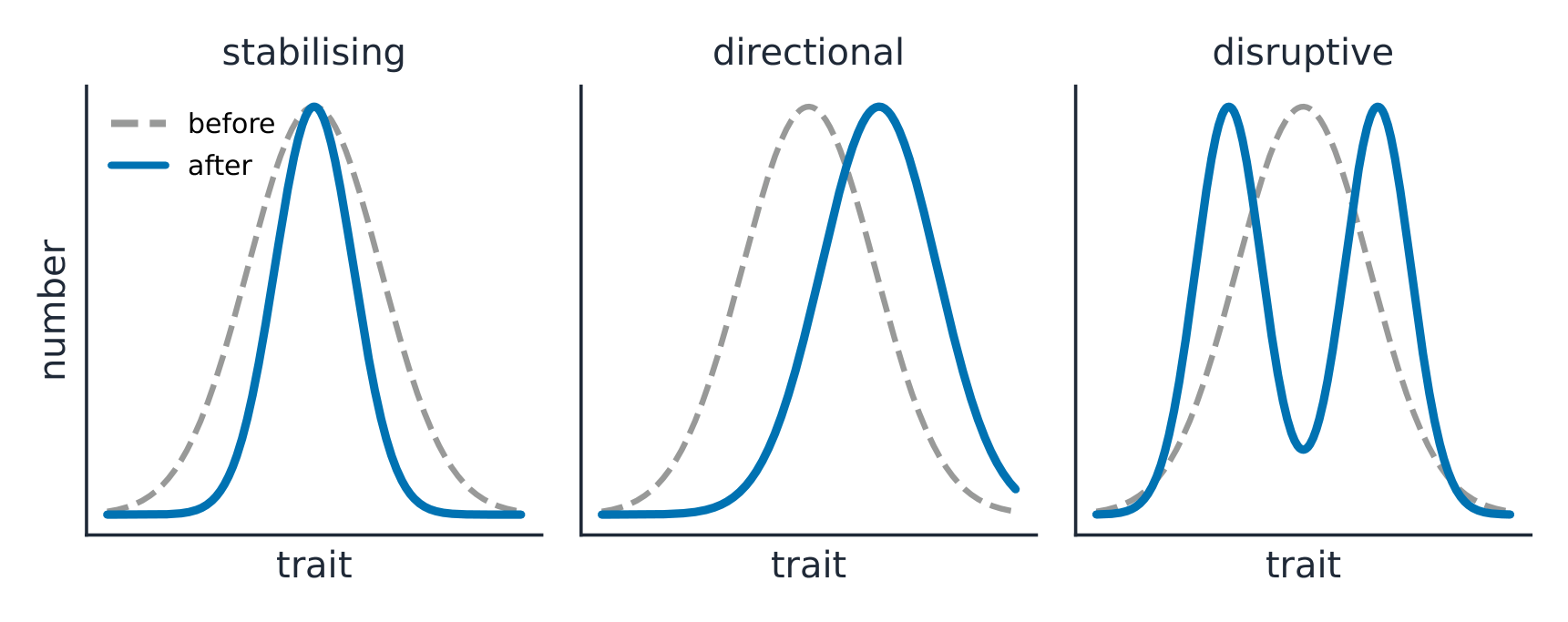
- Stabilising selection 稳定选择 favours the average and removes the extremes, in a stable environment (for example human birth mass).
- Directional selection 定向选择 favours one extreme when the environment changes, so the mean shifts (for example antibiotic resistance).
Match each example to the type of selection.
רמת קושי 2/5 · 140 מטבעות + בונוס קטן בהשלמה הראשונה היום
Stabilising keeps the mean; directional shifts it.
Speciation needs isolation
- A species is a group that can interbreed to produce fertile offspring. Speciation 物种形成 happens when two populations stop interbreeding and their allele frequencies change in different ways.
- Allopatric 异域的 speciation: a physical barrier such as a mountain or sea separates the populations. Sympatric 同域的 speciation: the populations live in the same place but cannot breed, for example because they breed at different times or have different courtship behaviour.
Worked example: allele frequency change. In a population of 500 beetles, 100 alleles out of 1000 are for dark colour. Ten generations later, 350 out of 1000 are.
- Starting frequency = 100 ÷ 1000 = 0.10; final frequency = 350 ÷ 1000 = 0.35.
- The frequency increased by 0.25, so the dark allele was probably favoured by directional selection.
In a population, 180 of 600 alleles for a gene are the dark allele. What is its frequency?
רמת קושי 2/5 · 140 מטבעות + בונוס קטן בהשלמה הראשונה היום
180 ÷ 600 = 0.3.
Two populations of the same fish live in one lake but breed at different times of year. Over time they become separate species. What is this?
רמת קושי 1/5 · 100 מטבעות + בונוס קטן בהשלמה הראשונה היום
They share a place, so there is no physical barrier.
Molecular evidence for evolution
- Closely related species have more similar DNA base sequences and more similar amino acid sequences in proteins (for example cytochrome c).
- Counting the differences shows how long ago two species shared a common ancestor, and has changed some classifications.
Two species whose cytochrome c differs by 2 amino acids are probably more closely related than two species whose cytochrome c differs by 20.
רמת קושי 1/5 · 100 מטבעות + בונוס קטן בהשלמה הראשונה היום
Fewer differences suggest a more recent common ancestor.
How scientists check new evidence
- New findings are published in scientific journals only after peer review: other experts check the methods and conclusions.
- Results are also discussed at conferences and must be repeated by other scientists before they are accepted.
Individuals do not evolve; populations do. An organism does not change its alleles because it "needs" to. Selection changes how common alleles are in the population over generations.
Evolution is a change in allele frequency. Mutation gives variation; natural selection makes useful alleles more common, and drift changes them by chance. Stabilising selection removes extremes; directional selection shifts the mean. Isolation (allopatric or sympatric) leads to new species. DNA and protein sequences show how closely species are related, and peer review checks new evidence.
Explain how a mountain range can lead to the formation of two new species.
Isolation, then different selection, then reproductive isolation.
מה השתבש? רק צוות האתר רואה זאת.