כיצד הסתיימה המלחמה הקרה
הוצגReform designed to preserve
- Following a long period of economic stagnation, Mikhail Gorbachev's internal reforms of perestroika and glasnost, designed to make the Soviet system more flexible, failed to stave off the collapse of the Soviet Union and the end of its hegemonic control over Eastern and Central European satellites.
- The CED states the purpose — to make the system more flexible — before stating the outcome.
- So this is not a reform intended to end the system; it is one that failed to save it.
פרסטרויקה וגלאסנוסט עוצבו כדי להפוך את המערכת הסובייטית...
רמת קושי 1/5 · 100 מטבעות + בונוס קטן בהשלמה הראשונה היום
הם כישלו למנוע קריסה; זה לא היה יעודם.
Echoes of 6.6's Russian pattern
- 6.6: autocratic reform, including the emancipation of the serfs, gave rise to revolutionary movements and eventually 1905.
- 9.7: reform designed to preserve the system failed to stave off its collapse.
- The CED does not draw the parallel, but the shape is the same and noticing it is legitimate analysis.
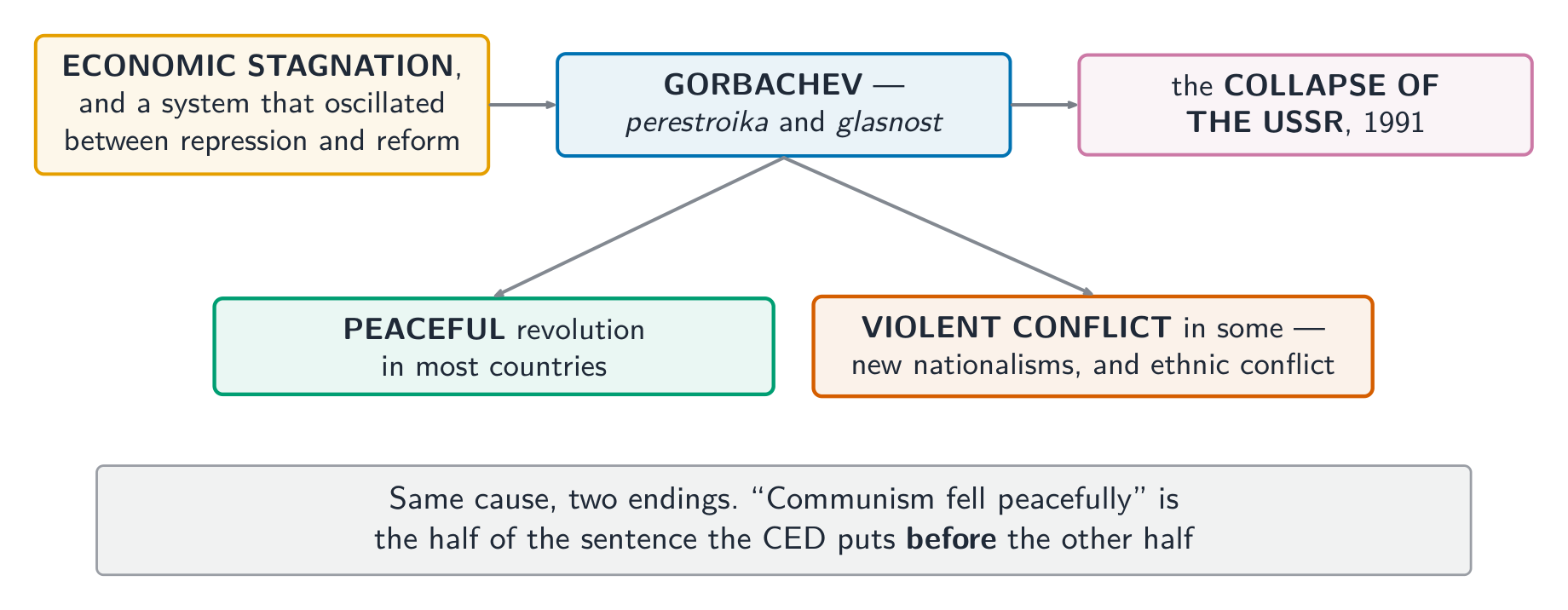
Same cause, two endings- the CED puts 'peaceful in most' before 'violent in some'
קריסת ברית המועצות ב-____ סימנה את סופה של המלחמה הקרה.
רמת קושי 1/5 · 100 מטבעות + בונוס קטן בהשלמה הראשונה היום
אחת התאריכים המעטים ש-CED מציינת במפורש.
Five consequences, dated
- The collapse of the USSR in 1991 ended the Cold War and led to the establishment of capitalist economies throughout Eastern Europe. Germany was reunited, the Czechs and the Slovaks parted, Yugoslavia dissolved, and the European Union was enlarged through the admission of former Eastern bloc countries.
- Five outcomes in two sentences, and they run from peaceful to violent along the same list.
- 1991 is one of the few dates the CED states outright, so it is worth carrying.
עקוב אחר הקריסה, והפרד את סיומה
'המהפכה השקטה ברוב המדינות' משולבת עם 'סכסוך אלים בחלקן', והתלמידים מוותרים על החצי השני.
בחר את כל הארבעה שינויים במפה שה-CED מציין.
רמת קושי 2/5 · 140 מטבעות + בונוס קטן בהשלמה הראשונה היום
הן נעות מספקניות עד לאלימות לאורך אותה רשימה.
Perestroika and glasnost were designed to make the Soviet system more flexible. The CED states the purpose before the outcome — these were reforms that failed to stave off collapse, not reforms intended to end the system, and reversing that reads the ending back into the intention.
הדפוס הרוסי ב-6.6 — реформа שמובילה לתוצאה שהיא אמורה למנוע — הוא בעל אותו צורה.
רמת קושי 1/5 · 100 מטבעות + בונוס קטן בהשלמה הראשונה היום
ה-CED אינו מצייר את המקבילה, אך הערתה מהווה ניתוח חוקי.
Why the same forces gave different outcomes
- 9.4 already said it: new nationalisms brought peaceful revolution in most countries but resulted in instability in some former Soviet republics.
- Reunification, separation and dissolution are three answers to one question — who does this state belong to?
- Writing that sentence explains four of the five outcomes at once.
איחוד, פרידה ופירוק הן שלוש תשובות ל...
רמת קושי 1/5 · 100 מטבעות + בונוס קטן בהשלמה הראשונה היום
9.4 ציינה כבר כי לאומיזם חדש יצר גם תוצאות שלום וגם אי-יציבות.
Causes and effects of an ending
- Causes: a long period of economic stagnation, and reforms that failed to make the system flexible enough.
- Effects: the Cold War ended, capitalist economies established, and four changes to the map.
- The CED supplies both halves in full, so this is a subtopic where quoting closely is the efficient strategy.
Four states face the same question in the same few years and give four different answers: one joins itself back together, two agree to part, and one comes apart in violence. The question was identical. Only the arrangements inside each state were not.
Following a long period of economic stagnation, Gorbachev's internal reforms of perestroika and glasnost, designed to make the Soviet system more flexible, failed to stave off the collapse of the Soviet Union and the end of its hegemonic control over Eastern and Central European satellites. The collapse of the USSR in 1991 ended the Cold War and led to the establishment of capitalist economies throughout Eastern Europe. Germany was reunited, the Czechs and the Slovaks parted, Yugoslavia dissolved, and the European Union was enlarged through the admission of former Eastern bloc countries.