ארבעה קווים למאה שנים
הוצגThe course's last set of claims
- Total war and political instability in the first half of the 20th century gave way to a polarised state order during the Cold War and eventually to efforts at transnational union.
- The stresses of economic collapse and total war engendered internal conflicts within European states and created conflicting conceptions of the relationship between the individual and the state, as demonstrated in the ideological battle between and among democracy, communism, and fascism.
- Diverse intellectual and cultural movements questioned the existence of objective knowledge, the ability of reason to arrive at truth, and the role of religion in determining moral standards.
'מלחמה כוללת' מתייחסת למלחמה בה המדינה מגייסת...
רמת קושי 1/5 · 100 מטבעות + בונוס קטן בהשלמה הראשונה היום
עבודה, תעשייה, מזון ודעת קהל, ולא רק צבא.
And a fourth, about everyday life
- Demographic changes, economic growth, total war, disruptions of traditional social patterns, and competing definitions of freedom and justice altered the experiences of everyday life.
- Five causes listed for one effect — the CED is signalling that daily life has multiple, simultaneous drivers.
- 6.1's everyday-life thread returns, now with war and competing definitions of freedom added to it.
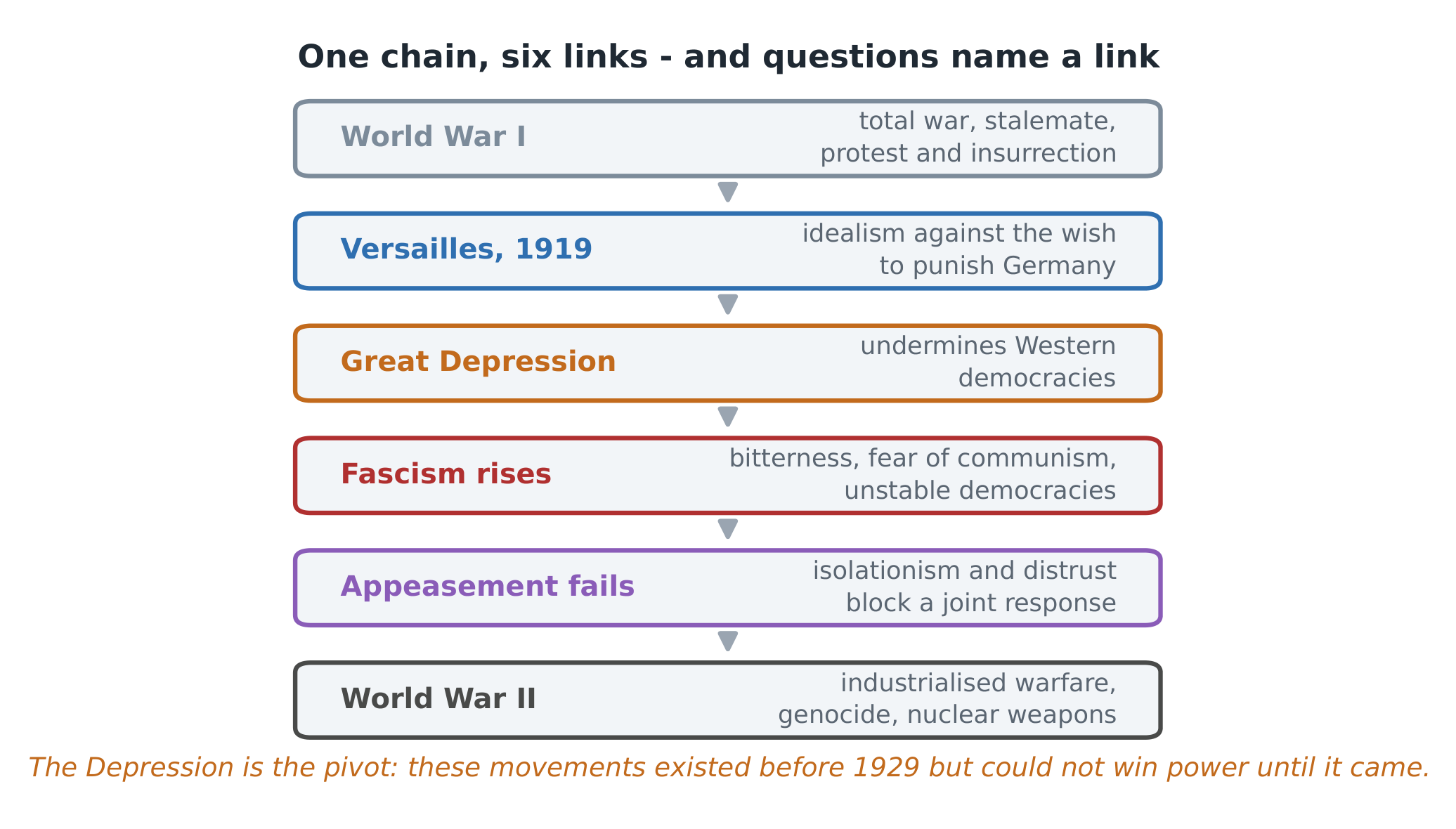
One chain from the First World War to the Second: Versailles, the Depression, fascism and appeasement
בחר את שלושת האידאולוגיות בקרבות ה- CED.
רמת קושי 2/5 · 140 מטבעות + בונוס קטן בהשלמה הראשונה היום
'בין ובין בתוך' מאפשר גם סכסוך בתוך כל מחנה.
'Total war' is a technical term here
- It means a war in which the state mobilises the whole society — labour, industry, food, opinion — not only an army.
- That is why the CED can put total war in the same sentence as internal conflict and everyday life.
- A war of that kind changes the state whether it is won or lost, which is 8.2's central point.
בחר את כל הכוחות שה- CED מציין שינו את חיי היומיום.
רמת קושי 2/5 · 140 מטבעות + בונוס קטן בהשלמה הראשונה היום
חמישה גורמים לאפקט אחד — נהלים מרובים המתרחשים בו זמנית.
The CED names three ideologies, not two. The battle is between and among democracy, communism, and fascism — and "among" allows for conflict within each camp as well as between them, so a two-sided account of the century has dropped a dimension the CED kept.
איזה מקווים של יחידה 8?
מיין כל משפט לחוט שלו.
מלחמה כוללת ואי-יציבות הפכו לסדר מדינתי ____ במהלך המלחמה הקרה.
רמת קושי 1/5 · 100 מטבעות + בונוס קטן בהשלמה הראשונה היום
ולבסוף לניסיונות איחוד חוצה-גבולות.
An ideological battle among three
- Between and among democracy, communism, and fascism — the CED names three, not two.
- The extra phrase and among allows for conflict within each camp as well as between them.
- So an answer that reduces the century to a two-sided contest has lost a dimension the CED preserved.
התנאים שנזכרו כאן היו קיימים כבר לפני 1914.
רמת קושי 1/5 · 100 מטבעות + בונוס קטן בהשלמה הראשונה היום
זה מה שהופך אותם להקשר ולא לגורם.
Writing the context
- The objective is the context in which global conflict developed in the 20th century.
- Conditions: unit 7's alliance system and Balkan crises, industrial capacity capable of total war, and no shared standard for settling disputes.
- Each of those was already in place before 1914 — that is what makes it context rather than cause.
A state that must feed, arm, employ and persuade an entire population in order to fight has taken on powers it will not readily give back. The war ends; the ministries do not close. That is why total war belongs in a sentence about the individual and the state.
Unit 8 opens four threads: total war and political instability gave way to a polarised state order and eventually to efforts at transnational union; economic collapse and total war created conflicting conceptions of the relationship between the individual and the state, seen in the battle between and among democracy, communism, and fascism; movements questioned objective knowledge, reason and religion's moral role; and five named forces altered the experiences of everyday life.