Drawings and tolerances: fits and stack-ups
Introduit| English | Sens |
|---|---|
| tolerance/ˈtɒlərəns/ | The permitted variation from a specified dimension or other measured requirement. |
| fit/fɪt/ | The relation between the sizes of a hole and the shaft in it, which sets whether they clear or interfere. |
| engineering drawing | A standardised technical drawing that fully defines a part's shape, size, tolerances and finish. |
| orthographic views | Separate views of a part, each looking straight along one axis, such as front, top and side. |
| datum | A reference feature, such as a surface or axis, from which dimensions and tolerances are measured. |
| hole-basis system | A system of fits in which the hole has a fixed basic tolerance and the shaft size is varied to give the fit. |
| clearance fit | A fit in which the shaft is always smaller than the hole, so the parts can slide or turn. |
| root sum of squares | A statistical tolerance stack in which the total variation is the square root of the sum of the squared part tolerances. |
| interference fit | A fit in which the shaft is always larger than the hole, so it is pressed or shrunk in and held by friction. |
"About 30 mm" is not a size
- A pump shaft must turn freely in its housing without rattling. "About 30 mm" cannot say that; a tolerance and a fit can.
- An engineering drawing uses orthographic views (front, top, side, plus sections) and measures every feature from a datum, the surface the part is located by.
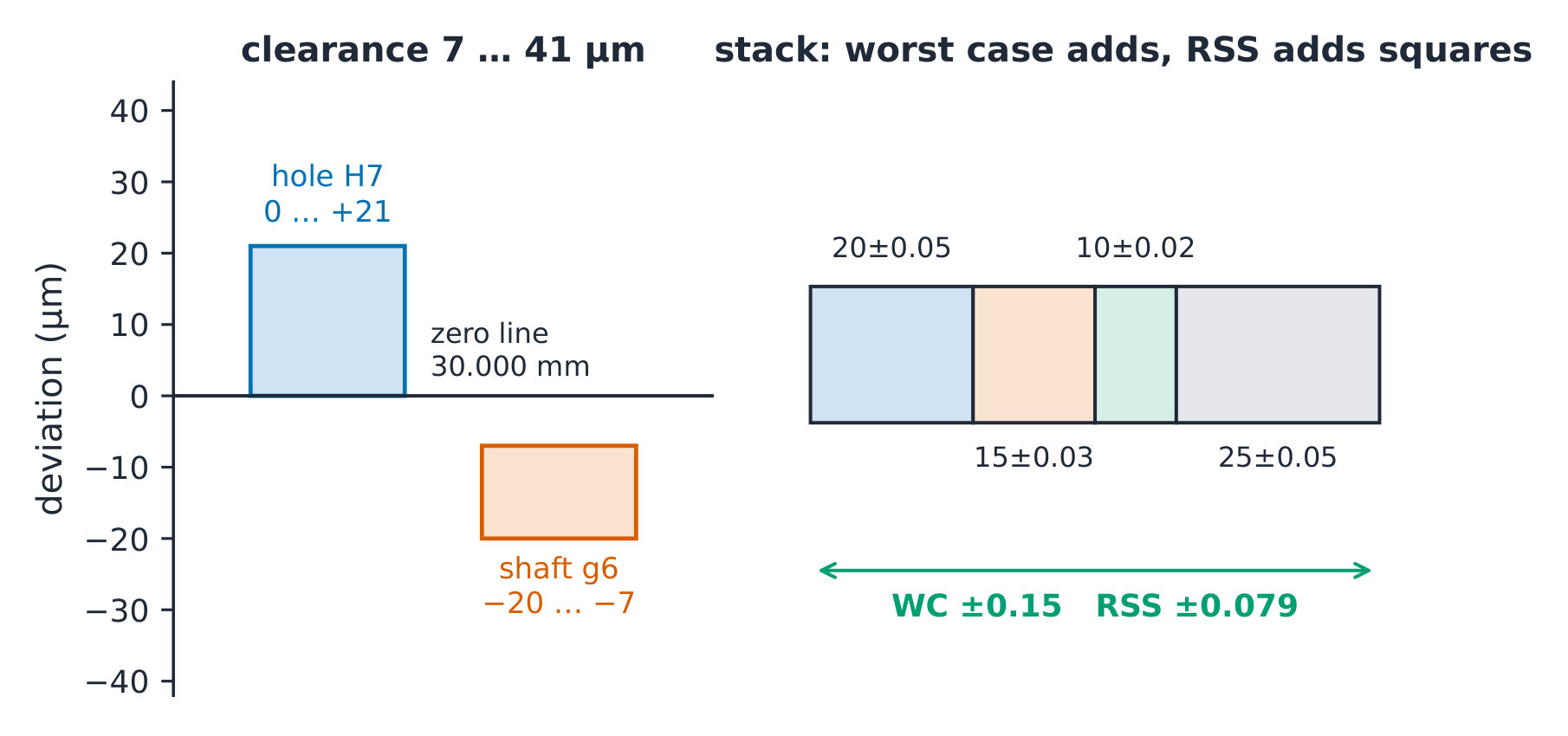
Reading a fit
- In the hole-basis system the hole is H, with lower deviation zero, and the shaft letter sets the kind of fit. The shaft is 30 H7/g6.
- Hole 30.000 to 30.021 mm; shaft 29.980 to 29.993 mm.
- Maximum clearance $30.021 - 29.980 = \mathbf{41}$ µm; minimum $30.000 - 29.993 = \mathbf{7}$ µm. Always positive, so it is a clearance fit.
Clearance, transition or interference?
Classify each fit or tolerance choice.
Hole 30.000-30.021 mm, shaft 29.980-29.993 mm: maximum clearance (micrometres)?
Difficulté 2/5 · 140 pièces + un petit bonus lors de la première réussite aujourd'hui
Largest hole minus smallest shaft.
Minimum clearance (micrometres)?
Difficulté 2/5 · 140 pièces + un petit bonus lors de la première réussite aujourd'hui
Smallest hole minus largest shaft.
Worst case against RSS
- When $n$ parts set a gap, the worst case adds the tolerances: $T_{WC} = \sum t_i$. If the errors are independent and centred, their variances add: $T_{RSS} = \sqrt{\sum t_i^2}$, the root sum of squares.
- RSS is smaller because every part at its worst limit at once is rare.
RSS gives a smaller stack than worst case because:
Difficulté 1/5 · 100 pièces + un petit bonus lors de la première réussite aujourd'hui
Independent errors partly cancel.
The spacer stack
- Four spacers of $\pm0.05$, $\pm0.03$, $\pm0.02$ and $\pm0.05$ mm: worst case $\pm\mathbf{0.15}$ mm, RSS $\pm\mathbf{0.079}$ mm.
- Add the housing bore depth at $\pm0.04$: $\pm0.19$ worst case and $\pm0.089$ RSS. Use worst case when one failure is unacceptable; use RSS for high volume from capable processes.
Worst-case tolerance of four spacers at 0.05, 0.03, 0.02 and 0.05 mm (plus or minus, mm)?
Difficulté 2/5 · 140 pièces + un petit bonus lors de la première réussite aujourd'hui
Add them.
RSS tolerance of the same four (three decimals, mm)?
Difficulté 2/5 · 140 pièces + un petit bonus lors de la première réussite aujourd'hui
Root of the sum of the squares.
30 H7/p6 (hole 30.000-30.021, shaft 30.022-30.035 mm): maximum interference (µm)?
Difficulté 2/5 · 140 pièces + un petit bonus lors de la première réussite aujourd'hui
$30.035 - 30.000 = 0.035$ mm.
Same fit: minimum interference (µm)?
Difficulté 2/5 · 140 pièces + un petit bonus lors de la première réussite aujourd'hui
$30.022 - 30.021 = 0.001$ mm: the smallest shaft is still 1 µm larger than the largest hole.
When the shaft must not turn
- A gear pressed onto its shaft needs the opposite of a running fit: an interference fit 过盈配合, with the shaft always larger than the hole.
- 30 H7/p6: hole 30.000 to 30.021 mm, shaft 30.022 to 30.035 mm. Interference runs from $30.022 - 30.021 = \mathbf{1}$ µm to $30.035 - 30.000 = \mathbf{35}$ µm, and it is assembled by pressing or by heating the hub.
Spacer stack with RSS $\pm 0.079$ mm taken as $3\sigma$, gap limit $\pm 0.10$ mm: $z$ (two decimals)?
Difficulté 2/5 · 140 pièces + un petit bonus lors de la première réussite aujourd'hui
$\sigma = 0.0794/3 = 0.0265$; $z = 0.10/0.0265 = 3.78$.
Worked example: what RSS really promises
- RSS treats each $\pm t_i$ as $3\sigma$. The four spacers then give $\sigma = 0.079/3 = 0.0265$ mm for the stack.
- If the gap allows only $\pm 0.10$ mm, the worst case ($\pm 0.15$) fails on paper, but $z = 0.10/0.0265 = \mathbf{3.78}$, so about 160 parts per million fall outside. RSS trades a guarantee for a defect rate: state the rate.
Three drawing slips
- Measuring from an edge that is not the datum. The part is located by its datum.
- RSS for a safety-critical one-off. Use worst case.
- Reading H7/g6 as interference. Letters g and h give clearance; p, s and u give interference.
An H7/g6 fit is an interference fit.
Difficulté 1/5 · 100 pièces + un petit bonus lors de la première réussite aujourd'hui
g gives clearance: 7 to 41 micrometres here.
Recap
- 30 H7/g6: clearance 7 to 41 µm.
- $T_{WC} = \sum t_i$, $T_{RSS} = \sqrt{\sum t_i^2}$: $\pm0.15$ against $\pm0.079$ mm for the four spacers.
- Every dimension starts at a datum.