Frequency: Miller, cascode, cascade
Introduit| English | Sens |
|---|---|
| coupling capacitor | condensateur de couplage |
| Miller capacitance | capacité de Miller |
| dominant pole | pôle dominant |
| cascode | cascode |
Every amplifier is a band-pass
- An audio amplifier loses the deepest bass and the highest treble, however good it is. Something removes both ends of the spectrum.
- At low frequencies the coupling capacitors block; at high frequencies tiny internal capacitances short the signal. This lesson finds both corners.
The low corner: coupling capacitors
- A coupling capacitor 耦合电容 passes the signal but blocks DC between stages. With the resistance $R_{eq}$ it sees, it forms a high-pass corner $f_{L} = \dfrac{1}{2\pi R_{eq}C}$.
- Find $R_{eq}$ with the sources zeroed. For the earlier CE stage, the input capacitor sees $R_{B} \parallel r_{\pi} = 10.2\,\text{k} \parallel 2.6\,\text{k} = 2.08\,\text{k}\Omega$.
Match each cause to the end of the band it limits.
Difficulté 2/5 · 140 pièces + un petit bonus lors de la première réussite aujourd'hui
Series capacitors block slow signals; shunt capacitors short fast ones. Together they make every amplifier a band-pass.
Worked example: f_L
- A 10 µF coupling capacitor on 2.08 kΩ: $f_{L} = \dfrac{1}{2\pi \times 2080 \times 10 \times 10^{-6}} = 7.7\,\text{Hz}$, well below the audio band.
- The resistances are in parallel, not in series. Adding them would give 12.8 kΩ and a corner 6 times too low.
A 1 µF coupling capacitor sees 10 kΩ. What is f_L, in Hz?
Difficulté 2/5 · 140 pièces + un petit bonus lors de la première réussite aujourd'hui
$\dfrac{1}{2\pi \times 10^{4} \times 10^{-6}} = 15.9$ Hz.
The Miller effect
- A small capacitance $C$ from the output of an inverting stage (gain $-A$) back to its input carries $C(1 + A)$ times the input's rate of change. The input sees a Miller capacitance 米勒电容 $C_{M} = C(1 + A)$ to ground.
- With $C = 5\,\text{pF}$ and $A = 80$: $C_{M} = 5 \times 81 = 405\,\text{pF}$. A tiny capacitor becomes a large one.
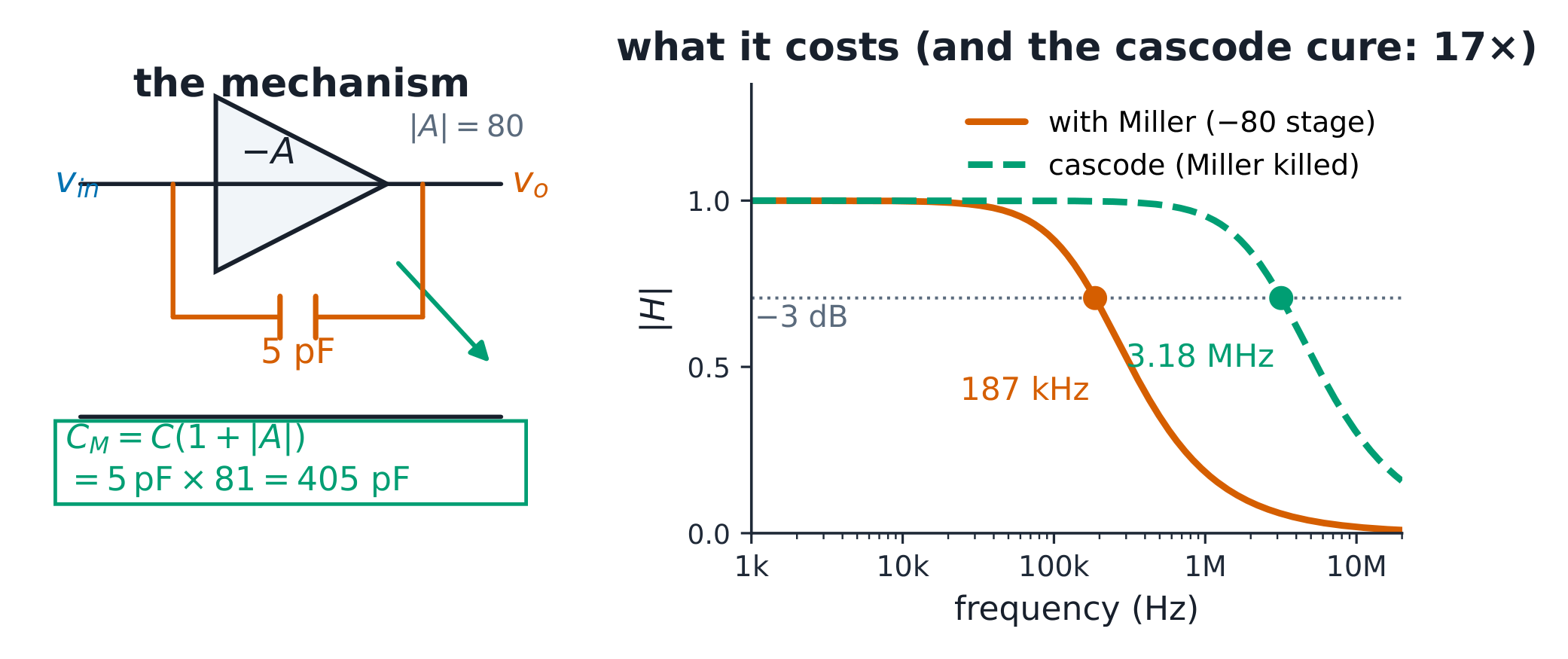
A 5 pF capacitor across a stage of gain −80 makes the input see
Difficulté 1/5 · 100 pièces + un petit bonus lors de la première réussite aujourd'hui
$C_{M} = C(1 + |A|) = 5 \times 81 = 405$ pF. The capacitor has the input at one end and an amplified, inverted copy at the other.
Worked example: f_H
- 405 pF plus 20 pF of stray capacitance on a 2 kΩ node: the dominant pole 主极点 is at $f_{H} = \dfrac{1}{2\pi \times 2000 \times 425 \times 10^{-12}} = 187\,\text{kHz}$.
- So the stage passes 7.7 Hz to 187 kHz at a gain of −80.
With 405 pF of Miller capacitance plus 20 pF stray on a 2 kΩ node, f_H is about
Difficulté 1/5 · 100 pièces + un petit bonus lors de la première réussite aujourd'hui
$f_{H} = \dfrac{1}{2\pi \times 2\,\text{k} \times 425\,\text{p}} = 187$ kHz. A cascode removes the Miller term: 25 pF alone gives 3.18 MHz.
The cascode cure
- A cascode 共射共基 stacks a second transistor on the first and holds its collector almost still. With no voltage swing across the 5 pF, there is no Miller multiplication.
- Only the 25 pF remains: $f_{H} = \dfrac{1}{2\pi \times 2000 \times 25 \times 10^{-12}} = 3.18\,\text{MHz}$, 17 times wider.
A cascode widens the bandwidth because it holds the first transistor's collector nearly still.
Difficulté 1/5 · 100 pièces + un petit bonus lors de la première réussite aujourd'hui
With almost no voltage swing across the feedback capacitance, it carries almost no current, so the Miller multiplication disappears.
Cascading stages narrows the band
- Two identical stages, each 3 dB down at 187 kHz, are 6 dB down there together. The overall −3 dB corner moves lower.
- For $n$ identical single-pole stages the corner shrinks by $\sqrt{2^{1/n} - 1}$: for two stages, $187 \times 0.644 = 120\,\text{kHz}$.
Two identical 187 kHz stages cascaded have an overall −3 dB corner at
Difficulté 1/5 · 100 pièces + un petit bonus lors de la première réussite aujourd'hui
Each stage is −3 dB at its corner, so the pair is −6 dB there. The overall −3 dB point is at $187 \times \sqrt{\sqrt{2} - 1} = 120$ kHz.
Three identical single-pole stages each have a 300 kHz corner. What is the overall −3 dB corner, in kHz?
Difficulté 2/5 · 140 pièces + un petit bonus lors de la première réussite aujourd'hui
$300 \times \sqrt{2^{1/3} - 1} = 300 \times 0.510 = 153$ kHz.
Three common slips
- Adding resistances for $R_{eq}$. With sources zeroed, the coupling capacitor usually sees resistances in parallel.
- Forgetting the Miller factor. A few picofarads across a high-gain stage can set the whole bandwidth.
- Quoting one stage's corner for the system. Cascaded stages narrow the band.
Recap
- Low corner: $f_{L} = \dfrac{1}{2\pi R_{eq}C}$ with sources zeroed.
- High corner: Miller multiplies feedback capacitance by $1 + A$; a cascode removes it.
- $n$ identical stages shrink the corner by $\sqrt{2^{1/n} - 1}$.