The diode model ladder
Introduit| English | Sens |
|---|---|
| doping | Adding small amounts of impurity atoms to a semiconductor to change how it conducts. |
| pn junction | Jonction PN |
| ideal model | A diode model that treats the diode as a perfect switch: zero voltage when on, zero current when off. |
| constant-drop model | Modèle à chute de tension constante |
| piecewise-linear model | modèle linéaire par morceaux |
| exponential model/ˌekspəˈnenʃl ˈmɒdl/ | A model in which equal input increments multiply the output by a constant factor. |
| dynamic resistance | dynamic resistance |
A one-way valve for current
- Plug a phone charger in and the mains alternates 50 times a second, yet the battery charges in one direction only. The first part to make that happen is the diode.
- A real diode is not a perfect valve. This lesson builds four models of it and shows which one a question needs.
Doping and the pn junction
- Pure silicon conducts poorly. Doping 掺杂 adds carriers: donor atoms give n-type silicon spare electrons; acceptor atoms give p-type silicon holes.
- Join them and the pn junction PN 结 conducts one way. Forward bias (p side positive) lets current grow exponentially; reverse bias widens the depletion region and blocks.
A pn junction is forward biased when the n side is more positive than the p side.
Difficulté 1/5 · 100 pièces + un petit bonus lors de la première réussite aujourd'hui
Forward bias puts the p side positive. With the n side positive the depletion region widens and the junction blocks.
A ladder of models
- Ideal model 理想模型: 0 V when on, open when off. Constant-drop model 恒压降模型: 0.7 V when on (silicon). Piecewise-linear model 折线模型: 0.7 V plus a small slope resistance.
- Exponential model 指数模型 (Shockley): $i = I_{S}\left(e^{v/nV_{T}} - 1\right)$, with $V_{T} = \dfrac{kT}{q} \approx 26\,\text{mV}$ at room temperature. Use it only when the curve's shape matters.
Match each diode model to what it assumes when the diode conducts.
Difficulté 2/5 · 140 pièces + un petit bonus lors de la première réussite aujourd'hui
Each step up the ladder adds accuracy and work. Start low and check against the next model up.
Why 0.7 V works so well
- The exponential is steep: ten times the current needs only $\ln 10 \times 26\,\text{mV} \approx 60\,\text{mV}$ more voltage (n = 1). The forward curve is almost a vertical wall.
- So in a loop with a resistor, the resistor sets the current and the diode voltage hardly moves. That is when the constant-drop model is accurate.
Ten times the diode current costs how much extra voltage (n = 1)?
Difficulté 1/5 · 100 pièces + un petit bonus lors de la première réussite aujourd'hui
$\ln 10 \times V_{T} = 2.303 \times 26 = 59.9$ mV. This steepness is why the 0.7 V model works; with n = 2 it would be 120 mV.
Worked example: three models, one circuit
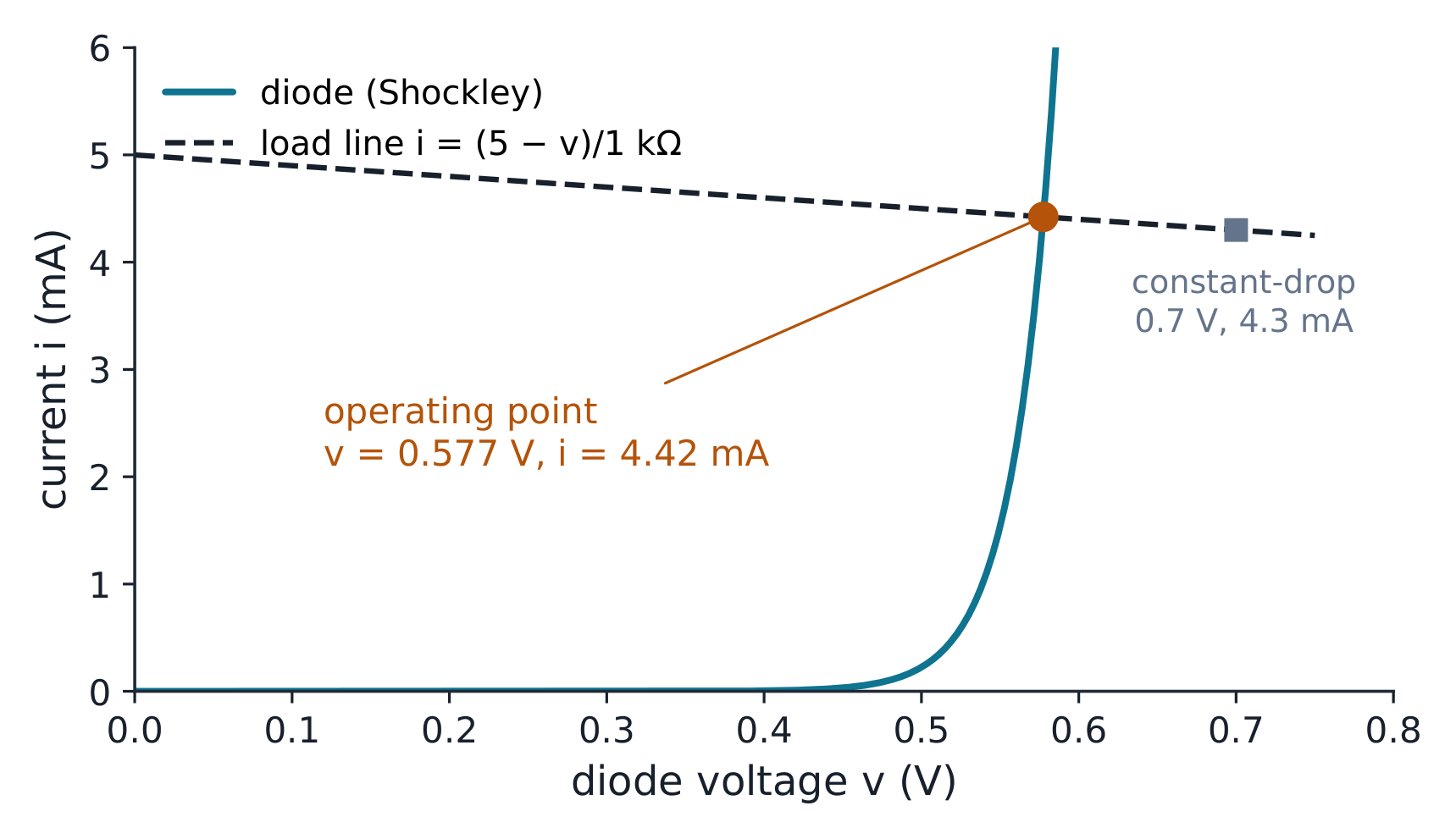
- 5 V drives a diode in series with 1 kΩ. Ideal: 5 mA. Constant-drop: $\dfrac{5 - 0.7}{1000} = 4.3\,\text{mA}$.
- Shockley ($I_{S} = 10^{-12}\,\text{A}$), solved numerically: $v_{D} = 0.5775\,\text{V}$, $i = 4.42\,\text{mA}$. The constant-drop answer is within 2.8%: its 0.12 V error becomes only 0.12 mA through 1 kΩ.
A 5 V source, diode and 1 kΩ. The constant-drop model reads
Difficulté 1/5 · 100 pièces + un petit bonus lors de la première réussite aujourd'hui
The 0.7 V drop leaves 4.3 V across 1 kΩ. The Shockley solution gives 4.42 mA; the resistor dominates the loop, so the simple model is close.
A 12 V supply drives an LED (take a 2.0 V drop) through 470 Ω. What is the current, in mA?
Difficulté 2/5 · 140 pièces + un petit bonus lors de la première réussite aujourd'hui
$\dfrac{12 - 2.0}{470} = 21.3$ mA. The constant-drop model works for any diode; an LED just has a larger drop.
The dynamic resistance
- Differentiate the Shockley law at the operating point: the diode acts like a dynamic resistance 动态电阻 $r_{d} = \dfrac{nV_{T}}{I_{D}}$ for small changes. At 4.42 mA, $r_{d} = \dfrac{26\,\text{mV}}{4.42\,\text{mA}} = 5.9\,\Omega$.
- A ±0.1 V wiggle on the 5 V source then drives $\dfrac{0.1}{1005.9} = 99.4\,\mu\text{A}$: the diode adds only 5.9 Ω to the loop for the wiggle.
This is the small-signal idea of the whole course. The DC bias sets the operating point using the nonlinear law; small wiggles around it see a simple linear resistance.
At 4.42 mA the diode's dynamic resistance (n = 1) is
Difficulté 1/5 · 100 pièces + un petit bonus lors de la première réussite aujourd'hui
$r_{d} = \dfrac{nV_{T}}{I_{D}} = \dfrac{26\,\text{mV}}{4.42\,\text{mA}} = 5.9\,\Omega$. The 26 mV is $V_{T}$; the resistance divides it by the current.
What is a diode's dynamic resistance at 1 mA, in ohms (n = 1, V_T = 26 mV)?
Difficulté 2/5 · 140 pièces + un petit bonus lors de la première réussite aujourd'hui
$\dfrac{26\,\text{mV}}{1\,\text{mA}} = 26\,\Omega$. Double the current and it halves: the diode looks stiffer the harder it conducts.
Three common slips
- Exponential model where a resistor dominates. The constant-drop model is the right tool there.
- "$r_{d}$ = 26 mV". That is $V_{T}$; the resistance is $\dfrac{nV_{T}}{I_{D}}$, with the current underneath.
- Forgetting n. At high current n approaches 2, and 60 mV per decade becomes 120 mV.
Recap
- A pn junction conducts one way, with a steep exponential forward curve.
- Ideal, constant-drop, piecewise-linear, exponential: pick the simplest model that answers the question.
- Small signals see $r_{d} = \dfrac{nV_{T}}{I_{D}}$ around the bias point.