Thermal expansion and specific heat capacity
Introduit| English | Sens |
|---|---|
| specific heat capacity/spəˈsɪfɪk hiːt kəˈpæsɪti/ | capacité thermique massique |
| thermal expansion/ˈθɜːml ekˈspænʃn/ | dilatation thermique |
| internal energy/ɪnˈtɜːnl ˈenədʒi/ | énergie interne |
Why bridges have gaps
- Railway lines have small gaps; bridges sit on rollers; power cables hang loose in summer.
- All for the same reason: things get bigger when they are heated.
- Heating also stores energy inside matter — measured by its specific heat capacity 比热容.
Thermal expansion 热膨胀
- Heat a material and its particles move more, so they take up more space — it expands.
- Gases expand the most, then liquids, then solids (whose particles are held tightly).
- Engineers leave gaps in rails and put bridges on rollers so the expansion does not buckle them.
- A tight metal jar lid loosens when you run it under hot water — the metal expands.
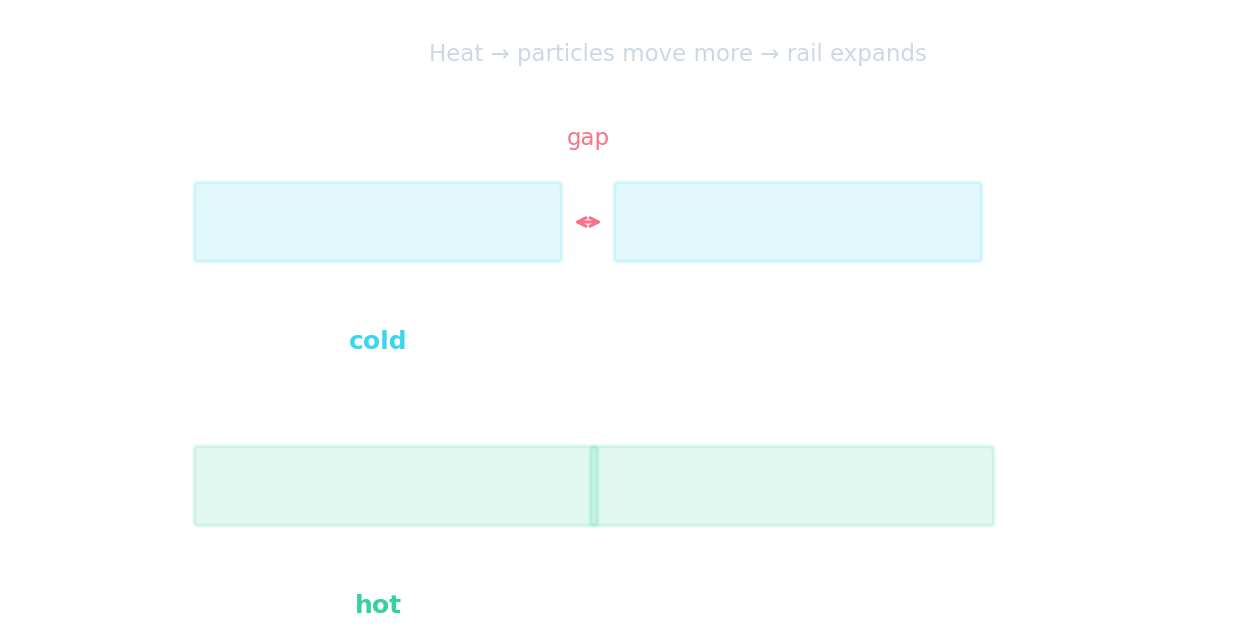
Thermal expansion: heating makes the rail longer, closing the gap left for it.
The particles don't get bigger. When a solid expands, the particles themselves stay the same size — they just vibrate more and push further apart. This is a common exam misconception.
For the same rise in temperature, which expands the most?
Difficulté 1/5 · 100 pièces + un petit bonus lors de la première réussite aujourd'hui
Gases expand the most, then liquids, then solids (whose particles are held most tightly).
Why are small gaps left between railway lines?
Difficulté 1/5 · 100 pièces + un petit bonus lors de la première réussite aujourd'hui
On a hot day the rails expand. The gaps give the extra length somewhere to go, so the track does not bend out of shape.
Internal energy 内能
- The internal energy of an object is the total energy of all its particles (their movement and arrangement).
- Heating an object raises its internal energy — usually raising its temperature too.
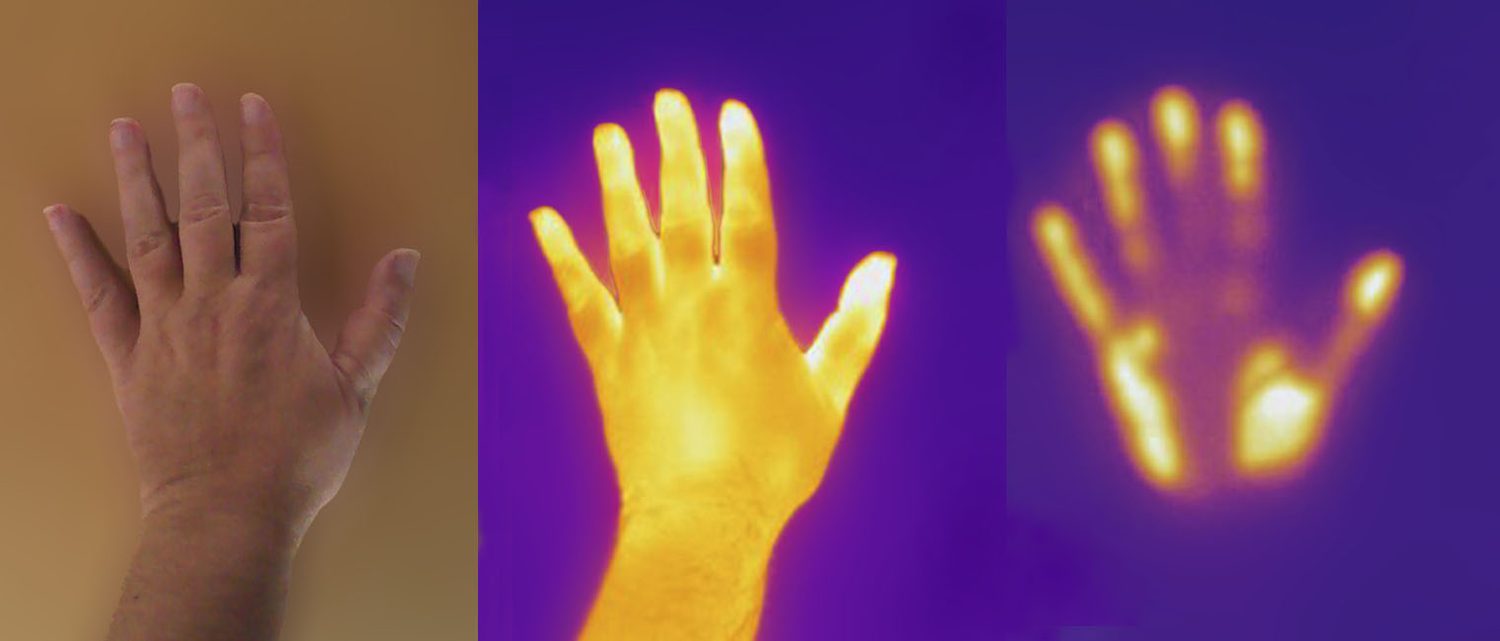
The same hand in ordinary light and through a thermal (infrared) camera
Specific heat capacity
- The specific heat capacity $c$ is the energy needed to raise the temperature of $1\ \text{kg}$ of a material by $1\ {}^{\circ}\text{C}$:
- So the energy to warm something is $\Delta E = m c\,\Delta\theta$.
- Water has a very high $c$ ($\approx 4200$ joules per kg per °C): it needs a lot of energy to warm up and cools down slowly. That is why the sea stays mild and water is used in heating systems.
Worked example. A kettle heats $0.50\ \text{kg}$ of water from $20\ {}^{\circ}\text{C}$ to $100\ {}^{\circ}\text{C}$. How much energy does the water gain? ($c = 4200$ J per kg per °C)
- Temperature rise: $\Delta\theta = 100 - 20 = 80\ {}^{\circ}\text{C}$. Then $\Delta E = mc\,\Delta\theta = 0.50 \times 4200 \times 80 = 168\,000\ \text{J}$ (168 kJ).
- An aluminium pan of the same mass ($c = 900$) would need only $0.50 \times 900 \times 80 = 36\,000\ \text{J}$ — under a quarter as much — because its specific heat capacity is lower.
Heating and specific heat capacity
Q = mcΔT
The heat energy needed is proportional to the temperature rise for a given mass of material.
How much energy is needed to heat $2.0\ \text{kg}$ of water by $10\ {}^{\circ}\text{C}$? (Use $c = 4200$ J per kg per °C.)
Difficulté 2/5 · 140 pièces + un petit bonus lors de la première réussite aujourd'hui
$\Delta E = mc\,\Delta\theta = 2.0 \times 4200 \times 10 = 84\,000\ \text{J}$.
Adding $8400\ \text{J}$ raises the temperature of $0.50\ \text{kg}$ of a metal by $40\ {}^{\circ}\text{C}$. What is its specific heat capacity, in J per kg per °C?
Difficulté 2/5 · 140 pièces + un petit bonus lors de la première réussite aujourd'hui
$c = \dfrac{\Delta E}{m\,\Delta\theta} = \dfrac{8400}{0.50 \times 40} = \dfrac{8400}{20} = 420$ J per kg per °C.
Because water has a high specific heat capacity, it warms up and cools down slowly.
Difficulté 1/5 · 100 pièces + un petit bonus lors de la première réussite aujourd'hui
A high specific heat capacity means a lot of energy is needed per degree, so water changes temperature slowly.
How much energy is needed to warm 2.0 kg of water from 15 °C to 25 °C? (c = 4200 J per kg per °C) Give your answer in J.
Difficulté 2/5 · 140 pièces + un petit bonus lors de la première réussite aujourd'hui
Δθ = 10 °C, so ΔE = 2.0 × 4200 × 10 = 84 000 J.
A 2.0 kg metal block takes 36 000 J to warm by 20 °C. What is its specific heat capacity, in J per kg per °C?
Difficulté 2/5 · 140 pièces + un petit bonus lors de la première réussite aujourd'hui
c = ΔE ÷ (m Δθ) = 36 000 ÷ (2.0 × 20) = 900 J per kg per °C.
You've got it
- heating makes matter expand — gases most, solids least; leave gaps for it
- internal energy = total energy of all the particles
- specific heat capacity $c = \dfrac{\Delta E}{m\,\Delta\theta}$, so $\Delta E = mc\,\Delta\theta$
- water has a high $c$ → warms and cools slowly
Write from the data: find the heating energy
- 1.5 kg of water is heated by 4 degrees. Use c = 4200 J per kg per degree.
- Find the energy. Say why water warms slowly compared with many metals.
How much energy heats 1.5 kg of water by 4 degrees if c is 4200 J per kg per degree, and why does the same energy warm many metals by more?
1.5 times 4200 is 6300, and 6300 times 4 is 25200 joules.
How much energy is needed?
Difficulté 1/5 · 100 pièces + un petit bonus lors de la première réussite aujourd'hui
1.5 times 4200 times 4 is 25200 joules. Other options — 84000 joules (the lesson example's result for 2.0 kg of water through 10 degrees); 420 joules per kg per degree (the lesson metal result).