Algèbre abstraite et théorie des nombres
Introduit| English | Sens |
|---|---|
| integral domain/ˈɪntɪɡrəl dəˈmeɪn/ | anneau intègre |
| kernel/ˈkɜːnl/ | noyau |
| zero divisor/ˈzɪərəʊ dɪˈvaɪzə/ | diviseur de zéro |
When division fails on a clock
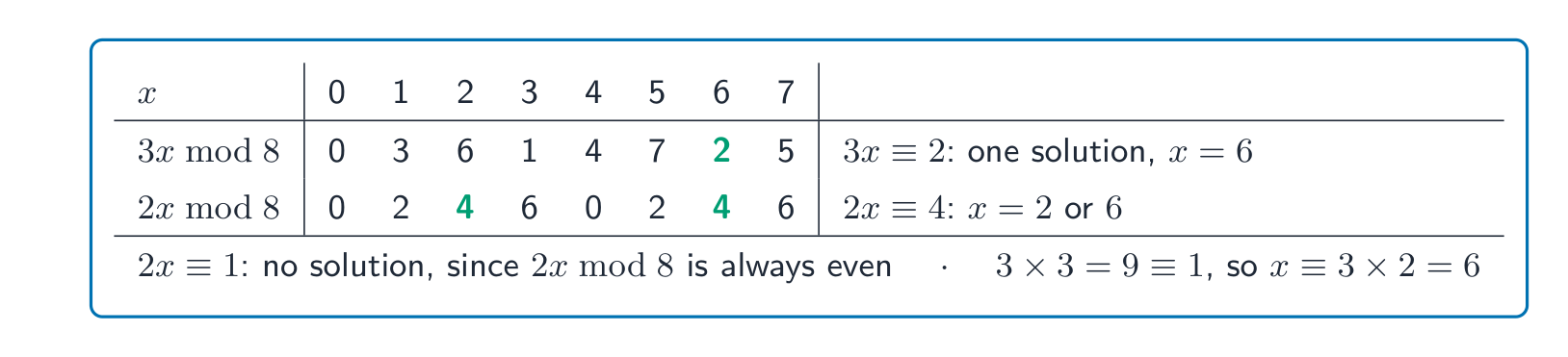
- A clock calculation keeps only a remainder. Modulo 8, $3\cdot3\equiv1$, so multiplying by 3 undoes multiplication by 3. But $2x\equiv1\pmod8$ has no integer solution: an even number cannot differ from 1 by a multiple of 8.
- The available operations depend on the structure: group, ring, integral domain 整环 or field. Throughout, $\mathbb Z_n$ means integer residue classes modulo $n$, with $n\ge2$; use the stated operation.
A group needs an operation and inverses
- A group has a closed associative operation, an identity and an inverse for every element. Commutativity is an extra property, called abelian. Inverses are relative to the operation: additive inverses are negatives; multiplicative inverses are reciprocals.
- $(\mathbb Z,+)$ and $(\mathbb Q\setminus\{0\},\times)$ are groups. The integers under multiplication fail because 2 has no integer inverse; the nonzero residues modulo 8 fail even closure, since $2\cdot4\equiv0$.
Which is a group?
Difficulté 1/5 · 100 pièces + un petit bonus lors de la première réussite aujourd'hui
The others lack inverses (or closure).
Subgroups and element orders
- A nonempty subset $H$ of a group is a subgroup if $ab^{-1}\in H$ for every $a,b\in H$. For additive groups, check $a-b\in H$. The subgroup generated by one element is cyclic; its order is the number of distinct elements it contains.
- In $(\mathbb Z_6,+)$, the element 2 generates $\{0,2,4\}$ and has order 3. Lagrange's theorem says a subgroup's size divides the size of a finite group. A subset of a suitable size still needs the subgroup test: $\{0,1\}$ has size 2 but is not closed under addition modulo 6.
Groupe ou pas ?
Vérifier la fermeture, l'associativité, l'élément neutre et les inverses pour chaque ensemble avec son opération indiquée.
What is the order of the element 4 in the additive group $\mathbb Z_{12}$?
Difficulté 2/5 · 140 pièces + un petit bonus lors de la première réussite aujourd'hui
The successive multiples are 4, 8, 0 modulo 12. The least positive number of additions returning to 0 is 3.
A student says that $\{0,1\}$ must be a subgroup of $(\mathbb Z_6,+)$ because 2 divides 6. Refute the claim and find a subgroup of order 2.
Le théorème de Lagrange donne une condition nécessaire de taille, pas un test de sous-groupe pour un sous-ensemble arbitraire. Le sous-ensemble proposé ne vérifie pas la stabilité : $1+1=2$ modulo 6 est hors de celui-ci. L’ensemble $\{0,3\}$ est un sous-groupe : il contient 0, $3+3=0$, et les deux éléments possèdent des opposés additifs dans l’ensemble. Son ordre est 2.
A homomorphism preserves the operation
- A group homomorphism $\varphi:G\to H$ satisfies $\varphi(ab)=\varphi(a)\varphi(b)$. Its kernel 核 is the set of elements sent to the identity. Thus $\ker\varphi=\{g:\varphi(g)=e_H\}$; the image is the set of outputs actually reached.
- The homomorphism is injective exactly when its kernel is $\{e_G\}$. If $\varphi(a)=\varphi(b)$, then $\varphi(ab^{-1})=e_H$; a trivial kernel forces $a=b$. A nontrivial kernel instead sends different inputs to the same output.
A homomorphism is injective exactly when its ____ is trivial.
Difficulté 1/5 · 100 pièces + un petit bonus lors de la première réussite aujourd'hui
Only the identity maps to the identity.
Quotients collect inputs with the same output
- For a normal subgroup $N$ ($gNg^{-1}=N$ for all $g\in G$), the cosets $gN$ form a quotient group, with $(gN)(hN)=(gh)N$. Normality makes this independent of representatives. Every kernel $K$ is normal, and $gK\mapsto\varphi(g)$ gives $G/K\cong\operatorname{im}\varphi$.
- For reduction $\varphi:\mathbb Z_{12}\to\mathbb Z_4$, the kernel is $\{0,4,8\}$. Two residues have the same output exactly when their difference is in that kernel. There are four cosets of size 3, so $\mathbb Z_{12}/\ker\varphi\cong\mathbb Z_4$. In general the quotient matches the image, which need not be the whole codomain.

For reduction $\varphi:\mathbb Z_{12}\to\mathbb Z_4$, how many elements are in the kernel?
Difficulté 2/5 · 140 pièces + un petit bonus lors de la première réussite aujourd'hui
The inputs sent to 0 modulo 4 are 0, 4 and 8. These are three distinct residues modulo 12.
Consider reduction $\psi:\mathbb Z_{18}\to\mathbb Z_6$. Show it is a well-defined additive homomorphism, find its kernel and image, and identify $\mathbb Z_{18}/\ker\psi$.
Les représentants différents par un multiple de 18 le sont aussi par un multiple de 6, donc la réduction est bien définie. La réduction préserve l’addition. Le noyau est $\{0,6,12\}$ et chaque classe modulo 6 est atteinte, donc l’image est $\mathbb Z_6$. La carte d’une classe du noyau vers sa valeur commune est une isomorphisme, donnant $\mathbb Z_{18}/\ker\psi\cong\mathbb Z_6$. Il existe six classes de taille 3.
Rings, zero divisors and fields
- A ring has an abelian additive group and associative multiplication distributing over addition; here it also has a multiplicative identity. An integral domain is a commutative ring with identity distinct from zero and no zero divisors. A zero divisor 零因子 is a nonzero element whose product with some nonzero element is zero.
- A field is a commutative ring with $1\ne0$ in which every nonzero element has a multiplicative inverse. Every field is a domain: if $ab=0$ and $a\ne0$, multiply by $a^{-1}$ to get $b=0$. The zero ring, where $1=0$, is excluded from both definitions.
Classify the structure, then calculate
- $\mathbb Z$ is a domain but not a field: 2 has no integer reciprocal. So is $\mathbb Q[x]$, the polynomial ring over the rationals: nonzero leading coefficients cannot multiply to zero, but the polynomial $x$ has no polynomial inverse.
- $\mathbb Z_6$ has $2\cdot3=0$ with both factors nonzero, so it is not a domain. For $n\ge2$, $\mathbb Z_n$ is a domain exactly when $n$ is prime; in that case it is a field. Composite moduli give nonzero factors of $n$ whose product is zero modulo $n$.
$\mathbb Z_7$ is an integral domain.
Difficulté 1/5 · 100 pièces + un petit bonus lors de la première réussite aujourd'hui
For n ≥ 2, the ring $\mathbb Z_n$ has no nonzero zero divisors exactly when n is prime. Since 7 is prime, $\mathbb Z_7$ is a field and hence an integral domain.
Which ring is an integral domain under the convention that 1 and 0 are distinct?
Difficulté 1/5 · 100 pièces + un petit bonus lors de la première réussite aujourd'hui
In $\mathbb Q[x]$, the product of nonzero polynomials has nonzero leading coefficient, so there are no zero divisors. In $\mathbb Z_6$, 2·3 = 0; in $\mathbb Z_4$, 2·2 = 0. The zero ring has 1 = 0.
Why a finite domain is a field
- Fix a nonzero $a$ in a finite integral domain $D$. The map $f(x)=ax$ is injective: $ax=ay$ gives $a(x-y)=0$, so $x=y$ because there are no zero divisors.
- An injective map from a finite set to itself is surjective. Hence some $x$ satisfies $ax=1$, giving an inverse for every nonzero $a$. Finiteness matters: multiplication by 2 on $\mathbb Z$ is injective but misses 1, so an infinite domain need not be a field.
Reconstruct the proof that every finite integral domain is a field. Explain separately why multiplication by 2 on $\mathbb Z$ and on $\mathbb Z_8$ cannot give the same conclusion.
Pour un $a$ non nul dans un anneau, $ax=ay$ implique $a(x-y)=0$, donc $x=y$. La multiplication par $a$ est injective. Sur un anneau fini, c'est ensuite surjective, donc 1 possède un antécédent, donnant une inverse de $a$. Sur $\mathbb Z$, la multiplication par 2 est injective mais pas surjective car l'ensemble est infini : 1 est absent. Sur $\mathbb Z_8$, l'ensemble est fini mais il y a des diviseurs de zéro : $2\cdot0=2\cdot4=0$, donc l'injectivité échoue.
Find an inverse with Bézout's identity
- For integers $a$ and $n\ge2$, $a$ has an inverse modulo $n$ exactly when $\gcd(a,n)=1$. Bézout's identity writes this gcd as $ua+vn$; when it is 1, the coefficient $u$ is an inverse of $a$ modulo $n$.
- To invert 17 modulo 43, use $43=2\cdot17+9$, $17=9+8$, $9=8+1$. Back-substitution gives $1=2\cdot43-5\cdot17$, so the inverse is $-5\equiv38\pmod{43}$. Check: $17\cdot38=646=15\cdot43+1$.
Which residue has a multiplicative inverse modulo 9?
Difficulté 1/5 · 100 pièces + un petit bonus lors de la première réussite aujourd'hui
$\gcd(4, 9) = 1$; $4 \cdot 7 = 28 \equiv 1$.
Find the least nonnegative inverse of 17 modulo 43.
Difficulté 2/5 · 140 pièces + un petit bonus lors de la première réussite aujourd'hui
Bézout gives 1 = 2·43 − 5·17. Thus −5, or 38 modulo 43, is the inverse. Direct check: 17·38 = 646 = 15·43 + 1.
A gcd counts the solutions
- For $ax\equiv b\pmod n$, let $d=\gcd(a,n)$. There are no solutions if $d\nmid b$. If $d\mid b$, there are exactly $d$ distinct solution classes modulo $n$; reduce to $(a/d)x\equiv b/d\pmod{n/d}$ and then lift back.
- For $6x\equiv9\pmod{15}$, $d=3$. The reduced equation $2x\equiv3\pmod5$ gives $x\equiv4\pmod5$. Lifting gives $x\equiv4,9,14\pmod{15}$: three classes, not one.
Find the least non-negative $x$ with $5x \equiv 3 \pmod 7$.
Difficulté 2/5 · 140 pièces + un petit bonus lors de la première réussite aujourd'hui
$5 \cdot 2 = 10 \equiv 3$.
How many distinct solution classes modulo 15 satisfy $6x\equiv9\pmod{15}$?
Difficulté 2/5 · 140 pièces + un petit bonus lors de la première réussite aujourd'hui
The gcd is 3, which divides 9. Dividing both sides and the modulus gives 2x ≡ 3 (mod 5), so x ≡ 4 (mod 5). The three classes modulo 15 are 4, 9 and 14.
Cancelling can change the modulus
- Cancelling an invertible factor keeps the modulus. In general, $ab\equiv ac\pmod n$ is equivalent to $b\equiv c\pmod{n/\gcd(a,n)}$. A common factor may be cancelled if the modulus is adjusted correctly.
- Thus $2x\equiv4\pmod8$ becomes $x\equiv2\pmod4$, giving the two classes $2,6$ modulo 8. Keeping modulus 8 after dividing would lose a solution. By contrast, $2x\equiv1\pmod8$ has no solution, since $\gcd(2,8)=2$ does not divide 1.
Combien de classes de résidus ?
Comptez le nombre de classes de solutions distinctes modulo le module indiqué, en utilisant le critère du pgcd.
Reduce powers only with the right hypotheses
- Euler's theorem gives $a^{\phi(n)}\equiv1\pmod n$ when $\gcd(a,n)=1$; $\phi(n)$ counts invertible residue classes. For prime $p$, Fermat gives $a^{p-1}\equiv1\pmod p$ if $p\nmid a$. The form $a^p\equiv a\pmod p$ holds for every integer $a$.
- Since $100=16\cdot6+4$, $3^{100}\equiv3^4\equiv4\pmod7$. Do not drop the coprimality condition: $\phi(8)=4$ but $2^4\equiv0\pmod8$, not 1.
Find the least nonnegative residue of $3^{100}$ modulo 7.
Difficulté 2/5 · 140 pièces + un petit bonus lors de la première réussite aujourd'hui
Since 7 is prime and does not divide 3, 3⁶ ≡ 1 (mod 7). Then 3¹⁰⁰ ≡ 3⁴ = 81 ≡ 4 (mod 7).
Combine congruences with compatible remainders
- The Chinese remainder theorem says that for coprime positive moduli $m,n$, any pair of remainders determines exactly one class modulo $mn$. For $x\equiv2\pmod3$ and $x\equiv3\pmod5$, write $x=2+3k$: $3k\equiv1\pmod5$, so $k\equiv2\pmod5$ and $x\equiv8\pmod{15}$.
- Without coprimality, check compatibility: remainders $a,b$ must agree modulo $\gcd(m,n)$. If they do, the combined class is unique modulo $\operatorname{lcm}(m,n)$, not necessarily $mn$. If they disagree, no integer satisfies both congruences.
Find the least nonnegative integer satisfying $x\equiv2\pmod3$ et $x\equiv3\pmod5$.
Difficulté 2/5 · 140 pièces + un petit bonus lors de la première réussite aujourd'hui
Write x = 2 + 3k. Modulo 5, 3k ≡ 1, so k ≡ 2 and x ≡ 8 (mod 15). Because 3 and 5 are coprime, this class is unique modulo 15.
Name the structure and keep the hypotheses
- Check the operation, identity and inverses before calling a set a group. Form quotient groups by normal subgroups; a homomorphism's quotient by its kernel matches its image. A finite domain is a field, but an infinite domain need not be.
- Before dividing or reducing a power, compute the gcd. Track the modulus when cancelling and lift all residue classes. For simultaneous congruences, check compatibility and report the correct combined modulus.
Solve $x\equiv2\pmod6$, $x\equiv5\pmod9$, giving all integers and the correct combined modulus. Then decide whether replacing the second remainder by 4 leaves any solution.
Le pgcd de 6 et 9 est 3, et les restes 2 et 5 sont congrus modulo 3. Écrivez $x=2+6k$. Alors $6k\equiv3\pmod9$, donc $2k\equiv1\pmod3$ et $k\equiv2\pmod3$. Ainsi $x=14+18t$ pour $t\in\mathbb Z$, une classe unique modulo $\operatorname{lcm}(6,9)=18$, mais pas 54. Les restes 2 et 4 ne sont pas congrus modulo 3, donc le couple modifié n'admet aucune solution.