Desintegración radiactiva y las tres radiaciones
Introducido| English | Significado |
|---|---|
| radioactivity/ˌreɪdɪəʊækˈtɪvɪti/ | radioactividad |
| radioactive decay/ˌreɪdɪəʊˈæktɪv dɪˈkeɪ/ | desintegración radiactiva |
| spontaneous/spɒnˈteɪnɪəs/ | espontánea |
| background radiation/ˈbækɡraʊnd ˌreɪdɪˈeɪʃn/ | radiación de fondo |
| radon/ˈreɪdɒn/ | radón |
| cosmic rays/ˈkɒzmɪk reɪz/ | rayos cósmicos |
| count rate/kaʊnt reɪt/ | tasa de conteo |
| alpha/ˈælfə/ | partícula alfa |
| ionising/ˈaɪənaɪzɪŋ/ | ionizante |
| beta/ˈbiːtə/ | partícula beta |
| gamma/ˈɡæmə/ | rayos gamma |
Unstable nuclei
- Some nuclei are unstable — sooner or later they break down and shoot out radiation.
- A Geiger counter clicks as it detects each burst.
- This is radioactivity 放射性, and it comes in three types.
Radioactive decay 放射性衰变
- An unstable nucleus breaks down and gives out radiation — radioactive decay.
- A nucleus may be unstable because it has too many neutrons or is too heavy.
- Decay is spontaneous 自发 (you cannot speed it up or slow it down) and random (you cannot say which nucleus is next, or exactly when).
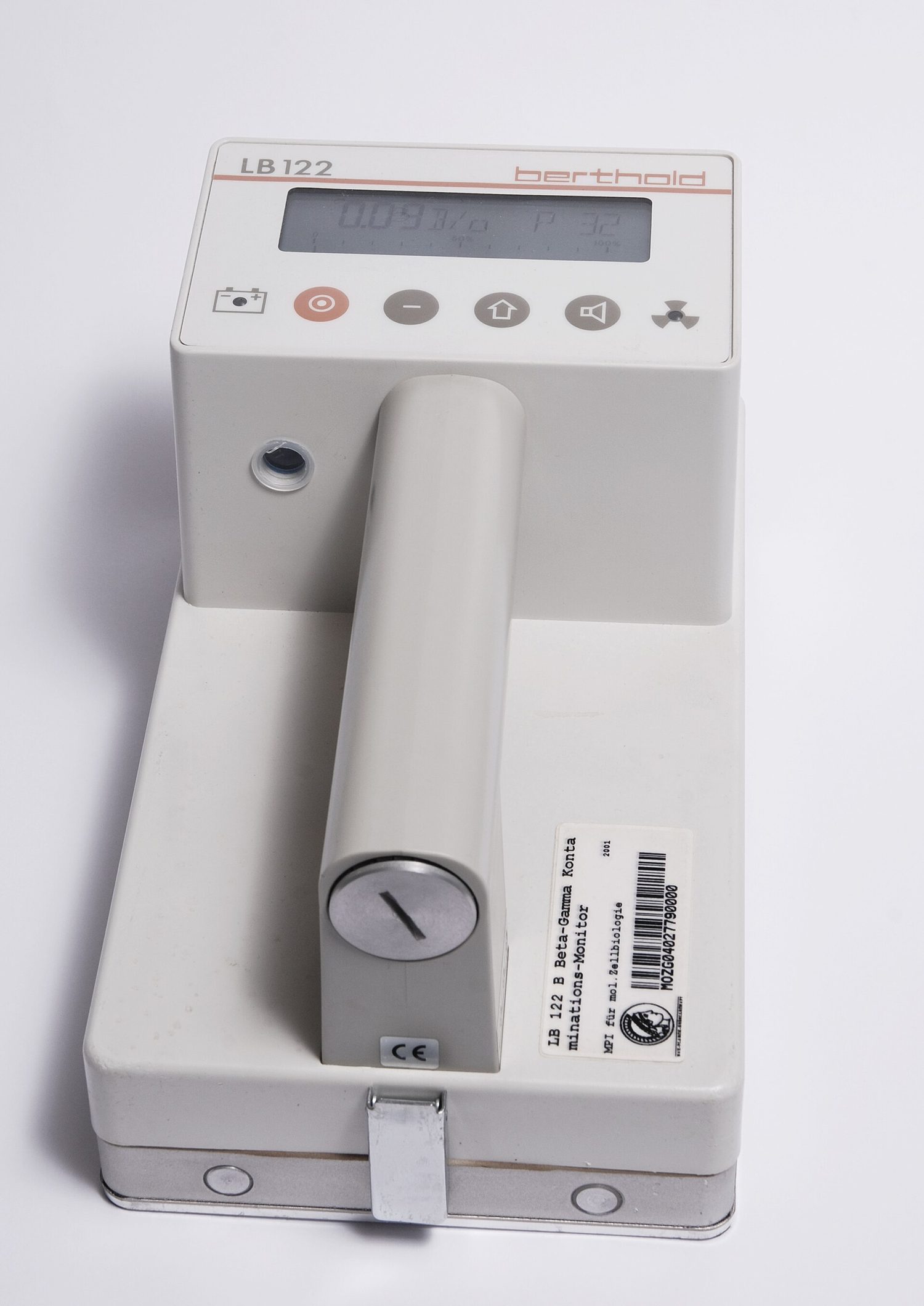
A Geiger counter detects and counts radiation
Desintegración radiactiva
N = N₀·bᵗ
El número de núcleos inestables decae exponencialmente.
La desintegración radiactiva es espontánea y aleatoria. Esto significa que:
Dificultad 1/5 · 100 monedas + un pequeño bono en el primer intento de hoy
Espontáneo = no desencadenado y no controlable; aleatorio = no puedes decir qué núcleo se desintegrará a continuación o exactamente cuándo.
Background radiation 背景辐射 and measuring
- Some radiation is around us all the time — background radiation.
- Main sources: radon 氡 gas (usually the biggest), rocks and buildings, food and drink, cosmic rays 宇宙射线 from space.
- A detector and counter give the count rate 计数率 (counts per second or minute).
- To find a source's true rate, subtract the background:
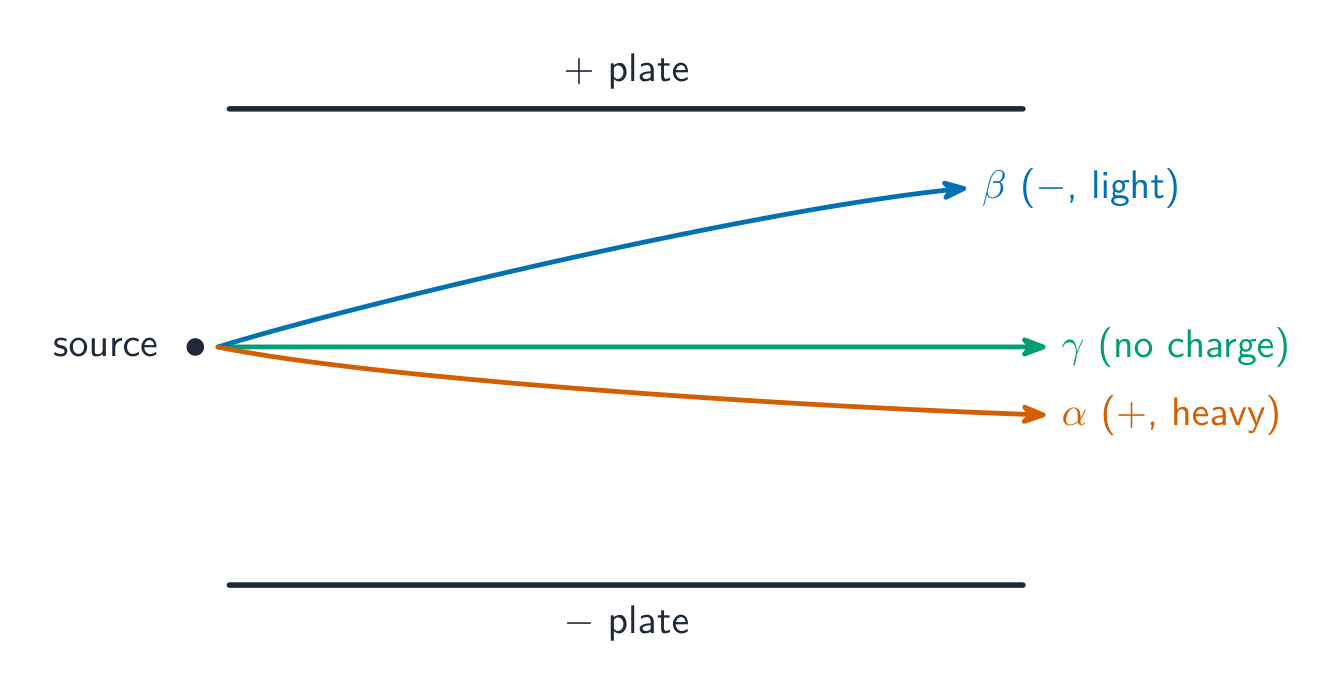
Deflection of radiation in an electric field
Una fuente marca $250$ cuentas/min. El fondo es $30$ cuentas/min. ¿Cuál es la tasa de conteo corregida, en cuentas/min?
Dificultad 2/5 · 140 monedas + un pequeño bono en el primer intento de hoy
Corregido = medido − fondo = $250 - 30 = 220$ cuentas/min.
The three types of radiation
- Alpha α粒子 (α) — a helium nucleus (charge $+2$): most ionising 电离, least penetrating — stopped by paper.
- Beta β粒子 (β) — a fast electron (charge $-1$): medium — stopped by a few mm of aluminium.
- Gamma γ射线 (γ) — a high-energy EM wave (no charge): least ionising, most penetrating — only reduced by thick lead.
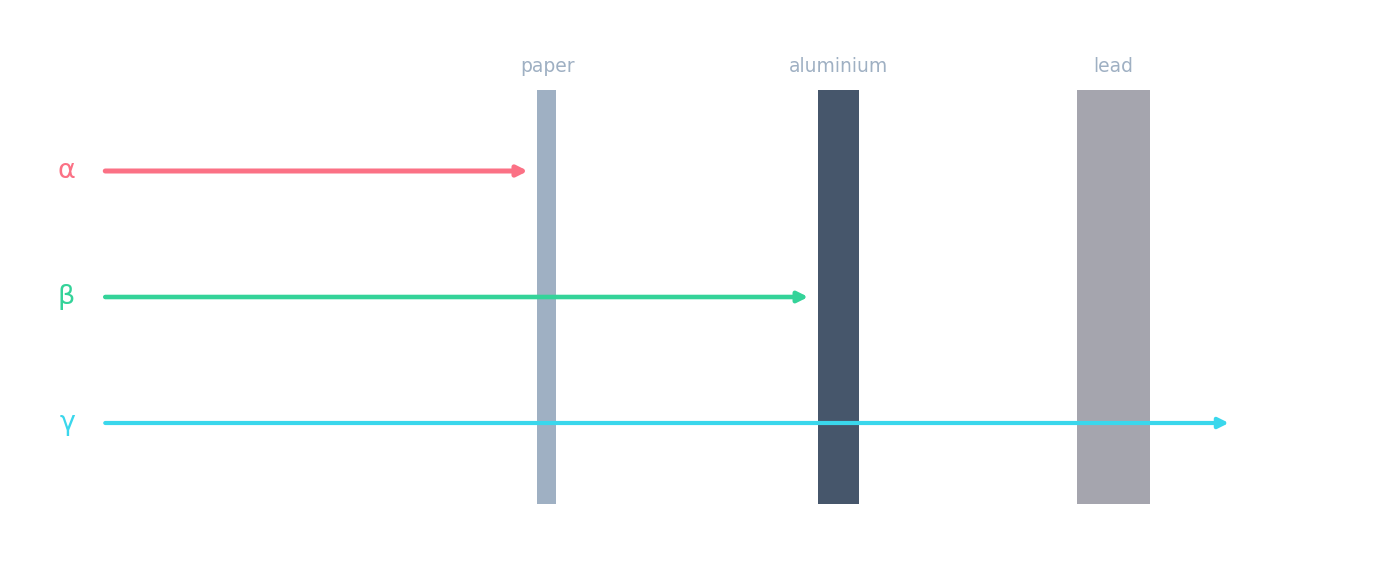
Asocia cada radiación con lo que la detiene.
Dificultad 2/5 · 140 monedas + un pequeño bono en el primer intento de hoy
Alpha es el menos penetrante (papel), beta es medio (aluminio), gamma es el más penetrante (el plomo grueso solo reduce su intensidad).
¿Qué radiación es la más ionizante pero la menos penetrante?
Dificultad 1/5 · 100 monedas + un pequeño bono en el primer intento de hoy
Alpha es la más ionizante (gran carga +2, lenta y pesada) pero se absorbe fácilmente —es la menos penetrante.
Deflection and decay equations
- Because α and β are charged, fields deflect them — in opposite directions (the lighter β bends more). Gamma (no charge) is not deflected.
- Alpha decay: lose 2 protons + 2 neutrons, so $A$ falls by 4 and $Z$ by 2.
- Beta decay: a neutron becomes a proton + the emitted electron, so $A$ stays the same and $Z$ rises by 1, e.g. $^{24}_{11}\text{Na} \rightarrow {}^{24}_{12}\text{Mg} + {}^{\ \ 0}_{-1}\beta$.
- Gamma: only energy leaves, so $A$ and $Z$ are unchanged.
Cuando un núcleo emite una partícula alfa, el número nucleónico A y el número atómico Z cambian en:
Dificultad 1/5 · 100 monedas + un pequeño bono en el primer intento de hoy
Una partícula alfa consta de 2 protones + 2 neutrones, por lo que A baja en 4 y Z baja en 2.
La radiación gamma es desviada por un campo magnético.
Dificultad 1/5 · 100 monedas + un pequeño bono en el primer intento de hoy
Los rayos gamma no tienen carga, por lo que no son desviados. Solo las partículas cargadas alfa y beta se curvan en campos.
Worked examples
1. A detector reads $340$ counts/min near a source; background is $20$ counts/min. Corrected count rate $= 340 - 20 = 320$ counts/min.
2. Paper barely changes the count; $3\ \text{mm}$ of aluminium brings it down to background. The source gives beta: not alpha (paper would stop it), not gamma (aluminium would not stop it).
Subtract the background first. It is there even with no source, so leaving it in makes every source look stronger.
You've got it
- decay is spontaneous and random; corrected rate = measured − background
- α (He nucleus, +2): most ionising, stopped by paper
- β (electron, −1): medium, stopped by aluminium; γ (EM wave): most penetrating, lead
- α decay: $A{-}4$, $Z{-}2$ · β decay: $A$ same, $Z{+}1$ · γ: no change; only α and β are deflected
Write from the data: find the corrected rate
- A detector reads 180 counts per minute. The background is 20 counts per minute.
- Find the corrected rate. Say what stops alpha radiation.
Una fuente emite 180 conteos por minuto y el fondo es de 20 conteos por minuto. ¿Cuál es la tasa corregida y qué detiene la radiación alfa?
180 menos 20 es 160. El fondo no forma parte de la tasa propia de la fuente.
¿Cuál es la tasa de conteo corregida?
Dificultad 1/5 · 100 monedas + un pequeño bono en el primer intento de hoy
180 menos 20 es 160 conteos por minuto.