Circuits with Capacitors and Inductors (LC Circuits)
Introducido| English | Significado |
|---|---|
| oscillate/ˈɒsɪleɪt/ | oscilar |
| resonance/ˈrezənəns/ | resonancia |
Energy sloshing back and forth — an electrical pendulum
- Charge a capacitor, connect it to an inductor, and something surprising happens.
- In an ideal circuit with no resistance or radiation loss, the energy swings back and forth; real circuits lose energy and their oscillations decay.
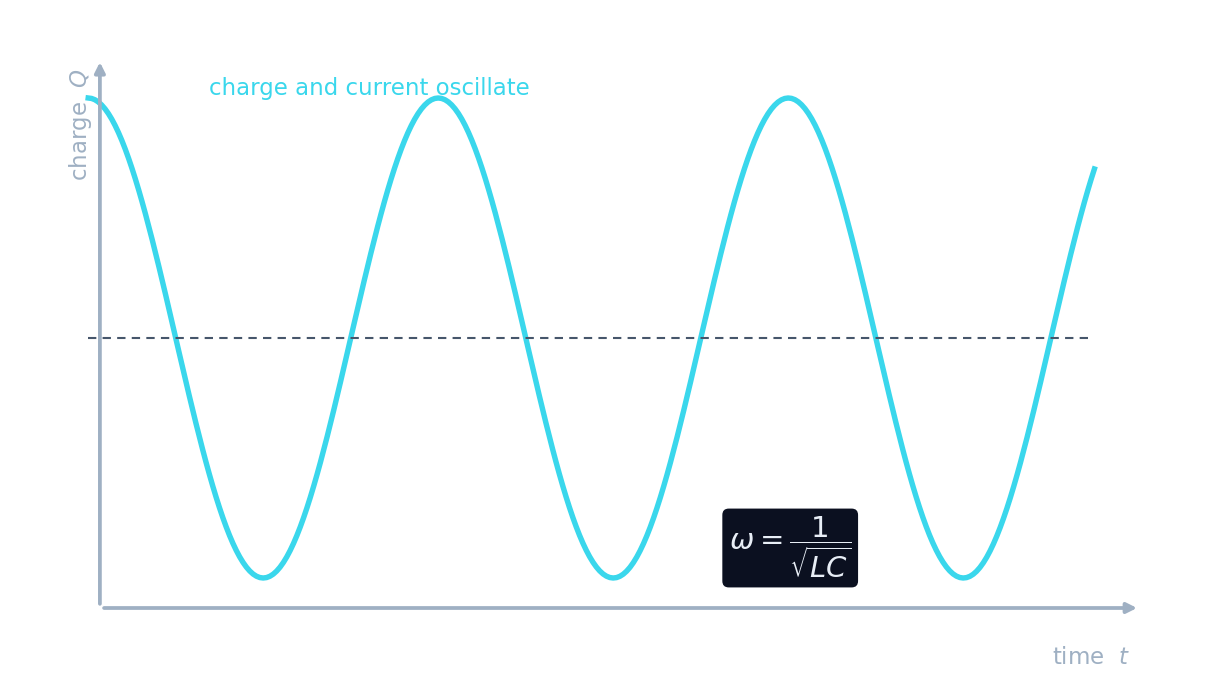
- The charge and current oscillate 振荡, like a pendulum swinging.
- A capacitor and inductor together make an LC circuit — the heart of a radio.
Energy trades between C and L
- The capacitor starts full: all the energy is in its electric field.
- It discharges through the inductor, driving a current.
- Now the energy is in the inductor's magnetic field.
- The inductor keeps the current going, recharging the capacitor the other way — and it repeats.
In an LC circuit, energy trades between:
Dificultad 1/5 · 100 monedas + un pequeño bono en el primer intento de hoy
Energy sloshes between the capacitor's E field and the inductor's B field.
The oscillation frequency
- The charge swings sinusoidally at angular frequency $\omega = \dfrac{1}{\sqrt{LC}}$.
- A bigger $L$ or $C$ means slower oscillation (a lower frequency).
- With no resistance the oscillation, in principle, never dies out.
- The current magnitude is largest when capacitor charge is zero; current is zero at maximum positive or negative charge.
The angular frequency of an LC circuit is:
Dificultad 1/5 · 100 monedas + un pequeño bono en el primer intento de hoy
$\omega = 1/\sqrt{LC}$ sets the oscillation rate.
An LC circuit has $L = 4\ \text{H}$ y $C = 1\ \text{F}$. Find $\omega$ (in rad/s).
Dificultad 2/5 · 140 monedas + un pequeño bono en el primer intento de hoy
$\omega = 1/\sqrt{LC} = 1/\sqrt{4} = 0.5\ \text{rad/s}$.
Just like a mass on a spring
- The LC circuit is the exact electrical twin of a mass–spring oscillator.
- Charge $Q$ plays the role of position; current $I$ plays the role of velocity.
- Inductance $L$ is like mass (inertia); $1/C$ is like the spring constant.
- Both obey the same equation, so both give simple harmonic motion.
LC circuit oscillations
In an LC circuit energy sloshes between the capacitor and the inductor - the electrical version of simple harmonic motion.
An LC circuit is the electrical analogue of a mass oscillating on a spring.
Dificultad 1/5 · 100 monedas + un pequeño bono en el primer intento de hoy
Charge ~ position, current ~ velocity, L ~ mass, 1/C ~ spring constant.
Select all true statements about an ideal LC circuit with nonzero stored energy and no resistance.
Dificultad 2/5 · 140 monedas + un pequeño bono en el primer intento de hoy
Oscillation, ω = 1/√(LC), SHM analogy. An ideal LC loses no energy — it just swaps.
Why it matters: tuning a radio
- Every radio station broadcasts at its own frequency.
- An LC tuning circuit resonates 共振 strongly near $\omega = 1/\sqrt{LC}$, responding more strongly near that frequency than far from it; selectivity depends on damping.
- Turning the tuning dial changes $C$, shifting which station you pick up.
- LC resonance is how a receiver plucks one signal from the air.
A radio uses an LC circuit's strong ____ at one frequency to pick a station.
Dificultad 1/5 · 100 monedas + un pequeño bono en el primer intento de hoy
LC resonance at $\omega = 1/\sqrt{LC}$ selects one station.
An LC circuit has $L = 1\ \text{H}$ and $C = 0.25\ \text{F}$. Find its angular frequency.
- $\omega = \dfrac{1}{\sqrt{LC}} = \dfrac{1}{\sqrt{1 \times 0.25}} = \dfrac{1}{0.5}$.
- $\omega = 2\ \text{rad/s}$.
In an ideal LC circuit the energy is never lost — it just swaps between the capacitor and inductor forever. The current is largest when the capacitor is empty (all magnetic energy), not when it is full. Line up energy and charge carefully.
An LC circuit oscillates as energy trades between the capacitor's electric field and the inductor's magnetic field, at $\omega = 1/\sqrt{LC}$. It is the electrical twin of a mass on a spring (SHM), and its resonance is how a radio tunes to one station.
Write from the data: find the angular frequency
- An LC circuit has L = 1 henry and C = 1/9 farad.
- Find the angular frequency. Say the current when the capacitor charge is maximum.
An LC circuit has inductance 1 henry and capacitance 1/9 farad. What is its angular frequency, and what is the current when the capacitor charge is maximum?
L C is 1/9, so the square root is 1/3 and the angular frequency is 3 radians per second.
An ideal LC circuit has L = 1 henry and C = 1/9 farad. What is its angular frequency, and what is the current when capacitor charge is maximum?
Dificultad 1/5 · 100 monedas + un pequeño bono en el primer intento de hoy
1 over the square root of 1/9 is 3 radians per second, and maximum charge means zero current.