Solving Related Rates Problems
Introducido| English | Significado |
|---|---|
| related rates/rɪˈleɪtɪd reɪts/ | Rates of change linked by a relationship between quantities, analysed by differentiating that relationship with respect to time. |
| similar triangles | similar triangles |
When two things change together
- A ladder slides down a wall; water fills a cone; two cars drive away from a crossroads. One rate is known and you want another. They are linked because the quantities are linked by an equation.
- Related rates 相关变化率 problems follow the same five steps every time. AP free-response questions usually include one.
The five steps
- 1. Draw and label everything that changes with letters; write the given rate and the wanted rate. 2. Relate the quantities with one equation (Pythagoras, area, volume, similar triangles).
- 3. Differentiate with respect to $t$ (every variable gets a $\frac{d}{dt}$). 4. Substitute the values at that instant. 5. Solve, with units and a sentence.
Volume grows fastest when big
y = a·x³ (V vs r)
Porque $\tfrac{dV}{dt}=4\pi r^2\tfrac{dr}{dt}$, a fixed radius rate makes the volume rate soar as $r$ grows.
A balloon. The radius of a spherical balloon grows at $2$ cm/s. How fast is the volume growing when $r=5$ cm?
- $V=\tfrac43\pi r^3$, so $\dfrac{dV}{dt}=4\pi r^2\dfrac{dr}{dt}$.
- Now substitute: $\dfrac{dV}{dt}=4\pi(25)(2)=200\pi\approx628\ \text{cm}^3/\text{s}$.
A circle's radius grows at 3 cm/s. How fast is its area growing when r = 10 cm? Give cm²/s to 1 decimal place.
Dificultad 2/5 · 140 monedas + un pequeño bono en el primer intento de hoy
dA/dt = 2πr dr/dt = 2π(10)(3) = 60π ≈ 188.5 cm²/s.
Differentiate first, substitute last
- A quantity that changes must stay a letter until you have differentiated. If you put $r=5$ in first, $V$ becomes a constant and its rate becomes 0.
- Only true constants (the ladder's length, the cone's shape) may be put in early.
A student puts r = 5 into V = (4/3)πr³ before differentiating and gets dV/dt = 0. What went wrong?
Dificultad 1/5 · 100 monedas + un pequeño bono en el primer intento de hoy
Substituting early turns a changing quantity into a constant, so its rate is lost.
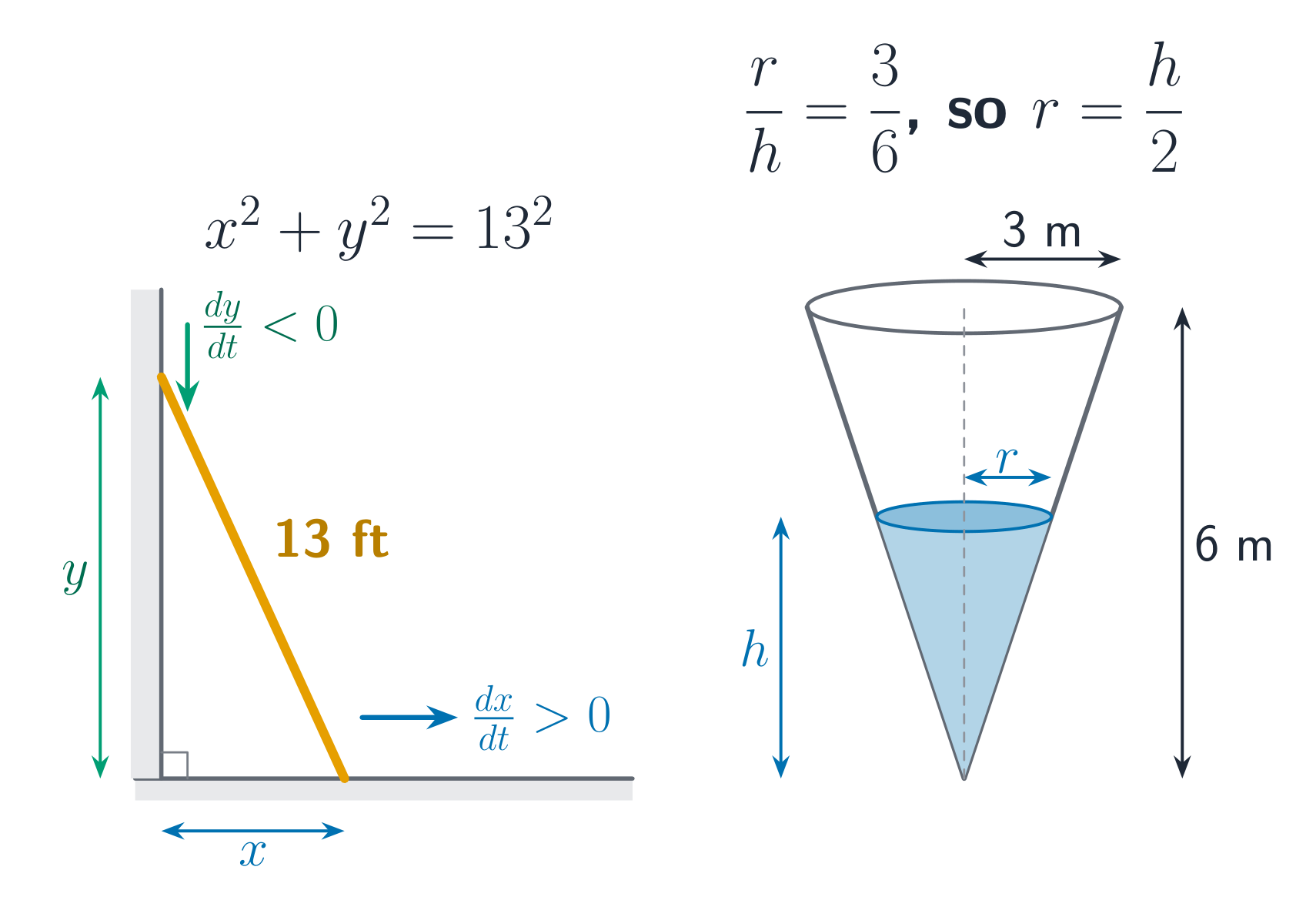
The sliding ladder. A 13 ft ladder leans on a wall. Its foot slides away at 2 ft/s. How fast is the top sliding down when the foot is 5 ft from the wall?
- Relate: $x^2+y^2=169$. Differentiate: $2x\dfrac{dx}{dt}+2y\dfrac{dy}{dt}=0$.
- At this instant $x=5$, so $y=\sqrt{169-25}=12$. Find every value before you substitute.
- $2(5)(2)+2(12)\dfrac{dy}{dt}=0$, so $\dfrac{dy}{dt}=-\dfrac56$ ft/s. The top slides down at $\tfrac56$ ft/s.
A 10 ft ladder's foot slides away from a wall at 1 ft/s. Find dy/dt (ft/s) for the top when the foot is 6 ft from the wall.
Dificultad 2/5 · 140 monedas + un pequeño bono en el primer intento de hoy
y = 8; 2(6)(1) + 2(8)dy/dt = 0, so dy/dt = −0.75 ft/s.
Filling a cone. Water pours at $2\ \text{m}^3/\text{min}$ into a cone (point down) with height 6 m and top radius 3 m. How fast is the water level rising when $h=4$ m?
- $V=\tfrac13\pi r^2h$ has two variables. Similar triangles give $r=\tfrac h2$, so $V=\dfrac{\pi h^3}{12}$.
- $\dfrac{dV}{dt}=\dfrac{\pi h^2}{4}\dfrac{dh}{dt}$, so $2=\dfrac{\pi(16)}{4}\dfrac{dh}{dt}$ and $\dfrac{dh}{dt}=\dfrac1{2\pi}\approx0.159$ m/min.
Same cone (r = h/2). Water pours in at 3 m³/min. How fast, in m/min, is h rising when h = 2 m? Give 3 significant figures.
Dificultad 2/5 · 140 monedas + un pequeño bono en el primer intento de hoy
dV/dt = (πh²/4) dh/dt, so 3 = π dh/dt and dh/dt = 3/π ≈ 0.955 m/min.
Removing an extra variable
- If the equation has a variable whose rate you do not know (like $r$ in the cone), replace it using the shape: similar triangles, a fixed ratio or a fixed length.
- Do this before differentiating, so that only the variables with known or wanted rates are left.
Two cars. Car A drives north at 60 mi/h; car B drives east at 80 mi/h, both from the same crossroads. How fast is the distance between them growing when A is 4 mi and B is 3 mi from the crossroads?
- $z^2=x^2+y^2$, so $z\dfrac{dz}{dt}=x\dfrac{dx}{dt}+y\dfrac{dy}{dt}$. At this instant $z=5$.
- $5\dfrac{dz}{dt}=3(80)+4(60)=480$, so $\dfrac{dz}{dt}=96$ mi/h.
Car B drives east at 30 mi/h and car A north at 40 mi/h from the same point. How fast does the distance between them grow when B is 6 mi and A is 8 mi from the point?
Dificultad 2/5 · 140 monedas + un pequeño bono en el primer intento de hoy
z = 10; 10 dz/dt = 6(30) + 8(40) = 500, so dz/dt = 50 mi/h.
- Never substitute a changing value before differentiating.
- Signs carry meaning: a quantity that is shrinking has a negative rate. Say "decreasing at 5/6 ft/s" rather than "−5/6".
- Give units of a rate (ft/s, m³/min) and answer in a sentence: AP awards a point for it.
Air enters a spherical balloon at 100 cm³/s. How fast is the radius growing when r = 5 cm? Give cm/s to 3 decimal places.
Dificultad 2/5 · 140 monedas + un pequeño bono en el primer intento de hoy
100 = 4π(25) dr/dt, so dr/dt = 1/π ≈ 0.318 cm/s.
- Draw → relate → differentiate in $t$ → substitute → solve.
- Find all values at the instant (Pythagoras, the shape) before substituting.
- Remove extra variables with the shape before differentiating.