Temperature scales · Escalas de temperatura
| English | Español |
|---|---|
| thermometer/θɜːˈmɒmɪtə/ | termómetro |
| thermocouple/ˈθɜːməkʌpl/ | termopar |
| thermodynamic/ˌθɜːməʊdaɪˈnæmɪk/ | termodinámico |
| kelvin/ˈkelvɪn/ | kelvin |
| absolute zero/ˈæbsəluːt ˈzɪərəʊ/ | cero absoluto |
| Celsius/ˈselsɪəs/ | Celsius |
How a thermometer 温度计 works
- A thermometer needs something that changes with temperature.
- A liquid expands, a metal's resistance rises, a gas swells.
- Read that change and you read the temperature.
Cómo funciona un termómetro 温度计
- Un termómetro necesita algo que cambie con la temperatura.
- Un líquido se expande, la resistencia de un metal aumenta, un gas se hincha.
- Lee ese cambio y leerás la temperatura.
Temperature scale lab · Laboratorio de escala de temperatura
Kelvin index = Celsius index + 2.73 · Índice Kelvin = Índice Celsius + 2.73
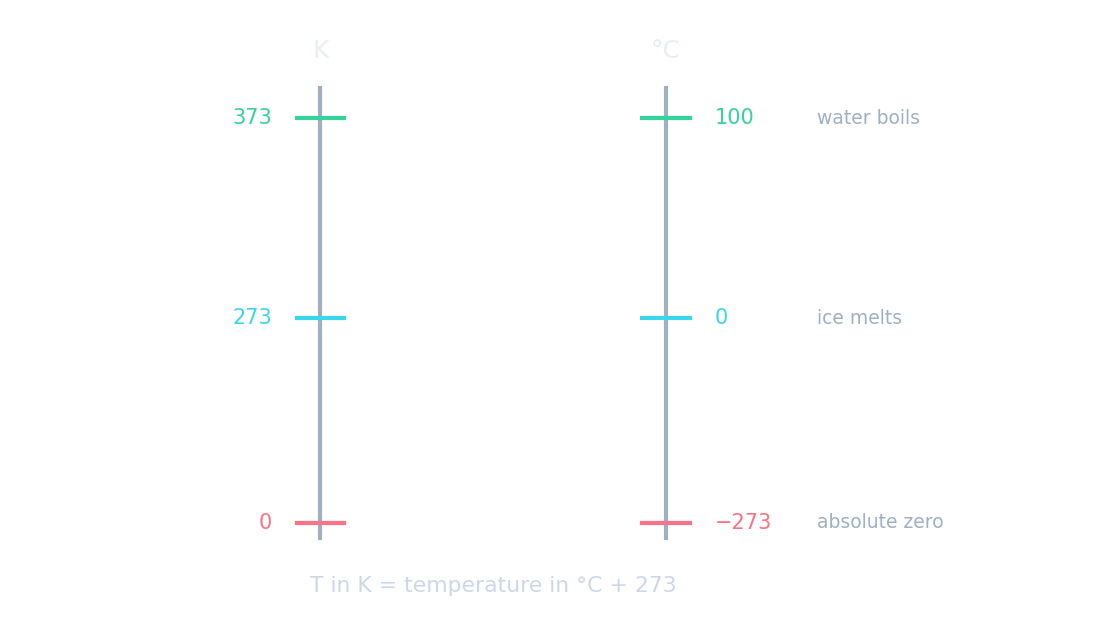
Slide Celsius temperature and see the Kelvin scale shift by 273. · Desplace la temperatura en Celsius y observe cómo se desplaza la escala Kelvin en 273.
Kinds of thermometer
- Anything that changes repeatably with temperature works:
- expansion of a liquid, resistance of a metal, e.m.f. of a thermocouple 热电偶, volume of a gas.
A thermometer measures temperature on a defined scale
Tipos de termómetro
- Cualquier cosa que cambie de forma repetible con la temperatura sirve:
- expansión de un líquido, resistencia de un metal, f.e.m. (fuerza electromotriz) de un termopar 热电偶, volumen de un gas.

Un termómetro mide la temperatura en una escala definida
Select all · todos the properties that can be used to measure temperature. · Seleccione todas las propiedades que pueden usarse para medir la temperatura.
Any property that changes repeatably with temperature works. The fixed colour of the case does not. · Cualquier propiedad que cambie repetidamente con la temperatura sirve. El color fijo de la caja no lo hace.
The absolute scale
- The thermodynamic 热力学 (absolute) scale uses the kelvin 开尔文 (K) and depends on no single substance.
- Absolute zero 绝对零度 ($0\ \text{K}$) is the lowest possible temperature — least internal energy. Nothing is colder.
La escala absoluta
- La escala termodinámica 热力学 (absoluta) usa la kelvin 开尔文 (K) y no depende de una sola sustancia.
- El cero absoluto 绝对零度 ($0\ \text{K}$) es la temperatura más baja posible — mínima energía interna. Nada es más frío.
Absolute zero (0 K) is: · El cero absoluto (0 K) es:
At 0 K a system has its least possible internal energy; nothing can be made colder. · A 0 K, un sistema tiene su energía interna mínima; nada puede enfriarse más.
Kelvin and Celsius 摄氏度
- $T/\text{K} = \theta/°\text{C} + 273.15$. So $0\ °\text{C} = 273\ \text{K}$.
- A kelvin and a Celsius degree are the same size, so a change of $1\ \text{K} = 1\ °\text{C}$.
- Always use kelvin in gas-law calculations.
Extrapolating the pressure-temperature line back to zero pressure gives absolute zero, about -273 degC
Kelvin y Celsius 摄氏度
- $T/\text{K} = \theta/°\text{C} + 273.15$. Por tanto, $0\ °\text{C} = 273\ \text{K}$.
- Un kelvin y un grado Celsius tienen el mismo tamaño, por lo que un cambio de $1\ \text{K} = 1\ °\text{C}$.
- Usa siempre kelvin en cálculos de leyes de los gases.

Extrapolando la línea de presión-temperatura hacia cero presión se obtiene el cero absoluto, aproximadamente -273 degC
What is $27\ °\text{C}$ in kelvin? · ¿Qué es $27\ °\text{C}$ en kelvin?
$T/\text{K} = \theta/°\text{C} + 273 = 27 + 273 = 300\ \text{K}$.
A temperature rise of 1 K is the same as a rise of 1 °C. · Un aumento de temperatura de 1 K es igual a un aumento de 1 °C.
The two scales have the same size of degree — only their zero points differ (by 273.15). · Ambas escalas tienen el mismo tamaño de grado; solo difieren sus puntos cero (en 273.15).
In gas-law calculations, the temperature must be in: · En los cálculos de leyes de gases, la temperatura debe estar en:
Gas laws use absolute temperature — kelvin. Using °C gives wrong answers. · Las leyes de los gases usan temperatura absoluta: kelvin. Usar °C da resultados incorrectos.
A temperature is 27 degrees Celsius. What is it in kelvin? · Una temperatura es de 27 grados Celsius. ¿Cuál es en kelvin?
T = 27 + 273 = 300 K. A temperature DIFFERENCE, though, is the same number in both scales: a rise of 27 C is a rise of 27 K. · T = 27 + 273 = 300 K. Sin embargo, una DIFERENCIA de temperatura es el mismo número en ambas escalas: un aumento de 27 C es un aumento de 27 K.
Why the thermodynamic scale is special
- It does not depend on the property of any particular substance — it is defined from the behaviour of an ideal gas, with absolute zero and the triple point of water as its fixed points.
- A liquid-in-glass thermometer assumes its liquid expands uniformly with temperature. That is only approximately true, so it agrees with the thermodynamic scale exactly only at the points where it was calibrated.
- That is the exam's "explain why a liquid-in-glass thermometer does not measure thermodynamic temperature".
Por qué la escala termodinámica es especial
- No depende de la propiedad de ninguna sustancia en particular; está definida a partir del comportamiento de un gas ideal, con el cero absoluto y el punto triple del agua como puntos fijos.
- Un termómetro de líquido en vidrio asume que su líquido se expande uniformemente con la temperatura. Esto solo es aproximadamente cierto, por lo que coincide con la escala termodinámica exactamente solo en los puntos donde fue calibrado.
- Esa es la respuesta al examen "explique por qué un termómetro de líquido en vidrio no mide temperatura termodinámica".
What makes the thermodynamic scale special? Select all · todos that apply. · ¿Qué hace especial a la escala termodinámica? Seleccione todas las opciones correctas.
The unit is a consequence, not the defining feature. A mercury thermometer's scale depends on how mercury happens to expand; this one depends on nothing of the sort. · La unidad es una consecuencia, no la característica definitoria. La escala de un termómetro de mercurio depende de cómo se expande el mercurio; esta no depende de eso.
Choosing a thermometer
- Platinum resistance: resistance varies linearly and repeatably with temperature over a wide range — very accurate. But it has a large thermal capacity, so it is slow and cannot follow a rapidly changing temperature.
- Thermocouple: two metal junctions give an e.m.f.; tiny, fast, wide range, measures at a point — ideal for a changing temperature.
- Liquid in glass: cheap and simple; limited range, slow, and reads only where the bulb is.
Elegir un termómetro
- Resistencia de platino: la resistencia varía de forma lineal y repetible con la temperatura en un amplio rango — muy preciso. Pero tiene una gran capacidad térmica, por lo que es lento y no puede seguir una temperatura que cambia rápidamente.
- Termopar: dos uniones metálicas generan una f.e.m.; pequeño, rápido, amplio rango, mide en un punto — ideal para una temperatura variable.
- Líquido en vidrio: barato y simple; rango limitado, lento y solo lee donde está la bombilla.
Match each thermometer to its key feature. · Empareje cada termómetro con su característica clave.
A large thermal capacity makes the resistance thermometer accurate but slow; a thermocouple's tiny junction responds fast; the absolute scale is defined from ideal-gas behaviour, not a material. · Una gran capacidad térmica hace al termómetro de resistencia preciso pero lento; la unión minúscula de un termopar responde rápido; la escala absoluta se define a partir del comportamiento del gas ideal, no de un material.
Match each thermometer to the property it uses. · Empareje cada termómetro con la propiedad que utiliza.
A thermocouple has a small thermal capacity and responds fast, which is why it is chosen for a rapidly changing temperature. · Un termopar tiene poca capacidad térmica y responde rápido, por lo que se elige para temperaturas que cambian rápidamente.
Worked example: finding absolute zero, then converting
A fixed volume of gas has pressure $100\ \text{kPa}$ at $0\ °\text{C}$ and $136.6\ \text{kPa}$ at $100\ °\text{C}$. Then: a gas is heated from $27\ °\text{C}$ to $742\ °\text{C}$.
- Gradient: $\dfrac{136.6 - 100}{100} = 0.366\ \dfrac{\text{kPa}}{°\text{C}}$; pressure is a straight line in temperature.
- Extrapolate to zero pressure: $\theta = -\dfrac{100}{0.366} = -273\ °\text{C}$ — absolute zero.
- Convert: $27\ °\text{C} = 300\ \text{K}$; $742\ °\text{C} = 1015\ \text{K}$.
- Temperature change: $742 - 27 = 715\ °\text{C} = 715\ \text{K}$ — a difference is the same number on both scales.
- Check: absolute zero is where the pressure of an ideal gas would fall to zero; the gas would liquefy long before, which is why the point is found by extrapolation, not by cooling.
Ejemplo resuelto: encontrar el cero absoluto y luego convertir
Un volumen fijo de gas tiene una presión de $100\ \text{kPa}$ a $0\ °\text{C}$ y $136.6\ \text{kPa}$ a $100\ °\text{C}$. Luego: un gas se calienta desde $27\ °\text{C}$ hasta $742\ °\text{C}$.
- Pendiente: $\dfrac{136.6 - 100}{100} = 0.366\ \dfrac{\text{kPa}}{°\text{C}}$; la presión es una línea recta en función de la temperatura.
- Extrapolar a presión cero: $\theta = -\dfrac{100}{0.366} = -273\ °\text{C}$ — cero absoluto.
- Convertir: $27\ °\text{C} = 300\ \text{K}$; $742\ °\text{C} = 1015\ \text{K}$.
- Cambio de temperatura: $742 - 27 = 715\ °\text{C} = 715\ \text{K}$ — una diferencia es el mismo número en ambas escalas.
- Comprobación: el cero absoluto es donde la presión de un gas ideal caería a cero; el gas se licuaría mucho antes, por eso el punto se encuentra mediante extrapolación, no mediante enfriamiento.
A gas is heated from $20\ °\text{C}$ to · hasta $95\ °\text{C}$. What is the temperature change, in K? · Un gas se calienta de $20\ °\text{C}$ a $95\ °\text{C}$. ¿Cuál es el cambio de temperatura en K?
A change is the same number on both scales: $95 - 20 = 75\ °\text{C} = 75\ \text{K}$. Adding 273 would be wrong here. · Un cambio es el mismo número en ambas escalas: $95 - 20 = 75\ °\text{C} = 75\ \text{K}$. Sumar 273 sería incorrecto aquí.
Add $273$ to convert a Celsius temperature to kelvin, but a temperature difference is the same number on both scales — do not add $273$ to a $\Delta T$. A kelvin temperature can never be negative. And absolute zero is the temperature of minimum internal energy, not zero energy — "the molecules stop moving" is not an accepted answer.
Añade $273$ para convertir una temperatura en grados Celsius a kelvin, pero una diferencia de temperatura es el mismo número en ambas escalas — no añadas $273$ a un $\Delta T$. Una temperatura en kelvin nunca puede ser negativa. Y el cero absoluto es la temperatura de energía interna mínima, no de energía cero — "las moléculas dejan de moverse" no es una respuesta aceptada.
Absolute zero is the temperature at which a substance has its ____ internal energy. · El cero absoluto es la temperatura a la que una sustancia tiene su ____ energía interna.
Not zero energy — the minimum possible. That is why "the molecules stop moving" is not accepted. · No es energía cero — es la mínima posible. Por eso "las moléculas dejan de moverse" no se acepta.
You've got it
- a thermometer uses any property that changes repeatably with temperature; the thermodynamic scale depends on no substance
- absolute zero $= 0\ \text{K} = -273.15\ °\text{C}$, the lowest possible temperature (minimum internal energy)
- $T/\text{K} = \theta/°\text{C} + 273$; a difference is the same in K and °C; use kelvin in gas laws
Lo has entendido
- un termómetro usa cualquier propiedad que cambie de forma repetible con la temperatura; la escala termodinámica no depende de ninguna sustancia
- cero absoluto $= 0\ \text{K} = -273.15\ °\text{C}$, la temperatura más baja posible (energía interna mínima)
- $T/\text{K} = \theta/°\text{C} + 273$; una diferencia es la misma en K y °C; usa kelvin en las leyes de los gases