Radioactive decay · Desintegración radiactiva
| English | Español |
|---|---|
| radiation/ˌreɪdɪˈeɪʃn/ | radiación |
| positron/ˈpɒzɪtrɒn/ | positrón |
| photon/ˈfəʊtɒn/ | fotón |
| penetration/ˌpenɪˈtreɪʃn/ | penetración |
| ionising/ˈaɪənaɪzɪŋ/ | ionizante |
| deflected/dɪˈflektɪd/ | deflectado |
| antiparticles/ˌæntɪˈpɑːtɪklz/ | antipartículas |
| neutrinos/njuːˈtriːnəʊz/ | neutrinos |
Three kinds of radiation 辐射
- An unstable nucleus settles down by throwing out radiation.
- There are three kinds — alpha, beta and gamma — and they behave very differently.
- Telling them apart is the heart of this topic.
Tres tipos de radiación 辐射
- Un núcleo inestable se estabiliza emitiendo radiación.
- Hay tres tipos — alfa, beta y gamma — y se comportan de manera muy diferente.
- Diferenciarlos es el núcleo de este tema.
What each one is
- α: a helium nucleus ($^{4}_{2}\alpha$), charge $+2e$, mass $\approx 4\ \text{u}$.
- β: a fast electron ($\beta^{-}$) or positron 正电子 ($\beta^{+}$), charge $\mp e$, tiny mass.
- γ: a high-energy photon 光子, no charge, no mass.
Qué es cada uno
- α: un núcleo de helio ($^{4}_{2}\alpha$), carga $+2e$, masa $\approx 4\ \text{u}$.
- β: un electrón rápido ($\beta^{-}$) o positrón 正电子 ($\beta^{+}$), carga $\mp e$, masa diminuta.
- γ: un fotón de alta energía 光子, sin carga, sin masa.
Radioactive decay · Desintegración radiactiva
A = A₀·bᵗ
Activity decays · decae exponentially — set the base b below 1. · La actividad decae exponencialmente: establece la base b por debajo de 1.
An α-particle is: · Una partícula α es:
An α-particle is $^{4}_{2}\alpha$ — a helium-4 nucleus with charge $+2e$. · Una partícula α es $^{4}_{2}\alpha$ — un núcleo de helio-4 con carga $+2e$.
Penetration 穿透 and ionising 电离
- α: stopped by paper; strongly ionising.
- β: stopped by a few mm of aluminium.
- γ: only reduced by thick lead; weakly ionising.
Penetración 穿透 e ionización 电离
- α: detenido por papel; fuertemente ionizante.
- β: detenido por unos pocos milímetros de aluminio.
- γ: solo atenuado por plomo grueso; débilmente ionizante.
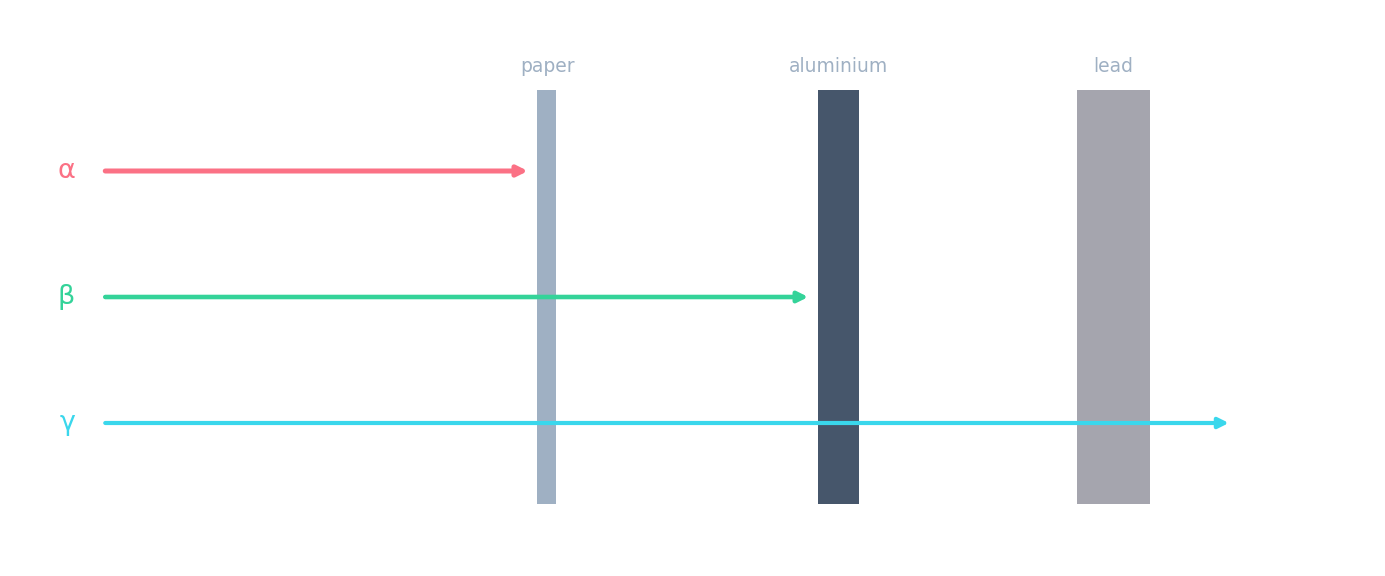
Match each radiation to what stops it. · Asocia cada radiación con lo que la detiene.
Penetration goes α < β < γ; ionising power goes the other way (α is the strongest ioniser). · La penetración sigue el orden α < β < γ; el poder ionizante va en sentido contrario (α es el más potente).
Of the three, α radiation is the most strongly ionising. · De las tres, la radiación α es la más fuertemente ionizante.
Yes — α is the strongest ioniser (and so the least penetrating); γ is the weakest ioniser (and most penetrating). · Sí — α es el más fuerte ionizador (y por tanto el menos penetrante); γ es el más débil ionizador (y el más penetrante).
In an electric field
- The field pushes charges: α is deflected 偏转 towards the negative plate, β$^{-}$ the opposite way, γ not at all.
- The force is $F = Eq$, so the α feels twice the force of a β — but its mass is thousands of times larger, so it curves far less.
- Same rule for any two charged particles in the same field: compare the forces by charge, the accelerations by $\dfrac{q}{m}$.
En un campo eléctrico
- El campo ejerce fuerza sobre las cargas: α se desvía 偏转 hacia la placa negativa, β$^{-}$ en dirección opuesta, γ no se desvía en absoluto.
- La fuerza es $F = Eq$, por lo que α siente el doble de fuerza que β — pero su masa es miles de veces mayor, así que se curva mucho menos.
- Mismo principio para cualquier par de partículas cargadas en el mismo campo: compara las fuerzas por carga, las aceleraciones por $\dfrac{q}{m}$.
An α-particle, a β⁻ particle and a γ-ray enter the same uniform electric field side by side. Which statement is correct? · Una partícula α, una partícula β⁻ y un rayo γ entran lado a lado en el mismo campo eléctrico uniforme. ¿Cuál afirmación es correcta?
Opposite charges are pushed opposite ways. The β⁻ has a far larger charge-to-mass ratio, so it accelerates far more; the uncharged γ feels no force. · Cargas opuestas son empujadas en sentidos opuestos. β⁻ tiene una relación carga-masa muy superior, por lo que acelera mucho más; el γ sin carga no experimenta fuerza.
Antiparticles 反粒子 and neutrinos 中微子
- Every particle has an antiparticle — same mass, opposite charge (the positron is the electron's).
- β-decay always emits a (anti)neutrino too: nearly massless, no charge, very hard to detect.
Antipartículas 反粒子 y neutrinos 中微子
- Cada partícula tiene una antipartícula — misma masa, carga opuesta (el positrón es la antipartícula del electrón).
- La desintegración β siempre emite también un (anti)neutrino: casi sin masa, sin carga, muy difícil de detectar.
The positron is the ____ of the electron. · El positrón es el ____ del electrón.
An antiparticle has the same mass but opposite charge — the positron is $+e$ to the electron's $-e$. · Una antipartícula tiene la misma masa pero carga opuesta; el positrón es $+e$ frente al $-e$ del electrón.
Why β is continuous
- α-decay shares energy between two particles → the α has one fixed energy (discrete).
- β-decay shares energy between three (with the neutrino) → β energies range from zero up to a maximum (continuous).
Por qué β es continua
- La desintegración α comparte energía entre dos partículas → el α tiene una energía fija (discreta).
- La desintegración β comparte energía entre tres (con el neutrino) → las energías de β varían desde cero hasta un máximo (continua).
β-particles come out with a continuous range of energies because the energy is shared among: · Las partículas β salen con un rango continuo de energías porque la energía se comparte entre:
With three particles sharing, the β can take any share up to a maximum. α-decay shares between two, fixing the α energy. · Al compartirse entre tres partículas, la β puede llevar cualquier fracción hasta un máximo. La desintegración α se reparte entre dos, fijando la energía de α.
Decay equations
- α: $^{A}_{Z}\text{X} \to {}^{A-4}_{Z-2}\text{Y} + {}^{4}_{2}\alpha$.
- β$^{-}$: $^{A}_{Z}\text{X} \to {}^{A}_{Z+1}\text{Y} + {}^{0}_{-1}\beta + \bar{\nu}_{e}$ (a neutron becomes a proton).
- β$^{+}$: $^{A}_{Z}\text{X} \to {}^{A}_{Z-1}\text{Y} + {}^{0}_{+1}\beta + \nu_{e}$ (a proton becomes a neutron).
Ecuaciones de desintegración
- α: $^{A}_{Z}\text{X} \to {}^{A-4}_{Z-2}\text{Y} + {}^{4}_{2}\alpha$.
- β$^{-}$: $^{A}_{Z}\text{X} \to {}^{A}_{Z+1}\text{Y} + {}^{0}_{-1}\beta + \bar{\nu}_{e}$ (un neutrón se convierte en protón).
- β$^{+}$: $^{A}_{Z}\text{X} \to {}^{A}_{Z-1}\text{Y} + {}^{0}_{+1}\beta + \nu_{e}$ (un protón se convierte en neutrón).
In α-decay, by how much does the nucleon number $A$ decrease? · En la desintegración α, ¿cuánto disminuye el número másico $A$?
The α carries away 4 nucleons (2 protons + 2 neutrons), so $A$ falls by 4 (and $Z$ by 2). · La α se lleva 4 nucleones (2 protones + 2 neutrones), así que $A$ disminuye en 4 (y $Z$ en 2).
In β$^{-}$ decay, the proton number $Z$: · En la desintegración β$^{-}$, el número protónico $Z$:
A neutron turns into a proton, so $Z$ rises by 1 while $A$ stays the same. · Un neutrón se transforma en un protón, así que $Z$ aumenta en 1 mientras $A$ permanece igual.
Worked example: nitrogen-12 and a field
Nitrogen-12, $^{12}_{7}\text{N}$, decays by emitting a positron. The emitted positron and an α-particle then pass through the same uniform electric field.
- Equation: $^{12}_{7}\text{N} \to {}^{12}_{6}\text{C} + {}^{0}_{+1}\beta + \nu_{e}$. Check: $12 = 12 + 0$ and $7 = 6 + 1$.
- Charge on the positron: $+e$ — the electron's antiparticle.
- Forces in the field: $F = Eq$, so $\dfrac{F_{\alpha}}{F_{\beta}} = \dfrac{2e}{e} = 2$.
- Accelerations: $a = \dfrac{Eq}{m}$, so $\dfrac{a_{\alpha}}{a_{\beta}} = \dfrac{2e / 4\,\text{u}}{e / (\text{u}/1840)} \approx \dfrac{1}{3700}$ — the positron accelerates thousands of times more.
- Check: twice the force but four thousand times the mass: the α barely bends. Both are pushed the same way, because both are positive.
Ejemplo resuelto: nitrógeno-12 y un campo
El nitrógeno-12, $^{12}_{7}\text{N}$, se desintegra emitiendo un positrón. El positrón emitido y una partícula α luego pasan por el mismo campo eléctrico uniforme.
- Ecuación: $^{12}_{7}\text{N} \to {}^{12}_{6}\text{C} + {}^{0}_{+1}\beta + \nu_{e}$. Verificación: $12 = 12 + 0$ y $7 = 6 + 1$.
- Carga del positrón: $+e$ — la antipartícula del electrón.
- Fuerzas en el campo: $F = Eq$, por tanto $\dfrac{F_{\alpha}}{F_{\beta}} = \dfrac{2e}{e} = 2$.
- Aceleraciones: $a = \dfrac{Eq}{m}$, por tanto $\dfrac{a_{\alpha}}{a_{\beta}} = \dfrac{2e / 4\,\text{u}}{e / (\text{u}/1840)} \approx \dfrac{1}{3700}$ — el positrón acelera miles de veces más.
- Verificación: el doble de fuerza pero cuatro mil veces la masa: el α apenas se curva. Ambos son empujados en la misma dirección, porque ambos son positivos.
Nucleus X (charge $+2e$, mass $4\ \text{u}$) and nucleus Y (charge $+e$, mass $3\ \text{u}$) are in the same uniform electric field. What is the ratio acceleration of X : acceleration of Y? · El núcleo X (carga $+2e$, masa $4\ \text{u}$) y el núcleo Y (carga $+e$, masa $3\ \text{u}$) están en el mismo campo eléctrico uniforme. ¿Cuál es la razón aceleración de X : aceleración de Y?
$a = \dfrac{Eq}{m}$, so the ratio is $\dfrac{2/4}{1/3} = \dfrac{0.5}{0.333} = 1.5$. The force ratio alone would be $2$; the masses change it. · $a = \dfrac{Eq}{m}$, así que la razón es $\dfrac{2/4}{1/3} = \dfrac{0.5}{0.333} = 1.5$. La sola razón de fuerzas sería $2$; las masas la modifican.
A β$^{-}$ particle comes from the nucleus — a neutron turns into a proton — not from the orbiting electrons. A γ-ray changes neither $A$ nor $Z$; it only carries away energy. And the reason β energies are continuous is the (anti)neutrino sharing the energy — that is the exam's favourite "explain" question in this topic.
Una partícula β$^{-}$ proviene del núcleo — un neutrón se convierte en protón — no de los electrones orbitales. Un rayo γ no cambia ni $A$ ni $Z$; solo transporta energía. Y la razón por la que las energías β son continuas es el (anti)neutrino compartiendo la energía — esa es la pregunta favorita de "explicar" en los exámenes para este tema.
You've got it
- α = He nucleus, $+2e$, $4\ \text{u}$ (paper-stopped, strong ioniser); β = electron/positron (Al-stopped); γ = photon (lead)
- in a field: force $\propto q$, acceleration $\propto \dfrac{q}{m}$; α and β$^{-}$ bend opposite ways, γ does not bend
- β-decay emits a (anti)neutrino, which is why its energy spectrum is continuous; α: $A{-}4, Z{-}2$; β$^{-}$: $Z{+}1$; β$^{+}$: $Z{-}1$
Lo has entendido
- α = núcleo He, $+2e$, $4\ \text{u}$ (detenido por papel, fuerte ionizador); β = electrón/positrón (detenido por Al); γ = fotón (plomo)
- en un campo: fuerza $\propto q$, aceleración $\propto \dfrac{q}{m}$; α y β$^{-}$ se curvan en sentidos opuestos, γ no se curva
- la desintegración β emite un (anti)neutrino, por eso su espectro de energía es continuo; α: $A{-}4, Z{-}2$; β$^{-}$: $Z{+}1$; β$^{+}$: $Z{-}1$