Buffer solutions · Soluciones amortiguadoras
| English | Español |
|---|---|
| buffer/ˈbʌfə/ | amortiguadora |
| weak acid/wiːk ˈæsɪd/ | ácido débil |
| conjugate base/ˈkɒndʒuːɡeɪt beɪs/ | base conjugada |
Solutions that resist change
- A buffer 缓冲溶液 resists a change in pH when a little acid or alkali is added.
- It is made from a weak acid 弱酸 and its conjugate base 共轭碱.
- It is vital in living things — like your blood.
Soluciones que resisten el cambio
- Una solución amortiguadora (buffer) resiste un cambio en el pH cuando se añade un poco de ácido o base.
- Está compuesta por un ácido débil y su base conjugada.
- Es vital en los seres vivos, como en tu sangre.
A buffer solution is made from: · Una solución buffer se forma con:
A weak acid and its conjugate base (e.g. ethanoic acid + sodium ethanoate) make a buffer. · Un ácido débil y su base conjugada (ej. ácido etanoico + etanoato sódico) forman un buffer.
A buffer keeps the pH almost constant when a small amount of acid or alkali is added. · Un buffer mantiene el pH casi constante cuando se añade una pequeña cantidad de ácido o álcali.
That is exactly what a buffer does — it resists changes in pH. · Eso es exactamente lo que hace un buffer: resiste cambios en el pH.
A buffer resists changes in pH when small amounts of acid or base are added. · Un buffer resiste cambios en el pH cuando se añaden pequeñas cantidades de ácido o base.
It contains a weak acid and its conjugate base. · Contiene un ácido débil y su base conjugada.
How a buffer works
It holds a store of both partners:
- added $\text{H}^+$ is removed by the conjugate base: $\text{CH}_3\text{COO}^- + \text{H}^+ \rightarrow \text{CH}_3\text{COOH}$.
- added $\text{OH}^-$ is removed by the weak acid: $\text{CH}_3\text{COOH} + \text{OH}^- \rightarrow \text{CH}_3\text{COO}^- + \text{H}_2\text{O}$.
So the pH barely changes.
A buffer mops up added acid or alkali
Cómo funciona una solución amortiguadora
Mantiene una reserva de ambos componentes:
- Los $\text{H}^+$ añadidos son eliminados por la base conjugada: $\text{CH}_3\text{COO}^- + \text{H}^+ \rightarrow \text{CH}_3\text{COOH}$.
- Los $\text{OH}^-$ añadidos son eliminados por el ácido débil: $\text{CH}_3\text{COOH} + \text{OH}^- \rightarrow \text{CH}_3\text{COO}^- + \text{H}_2\text{O}$.
Por lo tanto, el pH apenas cambia.
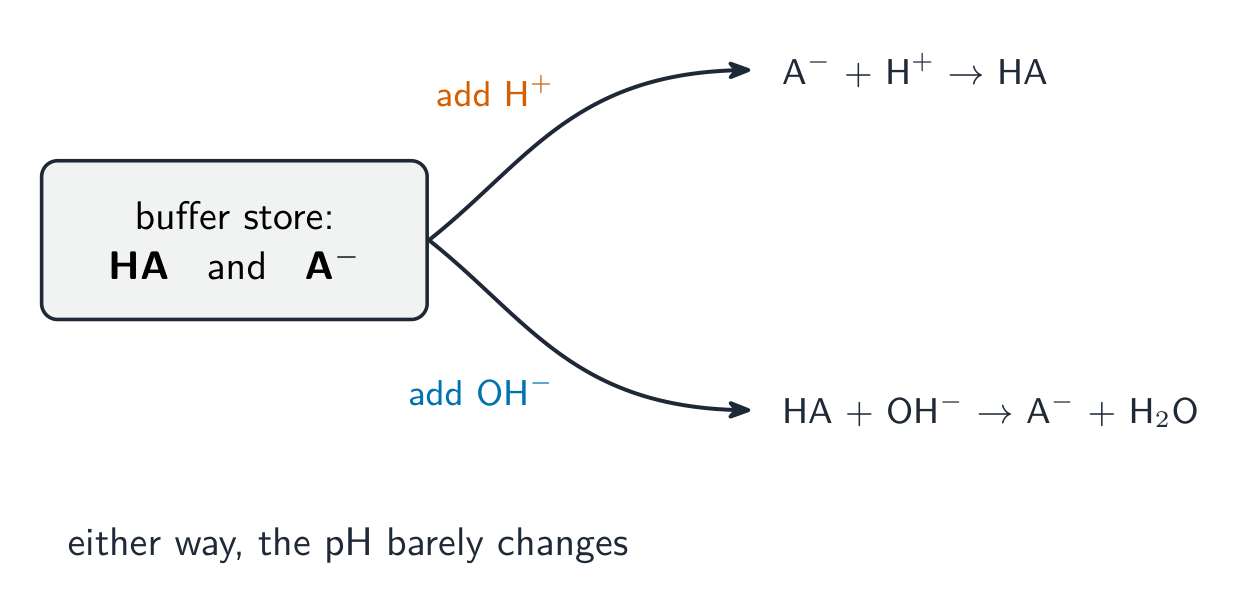
Una solución amortiguadora absorbe el ácido o la base añadidos
The buffer region · La región amortiguadora
On the curve, a buffer is the flat stretch where added acid or base barely moves the pH — then it jumps at the equivalence point. · En la curva, un buffer es el tramo plano donde añadir ácido o base apenas desplaza el pH — luego salta en el punto de equivalencia.
When a little acid (H⁺) is added to a buffer, it is removed by: · Cuando se añade un poco de ácido (H⁺) a un buffer, es eliminado por:
The conjugate base mops up added H⁺; the weak acid mops up added OH⁻, so the pH barely changes. · La base conjugada absorbe los H⁺ añadidos; el ácido débil absorbe los OH⁻ añadidos, por lo que el pH apenas cambia.
Match each buffer idea. · Relacione cada concepto de buffer.
Each item links the term to its correct meaning. · Cada elemento vincula el término con su significado correcto.
Finding the pH and uses
- Put the concentrations of the acid and its salt into the $K_a$ expression: $[\text{H}^+] = K_a \times \dfrac{[\text{acid}]}{[\text{salt}]}$.
- Buffers matter in life: $\text{HCO}_3^-$ keeps the pH of blood close to 7.4.
Cálculo del pH y aplicaciones
- Sustituye las concentraciones del ácido y su sal en la expresión $K_a$: $[\text{H}^+] = K_a \times \dfrac{[\text{acid}]}{[\text{salt}]}$.
- Las soluciones amortiguadoras son importantes en la vida: el $\text{HCO}_3^-$ mantiene el pH de la sangre cerca de 7,4.
In blood, the pH is kept close to 7.4 by the buffer ion: · En la sangre, el pH se mantiene cercano a 7.4 mediante el ion buffer:
The hydrogencarbonate ion buffers blood, keeping its pH around 7.4. · El ion hidrogenocarbonato amortigua la sangre, manteniendo su pH alrededor de 7.4.
Working out the pH
A buffer is 0.10 mol/dm³ ethanoic acid ($K_a = 1.8 \times 10^{-5}$) + 0.10 mol/dm³ sodium ethanoate.
- $[\text{H}^+] = K_a \times \dfrac{[\text{acid}]}{[\text{salt}]} = 1.8 \times 10^{-5} \times \dfrac{0.10}{0.10} = 1.8 \times 10^{-5}$
- $\text{pH} = -\log(1.8 \times 10^{-5}) = \mathbf{4.74}$
When acid and salt concentrations are equal, $[\text{H}^+] = K_a$, so the pH equals $\text{p}K_a$.
Cálculo del pH
Una solución amortiguadora es 0,10 mol/dm³ de ácido etanoico ($K_a = 1.8 \times 10^{-5}$) + 0,10 mol/dm³ de etanoato sódico.
- $[\text{H}^+] = K_a \times \dfrac{[\text{acid}]}{[\text{salt}]} = 1.8 \times 10^{-5} \times \dfrac{0.10}{0.10} = 1.8 \times 10^{-5}$
- $\text{pH} = -\log(1.8 \times 10^{-5}) = \mathbf{4.74}$
Cuando las concentraciones de ácido y sal son iguales, $[\text{H}^+] = K_a$, por lo que el pH es igual al $\text{p}K_a$.
You've got it
- a buffer = weak acid + its conjugate base; it resists pH change
- added $\text{H}^+$ is mopped up by A⁻; added $\text{OH}^-$ by HA
- find its pH from $[\text{H}^+] = K_a \times \frac{[\text{acid}]}{[\text{salt}]}$ (equal concentrations ⇒ pH = p$K_a$)
- blood is buffered by $\text{HCO}_3^-$ near pH 7.4
Lo has entendido
- una solución amortiguadora = ácido débil + su base conjugada; resiste el cambio de pH
- los $\text{H}^+$ añadidos son neutralizados por A⁻; los $\text{OH}^-$ añadidos por HA
- calcula su pH usando $[\text{H}^+] = K_a \times \frac{[\text{acid}]}{[\text{salt}]}$ (concentraciones iguales ⇒ pH = p$K_a$)
- la sangre está amortiguada por $\text{HCO}_3^-$ cerca de pH 7,4