Chinese course / HSK6 handouts
"If" statements
Printable paper with separate answer pages Step-by-step lessons
Original teaching practice. Read one pattern, cover its model and try the questions before checking the separate answer section. Examples adapted from Chinese Grammar Wiki (AllSet Learning, CC BY-NC-SA) retain the course-reference provenance.
if假使 … ,then / just就 … (if / supposing)
Supposing it happened
- In a philosophy class you imagine an unlikely situation.
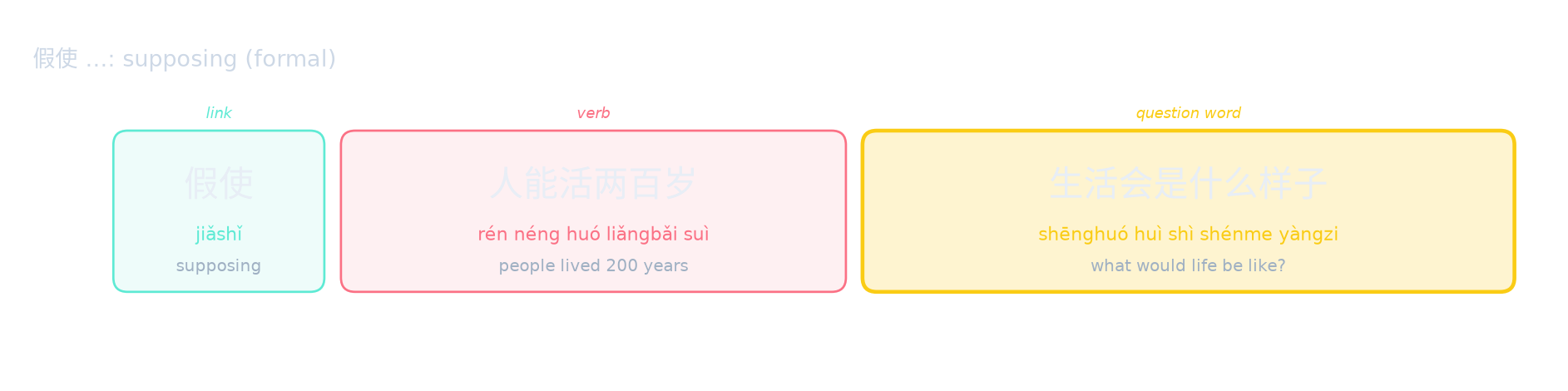
- if假使人能活两百岁,to live生活can / will会to be / is是what什么appearance样子? – "Supposing people could live to two hundred, what would life be like?"
if假使 A,(then / just就) B = if, supposing
- if假使 = "if, supposing", a literary if如果, often for hypothetical or unlikely situations.
- The result clause may take then / just就 / used in 便宜便 / also也.
supposing假使tomorrow明天it rains下雨,the match比赛then就is cancelled取消。
Imagined and formal conditions
- if假使not have / haven't没有you你(modifier / structural particle)的assistance帮助,I / me我then / just就improbable不会success成功。 – "Had it not been for your help, I would not have succeeded."
- Common in essays, speeches and literature.
if假使without没有your你的help帮助,I我then就wouldn't不会succeed成功。
Literary register
- In everyday speech, use if如果 / if要是: if要是tomorrow明天to rain下雨,….
- Put then / just就 after the subject of the result: I / me我then / just就improbable不会…, not then / just就I / me我improbable不会….
The "if" family
- if要是 (spoken) → if如果 (neutral) → if假如 / if假使 / if倘若 (literary).
- All pair with then / just就 in the result.
if要是you你have有time时间,then就come来吧。
Recap
- if假使 A,(Subject) then / just就 B = if / supposing A (literary, often hypothetical).
- Everyday: if如果 / if要是; literary relatives: if假如, if倘若.
Practise this pattern step by step.
Practice without the models
Choose a pattern, cover its teaching examples, and attempt its questions. Use the labels to find feedback in the separate key.
if假使 … ,then / just就 … (if / supposing)
1001.1 Complete: “Supposing it rains, the match will be cancelled.” if假使to rain下雨,competition (sports etc)比赛…………to cancel取消。
1001.2 Which “if” is the most spoken?
- A. if倘若
- B. if假如
- C. if要是
- D. if假使
1001.3 Build: “Had it not been for your help, I wouldn't have succeeded.”
Arrange all chunks: , / if假使not have / haven't没有you你(modifier / structural particle)的assistance帮助 / I / me我then / just就 / improbable不会success成功。
1001.4 if假使 suits formal essays better than casual chat.
True or false? Explain or repair the statement.
1001.5 In a philosophy class you imagine an unlikely situation. Close the examples. Say a Mandarin response, then write it in Chinese. Explain briefly in English what the lesson’s pattern adds. Compare with the model, then change one detail and try again.
Write or say your own response before reading the key.
A fresh situation
R1. Interpret and repair. A learner sees if假使tomorrow明天to stop classes停课,we / us我们then / just就to be at home在家to learn学习 and reports that class cancellation is confirmed. Repair it.
R2. Use it yourself. State a fallback arrangement if a venue is unavailable, using if假使.
Write your responses before opening the key. Compare meaning as well as form; a different valid answer need not copy the model.
Open the answers after your attempt
Answers and explanations
Check after your attempt. For open tasks, compare the message and the stated criteria, then revise one detail.
if假使 … ,then / just就 … (if / supposing)
1001.1 then / just就
if假使…,then / just就….
1001.2 C. if要是
if要是 is the everyday spoken “if”: if要是to rain下雨then / just就not不to go去(completed / change)了. if假如 is neutral, while if假使 and if倘若 are written or literary.
1001.3 if假使not have / haven't没有you你(modifier / structural particle)的assistance帮助,I / me我then / just就improbable不会success成功。
if假使 + condition, subject + then / just就 + result.
1001.4 True.
True. if假使 is literary and fits formal essays. In casual chat you would use if要是 or if如果.
1001.5 One possible response: if假使人能活两百岁,to live生活can / will会to be / is是what什么appearance样子?
Check meaning and form:
- My response conveys a message that fits the opening situation.
- I can explain the meaning of the pattern, rather than only naming it.
- In everyday speech, use if如果 / if要是: if要是tomorrow明天to rain下雨,….
- Put then / just就 after the subject of the result: I / me我then / just就improbable不会…, not then / just就I / me我improbable不会….
- I tried a second response with a name, time, place, or description changed.
This is supported productive practice. Compare meaning and structure; your answer need not copy the model. A partner or teacher must hear the spoken response to comment on pronunciation.
Fresh-situation answers
R1. The sentence gives a hypothetical condition and its consequence. It does not confirm cancellation. Check a separate notice before treating the premise as fact.
R2. One possible response. if假使this这个space场地cannot不能to use使用,we / us我们then / just就to change改to / arrive到library图书馆to discuss讨论。The fallback depends on unavailability. It does not assert that the current venue has been rejected.
Recall later. Tomorrow, convert a hypothetical plan into a factual report only after adding confirming evidence.