Chinese course / HSK5 handouts
Adjectives
Printable paper with separate answer pages Step-by-step lessons
Original teaching practice. Read one pattern, cover its model and try the questions before checking the separate answer section. Examples adapted from Chinese Grammar Wiki (AllSet Learning, CC BY-NC-SA) retain the course-reference provenance.
Adj + (degree marker)得desperately serious不得了 (extremely)
The final whistle
- Your school team has just won the city championship after a penalty shoot-out.
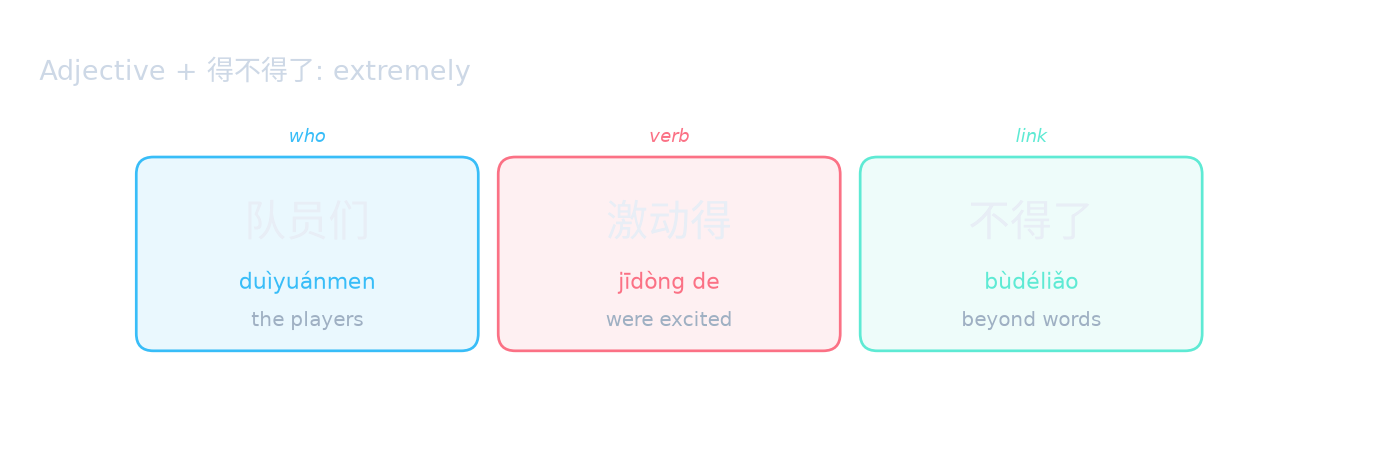
- team member队员(plural)们to move emotionally激动(degree marker)得desperately serious不得了。 – "The players were beside themselves with excitement."
Adj / feeling verb + (degree marker)得desperately serious不得了
- Adj + (degree marker)得desperately serious不得了 = "extremely, terribly": 热得desperately serious不得了, busy忙(degree marker)得desperately serious不得了, happy高兴(degree marker)得desperately serious不得了.
- (degree marker)得 links the adjective to desperately serious不得了 (literally "beyond what can be stood"), which ends the clause.
the subway地铁(in)里crowded挤extremely得不得了。
Good and bad extremes
- Bad: today今天热得desperately serious不得了,I / me我erhua variant of 一点一点儿also也unexpectedly不想to go out出门。 – "It's unbearably hot today; I don't want to go out at all."
- Good: to hear (sth said)听说you你want / will / need要to come来,child孩子(plural)们happy高兴(degree marker)得desperately serious不得了。 – "When they heard you were coming, the children were overjoyed."
the children孩子们happy高兴extremely得不得了。
One degree word, and (degree marker)得 is needed
- No degree / adjective linker很 / very非常 before the adjective: busy忙(degree marker)得desperately serious不得了, not degree / adjective linker很busy忙(degree marker)得desperately serious不得了.
- Keep (degree marker)得: rope累(degree marker)得desperately serious不得了, not rope累desperately serious不得了.
desperately serious不得了 on its own
- Alone, desperately serious不得了 means "terrible, serious": desperately serious不得了(completed / change)了,to catch fire着火(completed / change)了! – "Oh no, there's a fire!"
- terrific了不得 is different: "amazing, remarkable": he / him他really真terrific了不得 – "He's really something."
terrible不得了了,on fire着火了!
Recap
- Adj + (degree marker)得desperately serious不得了 = extremely (good or bad), spoken; no degree / adjective linker很 before it.
- desperately serious不得了! = disaster!; terrific了不得 = remarkable.
Practise this pattern step by step.
Adj + (degree marker)得degree / adjective linker很 (very)
Fresh air in the park
- After a week in a smoggy city, you walk in a mountain park.
- here这里(modifier / structural particle)的air空气fresh (experience, food etc)新鲜(degree marker)得degree / adjective linker很。 – "The air here is really fresh."
Adj + (degree marker)得degree / adjective linker很 = very, really
- Adj + (degree marker)得degree / adjective linker很 = "very, really", a little more emphatic and lively than degree / adjective linker很 + Adj.
- It ends the clause: good好(degree marker)得degree / adjective linker很, clear清楚(degree marker)得degree / adjective linker很, cheap便宜(degree marker)得degree / adjective linker很.
this这张map地图clear清楚very得很。

Confident comments
- he / him他(modifier / structural particle)的Chinese language中文good好(degree marker)得degree / adjective linker很,you你need not不用anxious担心。 – "His Chinese is really good; don't worry."
- Said flatly, it can be ironic: good好(degree marker)得degree / adjective linker很,again又to arrive late迟到(completed / change)了! – "Great, late again!"
his他的Chinese中文good好very得很。
degree / adjective linker很 after, not before
- Do not add degree / adjective linker很 before as well: fresh (experience, food etc)新鲜(degree marker)得degree / adjective linker很, not degree / adjective linker很fresh (experience, food etc)新鲜(degree marker)得degree / adjective linker很.
- Keep (degree marker)得: good好(degree marker)得degree / adjective linker很, not good好degree / adjective linker很.
(degree marker)得degree / adjective linker很 versus (degree marker)得desperately serious不得了 and degree / adjective linker很
- degree / adjective linker很fresh (experience, food etc)新鲜 is neutral; fresh (experience, food etc)新鲜(degree marker)得degree / adjective linker很 is more emphatic; fresh (experience, food etc)新鲜(degree marker)得desperately serious不得了 is the strongest.
- Verbs also take a (degree marker)得 complement, but (degree marker)得degree / adjective linker很 mostly follows adjectives and feeling verbs: he / him他to like喜欢(degree marker)得degree / adjective linker很.
he他likes it喜欢very much得很。
Recap
- Adj + (degree marker)得degree / adjective linker很 = very, really (emphatic, spoken).
- Scale: degree / adjective linker很 + Adj → Adj + (degree marker)得degree / adjective linker很 → Adj + (degree marker)得desperately serious不得了.
Practise this pattern step by step.
Adj + (completed / change)了 + (one / a一)erhua variant of 点点儿 (a bit too)
A bit too salty
- You taste the soup your roommate made. It's good, but there's slightly too much salt.
- 这汤salted咸(completed / change)了erhua variant of 点点儿。 – "This soup is a bit too salty."
Adj + (completed / change)了 + (one / a一)erhua variant of 点点儿 = a bit too …
- Adj + (completed / change)了 + (one / a一)erhua variant of 点点儿 = slightly more than wanted: see 大夫大(completed / change)了erhua variant of 点点儿 (a bit too big), early早(completed / change)了erhua variant of 一点一点儿 (a bit too early).
- It gently says something is off from the right amount.
this pair of这双shoes鞋big大了a bit点儿。

Polite complaints and comparisons
- 八点to hold a meeting开会,to / towards / correct对I / me我来说early早(completed / change)了erhua variant of 一点一点儿。 – "A meeting at eight is a little early for me."
- price价格expensive贵(completed / change)了erhua variant of 点点儿,can / be able to能cheap便宜erhua variant of 一点一点儿(yes/no ?)吗? – "It's a bit expensive; could you make it a bit cheaper?"
the price价格expensive贵了a bit点儿,can能cheap便宜a bit一点儿吗?
(completed / change)了 marks "too"
- see 大夫大(completed / change)了erhua variant of 点点儿 = a bit too big (off from what's needed). see 大夫大erhua variant of 一点一点儿 = a bit bigger (a comparison or request).
- It is mild; for a strong complaint use too太…(completed / change)了: 太咸(completed / change)了!
Versus slightly有点儿 + Adj
- slightly有点儿salted咸 also means "a bit salty", focusing on the feeling.
- 咸了erhua variant of 点点儿 measures against the right amount: just a little past it.
the soup汤a bit有点儿salty咸。
Recap
- Adj + (completed / change)了 + (one / a一)erhua variant of 点点儿 = a bit too … (slightly past the right amount).
- Adj + erhua variant of 一点一点儿 = a bit more (request); too太…(completed / change)了 = too … (strong).
Practise this pattern step by step.
have plenty of有的是 + Noun (have plenty of)
Plenty to choose from
- A friend worries she won't find a novel to read on holiday.
- 书架上have plenty of有的是novel小说,you你as one wishes随便variant of 借借。 – "There are plenty of novels on the shelf; borrow whatever you like."
have plenty of有的是 + Noun = have plenty of
- have plenty of有的是 + noun = "have plenty of, there's no shortage of": have plenty of有的是(concept of) time时间, have plenty of有的是means办法.
- It reassures: there is more than enough.
don't别worry着急,we我们have plenty of有的是time时间。

Topic first, have plenty of有的是 after
- this kind of这种thing东西,supermarket (abbr. for 超级市场)超市li, ancient measure of…里have plenty of有的是。 – "Things like this – the supermarket has loads."
- he / him他have plenty of有的是means办法。 – "He has plenty of ways (he'll manage)."
he他has plenty of有的是ways办法。
Not "some are"
- have plenty of有的是 = plenty; to have / there is有(modifier / structural particle)的 + noun = some: to have / there is有(modifier / structural particle)的person人to like喜欢 – "some people like it". Do not mix them up.
- No 很多 inside: have plenty of有的是coin钱, not have plenty of有的是很多coin钱.
have plenty of有的是 versus 很多
- to have / there is有很多(concept of) time时间 is neutral.
- have plenty of有的是(concept of) time时间 adds "so don't worry" – the speaker downplays any shortage.
we我们have有a lot of很多time时间。
Recap
- have plenty of有的是 + noun = plenty of, no shortage (reassuring, spoken).
- to have / there is有(modifier / structural particle)的 + noun = some; no 很多 inside have plenty of有的是.
Practise this pattern step by step.
Practice without the models
Choose a pattern, cover its teaching examples, and attempt its questions. Use the labels to find feedback in the separate key.
Adj + (degree marker)得desperately serious不得了 (extremely)
0101.1 Complete: “I'm terribly busy this week.” this这个week星期我忙…………desperately serious不得了。
0101.2 Which sentence is correct?
- A. he / him他happy高兴(degree marker)得desperately serious不得了。
- B. he / him他desperately serious不得了happy高兴。
- C. he / him他happy高兴desperately serious不得了(degree marker)得。
- D. he / him他degree / adjective linker很happy高兴(degree marker)得desperately serious不得了。
0101.3 Match each expression to its meaning.
-
- rope累(degree marker)得desperately serious不得了
-
- desperately serious不得了(completed / change)了!
-
- terrific了不得
-
A. remarkable
-
B. exhausted
-
C. oh no, this is serious!
0101.4 Build: “When they heard you were coming, the children were overjoyed.”
Arrange all chunks: to hear (sth said)听说you你want / will / need要to come来 / desperately serious不得了。 / ,child孩子(plural)们 / happy高兴(degree marker)得
0101.5 Your school team has just won the city championship after a penalty shoot-out. Close the examples. Say a Mandarin response, then write it in Chinese. Explain briefly in English what the lesson’s pattern adds. Compare with the model, then change one detail and try again.
Write or say your own response before reading the key.
Adj + (degree marker)得degree / adjective linker很 (very)
0102.1 Complete: “This hotel is really cheap.” 这家wine shop酒店cheap便宜…………。
0102.2 Which sentence is correct?
- A. air空气fresh (experience, food etc)新鲜(degree marker)得degree / adjective linker很。
- B. air空气degree / adjective linker很fresh (experience, food etc)新鲜(degree marker)得degree / adjective linker很。
- C. air空气fresh (experience, food etc)新鲜degree / adjective linker很。
- D. air空气(degree marker)得degree / adjective linker很fresh (experience, food etc)新鲜。
0102.3 Build: “His Chinese is really good.”
Arrange all chunks: (degree marker)得degree / adjective linker很。 / good好 / he / him他(modifier / structural particle)的Chinese language中文
0102.4 (degree marker)得desperately serious不得了 is usually stronger than (degree marker)得degree / adjective linker很.
True or false? Explain or repair the statement.
0102.5 After a week in a smoggy city, you walk in a mountain park. Close the examples. Say a Mandarin response, then write it in Chinese. Explain briefly in English what the lesson’s pattern adds. Compare with the model, then change one detail and try again.
Write or say your own response before reading the key.
Adj + (completed / change)了 + (one / a一)erhua variant of 点点儿 (a bit too)
0103.1 Complete: “These trousers are a bit too long.” this这strip条trousers裤子long长…………erhua variant of 点点儿。
0103.2 You want a slightly bigger size. What do you ask for?
- A. too太see 大夫大(completed / change)了(modifier / structural particle)的
- B. see 大夫大(completed / change)了erhua variant of 点点儿(modifier / structural particle)的
- C. slightly有点儿see 大夫大(modifier / structural particle)的
- D. see 大夫大erhua variant of 一点一点儿(modifier / structural particle)的
0103.3 Build: “A meeting at eight is a little early for me.”
Arrange all chunks: ,to / towards / correct对I / me我来说 / early早(completed / change)了 / erhua variant of 一点一点儿。 / 八点to hold a meeting开会
0103.4 太咸(completed / change)了 is a stronger complaint than 咸了erhua variant of 点点儿.
True or false? Explain or repair the statement.
0103.5 You taste the soup your roommate made. It's good, but there's slightly too much salt. Close the examples. Say a Mandarin response, then write it in Chinese. Explain briefly in English what the lesson’s pattern adds. Compare with the model, then change one detail and try again.
Write or say your own response before reading the key.
have plenty of有的是 + Noun (have plenty of)
0104.1 Reassure: “Don't worry, there are plenty of tickets.” don't别anxious担心,ticket票…………。
0104.2 What does to have / there is有(modifier / structural particle)的person人not不to like喜欢variant of 吃吃hot (spicy)辣 mean?
- A. Some people don't like spicy food.
- B. Plenty of people dislike spicy food.
- C. Everyone likes spicy food.
- D. Nobody likes spicy food.
0104.3 Build: “He has plenty of ways (to solve it).”
Arrange all chunks: means办法。 / he / him他 / have plenty of有的是
0104.4 have plenty of有的是(concept of) time时间 suggests there's no need to hurry.
True or false? Explain or repair the statement.
0104.5 A friend worries she won't find a novel to read on holiday. Close the examples. Say a Mandarin response, then write it in Chinese. Explain briefly in English what the lesson’s pattern adds. Compare with the model, then change one detail and try again.
Write or say your own response before reading the key.
A fresh situation
R1. Interpret and repair. A learner writes I / me我to have / there is有很多(modifier / structural particle)的to be / is是(concept of) time时间 to say I have plenty of time. Repair the construction.
R2. Use it yourself. React strongly to a tiring journey and say that plenty of seats remain.
Write your responses before opening the key. Compare meaning as well as form; a different valid answer need not copy the model.
Open the answers after your attempt
Answers and explanations
Check after your attempt. For open tasks, compare the message and the stated criteria, then revise one detail.
Adj + (degree marker)得desperately serious不得了 (extremely)
0101.1 (degree marker)得
Adj + (degree marker)得 + desperately serious不得了.
0101.2 A. he / him他happy高兴(degree marker)得desperately serious不得了。
he / him他happy高兴(degree marker)得desperately serious不得了 is right: a bare adjective + (degree marker)得desperately serious不得了 already means "extremely", so degree / adjective linker很 is not added.
0101.3 1–B: rope累(degree marker)得desperately serious不得了 = exhausted; 2–C: desperately serious不得了(completed / change)了! = oh no, this is serious!; 3–A: terrific了不得 = remarkable
The position and order of desperately serious不得了 / terrific了不得 change the meaning.
0101.4 to hear (sth said)听说you你want / will / need要to come来,child孩子(plural)们happy高兴(degree marker)得desperately serious不得了。
Cause, then subject + Adj + (degree marker)得desperately serious不得了.
0101.5 One possible response: team member队员(plural)们to move emotionally激动(degree marker)得desperately serious不得了。
Check meaning and form:
- My response conveys a message that fits the opening situation.
- I can explain the meaning of the pattern, rather than only naming it.
- No degree / adjective linker很 / very非常 before the adjective: busy忙(degree marker)得desperately serious不得了, not degree / adjective linker很busy忙(degree marker)得desperately serious不得了.
- Keep (degree marker)得: rope累(degree marker)得desperately serious不得了, not rope累desperately serious不得了.
- I tried a second response with a name, time, place, or description changed.
This is supported productive practice. Compare meaning and structure; your answer need not copy the model. A partner or teacher must hear the spoken response to comment on pronunciation.
Adj + (degree marker)得degree / adjective linker很 (very)
0102.1 (degree marker)得degree / adjective linker很
Adj + (degree marker)得degree / adjective linker很.
0102.2 A. air空气fresh (experience, food etc)新鲜(degree marker)得degree / adjective linker很。
air空气fresh (experience, food etc)新鲜(degree marker)得degree / adjective linker很 is right: a bare adjective + (degree marker)得degree / adjective linker很. A second degree / adjective linker很 is redundant, and (degree marker)得 must follow the adjective.
0102.3 he / him他(modifier / structural particle)的Chinese language中文good好(degree marker)得degree / adjective linker很。
Subject + Adj + (degree marker)得degree / adjective linker很.
0102.4 True.
The scale is degree / adjective linker很 → (degree marker)得degree / adjective linker很 → (degree marker)得desperately serious不得了.
0102.5 One possible response: here这里(modifier / structural particle)的air空气fresh (experience, food etc)新鲜(degree marker)得degree / adjective linker很。
Check meaning and form:
- My response conveys a message that fits the opening situation.
- I can explain the meaning of the pattern, rather than only naming it.
- Do not add degree / adjective linker很 before as well: fresh (experience, food etc)新鲜(degree marker)得degree / adjective linker很, not degree / adjective linker很fresh (experience, food etc)新鲜(degree marker)得degree / adjective linker很.
- Keep (degree marker)得: good好(degree marker)得degree / adjective linker很, not good好degree / adjective linker很.
- I tried a second response with a name, time, place, or description changed.
This is supported productive practice. Compare meaning and structure; your answer need not copy the model. A partner or teacher must hear the spoken response to comment on pronunciation.
Adj + (completed / change)了 + (one / a一)erhua variant of 点点儿 (a bit too)
0103.1 (completed / change)了
Adj + (completed / change)了 + erhua variant of 点点儿 = a bit too.
0103.2 D. see 大夫大erhua variant of 一点一点儿(modifier / structural particle)的
A request for “a bit bigger” is Adj + erhua variant of 一点一点儿.
0103.3 八点to hold a meeting开会,to / towards / correct对I / me我来说early早(completed / change)了erhua variant of 一点一点儿。
Adj + (completed / change)了 + erhua variant of 一点一点儿.
0103.4 True.
True. too太…(completed / change)了 is a strong complaint (“far too salty”), while adjective + (completed / change)了erhua variant of 点点儿 is mild and polite: 咸了erhua variant of 点点儿 “a little too salty”.
0103.5 One possible response: 这汤salted咸(completed / change)了erhua variant of 点点儿。
Check meaning and form:
- My response conveys a message that fits the opening situation.
- I can explain the meaning of the pattern, rather than only naming it.
- see 大夫大(completed / change)了erhua variant of 点点儿 = a bit too big (off from what's needed). see 大夫大erhua variant of 一点一点儿 = a bit bigger (a comparison or request).
- It is mild; for a strong complaint use too太…(completed / change)了: 太咸(completed / change)了!
- I tried a second response with a name, time, place, or description changed.
This is supported productive practice. Compare meaning and structure; your answer need not copy the model. A partner or teacher must hear the spoken response to comment on pronunciation.
have plenty of有的是 + Noun (have plenty of)
0104.1 have plenty of有的是
Topic + have plenty of有的是 = plenty.
0104.2 A. Some people don't like spicy food.
to have / there is有(modifier / structural particle)的 + noun means “some (of them)”: to have / there is有(modifier / structural particle)的person人not不to like喜欢variant of 吃吃hot (spicy)辣 “Some people don't like spicy food.” It says nothing about how many, so “plenty” overstates it.
0104.3 he / him他have plenty of有的是means办法。
Subject + have plenty of有的是 + noun.
0104.4 True.
It reassures that there is more than enough.
0104.5 One possible response: 书架上have plenty of有的是novel小说,you你as one wishes随便variant of 借借。
Check meaning and form:
- My response conveys a message that fits the opening situation.
- I can explain the meaning of the pattern, rather than only naming it.
- have plenty of有的是 = plenty; to have / there is有(modifier / structural particle)的 + noun = some: to have / there is有(modifier / structural particle)的person人to like喜欢 – "some people like it". Do not mix them up.
- No 很多 inside: have plenty of有的是coin钱, not have plenty of有的是很多coin钱.
- I tried a second response with a name, time, place, or description changed.
This is supported productive practice. Compare meaning and structure; your answer need not copy the model. A partner or teacher must hear the spoken response to comment on pronunciation.
Fresh-situation answers
R1. I / me我have plenty of有的是(concept of) time时间。have plenty of有的是 is the chunk introducing an abundant supply, followed by the noun (concept of) time时间. It is not formed by moving (modifier / structural particle)的to be / is是 after 很多.
R2. One possible response. 这次to travel旅行rope累(degree marker)得desperately serious不得了。still / also还have plenty of有的是seat座位。The first is a strong degree complement; the second stresses abundance. Neither should be read as a literal medical diagnosis or an exact seat count.
Recall later. Later, use an intense degree expression and an abundance expression with different nouns.