Chinese course / HSK4 handouts
Numbers
Printable paper with separate answer pages Step-by-step lessons
Original teaching practice. Read one pattern, cover its model and try the questions before checking the separate answer section. Examples adapted from Chinese Grammar Wiki (AllSet Learning, CC BY-NC-SA) retain the course-reference provenance.
Fractions with part分(of — literary)之
A survey result
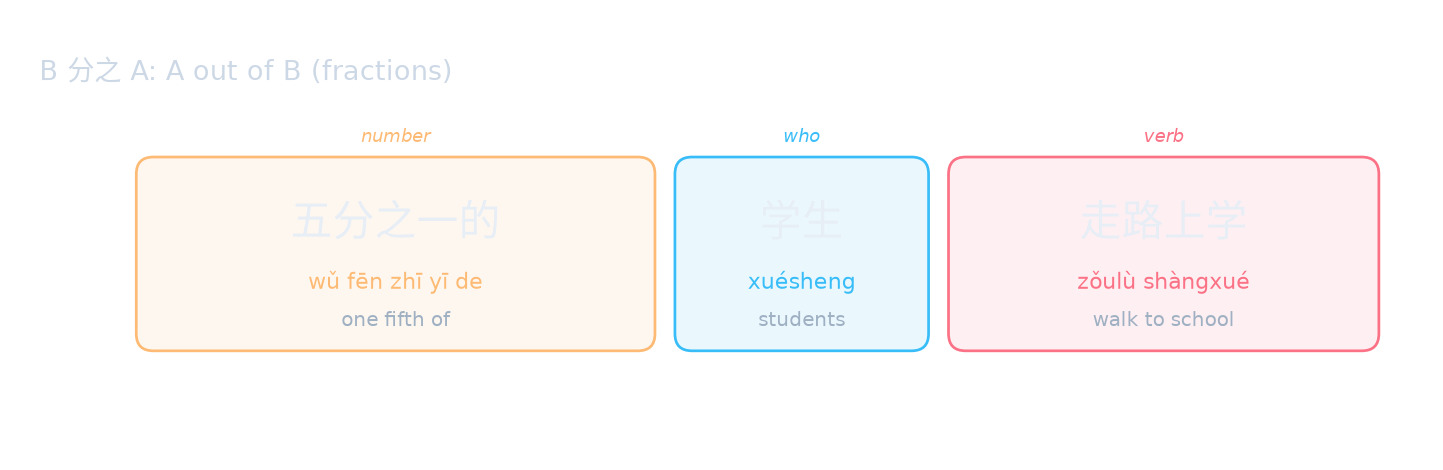
- Your class did a survey: of every five students, one walks to school.
- one fifth五分之一(modifier / structural particle)的student学生to walk走路to go to school上学。 – "One fifth of the students walk to school."
Denominator + part分(of — literary)之 + numerator
- B part分(of — literary)之 A = A/B: the bottom number comes first. one third三分之一 = 1/3, 四分之三 = 3/4.
- Before a noun, add (modifier / structural particle)的: 三分之二(modifier / structural particle)的person人 – "two thirds of the people".
three三parts of分之two二的people人agree同意。
Percentages: percent百分之
- percent百分之 + number = per cent: 百分之五十 = 50%, a hundred percent百分之百 = 100%.
- we / us我们(modifier / structural particle)的achievement成绩to raise提高(completed / change)了百分之二十。 – "Our scores rose by 20%."
the price价格rose提高了per cent百分之twenty二十。
Bottom number first
- Say the denominator first: 3/4 = 四分之三, not somewhat三分之四 (that is 4/3).
- 50% is 百分之五十, not fifty五十percent百分之.
half一半 and somewhat几分(of — literary)之how many / a few几
- 1/2 is usually half一半 in speech: half一半(modifier / structural particle)的student学生 – "half of the students".
- To ask "what fraction?", say somewhat几分(of — literary)之how many / a few几: to take possession of占somewhat几分(of — literary)之how many / a few几? – "What fraction is it?"
half一半的students学生are是girls女生。
Recap
- B part分(of — literary)之 A = A/B (bottom first): 四分之三 = 3/4; percent百分之 N = N%.
- half一半 = a half; + (modifier / structural particle)的 before a noun.
Practise this pattern step by step.
Practice without the models
Choose a pattern, cover its teaching examples, and attempt its questions. Use the labels to find feedback in the separate key.
Fractions with part分(of — literary)之
0701.1 Write 2/5 in Chinese: …………
0701.2 What is somewhat三分之四?
- A. 3.4
- B. 3/4
- C. 4/3
- D. 34%
0701.3 Match each expression to its value.
-
- 百分之五十
-
- one-quarter四分之一
-
- 三分之二
-
- a hundred percent百分之百
-
A. 50%
-
B. 1/4
-
C. 100%
-
D. 2/3
0701.4 In speech, half一半 is usually used for one half.
True or false? Explain or repair the statement.
0701.5 Your class did a survey: of every five students, one walks to school. Close the examples. Say a Mandarin response, then write it in Chinese. Explain briefly in English what the lesson’s pattern adds. Compare with the model, then change one detail and try again.
Write or say your own response before reading the key.
A fresh situation
R1. Interpret and repair. A class has thirty pupils; ten cycle. A learner writes somewhat三分之十 for the fraction cycling. Correct it.
R2. Use it yourself. State that two out of five books are new and explain numerator and denominator.
Write your responses before opening the key. Compare meaning as well as form; a different valid answer need not copy the model.
Open the answers after your attempt
Answers and explanations
Check after your attempt. For open tasks, compare the message and the stated criteria, then revise one detail.
Fractions with part分(of — literary)之
0701.1 五分之二
Denominator first: 五分之二.
0701.2 C. 4/3
The first number is the denominator: 4/3.
0701.3 1–A: 百分之五十 = 50%; 2–B: one-quarter四分之一 = 1/4; 3–D: 三分之二 = 2/3; 4–C: a hundred percent百分之百 = 100%
B part分(of — literary)之 A = A/B; percent百分之 N = N%.
0701.4 True.
half一半(modifier / structural particle)的student学生 is more natural than one half二分之一(modifier / structural particle)的student学生.
0701.5 One possible response: one fifth五分之一(modifier / structural particle)的student学生to walk走路to go to school上学。
Check meaning and form:
- My response conveys a message that fits the opening situation.
- I can explain the meaning of the pattern, rather than only naming it.
- Say the denominator first: 3/4 = 四分之三, not somewhat三分之四 (that is 4/3).
- 50% is 百分之五十, not fifty五十percent百分之.
- I tried a second response with a name, time, place, or description changed.
This is supported productive practice. Compare meaning and structure; your answer need not copy the model. A partner or teacher must hear the spoken response to comment on pronunciation.
Fresh-situation answers
R1. Ten out of thirty is one third三分之一. part分(of — literary)之 puts the denominator first: one third, not ten thirds. Reduce ten thirtieths to one third and check it against the class count.
R2. One possible response. five五本书中有两本to be / is是new新(modifier / structural particle)的,to take possession of占五分之二。Five is the whole group, the denominator; two is the selected part, the numerator. Check the fraction against the count.
Recall later. Later, turn a fresh part/whole count into a fraction and back into counts.