Chinese course / HSK4 handouts
Comparing similar time words
Printable paper with separate answer pages Step-by-step lessons
Original teaching practice. Read one pattern, cover its model and try the questions before checking the separate answer section. Examples adapted from Chinese Grammar Wiki (AllSet Learning, CC BY-NC-SA) retain the course-reference provenance.
after以后 vs (modifier / structural particle)的time时候 (after vs when)
When or after?
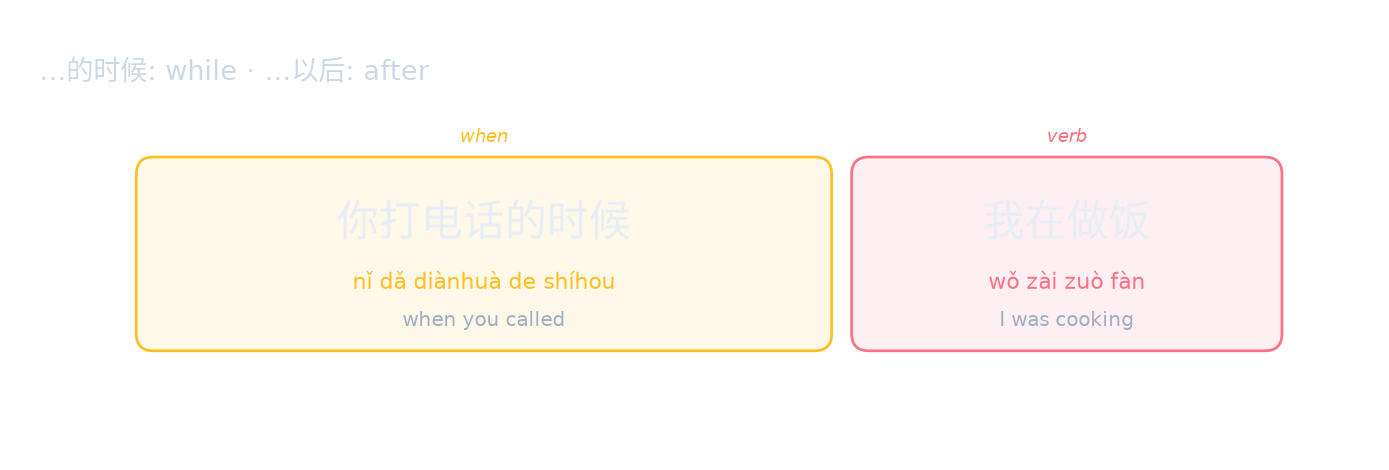
- You tell a friend about last night: you were cooking when he called, and you called back after dinner.
- you你to make a telephone call打电话(modifier / structural particle)的time时候I / me我at / in在to prepare a meal做饭,吃完饭after以后I / me我to / for / give给you你variant of 回回(completed / change)了telephone电话。 – "When you called, I was cooking; after dinner I called you back."
(modifier / structural particle)的time时候 = at the same time
- A (modifier / structural particle)的time时候,B = when A (is happening), B: the two overlap.
- I / me我to / arrive到(modifier / structural particle)的time时候,he / him他in the middle of正在to have a meal吃饭 – "When I arrived, he was eating."
I我arrive到when的时候,he他was正在eating吃饭。
after以后 = after, one then the other
- A after以后,B = after A has finished, B: the second follows the first.
- to finish class下课after以后,we / us我们to go去to play ball打球 – "After class, we'll go and play ball."
class ends下课after以后,we我们go去play ball打球。
Overlap or sequence?
- If B happens during A, use (modifier / structural particle)的time时候; if B happens after A ends, use after以后.
- to have a meal吃饭(modifier / structural particle)的time时候don't be fooled by the fact…别看cell phone手机 (during the meal) is different from to have a meal吃饭after以后don't别right away马上to go to bed睡觉 (after the meal).
With completed verbs
- Verb + (completed / change)了 + after以后 stresses completion: you你to / arrive到(completed / change)了after以后to / for / give给I / me我to make a telephone call打电话.
- For one finished event followed by another, after以后 is the safe choice: I / me我做完作业after以后to go去to go to bed睡觉.
you你arrive到了after以后to给me我make打a call电话。
Recap
- (modifier / structural particle)的time时候 = when (overlapping time); after以后 = after (one event follows another).
- Ask: does B happen during A or after it?
Practise this pattern step by step.
Practice without the models
Choose a pattern, cover its teaching examples, and attempt its questions. Use the labels to find feedback in the separate key.
after以后 vs (modifier / structural particle)的time时候 (after vs when)
3001.1 During the meal: “Don't look at your phone while eating.” to have a meal吃饭…………don't be fooled by the fact…别看cell phone手机。
3001.2 “After eating, don't go to bed straight away.” Which fits? to have a meal吃饭____don't别right away马上to go to bed睡觉。
- A. before以前
- B. time时候
- C. (modifier / structural particle)的time时候
- D. after以后
3001.3 Build: “After class, we'll go and play ball.”
Arrange all chunks: to play ball打球。 / to finish class下课after以后 / , / we / us我们to go去
3001.4 I / me我to / arrive到(modifier / structural particle)的time时候,he / him他in the middle of正在to have a meal吃饭 means he was eating when I arrived.
True or false? Explain or repair the statement.
3001.5 You tell a friend about last night: you were cooking when he called, and you called back after dinner. Close the examples. Say a Mandarin response, then write it in Chinese. Explain briefly in English what the lesson’s pattern adds. Compare with the model, then change one detail and try again.
Write or say your own response before reading the key.
A fresh situation
R1. Interpret and repair. A learner translates to finish class下课(modifier / structural particle)的time时候 as after class. What timing difference is lost?
R2. Use it yourself. Say you will phone after arriving and that you were tired when you arrived yesterday.
Write your responses before opening the key. Compare meaning as well as form; a different valid answer need not copy the model.
Open the answers after your attempt
Answers and explanations
Check after your attempt. For open tasks, compare the message and the stated criteria, then revise one detail.
after以后 vs (modifier / structural particle)的time时候 (after vs when)
3001.1 (modifier / structural particle)的time时候
Overlapping time takes (modifier / structural particle)的time时候.
3001.2 D. after以后
After the meal has finished = after以后.
3001.3 to finish class下课after以后,we / us我们to go去to play ball打球。
A after以后,B.
3001.4 True.
True. …(modifier / structural particle)的time时候 marks time that overlaps with the main event: when I arrived, he was in the middle of eating. after以后 would mean he ate after I arrived.
3001.5 One possible response: you你to make a telephone call打电话(modifier / structural particle)的time时候I / me我at / in在to prepare a meal做饭,吃完饭after以后I / me我to / for / give给you你variant of 回回(completed / change)了telephone电话。
Check meaning and form:
- My response conveys a message that fits the opening situation.
- I can explain the meaning of the pattern, rather than only naming it.
- If B happens during A, use (modifier / structural particle)的time时候; if B happens after A ends, use after以后.
- to have a meal吃饭(modifier / structural particle)的time时候don't be fooled by the fact…别看cell phone手机 (during the meal) is different from to have a meal吃饭after以后don't别right away马上to go to bed睡觉 (after the meal).
- I tried a second response with a name, time, place, or description changed.
This is supported productive practice. Compare meaning and structure; your answer need not copy the model. A partner or teacher must hear the spoken response to comment on pronunciation.
Fresh-situation answers
R1. to finish class下课(modifier / structural particle)的time时候 means when class ends or at that time; to finish class下课after以后 means after class. They can be close in a situation but are not identical time relations.
R2. One possible response. I / me我to / arrive到home家after以后to / for / give给you你to make a telephone call打电话。yesterday昨天perfect到家(modifier / structural particle)的time时候,I / me我degree / adjective linker很rope累。after以后 locates the later call; (modifier / structural particle)的time时候 supplies the time at which the tiredness held.
Recall later. Tomorrow, draw an event and a later action before choosing after以后 or (modifier / structural particle)的time时候.