Chinese course / HSK4 handouts
Noun phrases
Printable paper with separate answer pages Step-by-step lessons
Original teaching practice. Read one pattern, cover its model and try the questions before checking the separate answer section. Examples adapted from Chinese Grammar Wiki (AllSet Learning, CC BY-NC-SA) retain the course-reference provenance.
all所有((modifier / structural particle)的) + Noun (all)
Everyone in the room
- Your teacher makes an announcement to the whole school.
- all所有(modifier / structural particle)的student学生all / both都want / will / need要to participate参加tomorrow明天(modifier / structural particle)的to take an exam考试。 – "All students must take tomorrow's exam."
all所有((modifier / structural particle)的) + Noun + all / both都
- all所有((modifier / structural particle)的) + noun = "all (of the)": it covers every member of a group. all / both都 usually follows before the verb.
- (modifier / structural particle)的 is optional: 所有人, all所有(modifier / structural particle)的question问题.
all所有的questions问题all都solved解决了。

As subject or as object
- Subject: 所有人all / both都to agree同意(completed / change)了。 – "Everyone agreed."
- Object: I / me我看过all所有(modifier / structural particle)的book书。 – "I've read all the books." With the books as the topic, all / both都 alone does the job: these这些book书I / me我all / both都看过.
I我read看(experience)过all所有的books书。
Add all / both都 when it is the subject
- As a subject, all所有 + noun normally needs all / both都: all所有(modifier / structural particle)的person人all / both都to come来(completed / change)了, not all所有(modifier / structural particle)的人来(completed / change)了.
- all所有 goes before a noun; it is not an adverb: we / us我们all / both都to go去, not we / us我们all所有to go去.
all所有 versus everything一切 and whole全部
- everything一切 = everything, often abstract: everything一切all / both都can / will会good好(modifier / structural particle)的 – "Everything will be fine."
- whole全部 = the whole, all of it: coin钱whole全部花完(completed / change)了 – "The money is all spent."
everything一切all都will会be fine好的。
Recap
- all所有((modifier / structural particle)的) + noun + all / both都 + verb = all … (every one).
- Needs all / both都 as a subject; everything一切 = everything (abstract), whole全部 = all of it.
Practise this pattern step by step.
… one of (sth)之一 (one of)
Showing friends the sights
- You are introducing China's great sights to visiting friends.
- the Great Wall长城to be / is是world世界(bound form) up上most最famous有名(modifier / structural particle)的to construct建筑one of (sth)之一。 – "The Great Wall is one of the most famous structures in the world."
… one of (sth)之一 = one of …
- (group) + one of (sth)之一 = "one of (the group)": cause原因one of (sth)之一, best最好(modifier / structural particle)的friend朋友one of (sth)之一.
- The group comes first, with one of (sth)之一 at the end.
he他is是my我best最好的friends朋友one of之一。

Reasons, problems, features
- weather天气no good不好to be / is是competition (sports etc)比赛to cancel取消(modifier / structural particle)的cause原因one of (sth)之一。 – "Bad weather was one of the reasons the match was cancelled."
- panda熊猫to be / is是China中国(modifier / structural particle)的emblem象征one of (sth)之一。 – "The panda is one of China's symbols."
the panda熊猫is是China's中国的symbols象征one of之一。
one of (sth)之一 goes last
- Say best最好(modifier / structural particle)的friend朋友one of (sth)之一, not one of (sth)之一best最好(modifier / structural particle)的friend朋友 (English word order).
- Do not add 一个: cause原因one of (sth)之一, not 一个cause原因one of (sth)之一.
one of (sth)之一 and fractions
- (of — literary)之 also appears in fractions: one third三分之一 = one third. In one of (sth)之一 alone, it means "one of".
- among其中one of (sth)之一 = one of them: 这三本书,among其中one of (sth)之一to be / is是I / me我to write写(modifier / structural particle)的.
among them其中one之一is是by me我written写的。
Recap
- Group + one of (sth)之一 = one of …: most最famous有名(modifier / structural particle)的…one of (sth)之一, cause原因one of (sth)之一.
- one of (sth)之一 goes last; no 一个 in front; among其中one of (sth)之一 = one of them.
Practise this pattern step by step.
additional另外 + Number + MW + Noun (another)
Two more questions
- You have answered the first question in an interview, and the interviewer has more.
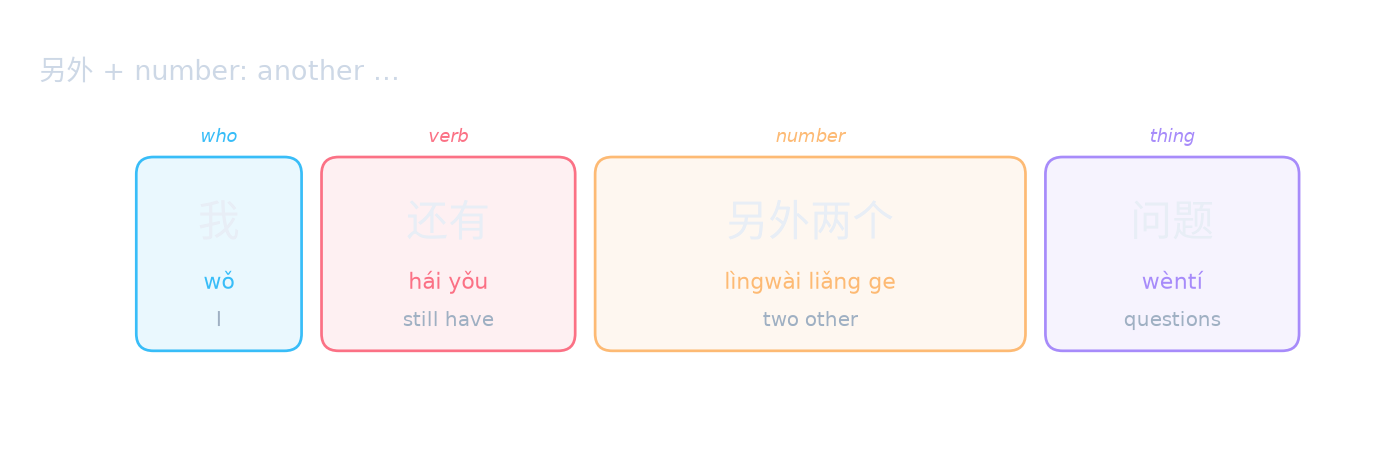
- I / me我furthermore还有additional另外两个question问题。 – "I have another two questions."
additional另外 + number + MW + noun
- additional另外 + (number) + MW + noun = "another / the other": additional另外一个person人, additional另外两本书.
- It can also take (modifier / structural particle)的: additional另外(modifier / structural particle)的means办法 – "another way".
the other另外one一个person人is是my我classmate同学。
The rest of a group
- 三个人里,一个to be / is是teacher老师,additional另外两个to be / is是student学生。 – "Of the three, one is a teacher and the other two are students."
- additional另外 picks out the remaining members after one has been mentioned.
one一个is是a teacher老师,the other另外two两个are是students学生。
Order of additional另外 and the number
- Put additional另外 before the number: additional另外两个, not 两个additional另外.
- additional另外 + noun phrase = the other / another; additional另外,… at the start = in addition (a new point).
additional另外 versus else别的 and other其他
- else别的 = other (any other, unspecified): you你furthermore还有else别的question问题(yes/no ?)吗?
- other其他 = the other(s), the rest: 其他人all / both都to walk走(completed / change)了. additional另外 often comes with a number.
the other其他people人all都left走了。
Recap
- additional另外 + number + MW + noun = another / the other …: additional另外两个question问题.
- additional另外 goes before the number; else别的 = any other; other其他 = the rest.
Practise this pattern step by step.
Practice without the models
Choose a pattern, cover its teaching examples, and attempt its questions. Use the labels to find feedback in the separate key.
all所有((modifier / structural particle)的) + Noun (all)
2201.1 Complete: “All the shops are closed.” all所有(modifier / structural particle)的store商店…………to close a door关门(completed / change)了。
2201.2 Which sentence is correct?
- A. we / us我们all所有to come来(completed / change)了。
- B. all所有(modifier / structural particle)的person人all / both都to come来(completed / change)了。
- C. all所有(modifier / structural particle)的人来(completed / change)了。
- D. person人all所有all / both都to come来(completed / change)了。
2201.3 Build: “I've read all the books.”
Arrange all chunks: I / me我 / book书。 / all所有(modifier / structural particle)的 / 看过
2201.4 everything一切all / both都can / will会good好(modifier / structural particle)的 means “Everything will be fine.”
True or false? Explain or repair the statement.
2201.5 Your teacher makes an announcement to the whole school. Close the examples. Say a Mandarin response, then write it in Chinese. Explain briefly in English what the lesson’s pattern adds. Compare with the model, then change one detail and try again.
Write or say your own response before reading the key.
… one of (sth)之一 (one of)
2202.1 Complete: “She is one of my best friends.” she / her她to be / is是I / me我best最好(modifier / structural particle)的friend朋友…………。
2202.2 Which phrase is correct?
- A. 一个China中国最大(modifier / structural particle)的city城市one of (sth)之一
- B. China中国最大(modifier / structural particle)的city城市one of (sth)之一
- C. China中国one of (sth)之一最大(modifier / structural particle)的city城市
- D. one of (sth)之一China中国最大(modifier / structural particle)的city城市
2202.3 Build: “The panda is one of China's symbols.”
Arrange all chunks: panda熊猫 / one of (sth)之一。 / to be / is是 / China中国(modifier / structural particle)的emblem象征
2202.4 among其中one of (sth)之一 means “one of them”.
True or false? Explain or repair the statement.
2202.5 You are introducing China's great sights to visiting friends. Close the examples. Say a Mandarin response, then write it in Chinese. Explain briefly in English what the lesson’s pattern adds. Compare with the model, then change one detail and try again.
Write or say your own response before reading the key.
additional另外 + Number + MW + Noun (another)
2203.1 Complete: “This one is mine; the other one is my brother's.” this这个to be / is是I / me我(modifier / structural particle)的,…………一个to be / is是I / me我younger brother弟弟(modifier / structural particle)的。
2203.2 Which phrase is correct?
- A. additional另外两个student学生
- B. additional另外student学生两个
- C. 两个additional另外student学生
- D. 两个student学生additional另外
2203.3 Build: “One is a teacher; the other two are students.”
Arrange all chunks: additional另外两个 / to be / is是student学生。 / , / 一个to be / is是teacher老师
2203.4 you你furthermore还有else别的question问题(yes/no ?)吗 asks about any other questions.
True or false? Explain or repair the statement.
2203.5 You have answered the first question in an interview, and the interviewer has more. Close the examples. Say a Mandarin response, then write it in Chinese. Explain briefly in English what the lesson’s pattern adds. Compare with the model, then change one detail and try again.
Write or say your own response before reading the key.
A fresh situation
R1. Interpret and repair. A class has many pupils and Wang Li (1900-1986), one of…王力to be / is是best最好(modifier / structural particle)的student学生one of (sth)之一. Someone translates it as Wang Li is the only best pupil. Correct it.
R2. Use it yourself. Say you have two books and want another three, making the additional quantity clear.
Write your responses before opening the key. Compare meaning as well as form; a different valid answer need not copy the model.
Open the answers after your attempt
Answers and explanations
Check after your attempt. For open tasks, compare the message and the stated criteria, then revise one detail.
all所有((modifier / structural particle)的) + Noun (all)
2201.1 all / both都
all所有 + noun as subject takes all / both都.
2201.2 B. all所有(modifier / structural particle)的person人all / both都to come来(completed / change)了。
all所有(modifier / structural particle)的person人all / both都to come来(completed / change)了 is right: all所有(modifier / structural particle)的 + noun is a whole group, so the verb needs all / both都. all所有 cannot follow the noun, and we / us我们all所有 is not used.
2201.3 I / me我看过all所有(modifier / structural particle)的book书。
all所有(modifier / structural particle)的 + noun as the object.
2201.4 True.
everything一切 = everything (often abstract).
2201.5 One possible response: all所有(modifier / structural particle)的student学生all / both都want / will / need要to participate参加tomorrow明天(modifier / structural particle)的to take an exam考试。
Check meaning and form:
- My response conveys a message that fits the opening situation.
- I can explain the meaning of the pattern, rather than only naming it.
- As a subject, all所有 + noun normally needs all / both都: all所有(modifier / structural particle)的person人all / both都to come来(completed / change)了, not all所有(modifier / structural particle)的人来(completed / change)了.
- all所有 goes before a noun; it is not an adverb: we / us我们all / both都to go去, not we / us我们all所有to go去.
- I tried a second response with a name, time, place, or description changed.
This is supported productive practice. Compare meaning and structure; your answer need not copy the model. A partner or teacher must hear the spoken response to comment on pronunciation.
… one of (sth)之一 (one of)
2202.1 one of (sth)之一
Group + one of (sth)之一 = one of.
2202.2 B. China中国最大(modifier / structural particle)的city城市one of (sth)之一
The group comes first, one of (sth)之一 last.
2202.3 panda熊猫to be / is是China中国(modifier / structural particle)的emblem象征one of (sth)之一。
X to be / is是 + group + one of (sth)之一.
2202.4 True.
among其中 refers back to the group.
2202.5 One possible response: the Great Wall长城to be / is是world世界(bound form) up上most最famous有名(modifier / structural particle)的to construct建筑one of (sth)之一。
Check meaning and form:
- My response conveys a message that fits the opening situation.
- I can explain the meaning of the pattern, rather than only naming it.
- Say best最好(modifier / structural particle)的friend朋友one of (sth)之一, not one of (sth)之一best最好(modifier / structural particle)的friend朋友 (English word order).
- Do not add 一个: cause原因one of (sth)之一, not 一个cause原因one of (sth)之一.
- I tried a second response with a name, time, place, or description changed.
This is supported productive practice. Compare meaning and structure; your answer need not copy the model. A partner or teacher must hear the spoken response to comment on pronunciation.
additional另外 + Number + MW + Noun (another)
2203.1 additional另外
additional另外 + number + MW = the other one.
2203.2 A. additional另外两个student学生
additional另外 comes before the number.
2203.3 一个to be / is是teacher老师,additional另外两个to be / is是student学生。
additional另外 picks out the remaining members.
2203.4 True.
True. else别的 means “other, any other”: you你furthermore还有else别的question问题(yes/no ?)吗? “Do you have any other questions?”
2203.5 One possible response: I / me我furthermore还有additional另外两个question问题。
Check meaning and form:
- My response conveys a message that fits the opening situation.
- I can explain the meaning of the pattern, rather than only naming it.
- Put additional另外 before the number: additional另外两个, not 两个additional另外.
- additional另外 + noun phrase = the other / another; additional另外,… at the start = in addition (a new point).
- I tried a second response with a name, time, place, or description changed.
This is supported productive practice. Compare meaning and structure; your answer need not copy the model. A partner or teacher must hear the spoken response to comment on pronunciation.
Fresh-situation answers
R1. He is one of the best pupils. one of (sth)之一 selects one member from a group; it does not assert uniqueness. The group is expressed before one of (sth)之一.
R2. One possible response. I / me我already已经to have / there is有两本书(completed / change)了,still / also还want / think / miss想again / then再to buy买三本。Another form is additional另外three三本书 for three additional books. The final total would be five if the purchase happens; wanting them is not owning them.
Recall later. Tomorrow, contrast one of a group with the only one and an extra quantity.