Chinese course / HSK4 handouts
"If" statements
Printable paper with separate answer pages Step-by-step lessons
Original teaching practice. Read one pattern, cover its model and try the questions before checking the separate answer section. Examples adapted from Chinese Grammar Wiki (AllSet Learning, CC BY-NC-SA) retain the course-reference provenance.
if要是 … ,then / just就 … (if – spoken)
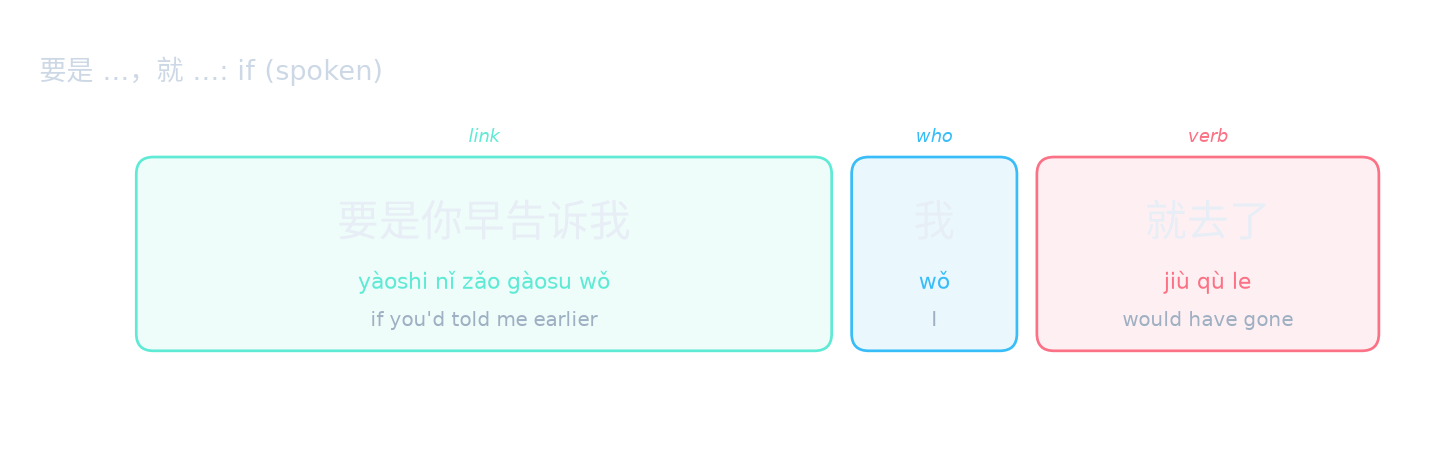
If I'd known
- Your friend didn't tell you about the party, and you would have loved to go.
- if要是you你early早to tell告诉I / me我,I / me我then / just就to go去(completed / change)了。 – "If you'd told me earlier, I would have gone."
if要是 A,(Subject) then / just就 B
- if要是 = "if", the spoken partner of if如果. The result clause takes then / just就 after its subject.
- if (coming after a…的话 can close the condition: if要是you你to have time (to do sth)有空if (coming after a…的话,then / just就to come来(suggestion)吧.
if要是you你are free有空,then就come来吧。
Real and unreal conditions
- Possible: if要是tomorrow明天不下雨,we / us我们then / just就to go去to climb a mountain爬山。 – "If it doesn't rain tomorrow, we'll go hiking."
- Past, unreal: if要是I / me我早点儿to go out出门,then / just就improbable不会to arrive late迟到(completed / change)了。 – "If I'd left earlier, I wouldn't have been late."
if要是I我earlier早a bit点儿left出门,then就wouldn't不会be late迟到了。
then / just就 after the subject
- Subject first, then then / just就: I / me我then / just就to go去, not then / just就I / me我to go去.
- if要是 is spoken; in an essay, if如果 or if假如 sounds better.
if要是 versus if如果 and if only只要
- if如果 is neutral and written: if如果to have / there is有question问题,to ask请connection联系I / me我.
- if only只要…then / just就 = as long as (the condition is enough): if only只要to have time (to do sth)有空,I / me我then / just就to come来.
if如果there are有questions问题,please请contact联系me我。
Recap
- if要是 A (if (coming after a…的话),Subject + then / just就 B = if A, then B (spoken).
- Also for unreal past conditions (then / just就improbable不会…(completed / change)了); if如果 is the neutral/written form.
Practise this pattern step by step.
Practice without the models
Choose a pattern, cover its teaching examples, and attempt its questions. Use the labels to find feedback in the separate key.
if要是 … ,then / just就 … (if – spoken)
1701.1 Complete (spoken): “If you're tired, have a rest.” …………you你rope累(completed / change)了,then / just就rest休息(used after a verb) give it…一下。
1701.2 Which sentence is correct?
- A. if要是to rain下雨,then / just就we / us我们不去。
- B. we / us我们will就要to be / is是to rain下雨不去。
- C. if要是to rain下雨,we / us我们then / just就not不to go去。
- D. if要是to rain下雨,we / us我们not不then / just就to go去。
1701.3 Build: “If I'd left earlier, I wouldn't have been late.”
Arrange all chunks: , / to arrive late迟到(completed / change)了。 / then / just就improbable不会 / if要是I / me我早点儿to go out出门
1701.4 if如果 suits formal writing better than if要是.
True or false? Explain or repair the statement.
1701.5 Your friend didn't tell you about the party, and you would have loved to go. Close the examples. Say a Mandarin response, then write it in Chinese. Explain briefly in English what the lesson’s pattern adds. Compare with the model, then change one detail and try again.
Write or say your own response before reading the key.
A fresh situation
R1. Interpret and repair. A friend says if要是you你to have / there is有(concept of) time时间,we / us我们so / therefore所以in the same place一起to go去. Repair the paired result clause.
R2. Use it yourself. Invite someone for tea if they finish early, while keeping the condition uncertain.
Write your responses before opening the key. Compare meaning as well as form; a different valid answer need not copy the model.
Open the answers after your attempt
Answers and explanations
Check after your attempt. For open tasks, compare the message and the stated criteria, then revise one detail.
if要是 … ,then / just就 … (if – spoken)
1701.1 if要是
if要是 + condition, then / just就 + result.
1701.2 C. if要是to rain下雨,we / us我们then / just就not不to go去。
if要是to rain下雨,we / us我们then / just就not不to go去 is right: in the result clause, then / just就 comes after the subject we / us我们 and before the verb phrase.
1701.3 if要是I / me我早点儿to go out出门,then / just就improbable不会to arrive late迟到(completed / change)了。
if要是 + condition, then / just就improbable不会…(completed / change)了.
1701.4 True.
if要是 is spoken; if如果 is neutral and written.
1701.5 One possible response: if要是you你early早to tell告诉I / me我,I / me我then / just就to go去(completed / change)了。
Check meaning and form:
- My response conveys a message that fits the opening situation.
- I can explain the meaning of the pattern, rather than only naming it.
- Subject first, then then / just就: I / me我then / just就to go去, not then / just就I / me我to go去.
- if要是 is spoken; in an essay, if如果 or if假如 sounds better.
- I tried a second response with a name, time, place, or description changed.
This is supported productive practice. Compare meaning and structure; your answer need not copy the model. A partner or teacher must hear the spoken response to comment on pronunciation.
Fresh-situation answers
R1. if要是you你to have / there is有(concept of) time时间,we / us我们then / just就in the same place一起to go去。if要是 introduces a condition; then / just就 gives the consequence in this taught pair. so / therefore所以 would frame a reason/result relation differently.
R2. One possible response. if要是you你早点儿to make做to finish完,we / us我们then / just就in the same place一起to go去to drink tea喝茶。The invitation depends on early completion; it does not claim that completion has happened.
Recall later. Later, change both the condition and result, checking the subject before then / just就.