Control volumes: what holds the nozzle on
مُقدَّم| English | المعنى |
|---|---|
| control volume | A region selected for analysis whose boundary may be crossed by mass as well as energy. |
| continuity/kɒntɪˈnjuːɪti/ | The mass balance for a flow: what enters a control volume must leave it, so Q = VA stays constant for a liquid. |
| Bernoulli | The energy equation along a streamline for steady, incompressible, frictionless flow: pressure head plus velocity head plus height is constant. |
The bolts feel the push
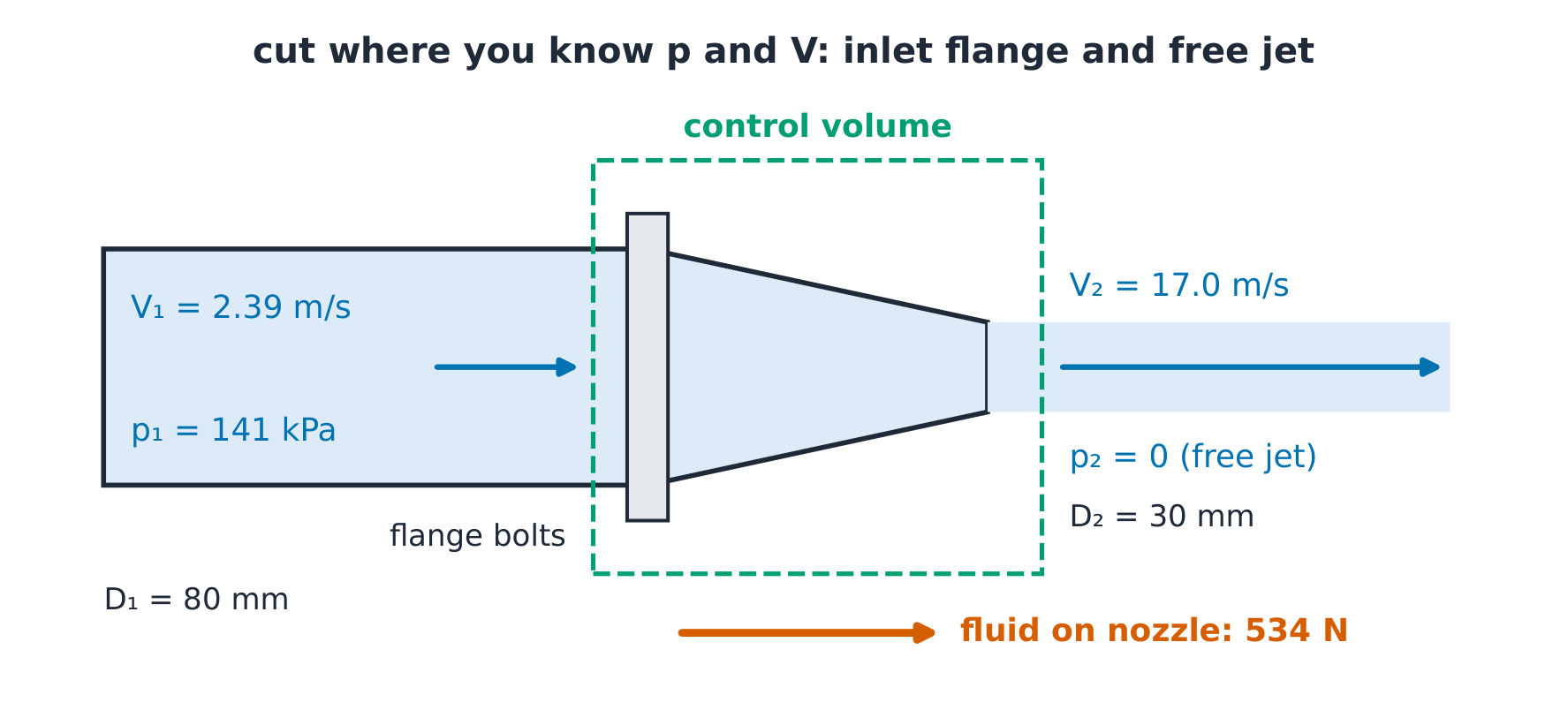
- A wash-down nozzle must be bolted on, and the bolt load comes from momentum and pressure together. The clean way to find it is a control volume 控制体积: draw a boundary and account for everything that crosses it.
- Cut where pressure and velocity are known, and through the bolts whose force you want.
Two balances
- Mass (continuity 连续性方程): $Q = V_1A_1 = V_2A_2$ for a liquid.
- Momentum: $\sum F = \dot m(V_2 - V_1)$, where $\sum F$ includes the pressure forces on the cut faces as well as the force from the walls.
Which term is it?
Sort each quantity into its place in the control-volume balance.
12 L/s through a 30 mm nozzle: jet speed (one decimal, m/s)?
الصعوبة 2/5 · 140 عملة + مكافأة صغيرة عند الإنجاز الأول اليوم
Q over the area 7.069e-4 m2.
Put the steps of a control-volume force calculation in order.
الصعوبة 3/5 · 200 عملة + مكافأة صغيرة عند الإنجاز الأول اليوم
The boundary comes first; the sign reversal comes last.
The nozzle bolts
- $Q = 12$ L/s enters an 80 mm pipe and leaves a 30 mm nozzle: $V_1 = \mathbf{2.39}$ m/s and $V_2 = \mathbf{17.0}$ m/s.
- Bernoulli 伯努利方程 to the jet ($p_2 = 0$ gauge) gives $p_1 = \tfrac12\rho(V_2^2 - V_1^2) = \mathbf{141}$ kPa.
- $p_1A_1 + F = \rho Q(V_2 - V_1)$ gives $F = 174.7 - 708.6 = -534$ N: the fluid pushes the nozzle downstream with 534 N, and the bolts carry it in tension.
Inlet gauge pressure upstream of that nozzle, V1 = 2.39 m/s (kPa, whole number)?
الصعوبة 2/5 · 140 عملة + مكافأة صغيرة عند الإنجاز الأول اليوم
Half rho times (V2 squared minus V1 squared).
The bolt force (N, whole number, magnitude)?
الصعوبة 2/5 · 140 عملة + مكافأة صغيرة عند الإنجاز الأول اليوم
p1 A1 minus rho Q (V2 - V1) = 708.6 - 174.7.
At the nozzle, which term is larger?
الصعوبة 1/5 · 100 عملة + مكافأة صغيرة عند الإنجاز الأول اليوم
708.6 N of pressure against 174.7 N of momentum gain.
Turning the flow: a 90° bend
- The same 12 L/s turns through $90°$ at 150 kPa gauge. Each direction carries $pA + \rho QV = 754.0 + 28.6 = 782.6$ N, so the anchor holds $\sqrt2 \times 782.6 = \mathbf{1107}$ N at $45°$.
- At this low speed the pressure term is 26 times the momentum term, which is why low-velocity, high-pressure lines still need thrust blocks.
Anchor force on the 90 degree bend, 782.6 N per direction (N, whole number)?
الصعوبة 2/5 · 140 عملة + مكافأة صغيرة عند الإنجاز الأول اليوم
Root two times the per-direction force.
A jet on a plate
- Turn the nozzle's jet onto a flat plate square to it. The plate turns the flow through 90°, so all the jet's momentum flux is removed: $F = \rho QV = 998 \times 0.012 \times 17.0 = \mathbf{203}$ N.
- The jet is at atmospheric pressure, so there is no pressure term here, only momentum. That is the force a wash-down operator feels holding the plate.
The 12 L/s, 17.0 m/s jet on a fixed plate normal to it: force (N, nearest whole)?
الصعوبة 2/5 · 140 عملة + مكافأة صغيرة عند الإنجاز الأول اليوم
$\rho QV = 998 \times 0.012 \times 16.98 = 203$ N.
Worked example: a plate that moves away
- Let the plate recede at $u = 5$ m/s. In the plate's frame the jet arrives at $17.0 - 5 = 12.0$ m/s, and only $\rho A(V - u)$ kg/s reaches it.
- $F = \rho A(V - u)^2 = 998 \times 7.069 \times 10^{-4} \times 12.0^2 = \mathbf{101}$ N, and the power delivered is $Fu = 506$ W. Turbines exploit exactly this trade between force and speed.
Same jet (30 mm nozzle) on a plate receding at 5 m/s: force (N, nearest whole)?
الصعوبة 2/5 · 140 عملة + مكافأة صغيرة عند الإنجاز الأول اليوم
$998 \times 7.069 \times 10^{-4} \times (16.98 - 5)^2 = 101$ N.
A plate moving away from the jet feels the same force as a fixed one.
الصعوبة 1/5 · 100 عملة + مكافأة صغيرة عند الإنجاز الأول اليوم
The relative speed falls and so does the mass flow reaching it: 101 N against 203 N.
Three control-volume slips
- Leaving out the pressure on the cut faces. It is often the biggest term.
- Gauge at one face, absolute at the other. Use one reference throughout.
- Force on the fluid reported as force on the pipe. They are equal and opposite.
The force on the pipe is equal and opposite to the force on the fluid.
الصعوبة 1/5 · 100 عملة + مكافأة صغيرة عند الإنجاز الأول اليوم
Newton's third law across the wall.
Recap
- $Q = VA$ is conserved: 2.39 m/s in the pipe becomes 17.0 m/s in the jet.
- $\sum F = \dot m(V_2 - V_1)$, component by component, pressure forces included.
- Nozzle bolts: 534 N in tension; bend anchor: 1107 N at 45°.