Laplace transform and system functions
مُقدَّم| English | المعنى |
|---|---|
| poles and zeros | The values of s that make a transfer function infinite (poles) or zero (zeros). |
| system function | دالة النظام |
| region of convergence | region of convergence |
| frequency response | How a system's gain and phase change with the frequency of a sinusoidal input. |
Read a circuit from a few dots
- A tone control's behaviour (how fast it settles, whether it rings, which frequencies it boosts) can be read from a handful of dots on a plane.
- Those dots are the poles and zeros of the system function. This lesson reads time and frequency behaviour from them.
The system function
- The system function 系统函数 is $H(s) = \dfrac{Y(s)}{X(s)}$, the Laplace transform of the impulse response $h(t)$.
- For circuits, $H(s)$ is a ratio of polynomials. Factor it into poles and zeros 零极点: values of $s$ where $H$ blows up or vanishes.
H(s) = (s + 3)/((s + 1)(s + 5)). Where are the poles and zero?
الصعوبة 1/5 · 100 عملة + مكافأة صغيرة عند الإنجاز الأول اليوم
Poles make the denominator zero ($s = -1, -5$); the zero makes the numerator zero ($s = -3$).
Poles are the natural modes
- Each pole $p$ adds a term $e^{pt}$ to the response. A real negative pole decays; a complex pair rings; a pole in the right half-plane grows.
- A causal system is stable when every pole lies in the open left half-plane. The region of convergence 收敛域 (ROC) records which side of the poles the transform converges on, and so whether $h$ is causal.
Match each pole position to the mode it adds.
الصعوبة 2/5 · 140 عملة + مكافأة صغيرة عند الإنجاز الأول اليوم
A pole $p$ contributes $e^{pt}$: the real part sets growth or decay, the imaginary part the ringing frequency.
H(s) = 1/(s − 2) with ROC Re(s) > 2 describes
الصعوبة 1/5 · 100 عملة + مكافأة صغيرة عند الإنجاز الأول اليوم
An ROC to the right of the pole means $h(t) = e^{2t}u(t)$, causal but growing. A causal system with a right-half-plane pole is unstable.
Worked example: the step response
- $H(s) = \dfrac{1}{s + 1}$ driven by a step $\dfrac{1}{s}$: $Y(s) = \dfrac{1}{s(s + 1)} = \dfrac{1}{s} - \dfrac{1}{s + 1}$.
- So $y(t) = 1 - e^{-t}$: the same answer as the convolution, by three lines of partial fractions.
H(s) = 4/(s + 2) is driven by a unit step. What is the final value of y(t)?
الصعوبة 2/5 · 140 عملة + مكافأة صغيرة عند الإنجاز الأول اليوم
$Y(s) = \dfrac{4}{s(s + 2)} = \dfrac{2}{s} - \dfrac{2}{s + 2}$, so $y(t) = 2 - 2e^{-2t} \to 2$: the DC gain $H(0) = 2$.
One pole, three readings
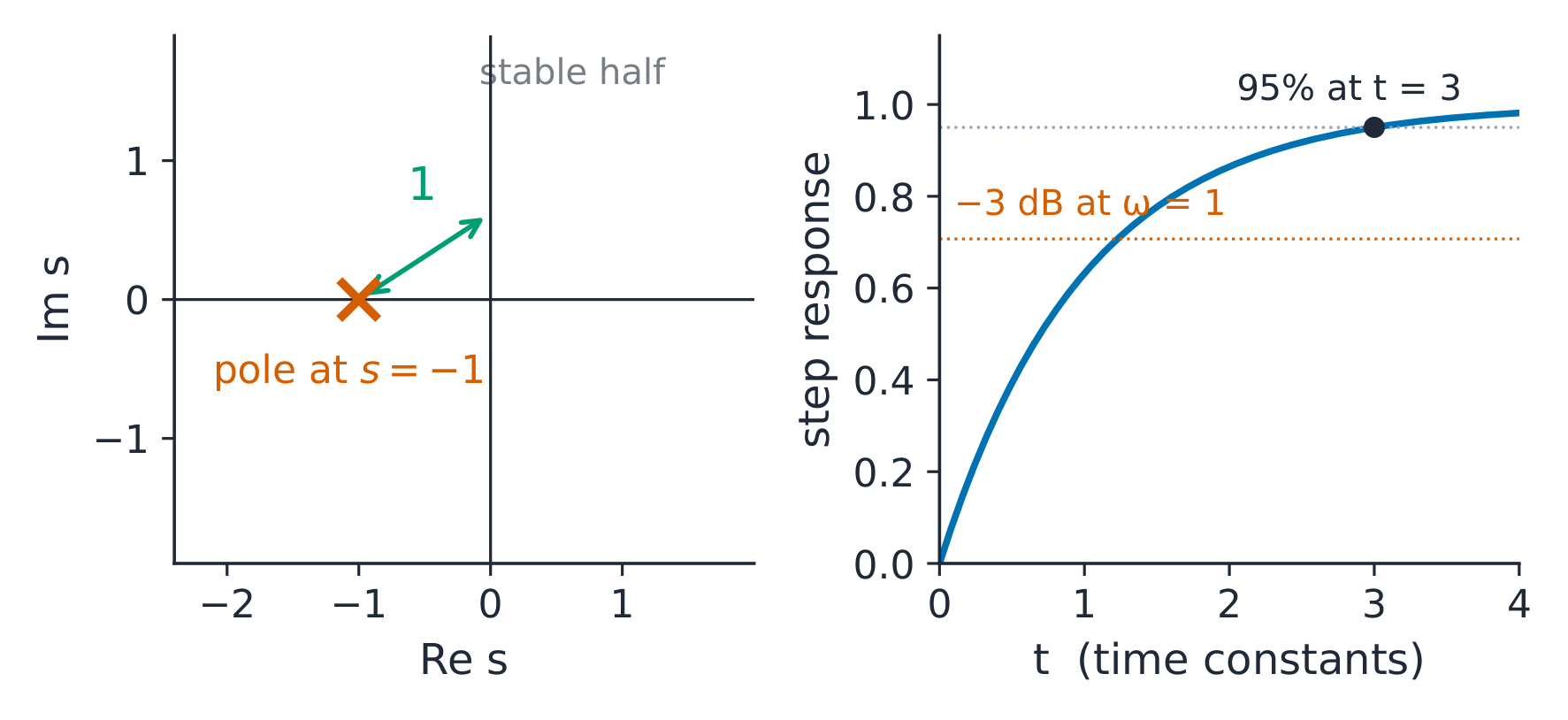
- The pole at $s = -1$ is the $e^{-t}$ decay, time constant 1 s; the step response reaches 95% at $t = 3$ s.
- On the frequency response 频率响应 $H(j\omega)$, $|H(j1)| = \dfrac{1}{\sqrt{2}} = 0.707$: the −3 dB point is at the pole's distance from the origin, with phase −45°.
H(s) = 1/(s + 1). At ω = 1 rad/s, |H(jω)| is
الصعوبة 1/5 · 100 عملة + مكافأة صغيرة عند الإنجاز الأول اليوم
$|H(j1)| = \dfrac{1}{|1 + j|} = \dfrac{1}{\sqrt{2}}$. A lone pole puts the −3 dB point at its distance from the origin.
Worked example: a tone control
- $H(s) = \dfrac{s^{2} + 2s + 100}{(s + 1)(s + 10)}$. Poles at −1 and −10, both in the left half-plane: stable. DC gain $\dfrac{100}{10} = 10$, a 20 dB bass lift; high-frequency gain 1.
- The zeros $-1 \pm j9.95$ sit close to the imaginary axis near 10 rad/s, so they carve a notch there: $|H(j10)| \approx 0.14$, about −17 dB.
The tone control (s² + 2s + 100)/((s+1)(s+10)) has DC gain —
الصعوبة 1/5 · 100 عملة + مكافأة صغيرة عند الإنجاز الأول اليوم
Put $s = 0$: $\dfrac{100}{1 \times 10} = 10$, a 20 dB bass lift. At high frequency the $s^{2}$ terms dominate and the gain tends to 1.
Three common slips
- Poles without the ROC. $\dfrac{1}{s + 1}$ with an ROC to the left of −1 is anti-causal and unstable.
- Applying the distance rule everywhere. The −3 dB point equals the pole distance only for a lone first-order pole.
- Forgetting the zeros. Zeros near the $j\omega$ axis carve notches the poles alone do not predict.
A causal system with poles at −2 and +0.1 is stable, because most of its poles are in the left half-plane.
الصعوبة 1/5 · 100 عملة + مكافأة صغيرة عند الإنجاز الأول اليوم
One right-half-plane pole is enough. The mode $e^{0.1t}$ grows without limit, however slowly.
Recap
- $H(s) = \dfrac{Y(s)}{X(s)}$; poles set the natural modes, zeros shape the response.
- Causal and stable: all poles in the left half-plane.
- Put $s = j\omega$ for the frequency response.