Your learning plan · Continue · Review →
Academic Task 1 processes — follow the arrows, then write
مُقدَّميبقى موقعك المحفوظ في هذا المتصفح. لا يكتمل استئناف الموقع الدرس أو الإجابة على أسئلته.
A process is more than a row of nouns
- Outcome: write and revise a connected Academic Task 1 report that preserves what a diagram actually shows. Start with the writing criteria and selection and overviews. A recycling symbol may suggest repetition, but the arrows decide whether this particular process returns to an earlier stage.
- Trace the input, operations and output before drafting. Look for a split, a merge, a return path, a condition and any number with its unit. These original fictional schematics teach reporting relationships; they are not real manufacturing instructions or official test items. The arrows have a job. Let them do it before the adjectives arrive.
Worked sequence: keep the transformation and order
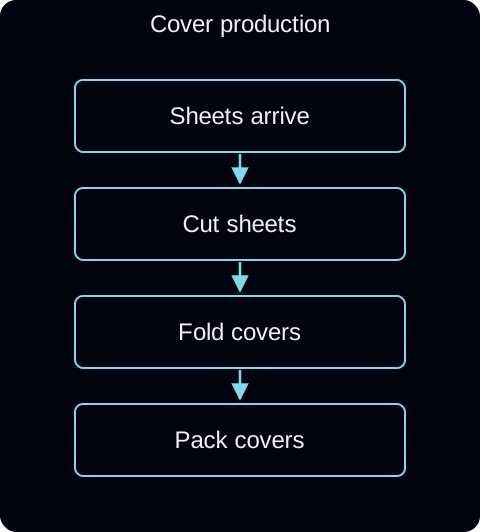
- In this cover-production diagram, a weak excerpt says “Covers are packed, then sheets are folded and cut.” It reverses the source. A more accurate overview is “Sheets pass through cutting and folding before the covers are packed.” A detail can then explain that cutting precedes folding. It is a short teaching excerpt, not a complete 150-word report.
- An arrow supplies the shown sequence, not every possible cause or advantage. Do not add faster, cheaper or more durable unless the visual gives that information. Nor should you claim that a named machine or worker performs an action when neither is supplied.

Worked cycle: the bottom box need not be the end
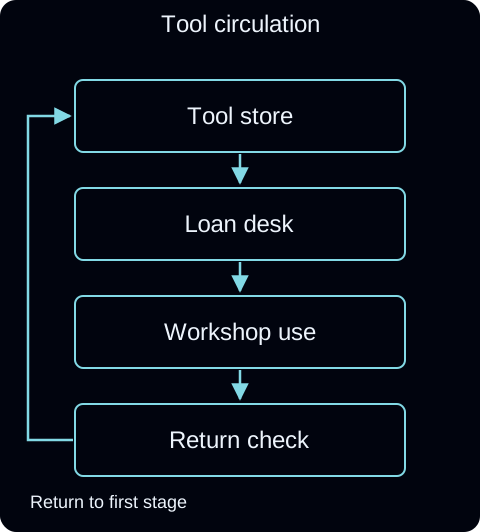
- Here, a weak overview says “The process ends permanently with checking the returned tools.” The arrow instead returns to the tool store. A better excerpt is “Tools circulate from storage through lending, use and return checking before re-entering storage.” The store is a useful starting point for the description, not proof that the cycle has a once-only beginning.
- A return arrow does not establish unlimited lifespan, exact duration or the number of repetitions. Describe the loop and its main phases, then explain the labelled relationships. Do not add an unshown disposal branch merely because real tools eventually wear out.

Worked parallel paths: preserve each component’s work
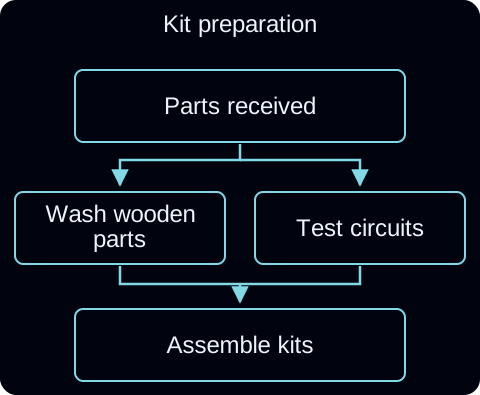
- A weak excerpt says “Every component is washed and then tested.” The diagram gives different work to different parts. A better description is “Wooden parts are washed and circuits are tested on separate paths before kits are assembled.” Explain both preparations and their merge, rather than forcing the drawing into one straight chain.
- Separate paths do not, by themselves, establish exact simultaneous start times or equal durations. A different diagram may split into alternative outcomes after a condition; follow those labels rather than treating both outcomes as compulsory. You will practise both structures below.

Choose grammar that preserves actors and labels
- Use active forms when a named actor matters: “Staff sort the files.” Use a suitable passive when the action is central and its operator is unnamed: “The files are scanned.” Passive means be + past participle, as in are cut, are bound and are packed; it is not a rule that every process sentence must be passive. Keep a generic process in a consistent present description unless its dates or status require another tense.
- Keep durations, temperatures, quantities and conditions with the correct stage. “Dry for two hours” is not “dry at two degrees”, and a duration for one box is not the full process time. Do not make an exact stage count the main feature when a different grouping of inputs, operations and outputs would count differently.
Guided diagram decisions
- Ten fresh diagrams include a planning cue. Trace the arrows and read every label before choosing the best reporting sentence or plan. For a branch, identify whether the boundary belongs to one route; for a cycle, follow the return path; for parallel preparation, preserve the separate work and common next step.
- These are decisions about writing, not ten complete reports or official multiple-choice Writing tasks. Use the explanation to locate the particular error: reversed order, swapped object, wrong unit, invented operator, missing arm or unshown outcome. Then repair that decision against the diagram.
Original schematic teaching process:

View Badge production at full size
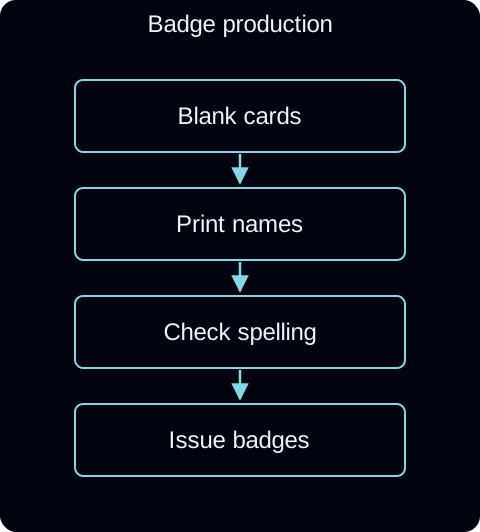
Reporting decision: Which overview follows the input and output?
Choose ONE answer.
Planning cue: Locate the input, final output and intervening work.
Difficulty 1/5 · 100 coins + a small bonus on first completion today
The arrows move from blank cards to issuing badges, with checking after printing. There is no return arrow or attendance outcome. State the broad transformation without adding an effect.
Original schematic teaching process:

View Tray circulation at full size
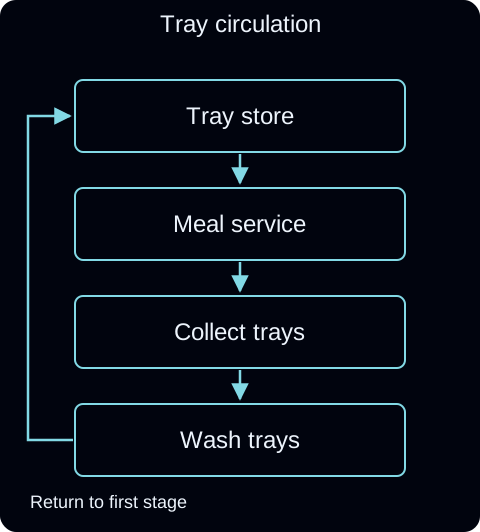
Reporting decision: Which broad description fits?
Choose ONE answer.
Planning cue: Inspect the arrow returning to the first box.
Difficulty 1/5 · 100 coins + a small bonus on first completion today
The return arrow leads back to the store. Neither disposal nor a cycle time is shown. A cycle has a reusable description point, not a diagram-supported permanent final stage.
Original schematic teaching process:

View Display assembly at full size
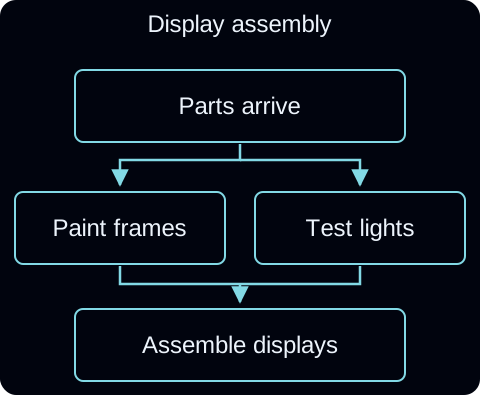
Reporting decision: Which sentence preserves the two paths?
Choose ONE answer.
Planning cue: Read each arm before reading the merge.
Difficulty 1/5 · 100 coins + a small bonus on first completion today
The split assigns different work to frames and lights and merges at assembly. It does not give an order between the arms, identical operations or measured duration.
Original schematic teaching process:

View Parcel sorting at full size
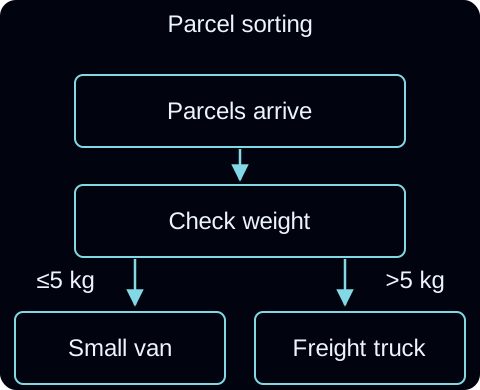
Reporting decision: A parcel weighs exactly 5 kg. Which route matches the diagram?
Choose ONE answer.
Planning cue: The boundary belongs to one labelled branch.
Difficulty 1/5 · 100 coins + a small bonus on first completion today
The ≤5 kg outcome includes exactly 5 kg. The truck branch is >5 kg, and the two outputs are alternatives. Preserve the condition when describing the route.
Original schematic teaching process:

View Filter preparation at full size
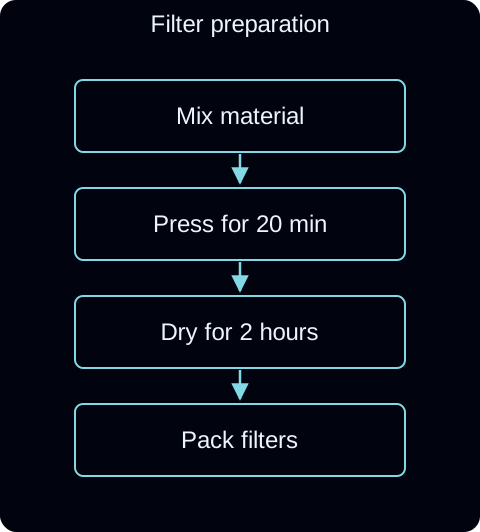
Reporting decision: Which detail is accurate?
Choose ONE answer.
Planning cue: Attach each duration to its own action.
Difficulty 1/5 · 100 coins + a small bonus on first completion today
The durations belong to two specific stages in the shown order. Mixing and packing have no stated durations, so their time cannot be assumed to be zero or included in an exact overall total.
Original schematic teaching process:

View Ticket dispatch at full size
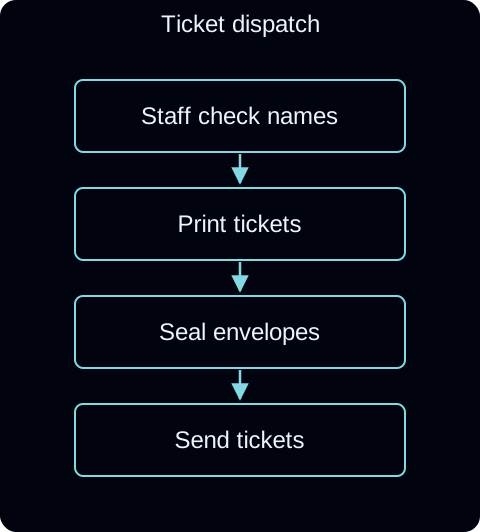
Reporting decision: Which sentence keeps the named actor?
Choose ONE answer.
Planning cue: Keep who acts on what.
Difficulty 1/5 · 100 coins + a small bonus on first completion today
Staff is the named agent for checking. Passive are printed suits the next stage when no printer operator is named. Active and passive can coexist; they are not a compulsory all-passive recipe.
Original schematic teaching process:

View Cardboard cutting at full size
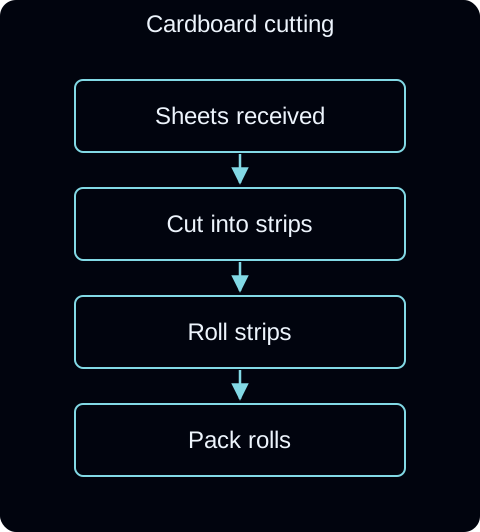
Reporting decision: Which passive is grammatical and accurate?
Choose ONE answer.
Planning cue: Use be plus the appropriate past participle without changing the order.
Difficulty 1/5 · 100 coins + a small bonus on first completion today
Are cut is the passive; the past participle is cut. Are cutting normally makes sheets the active cutter, and cutted is not the form. The final option reverses the shown sequence.
Original schematic teaching process:

View Bottle collection at full size
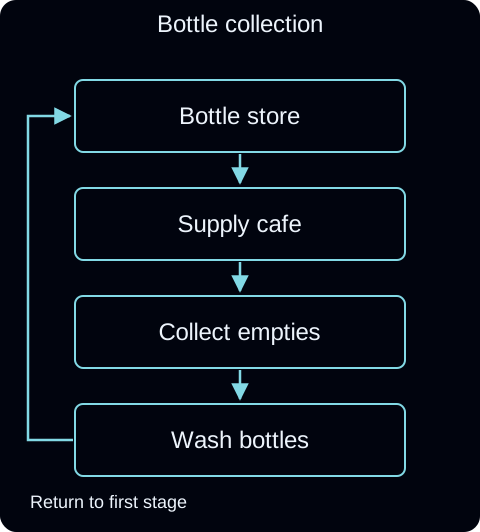
Reporting decision: Which addition lacks evidence?
Choose ONE answer.
Planning cue: Separate the existence of a loop from its unlabelled limits.
Difficulty 1/5 · 100 coins + a small bonus on first completion today
The loop shows return but supplies no lifetime count. The other descriptions follow its arrows. A cycle does not prove unlimited reuse or a particular number of rounds.
Original schematic teaching process:

View Fabric preparation at full size
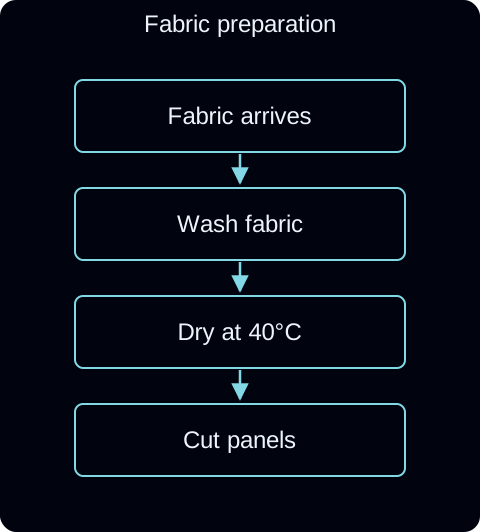
Reporting decision: Which description keeps the numeric label?
Choose ONE answer.
Planning cue: Read the action and unit together.
Difficulty 1/5 · 100 coins + a small bonus on first completion today
The temperature labels drying only. It is not a time or a condition for washing/cutting. Report the relevant supplied number with its unit instead of transferring it to another stage.
Original schematic teaching process:

View Sound kit preparation at full size
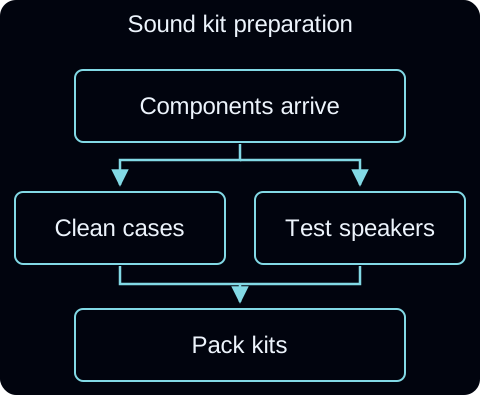
Reporting decision: Which grouping follows the diagram?
Choose ONE answer.
Planning cue: Use the split and merge to organise details.
Difficulty 1/5 · 100 coins + a small bonus on first completion today
The two arms assign cleaning to cases and testing to speakers before the merge. Keeping both main paths preserves the whole process. The diagram provides operations, not their unstated reasons.
Independent decisions from twenty new diagrams
- These twenty distinct sources remove the planning cue. Each diagram has an equivalent text description and a full-size link. Select the answer supported by this drawing, rather than borrowing an operation or timing from an earlier process with similar objects.
- A correct decision is useful evidence about that local objective, not proof that you can write a whole process report. The full writing tasks later require your own connected prose. Study across sessions if useful, and keep a short list of the diagram relationships you confuse.
Original schematic teaching process:

View Envelope production at full size
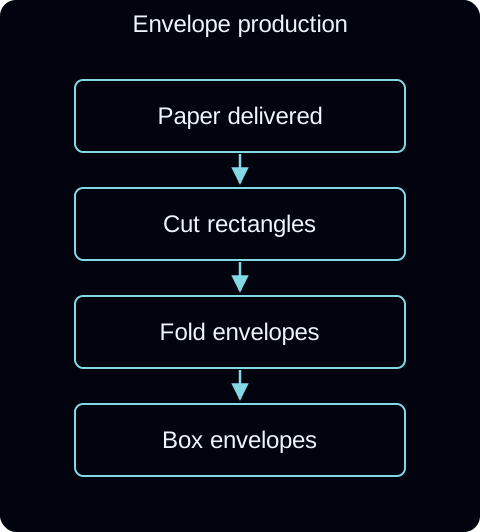
Reporting decision: Which overview stays within the diagram?
Choose ONE answer.
Difficulty 1/5 · 100 coins + a small bonus on first completion today
The sequence is paper → cutting → folding → boxing. Neither a return route nor comparative costs are supplied. Select the transformation and broad phases rather than an invented advantage.
Original schematic teaching process:

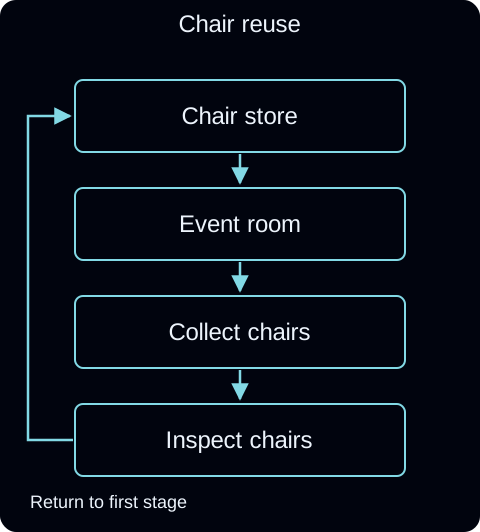
Reporting decision: Which description fits the overall organisation?
Choose ONE answer.
Difficulty 1/5 · 100 coins + a small bonus on first completion today
The return arrow closes the cycle. It does not show a disposal branch or event duration. Use a cycle overview without inventing limits or outcomes.
Original schematic teaching process:

View Sensor assembly at full size
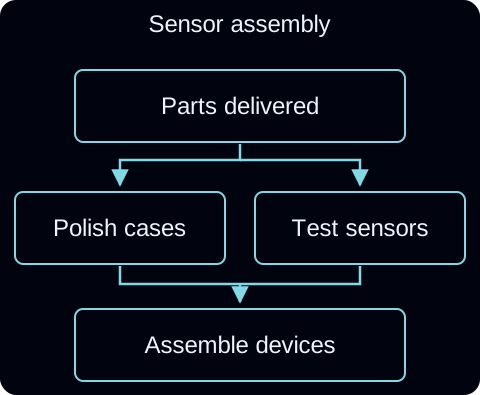
Reporting decision: Which description preserves the branches?
Choose ONE answer.
Difficulty 1/5 · 100 coins + a small bonus on first completion today
The two preparation arms lead to assembly. The diagram does not put one arm before the other or specify elapsed time; it assigns different work to different parts.
Original schematic teaching process:

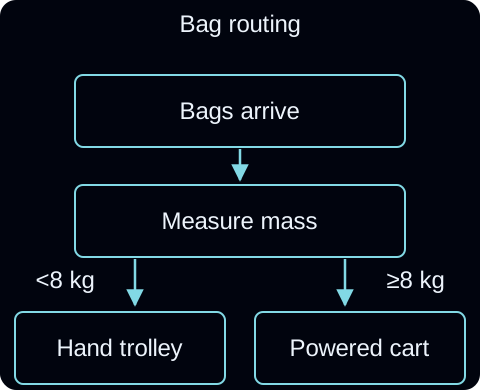
Reporting decision: Which sentence preserves the boundary?
Choose ONE answer.
Difficulty 1/5 · 100 coins + a small bonus on first completion today
The ≥8 kg arm includes exactly 8 kg; the <8 kg arm does not. The outputs are alternatives and carrying capacities are not given.
Original schematic teaching process:

View Clay tag preparation at full size
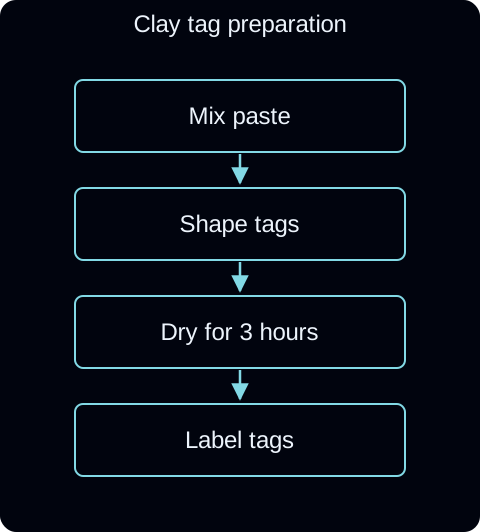
Reporting decision: Which duration statement is supported?
Choose ONE answer.
Difficulty 1/5 · 100 coins + a small bonus on first completion today
Three hours belongs to drying alone. The other stages have no timings, and labelling comes later. Unknown durations cannot be silently treated as zero.
Original schematic teaching process:

View Poster handling at full size
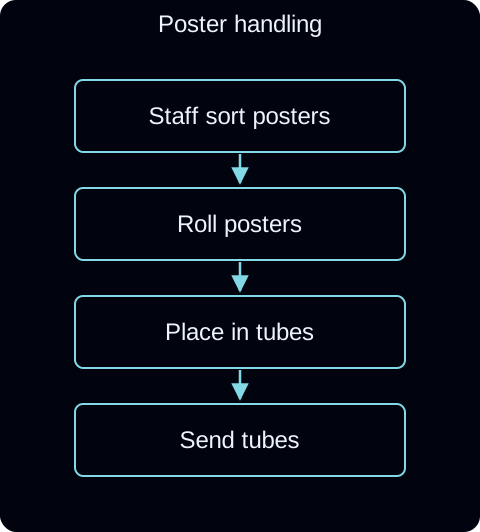
Reporting decision: Which sentence preserves agency?
Choose ONE answer.
Difficulty 1/5 · 100 coins + a small bonus on first completion today
The first box identifies the sorting actor. Later actions can be described passively, but their operators are not specified. A named actor at one stage does not automatically identify every later operator.
Original schematic teaching process:

View Wooden tile preparation at full size
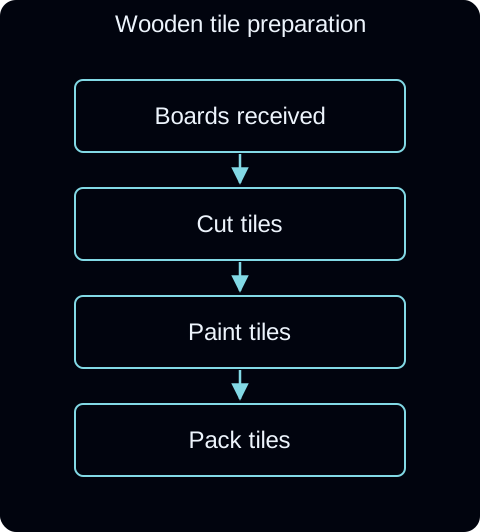
Reporting decision: Which sentence is both grammatical and accurate?
Choose ONE answer.
Difficulty 1/5 · 100 coins + a small bonus on first completion today
Cut is also the past participle, and are painted supplies the passive form for the next stage. The other sentences misuse forms or reverse the arrows. Accuracy includes grammar and the source relationship.
Original schematic teaching process:

View Cup circulation at full size
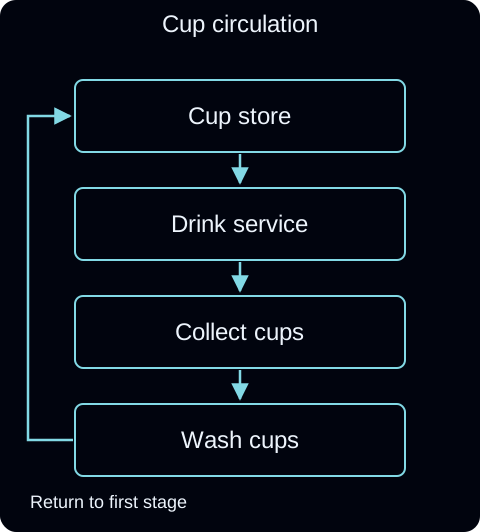
Reporting decision: Which claim should be removed?
Choose ONE answer.
Difficulty 1/5 · 100 coins + a small bonus on first completion today
The return path establishes circulation, not infinite durability. The remaining statements follow the arrows. A diagram can show repetition without giving a lifespan.
Original schematic teaching process:

View Sheet treatment at full size
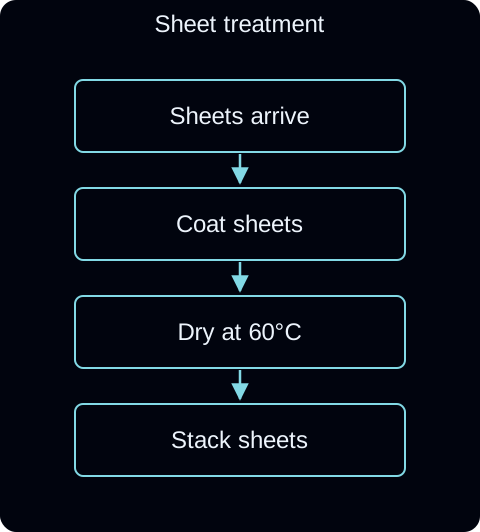
Reporting decision: Which detail retains the supplied measurement?
Choose ONE answer.
Difficulty 1/5 · 100 coins + a small bonus on first completion today
60°C labels the drying stage. It is a temperature, not a duration, storage instruction or whole-factory condition. Keep a numerical detail attached to the box that supplies it.
Original schematic teaching process:

View Lamp assembly at full size
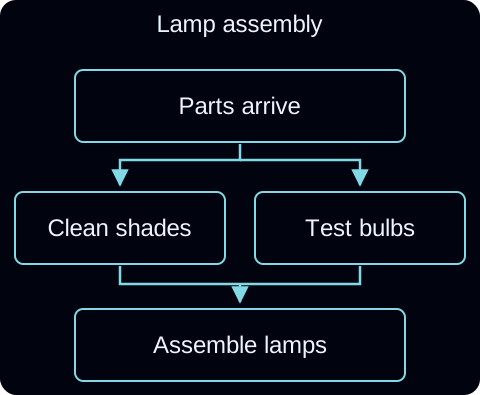
Reporting decision: Which plan preserves the main phases?
Choose ONE answer.
Difficulty 1/5 · 100 coins + a small bonus on first completion today
The split shows two distinct preparations that feed assembly. Omitting one main arm loses coverage, and no causal statement links the preparations to one another. Order follows the arrows, not the visual topic alone.
Original schematic teaching process:

View Seed packet production at full size
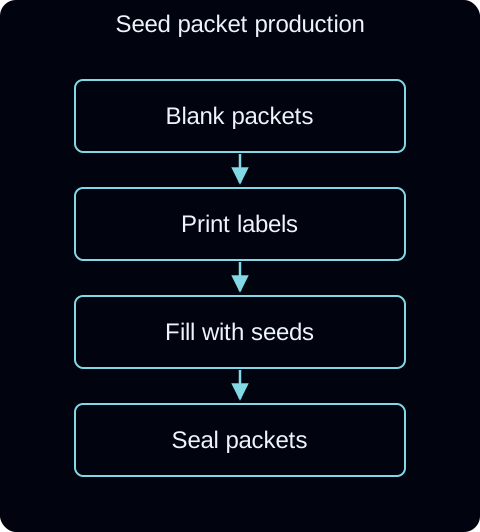
Reporting decision: Which overview is accurate?
Choose ONE answer.
Difficulty 1/5 · 100 coins + a small bonus on first completion today
The arrows supply label → fill → seal. Germination and recycling are not shown. An overview can describe the production stages without claiming the product’s later success.
Original schematic teaching process:

View Camera loan cycle at full size
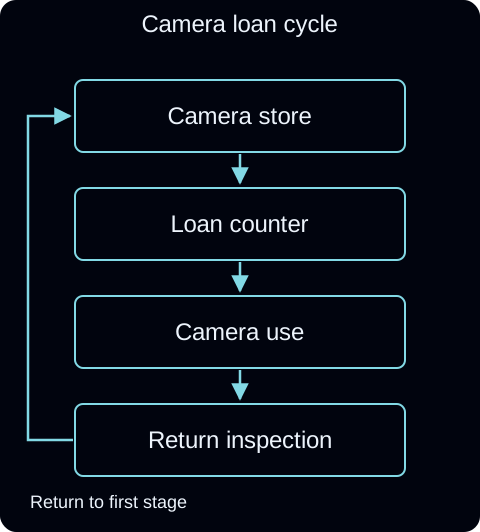
Reporting decision: Which statement preserves the loop?
Choose ONE answer.
Difficulty 1/5 · 100 coins + a small bonus on first completion today
Inspection lies between use and the returning storage path. The diagram says nothing about first-ever use, disposal or loan length. Report the repeated relationship rather than an invented rule.
Original schematic teaching process:

View Model assembly at full size
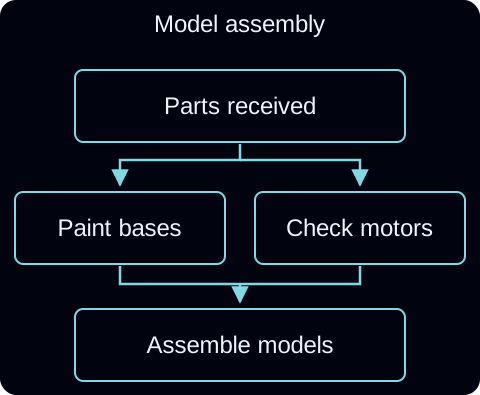
Reporting decision: Which sentence avoids an unsupported order between arms?
Choose ONE answer.
Difficulty 1/5 · 100 coins + a small bonus on first completion today
The arms converge on assembly but do not specify clock synchronisation or one arm’s precedence. Painting applies to bases; checking applies to motors. Do not force a pair of paths into a single chain.
Original schematic teaching process:

View Panel routing at full size
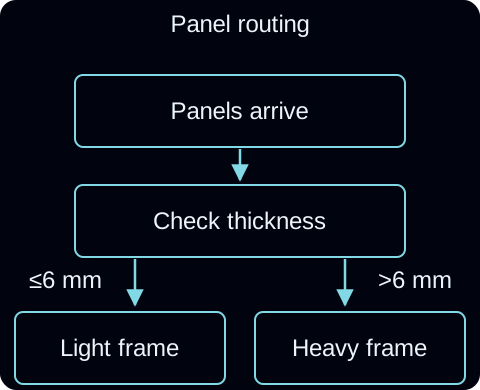
Reporting decision: Which route follows a 6 mm measurement?
Choose ONE answer.
Difficulty 1/5 · 100 coins + a small bonus on first completion today
The ≤6 mm branch includes equality, while >6 mm excludes it. The branches offer alternative routes, not sequential stages, and do not compare durability.
Original schematic teaching process:

View Sign preparation at full size
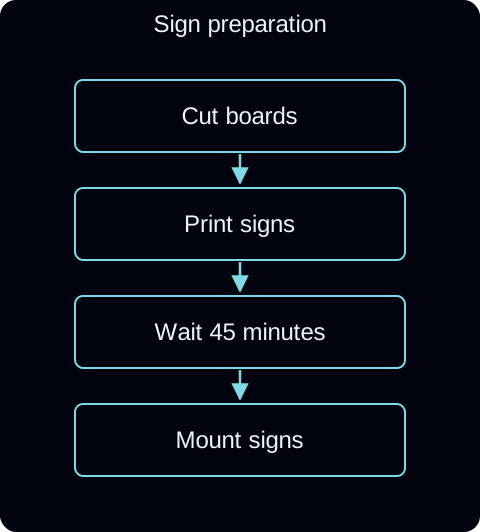
Reporting decision: Which report preserves the waiting stage?
Choose ONE answer.
Difficulty 1/5 · 100 coins + a small bonus on first completion today
The label specifies a wait after printing. It does not time printing or dictate a universal stage-count convention. Describe the actual operations rather than making an arbitrary count your main feature.
Original schematic teaching process:

View Record archiving at full size
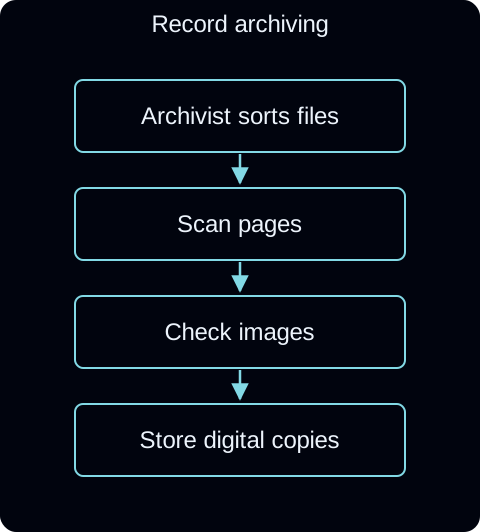
Reporting decision: Which sentence keeps the process relationship?
Choose ONE answer.
Difficulty 1/5 · 100 coins + a small bonus on first completion today
The sorting actor and scan/check order are supplied. Disposal, improvement and a new scanner are not shown. Passive forms can keep the later actions in focus without inventing equipment or outcomes.
Original schematic teaching process:

View Metal label finishing at full size
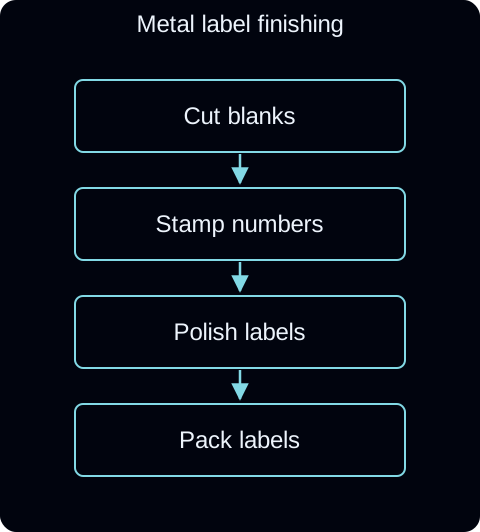
Reporting decision: Which passive follows the sequence?
Choose ONE answer.
Difficulty 1/5 · 100 coins + a small bonus on first completion today
Are cut, numbered and polished shares the passive auxiliary and preserves the shown order. The other options use incorrect forms, reverse the order or make labels the acting agent.
Original schematic teaching process:

View Basket circulation at full size
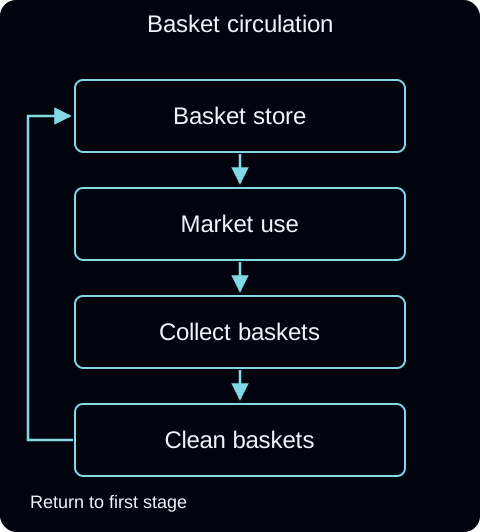
Reporting decision: Which limit is absent from the diagram?
Choose ONE answer.
Difficulty 1/5 · 100 coins + a small bonus on first completion today
The loop and its order are visible, but no reuse limit is supplied. Missing lifetime information does not remove the explicit return relationship. Identify what is genuinely absent, not what the arrows already show.
Original schematic teaching process:

View Card lamination at full size
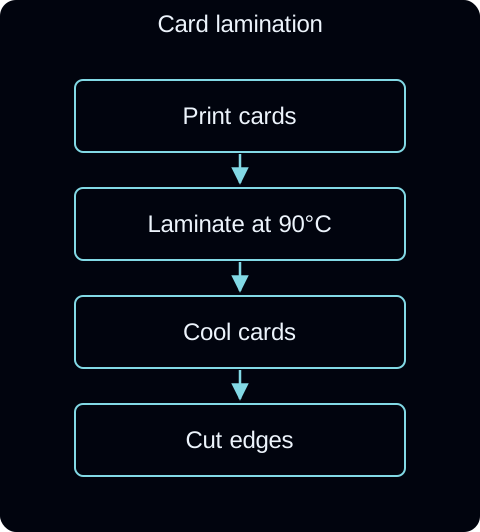
Reporting decision: Which sentence uses the temperature correctly?
Choose ONE answer.
Difficulty 1/5 · 100 coins + a small bonus on first completion today
90°C belongs to lamination and does not time cooling or label printing. The arrows then show cooling followed by edge cutting. Carry both the unit and position into the sentence.
Original schematic teaching process:

View Toy preparation at full size
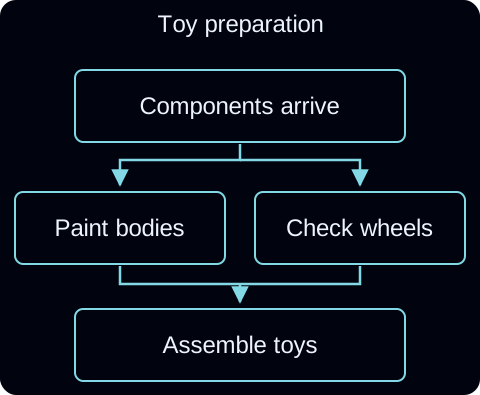
Reporting decision: Which overview includes the main structure?
Choose ONE answer.
Difficulty 1/5 · 100 coins + a small bonus on first completion today
The two arms show different operations on different components. Their duration and a return path are absent. Select the branching-and-merge organisation without adding a speed comparison.
Transfer: one returned-case diagram, three decisions
- Three questions reuse one fresh diagram. It is one shared source, not three independent processes. Select its broad organisation, preserve the object-action relationships and check which proposed addition has no source evidence. Do not assume an example from another diagram still applies.
- Use the decisions to plan a report: introduce what is represented, identify the main structure, then group the meaningful operations. Different paragraph plans can work. A fixed number of sentences or a compulsory phrase cannot replace accurate relationships.
Original schematic teaching process:

View Returned cases at full size
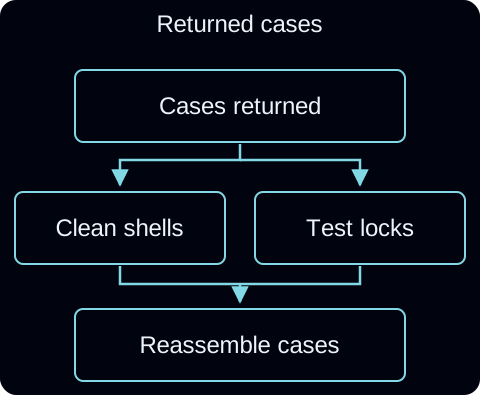
Reporting decision: Which overview preserves the process?
Choose ONE answer.
Difficulty 1/5 · 100 coins + a small bonus on first completion today
Shell cleaning and lock testing are separate arms that merge at reassembly. Neither disposal nor timing is given. This is one shared diagram across three reporting decisions.
Original schematic teaching process:
View Returned cases at full size
Reporting decision: Which sentence assigns actions accurately?
Choose ONE answer.
Difficulty 1/5 · 100 coins + a small bonus on first completion today
Each arm names a different object and action. The first alternative swaps them, the second changes agency and the third reverses the merge. Keep the source’s nouns attached to its verbs.
Original schematic teaching process:
View Returned cases at full size
Reporting decision: Which explanation is unsupported?
Choose ONE answer.
Difficulty 1/5 · 100 coins + a small bonus on first completion today
No customer complaint or reason is shown. The other statements identify visible nodes and relationships. Reporting what happens does not authorise a plausible story about why.
Write a complete report of book repair
- Use the new diagram in the task to write at least 150 words in connected prose before opening the models. Official Academic Task 1 uses about 20 minutes; practise untimed first if needed, then try that allocation. The local page does not enforce length, mark your writing or predict a band. Planning notes do not replace the connected report.
- After drafting, compare the complete weaker and improved responses, annotations and alternative organisation. Revise one error in your own sequence, coverage or evidence. Your draft stays on this page; copy it before leaving. A model is one possible report, not a speech to memorise.
Original schematic Academic Task 1 process:

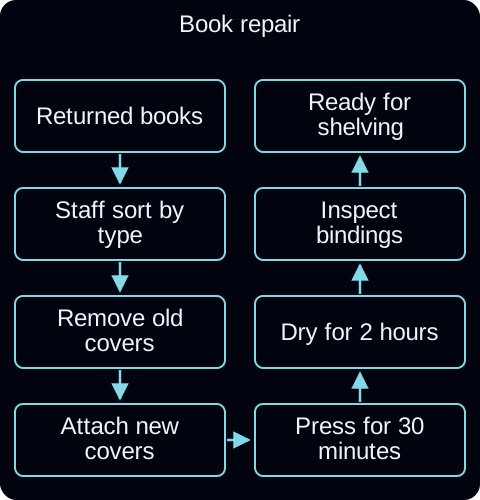
Write at least 150 words in connected prose, summarising the main features and relevant relationships. Draft before opening the complete models, then revise one sequence, coverage or evidence error. This page does not grade writing or enforce length. Your draft stays on this page; copy it before leaving.
Several reports can preserve the same process. Compare the evidence, grouping and grammar rather than matching model phrases. This is private comparison and revision, not automatic evaluation, demonstrated proficiency or a band estimate.
Write again from a different process structure
- This second full task supplies a fresh kit-restoration diagram. Read its paths and labels yourself and draft at least 150 words before revealing the models. Avoid carrying the previous report’s grammar, timings or process shape into this source simply because both involve returned objects.
- Compare each paragraph’s job and every claim’s support. Use the five criteria to revise one concrete weakness. Recording comparison and revision is private self-review; it does not independently assess the report, demonstrate proficiency or assign an IELTS mark. Several organisations and wordings can preserve the same drawing.
Original schematic Academic Task 1 process:

View Kit restoration at full size
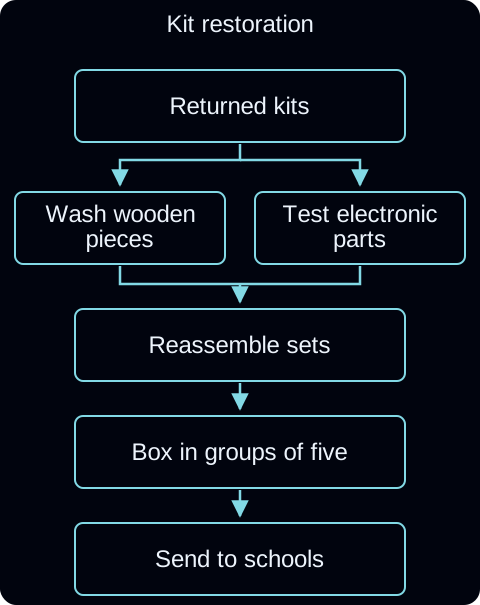
Write at least 150 words in connected prose, summarising the main features and relevant relationships. Draft before opening the complete models, then revise one sequence, coverage or evidence error. This page does not grade writing or enforce length. Your draft stays on this page; copy it before leaving.
Several reports can preserve the same process. Compare the evidence, grouping and grammar rather than matching model phrases. This is private comparison and revision, not automatic evaluation, demonstrated proficiency or a band estimate.
Later review: retrieve a sequence and a boundary
- After a break, use the fresh folder and container diagrams before reopening the worked cases. Explain the rejected alternative: was its grammar wrong, did it reverse an arrow, or did it put equality on the wrong side of a condition? Correct wording should preserve meaning as well as form.
- If order and evidence remain difficult, return to the relevant worked contrast above. For another visual-report task, continue with map comparisons and complete reports. For precise quantity and change phrases, use the language of change; for numerical overviews, revisit selection and reporting. A process arrow is not automatically a map route.
Original schematic teaching process:

View Folder preparation at full size
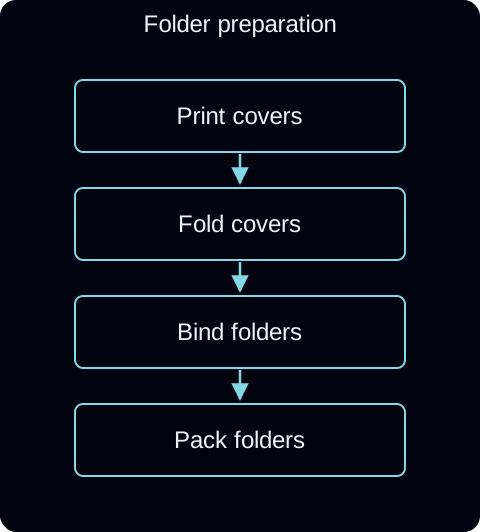
Reporting decision: Which repair preserves order and grammar?
Choose ONE answer.
Difficulty 1/5 · 100 coins + a small bonus on first completion today
Printed, folded, bound and packed are the appropriate participles, and the sequence is retained. The other options misuse forms, reverse work or invent a sales effect.
Original schematic teaching process:

View Container routing at full size
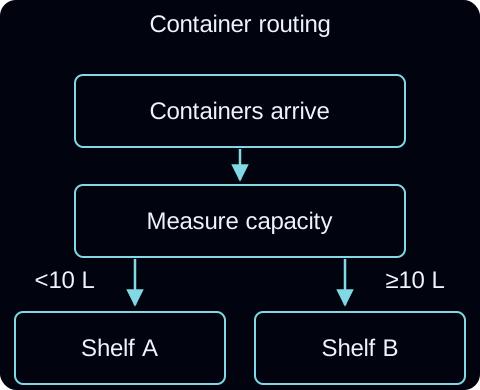
Reporting decision: Where does a 10-litre container go?
Choose ONE answer.
Difficulty 1/5 · 100 coins + a small bonus on first completion today
The ≥10 L branch includes exactly ten litres and leads to Shelf B. The <10 L branch does not. Capacity is not a mass measurement; retain the unit and equality boundary.
Report the supplied process, not an imagined better one
- Recap: trace structure, select the main phases, preserve every important branch or loop, then support them with accurate operations and labels. Choose active/passive forms for the sentence’s purpose. A report can be clear without invented machinery, causes, timings or benefits.
- Format checked on 19 October 2026 against the official IELTS Academic Writing guide. Every diagram, question and model here is original schematic teaching. Independent subject, language, key, rights and learner reviews remain pending. These activities are not official tasks, calibrated model bands or a demonstrated writing outcome.