Your learning plan · Continue · Review →
着 — describing a continuing state
مُقدَّميبقى موقعك المحفوظ في هذا المتصفح. لا يكتمل استئناف الموقع الدرس أو الإجابة على أسئلته.
The classroom door is open
- You walk past the classroom at lunch. Nobody is inside, but the door is open and the lights are on.
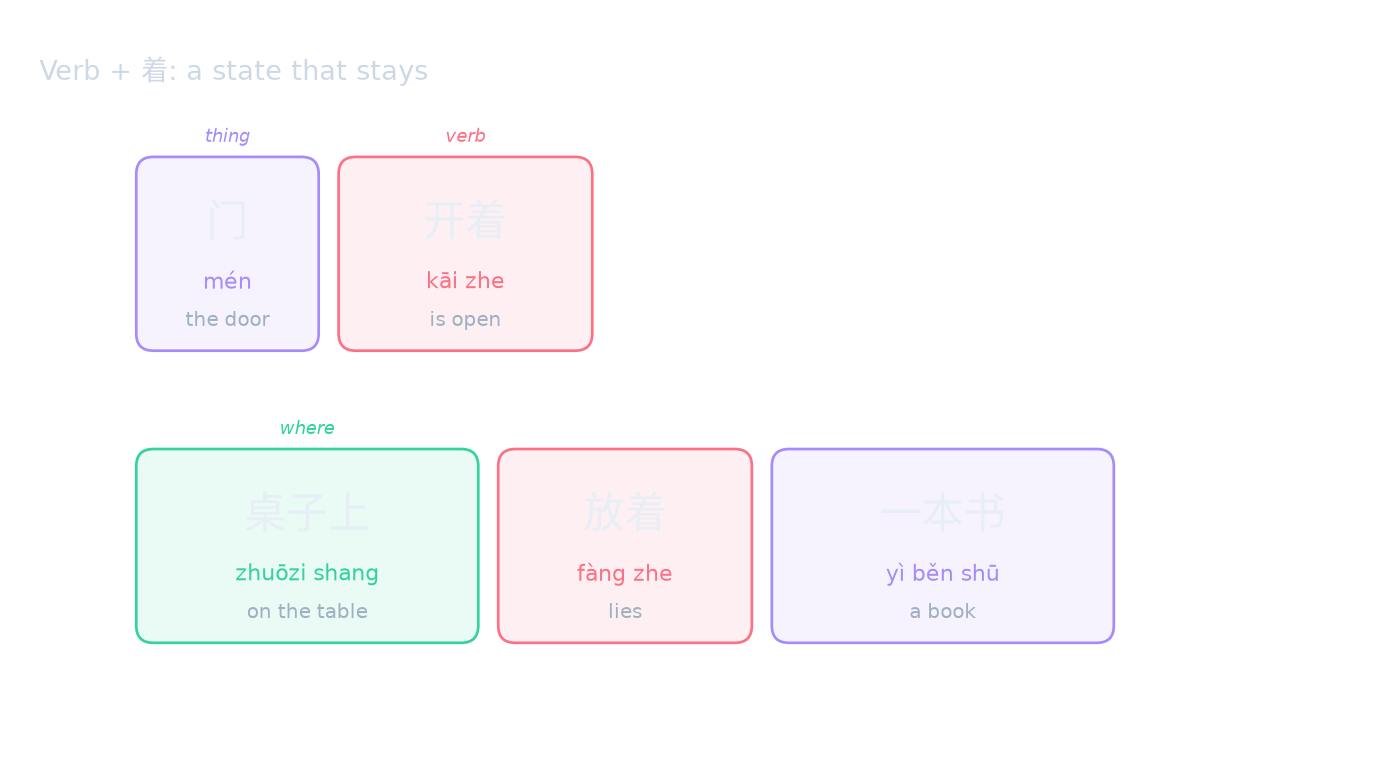
- 门开(ongoing -ing)着,lamp灯also也开着。 — "The door is open, and the lights are on too."
Verb + (ongoing -ing)着: a continuing state
- (ongoing -ing)着 (zhe) after a verb shows a state that continues: 门开(ongoing -ing)着, the door is (standing) open; he他attire穿着one, a一(measure word)件red红jacket衣服, he is wearing a red jacket.
- It describes how things are, not a quick action. to open a door (lit. and…开门 is the action of opening; 门开(ongoing -ing)着 is the result that stays.
he他wear穿着a一(measure word)件red红jacket衣服。
Complete: “The door is open.” 门开____。
الصعوبة 1/5 · 100 عملة + مكافأة صغيرة عند الإكمال الأول اليوم
Verb + 着 shows the open state continues.
Describing a place
- Place + verb + (ongoing -ing)着 + thing: table桌子on上place放(ongoing -ing)着one, a一(measure word)本book书。 — "There is a book lying on the table."
- wall墙on上to write写(ongoing -ing)着name (of a person or thing)名字。 — "Names are written on the wall." This pattern is common in descriptions of rooms and pictures.
table桌子on上place放着a一(measure word)本book书。
Which sentence describes a book lying on the table?
الصعوبة 1/5 · 100 عملة + مكافأة صغيرة عند الإكمال الأول اليوم
Place + verb + 着 + thing is the pattern for describing a scene.
Doing one thing while doing another
- he他to laugh笑(ongoing -ing)着variant of 说说:"hello你好!" — "He said hello with a smile." The first verb with (ongoing -ing)着 shows the manner of the second action.
- we / us我们to sit坐(ongoing -ing)着to have a meal吃饭(suggestion)吧。 — "Let's sit down to eat."
Build: “Let’s sit down to eat.”
الصعوبة 3/5 · 200 عملة + مكافأة صغيرة عند الإكمال الأول اليوم
Verb1 + 着 + verb2 shows how the second action is done.
Watch out
- (ongoing -ing)着 describes a continuing state. For an action in progress, at / in在 or in the middle of正在 is usual: he他at / in在to read看书, he is reading.
- Negative uses not / haven't没: gate门not / haven't没to open (transitive or…开(ongoing -ing)着, the door is not open. Do not use not不 with (ongoing -ing)着.
门不开着 is the usual way to say “The door is not open”.
الصعوبة 1/5 · 100 عملة + مكافأة صغيرة عند الإكمال الأول اليوم
False. The negative of verb + 着 uses 没 — 门没开着.
Recap
- Verb + (ongoing -ing)着 = a state that continues: 门开(ongoing -ing)着, attire穿着red红jacket衣服.
- Place + verb + (ongoing -ing)着 + thing describes a scene; verb1 + (ongoing -ing)着 + verb2 gives the manner. Negative: not / haven't没……(ongoing -ing)着.
Describe your desk or bedroom to a friend on the phone. Say what is on the desk, what is on the wall and whether the window is open. Close the examples. Say it, then write it in Chinese.
Compare meaning and word order with the model; your sentences need not copy it. A partner or teacher must hear the spoken version to comment on pronunciation.