PID 控制与校正
引入| English | 释义 | 拼音 |
|---|---|---|
| PID controller | PID 控制器 | PID kòng zhì qì |
| proportional/prəˈpɔːʃənl/ | 比例 | bǐ lì |
| integral/ˈɪntɪɡrəl/ | 积分 | jī fēn |
| derivative/dɪˈrɪvətɪv/ | 微分 | wēi fēn |
| lead compensator | 超前校正装置 | chāo qián jiào zhèng zhuāng zhì |
| anti-windup | 抗饱和 | kàng bǎo hé |
The controller you will tune most
- Most industrial loops run a PID. It is the first controller an engineer tunes, and the one tuned most often.
- Each of its three terms buys one behaviour and charges a known price.
Three terms
- A PID controller PID 控制器 acts on the error $e = r - y$: $u = K_{p}e + K_{i}\displaystyle\int e\,dt + K_{d}\dfrac{de}{dt}$.
- Proportional 比例 reacts now. Integral 积分 remembers, removing steady-state error. Derivative 微分 anticipates, adding damping.
Match each term to what it does.
难度 2/5 · 今日首次完成可获 140 金币及少量额外奖励
Each term buys one behaviour; the price list follows.
Ziegler–Nichols tuning
- Raise the proportional gain until the loop just oscillates. Record the ultimate gain $K_{u}$ and the period $T_{u}$.
- The PID row of the table: $K_{p} = 0.6K_{u}$, $T_{i} = T_{u}/2$, $T_{d} = T_{u}/8$. In parallel form, $K_{i} = K_{p}/T_{i}$ and $K_{d} = K_{p}T_{d}$.
A loop oscillates at K_u = 20 with period T_u = 4 s. What integral time T_i does the Ziegler–Nichols PID row give, in s?
难度 2/5 · 今日首次完成可获 140 金币及少量额外奖励
$T_{i} = T_{u}/2 = 2$ s, with $K_{p} = 0.6 \times 20 = 12$ and $T_{d} = T_{u}/8 = 0.5$ s.
K_p = 28.8 and T_i = 1.11 s. What is the parallel integral gain K_i? Give 1 decimal place.
难度 2/5 · 今日首次完成可获 140 金币及少量额外奖励
$K_{i} = K_{p}/T_{i} = 28.8/1.11 = 25.9$ per second.
The price list
- P alone never removes steady-state error. I adds phase lag. D amplifies measurement noise.
- Take the derivative of the measurement, not the error, or every setpoint step kicks the actuator.
Taking the derivative of the error, instead of the measurement, makes a setpoint step kick the actuator.
难度 1/5 · 今日首次完成可获 100 金币及少量额外奖励
A step in r has an infinite slope, so de/dt spikes. The measured output moves smoothly, so derivative on y avoids the kick.
Worked example: Ziegler–Nichols
- The running plant oscillates at $K_{u} = 48$, $T_{u} = 2.22$ s, so $K_{p} = 28.8$, $T_{i} = 1.11$ s, $T_{d} = 0.278$ s.
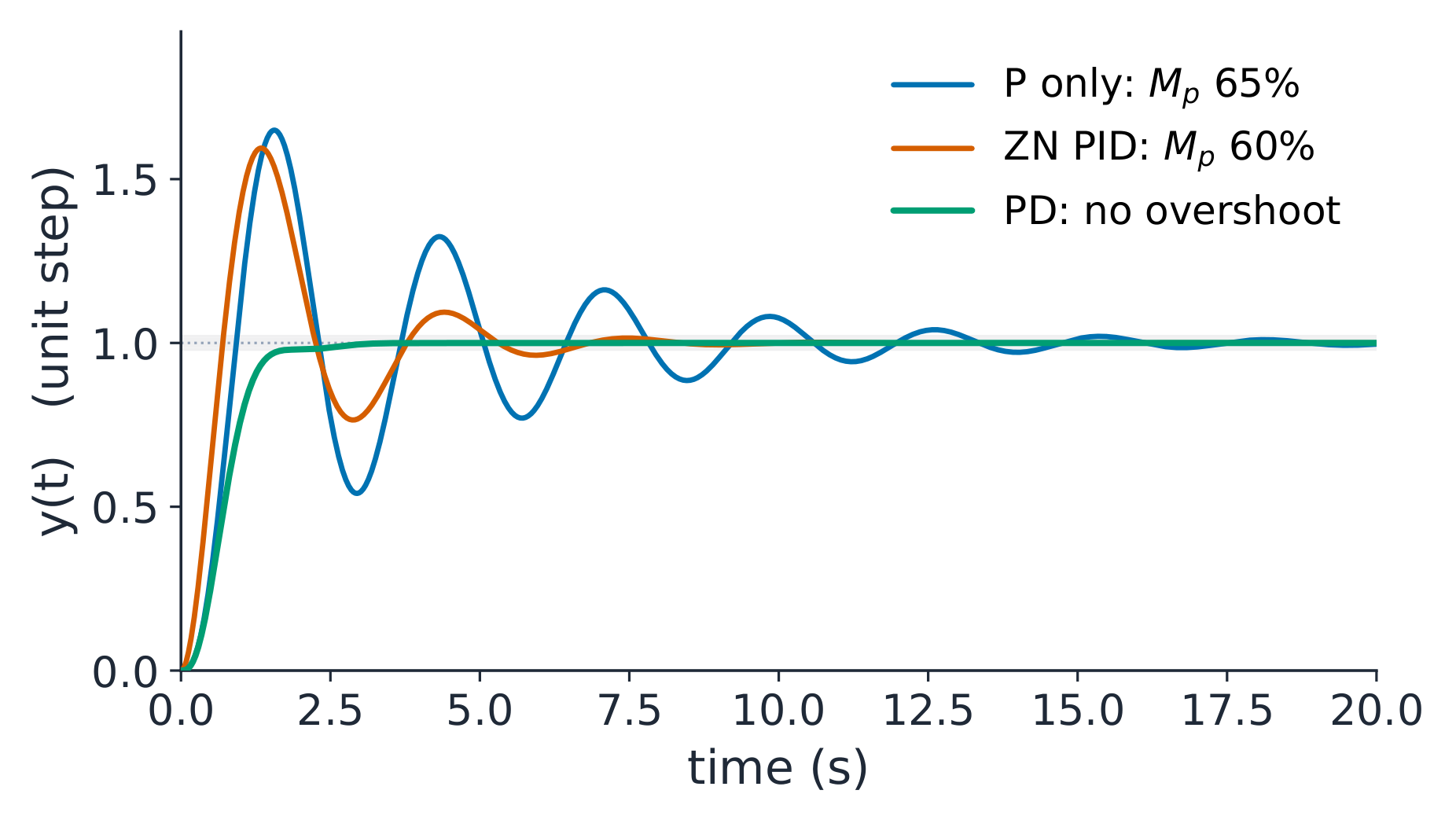
- P alone overshoots 65% and leaves a ramp error of $8/K_{p} = 0.278$. The PID removes that error but still rings at 60%: a first cut, not a finish.
The running plant 1/[s(s + 2)(s + 4)] runs with P control, K_p = 16. What is the ramp error?
难度 2/5 · 今日首次完成可获 140 金币及少量额外奖励
$K_{v} = K_{p}/(2 \times 4) = 2$, so the ramp error is $1/K_{v} = 0.5$. An integrator would remove it.
Worked example: add derivative
- With $K_{p} = 28.8$ the PD polynomial is $s^{3} + 6s^{2} + (8 + K_{p}T_{d})s + K_{p}$: derivative adds to the damping term.
- At $T_{d} = 0.5$ s the poles are $-2$ and $-2 \pm j3.22$. With D on the measurement the step shows no overshoot and settles in 2.1 s.
一个旋钮管增益,一个管阻尼
拖动 Kp 与 Td,看超调、调节时间与劳斯判定一起变化;只加增益在 48 处失稳, 而阻尼能修复它。
With K_p = 20 and T_d = 0.3 s on the running plant, what is the s-coefficient of the PD characteristic polynomial?
难度 2/5 · 今日首次完成可获 140 金币及少量额外奖励
$8 + K_{p}T_{d} = 8 + 6 = 14$. Derivative raises the damping term directly.
The lead compensator
- A lead compensator 超前校正装置 $\dfrac{1 + \tau s}{1 + \alpha\tau s}$, with $0 < \alpha < 1$, adds phase near one frequency: $\sin\phi_{m} = \dfrac{1 - \alpha}{1 + \alpha}$.
- For +45°, $\alpha = 0.172$. It also raises the high-frequency gain by $1/\alpha = 5.8$, which the design must absorb.
A lead network must add 30° at its peak. What α does it need? Give 3 decimal places.
难度 2/5 · 今日首次完成可获 140 金币及少量额外奖励
$\alpha = (1 - \sin 30°)/(1 + \sin 30°) = 0.5/1.5 = 0.333$. Its high-frequency gain rises by $1/\alpha = 3$.
Anti-windup
- When the actuator saturates, the integrator keeps adding error it cannot use, then releases it as one big overshoot.
- Anti-windup 抗饱和 stops this: clamp the integrator while saturated, or feed back the saturation excess.
Three common slips
- Ultimate gain on a plant that never oscillates. Use the step-response version of the table.
- Mixing tuning forms. $K_{p}, T_{i}, T_{d}$ are not the parallel gains.
- Forgetting the lead's $1/\alpha$. The extra high-frequency gain eats the margin you bought.
Recap
- P reacts, I remembers, D anticipates.
- Ziegler–Nichols gives a first cut; margins and simulation finish the job.
- Derivative on the measurement; anti-windup always.