| English | 释义 | 拼音 |
|---|---|---|
| embedded computer/emˈbedɪd kəmˈpjuːtə/ | 嵌入式计算机 | qiàn rù shì jì suàn jī |
| Internet of Things/ˈɪntənet ɒv θɪŋz/ | 物联网 | wù lián wǎng |
| unpatched software/ʌnˈpætʃt ˈsɒftweə/ | 未打补丁的软件 | wèi dǎ bǔ dīng de ruǎn jiàn |
| virus/ˈvaɪrəs/ | 病毒 | bìng dú |
| worm/wɜːm/ | 蠕虫 | rú chóng |
| ransomware/ˈrænsəmweə/ | 勒索软件 | lè suǒ ruǎn jiàn |
| remote access trojan/rɪˈməʊt ˈækses ˈtrəʊdʒn/ | 远程访问木马 | yuǎn chéng fǎng wèn mù mǎ |
Cameras that took down the web, 2016
- On 21 October 2016 many people on the US east coast could not reach Twitter, Netflix, Reddit or GitHub. A botnet called Mirai had flooded Dyn, a company that translates website names into addresses. Mirai had taken over hundreds of thousands of home cameras and routers by trying a list of about 60 factory-default usernames and passwords.
- Every connected device has weaknesses. Knowing the kinds of device and the attacks that use their weaknesses is the first step in protecting them.
How did Mirai take over devices?
难度 1/5 · 今日首次完成可获 100 金币及少量额外奖励
About 60 default logins.
Kinds of device
- General-purpose computers (laptops, servers, phones) run many programs. An embedded computer 嵌入式计算机 is built into another product to do one job: a printer, a car's braking system, a smart thermostat.
- The Internet of Things 物联网 (IoT) is the network of everyday devices connected to the internet — cameras, doorbells, medical monitors.
Name the malware from its behaviour
A worm self-spreads; a virus needs a user; ransomware encrypts for money; a rootkit hides.
Which is an embedded computer?
难度 1/5 · 今日首次完成可获 100 金币及少量额外奖励
Built in to do one job.
Common vulnerabilities
- Default or weak passwords, unpatched software 未打补丁的软件 (known bugs never fixed), unnecessary open services, and old devices that no longer receive updates.
- Many IoT devices are cheap, rarely updated and left running for years.
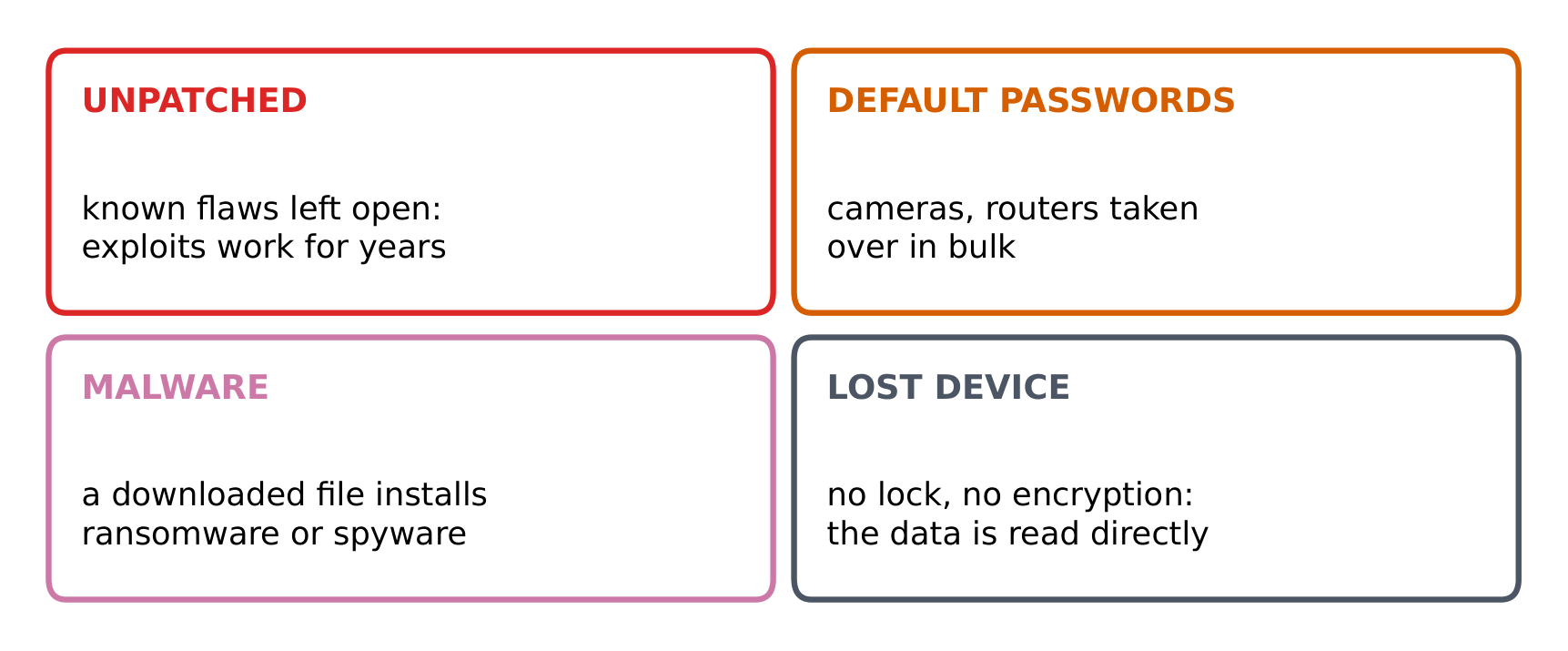
Which are device vulnerabilities?
难度 2/5 · 今日首次完成可获 140 金币及少量额外奖励
A strong password is a protection.
Kinds of malware
- A virus 病毒 attaches to a file and spreads when a person runs it; a worm 蠕虫 spreads by itself across a network.
- Ransomware 勒索软件 encrypts files and demands payment; a remote access trojan 远程访问木马 (RAT) looks harmless but gives an attacker hidden control.
Match each malware type to its behaviour.
难度 2/5 · 今日首次完成可获 140 金币及少量额外奖励
Four types.
Worked example: analyse the Mirai attack
- Vulnerability: IoT devices with unchanged default passwords and open remote-login services.
- Malware type: worm-like — infected devices scanned the internet for more victims automatically.
- Impact and fix: a huge flood of traffic took down a DNS provider; changing default passwords, closing unused services and updating firmware would have blocked it.
Which step would most directly have stopped Mirai?
难度 1/5 · 今日首次完成可获 100 金币及少量额外奖励
Mirai relied on default logins.
One device, many victims
- A weak device can be the entry point to a whole network, or a soldier in a botnet attacking someone else.
- So securing your own device protects other people too.
A hacked home device can be used to attack other people's services.
难度 1/5 · 今日首次完成可获 100 金币及少量额外奖励
As part of a botnet.
"It's only a camera" is how many attacks begin. Small devices are still computers on the network; treat them with the same care as a laptop.
Small IoT devices are too simple to be security risks.
难度 1/5 · 今日首次完成可获 100 金币及少量额外奖励
They are computers on the network.
Devices include general-purpose and embedded computers and IoT devices. Default passwords, unpatched software and open services are common weaknesses; viruses, worms, ransomware and remote access trojans exploit them.
A family buys a smart doorbell. List three steps to secure it and explain each.
Practical device security.