IB Diploma Programme Philosophy HL (current guide). This topic covers
the COMPULSORY CORE THEME in full — Being human — the course's
spine: what it is to be human, examined through identity, freedom,
personhood and mind–body, with the PHILOSOPHICAL CRAFT (argument
analysis, the classic skills) taught alongside. Every study of an
optional theme returns to this core; every paper rewards the craft it
teaches. The worked examples are original.
Must-know for the core theme:
Family
Content
craft
premises, conclusions, validity vs soundness; deduction, induction
identity
personal identity over time: body, memory, psychological continuity
personhood
persons vs humans: criteria and their edges
freedom
determinism, compatibilism, libertarianism; moral responsibility
mind
dualism vs physicalism; the zombie and what-it-is-like
1.2
The philosophical craft
English
Philosophy 哲学 proceeds by argument 论证: premises offered in support of a
conclusion. The craft the papers test: identify the CONCLUSION and the
PREMISES; evaluate the INFERENCE (VALID if the conclusion follows
necessarily, whatever the premises' truth; SOUND if valid with true
premises — validity is about form, soundness adds truth); and
recognise the argument forms: deductive (necessity) and inductive 归纳的
(probability from cases). The classic failures each have names:
BEGGING THE QUESTION (the conclusion smuggled into a premise), the
STRAW MAN (refuting a weakened copy), the FALSE DILEMMA (two options
declared the only ones), the APPEAL TO AUTHORITY (a name where a
reason belongs). Philosophical writing is this discipline made
visible: a CLAIM, a REASON, an OBJECTION answered: the essay's spine
in three moves. The second craft is the thought experiment 思想实验 (philosophy’s laboratory): an imagined case (the ship of Theseus, the
teleporter) that isolates a concept by stressing it; the paper asks
what the case shows and what it assumes.
Worked example. “Every event has a cause, so my choices have
causes, so I am not free.” Identify: P1 every event caused; C1 choices
caused; C2 not free. Valid? Only with a suppressed premise — that
caused choices are not free — and THAT premise is precisely what the
compatibilist denies: the argument begs the question against
compatibilism. The analysis is the model: name the parts, test the
form, find the suppressed premise.
Personal identity 人格同一性 asks what makes you the same person over time, with three classic answers. The body theory 身体理论: numerical continuity of the
organism (its strength: it matches how we identify people; its
problem: the ship of Theseus — replace every part and identity seems
untouched). The memory theory 记忆理论 (Locke): sameness of consciousness —
memory connections join the person across time (its problem: Reid's
brave officer — the old general remembers the officer, the officer
the boy, the general not the boy: memory is not transitive, identity
must be). The psychological continuity theory 心理连续性理论 (Parfit): overlapping chains of psychological connections; identity is not what matters, as the teleporter thought experiment suggests survival without
identity, so personal identity may be a matter of degree.
Personhood 人格 asks what qualifies as a person — a moral category, not a
biological one: humans are biological, persons are beings with
rational agency, consciousness, the capacity for relationships
(persons may be non-human; some humans, arguendo, may lack
personhood). The criteria (self-consciousness, rationality,
communication, moral agency) each draw edges — the infant, the
severely cognitively impaired, the possible machine — which is why
the concept is ethically loaded: abortion, end-of-life and animal
ethics all turn on it. The craft applies: a criterion proposed, a
counter-case found, the criterion refined.
The free will 自由意志 problem in one line: if every event has a cause, is any
choice free? HARD DETERMINISM: no — causation is universal, freedom
is an illusion, and moral responsibility needs rethinking. LIBERTARIANISM:
yes — agents originate actions; at least some choices are uncaused
causings (its burden: how an uncaused event can be controlled, and
thus an agent's). COMPATIBILISM: freedom and determinism coexist — a
free act is one caused in the right way, by the agent's own desires
and reasons without coercion (its burden: if the desires are
themselves caused, is the “right way” enough?). The thought
experiments stress each: Frankfurt's unwilling addict (he acts on his
desire but wants otherwise — unfree even undetermined? second-order
desire as the key) and the manipulation case (a agent's desires
implanted — desires “his own” by the compatibilist criterion, yet
intuitively unfree).
The human condition frames the whole theme: that we are the animal
that asks what it is — self-interpreting beings whose identities are
partly chosen, partly given; finitude, embodiment and mortality as the
conditions philosophy thinks within. And MIND: Dualism 二元论 (mind distinct
from body — substance or property) against physicalism 物理主义 (all facts,
mental included, are physical): the KNOWLEDGE ARGUMENT (Mary the
scientist who knows all the physical facts and learns something new
on seeing colour, a physicalist must say what she learns) and the
ZOMBIE thought experiment (a being physically identical with no inner
life — conceivable? and does conceivability entail possibility?).
Argument anatomy: premises, conclusion, validity vs soundness, deduction vs induction; the named fallacies; the claim-reason-objection spine; thought experiments read as stress tests (craft).
Identity: the three theories with their classic counter-cases (Theseus, Reid's officer, the teleporter); Parfit's survival-without-identity claim (identity).
Personhood: the criteria and their edges; the moral uses of the concept (personhood).
Freedom: hard determinism, libertarianism, compatibilism with each one's burden; Frankfurt's addict and the manipulation case (freedom).
Mind: dualism vs physicalism; the knowledge argument and the zombie; what each shows and assumes (mind).
The worked determinism argument's suppressed premise found and named (craft).
Boundary notes: the papers mark PHILOSOPHICAL SKILL — argument
analysis in Section A, developed response in essays — and the core
theme's concepts reappear in every optional theme. All worked
examples are original; the classic cases cited are the standard
canon.
IB philosophy first assessment 2025. Core Being human; one optional theme at SL, two at HL; one school-selected prescribed text. HL extension is Philosophy and contemporary issues. No unverified prescribed text is chosen by default.
Mapped preparation outcomes: ib_philosophy_hl.1.1, ib_philosophy_hl.1.2. Read the matching native lesson first. Actual approved choices, evidence and final learner work remain separate.
Source vocabulary
premise 前提; validity 有效性.
Explanation and worked method
A premise gives a reason; a conclusion is the claim those reasons aim to support. Validity concerns whether true premises would guarantee the conclusion. Soundness also requires true premises. A definition of personhood must be argued for and tested, not assumed from everyday wording.
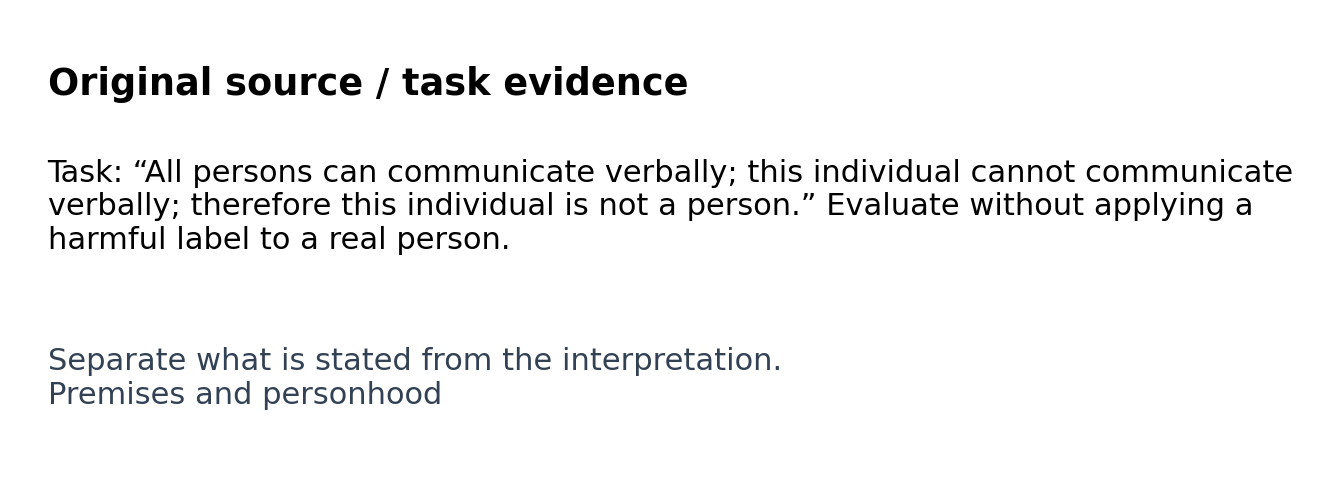
Task: “All persons can communicate verbally; this individual cannot communicate verbally; therefore this individual is not a person.” Evaluate without applying a harmful label to a real person.
The argument has the valid denying-the-consequent form if the first premise is accepted. The premise is highly contestable: temporary inability to speak is a counterexample to using verbal performance as a necessary condition. A valid form does not establish soundness.
Independent transfer
Propose consciousness as a personhood criterion and identify a difficulty in applying it.
Attempt independently before reading the model.
Checked original model
A consciousness criterion can link personhood to experience, but its necessity, sufficiency and meaning need argument. Temporary unconsciousness challenges a momentary test, and other minds raise evidential problems. Distinguish the concept from a performance proxy and consider a defensible revision.
These are authored formative expectations, not official IB descriptors. Accept other justified arguments with evidence and material limits.
Source and task holds
This supplement teaches the method for this part of the course. The full assessment criteria and any texts your school chooses come from your teacher.