Scope and prerequisites
IB Language A language and literature first assessment 2021; English focus. This supplemental reference covers only the listed preparation outcomes. School selections, full-guide procedures and required live or recorded performance are separate.
- Form a focused global issue 全球性问题 and select relevant extracts
- Balance extract analysis with whole-work or body-of-work discussion
Prerequisites: Close reading 细读; distinguish literary work and non-literary body of work.
Explain and choose the method
The global issue should have wider significance and operate in local contexts.
For this course, connect a literary work and a non-literary body of work; explain how choices construct the issue in extracts and beyond them.
A global issue must be focused enough to trace through specific choices. “Recognition of inherited and emerging identities” is more focused than “identity”. In Language and Literature, the assessed oral connects one eligible literary work with one eligible non-literary body of work. An original story and one classroom notice can rehearse links, but do not become the school's assessed pairing or a complete body of work.
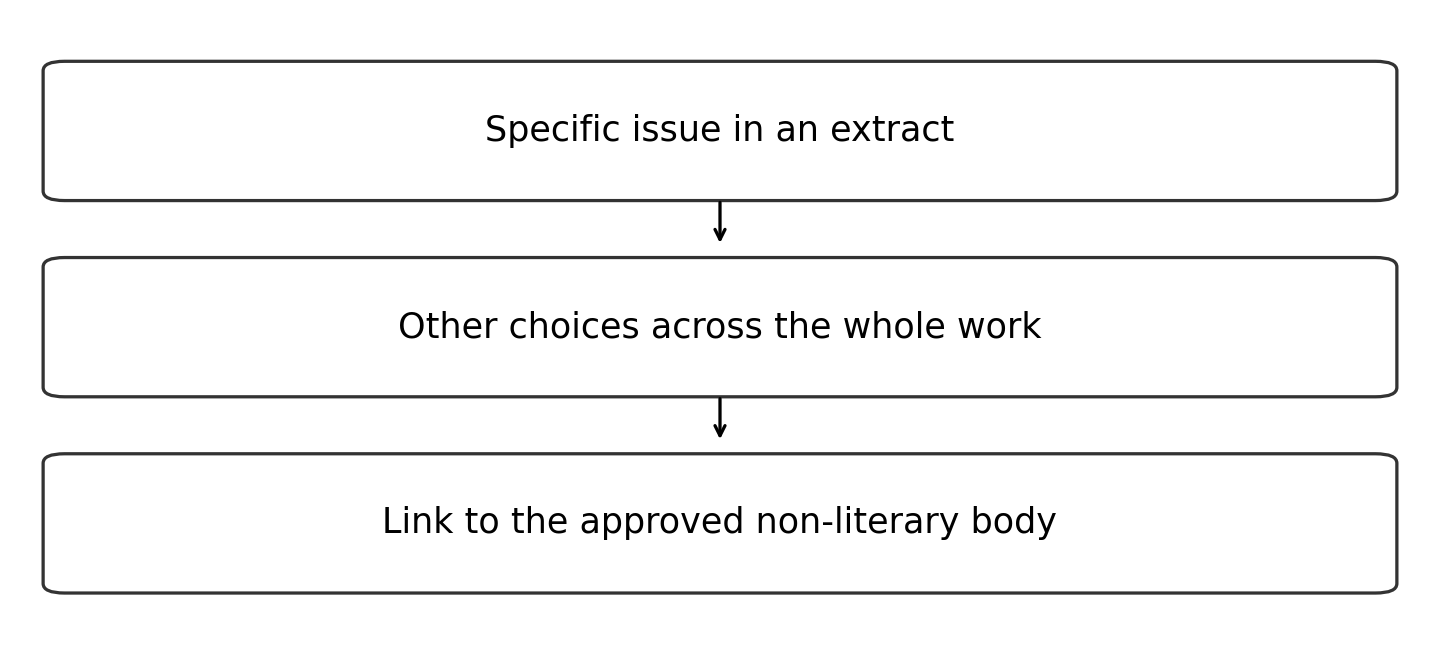
Existing worked example: Select an extract where labels shape a character's treatment and a related text from an approved non-literary body of work. Compare how diction 措辞 and framing operate, then show where the pattern continues or changes across each work.
Complete original context
Original classroom texts, written for this supplement. They are not school-selected assessed works.
Text A — The label Every morning I polished the brass plate beside the door. It carried my father's name, and visitors asked for him even after I took charge of the shop. I answered their questions, found the parts, and wrapped each purchase. Still, at the door, they thanked the name on the plate. One afternoon I put a small card below it: “Ask for Leila.” The next visitor read the card aloud, hesitated, and then asked me where the hinges were. I left the brass plate shining. The card stayed too.
Text B — A space on the shelf (original poem) I cleared a place beside the cup, not where the cup had been. The shelf kept its old circle; the new wood still looked clean. By evening, two rings darkened it. I did not rub them out.
Context supplied for this exercise: both texts are contemporary original classroom writing in English. No author biography, translation 翻译 history or evidence 证据 about a real society is supplied. Compare what the wording permits; do not invent historical facts. A real course comparison must use the school's eligible studied works.
Independent practice and checked reasoning
Transfer 1
Form a focused issue from Text A, and give an extract-level observation plus a whole-text connection.
Reasoning: “How inherited names affect recognition of a new worker” is focused. At extract level, visitors thank the plate rather than Leila; the card makes her name visible. Across the whole short text, the movement from polishing the inherited name to keeping both labels complicates a simple rejection of inheritance. For a real oral, make whole-work connections across the actual studied work rather than treating this short story as the full qualification's reading.
Transfer 2
Using the repair notice from sheet 1 as a rehearsal 排练, propose a cautious connection to access and recognition. Explain why one notice is insufficient to claim an assessed body of work.
Reasoning: The desk-help footer recognises readers who cannot independently book; its prominence can be compared with who is named and addressed in the story. The connection needs a clearly stated issue and evidence rather than asserting identical situations. A body of work and its eligibility require school selection and fuller source context; one original classroom notice cannot establish that requirement.
Transfer 3
Outline a balanced oral rehearsal and two follow-up questions. Separate what can be checked in writing from live evidence still needed.
Reasoning: Introduce the issue; analyse the literary extract and wider work; analyse the non-literary extract and wider body; compare and qualify the findings. Ask “Which detail 细节 challenges your reading?” and “Where else does this issue change in the work?” Written planning can check focus and references. Teacher-led interaction, eligible sources, permitted notes and actual recorded performance remain required.
Limits and next use
The oral is supervised spoken assessment, not an essay submitted in its place. Teacher verifies text eligibility, extract limits, notes and scheduling against the guide.
All tasks here are public original practice with authored guidance. They are not official questions or fresh diagnostics. Existing protected tests and mocks remain separate.