Hormones, stress and behavioural regulation
Scope and prerequisites
Supported GRE topic 25 (HB.1). Use the overview measurement lesson VI when interpreting research evidence. Existing official questions are traced in bank_review_form.yaml; original tasks below are not ETS items.
Concepts and method
HPA axis 下丘脑-垂体-肾上腺轴: The hypothalamus-pituitary-adrenal chain producing the slower cortisol stress response. negative feedback 负反馈: A product inhibiting its own upstream release, bounding the response.
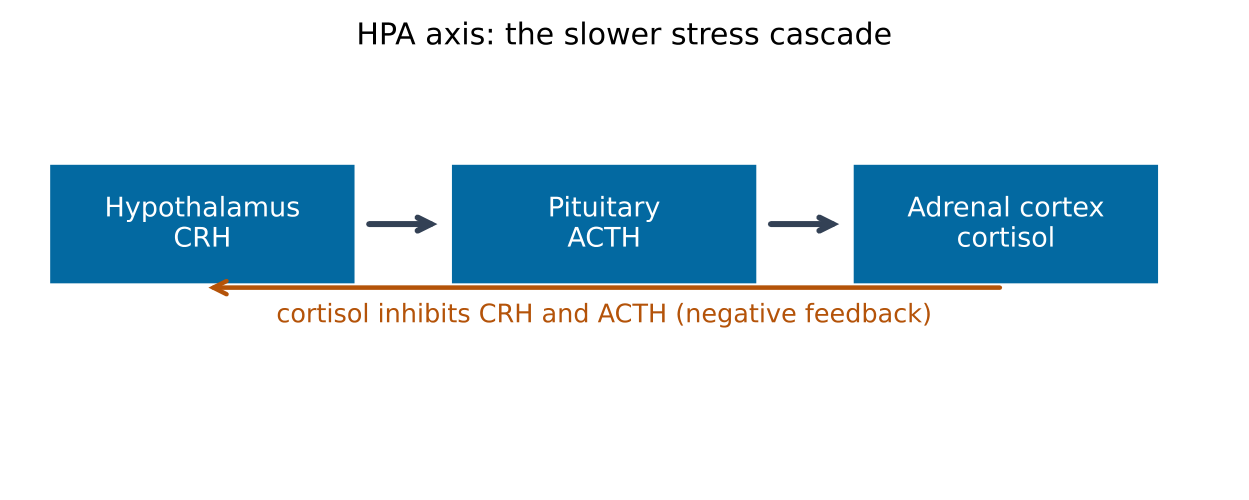
The stress response runs on two clocks. The fast sympathetic-adrenal-medullary path releases adrenaline within seconds; the slower HPA axis runs hypothalamus (CRH) to pituitary (ACTH) to adrenal cortex (cortisol) over minutes, mobilising energy and suppressing non-urgent functions. Chronic stress can affect health through several interacting pathways; cortisol is one part of this regulation, not a single inevitable cause.
Key regulatory hormones: progesterone prepares and maintains the uterine lining for implantation; oxytocin drives labour contractions and milk let-down and is linked to bonding; melatonin times sleep-wake cycles; insulin and glucagon manage blood glucose in opposition. Match the hormone to the loop it serves, not to a vague mood label.
Hormones differ from neural signals in timing and targeting: neural signalling is often faster and spatially directed; hormonal signalling often acts over longer times through circulation. These are tendencies with exceptions, not an absolute division. Only cells carrying the matching receptor respond, so a circulating hormone can still be selective.
Feedback keeps the system bounded: cortisol inhibits CRH and ACTH release (negative feedback), so the axis ramps down when the stressor passes. Feedback failure or chronic activation — not the hormone itself — is what turns an adaptive response into a liability.
The HPA sequence connects hypothalamic CRH, pituitary ACTH and adrenal-cortex cortisol. Cortisol participates in feedback that can inhibit upstream release. Sympathetic-adrenal responses can act more quickly. Neural and endocrine signalling overlap in function; timing is a useful tendency, not an absolute fast/slow division. Circulating hormones act selectively because target cells differ in receptors. Chronic stress involves multiple pathways and cannot be reduced to one inevitable cortisol effect.
Worked reasoning
A near-miss in traffic: adrenaline within seconds, then cortisol via the HPA axis over minutes; cortisol later inhibits CRH/ACTH to settle the response. Progesterone prepares the uterus for a fertilised ovum. Melatonin rises at night to time sleep.
Order CRH, ACTH and cortisol by their place in the HPA pathway, then explain negative feedback without calling cortisol harmful in itself.
Hypothalamus releases CRH, which stimulates pituitary ACTH, which stimulates adrenal-cortex cortisol. Cortisol can inhibit upstream signalling, helping regulate the response. This adaptive control differs from saying the hormone is always harmful. Repeated activation, context and regulation matter.
Independent transfer
A hormone reaches many organs but affects only some cells. Explain why broad circulation and selective effects are compatible.
Attempt independently, then use the matching skill sheet solution.
Review and source limits
Avoid this error: Assigning a hormone a single emotion, or forgetting receptor selectivity; hormones broadcast but only receptor-bearing cells answer. Teaching scope comes from teaching.yaml and the source/key/crop review in bank_review_form.yaml. Detailed current diagnostic criteria require an authenticated manual; neither historical ETS practice nor this educational reference certifies them.