Conditioning, reinforcement and observational learning
Scope and prerequisites
Supported GRE topic 16 (LR.1). Use the overview measurement lesson VI when interpreting research evidence. Existing official questions are traced in bank_review_form.yaml; original tasks below are not ETS items.
Concepts and method
negative reinforcement 负强化: Strengthening a behaviour by removing an aversive stimulus; not punishment. extinction 消退: Weakening of a conditioned response when the CS no longer predicts the US or the behaviour is no longer reinforced.
Classical conditioning pairs a neutral stimulus with an unconditioned stimulus until the neutral stimulus (now conditioned) evokes a conditioned response: bell then food gives bell-evoked salivation. Key phenomena: acquisition, extinction when the CS appears without the US, spontaneous recovery after a pause, generalisation to similar stimuli and discrimination between them. The CS predicts the US; timing and contingency matter.
Operant conditioning changes voluntary behaviour by its consequences. Reinforcement INCREASES behaviour: positive adds something wanted, negative removes something aversive. Punishment DECREASES behaviour: positive adds something aversive, negative removes something wanted. Negative reinforcement is not punishment: both escape and avoidance strengthen the behaviour that ends or prevents the aversive event.
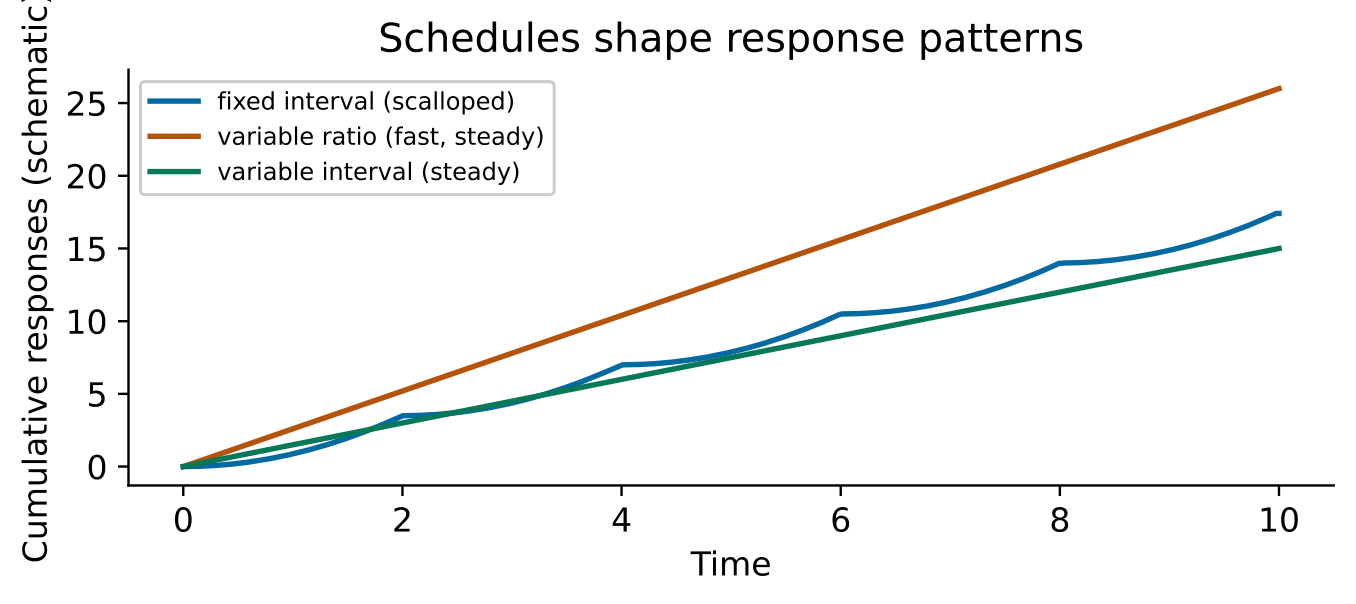
Reinforcement schedules shape response patterns. Fixed-ratio schedules give high rates with a post-reinforcement pause; variable-ratio schedules give the highest, steadiest rates and resist extinction (gambling). Fixed-interval schedules give scalloped responding that rises near the interval end; variable-interval schedules give steady moderate rates. Ratio schedules count responses; interval schedules count time.
Observational learning needs attention to the model, retention of what was seen, the ability to reproduce it, and motivation; vicarious reinforcement (seeing the model rewarded) raises imitation. Bandura's Bobo doll studies showed children imitate filmed aggression. Modelling extends learning beyond direct experience.
Positive means adding; negative means removing. Reinforcement increases the target behaviour; punishment decreases it. Classify from the observed contingency and subsequent behaviour, not the adult's intention. Ratio schedules depend on responses; interval schedules depend on elapsed time before a response can be reinforced. Extinction means the previously reinforced response or cue no longer receives its former consequence; it is not simply forgetting.
Worked reasoning
A tone repeatedly followed by food comes to evoke salivation; presenting the tone without food extinguishes it, yet the response can briefly return after a rest (spontaneous recovery). A slot machine is a variable-ratio schedule: rapid, steady, extinction-resistant play. Taking an aspirin to end a headache is negative reinforcement; a fine for late work is negative punishment.
Access to a game is removed after interruptions, and interruptions decline. An alarm stops after homework begins, and starting increases. Classify both.
Removing access and decreasing interruptions is negative punishment. Removing the alarm and increasing starting is negative reinforcement. The same word removing occurs in both; the direction of change in the named behaviour separates them. These are descriptions of fictional contingencies, not recommended classroom interventions.
Independent transfer
Rewards follow every fifth response in one task and the first response after varying time intervals in another. Identify the schedules and the condition that earns each reward.
Attempt independently, then use the matching skill sheet solution.
Review and source limits
Avoid this error: Calling negative reinforcement punishment, or treating any unpredictable reward as variable-ratio; interval schedules pay the first response AFTER the interval. Teaching scope comes from teaching.yaml and the source/key/crop review in bank_review_form.yaml. Detailed current diagnostic criteria require an authenticated manual; neither historical ETS practice nor this educational reference certifies them.