- Order and calculate with positives, negatives, decimals and fractions; the four operations with formal written methods.
- Primes, factors, HCF/LCM by prime decomposition; indices, roots, surd 无理数s (H) and standard form 标准形式.
- Fractions ↔ decimals ↔ percentages as operators; rounding, estimation and bounds (H).
-
1
数论
1.1
Number: the foundations everything else stands on
词汇 训练English 中文 拼音 standard form/ˈstændəd fɔːm/ 标准形式 biāo zhǔn xíng shì surd/sɜːd/ 无理数 wú lǐ shù 1.1
算术、因数、倍数及质数(N1–N4)
教学大纲
算术、因数、倍数和质数(AQA 8463-风格 N1-N5 关于 8300 的规则)。
- 对整数、小数和分数进行排序;使用六个不等号和等号。
- 运用四种运算的正式笔算方法处理整数、小数、分数和带分数,并结合家庭理财等实际情境。
- 利用逆运算和运算优先级(BIDMAS)。
- 通过质因数分解运用质数、因数、倍数、最大公因数和最小公倍数;(H) 系统列举及计数乘积法则。
来源:Cambridge International 教学大纲
Ordering and symbols: order positive and negative integers, decimals and fractions on a number line; use =, ≠, <, >, ≤, ≥.
The four operations (N2): formal written methods for integers, decimals, proper and improper fractions and mixed numbers, all signs — set in context including household finance: profit, loss, cost price, selling price, debit, credit, balance, income tax, VAT, interest rate.
Inverse operations and priority (N3): cancellation to simplify; BIDMAS 运算顺序 — brackets, indices/powers, roots, division/multiplication, addition/subtraction.
Primes and structure (N4): prime numbers, factors, multiples, common factors, common multiples, HCF, LCM; prime factorisation 质因数分解 in index form (product notation; unique factorisation). Worked pattern:
- 200 = 2³ × 5²
- HCF = product of the lowest powers of common primes; LCM = product of the highest powers of all primes.
(N5) systematic listing and the product rule for counting (H).
词汇 训练English 中文 拼音 prime factorisation/praɪm ˌfæktəraɪˈzeɪʃn/ 质因数分解 zhì yīn shù fēn jiě BIDMAS 运算顺序 yùn suàn shùn xù 1.3
指数、根式、科学计数法及取值范围(N11–N16)
教学大纲
指数、根式、科学记数法和界限(AQA 8300 规则 N7-N9,N14-N16)。
- 运用指数法则处理整数及 (H) 分数指数;进行开方运算。
- (H) 化简根式并分母有理化。
- 计算 A x 10^n 形式的科学记数法并解读计算器显示结果。
- 通过四舍五入至一位有效数字估算答案;按 dp 和 sf 进行四舍五入。
- (H) 用不等式符号写出误差区间,并通过计算应用上界和下界。
来源:Cambridge International 教学大纲
Indices (N7): laws — a^m × a^n = a^(m+n), a^m ÷ a^n = a^(m-n), (a^m)^n = a^(mn), a^(-n) = 1/a^n, a^(1/2) = √a; (H) fractional indices a^(m/n) = the n-th root of a^m.
Surds (N8, H): √12 = √(4 × 3) = 2√3 — simplify; rationalise denominators (multiply by the conjugate: 1/(3+√2) × (3−√2)/(3−√2) = (3−√2)/7).
Standard form (N9): A × 10ⁿ, 1 ≤ A < 10, n an integer — add/subtract (match powers), multiply/divide (multiply the As, add the ns); interpret calculator displays.
Estimation (N14): round each value to 1 significant figure, compute, decide over- or under-estimate; check calculations by approximation.
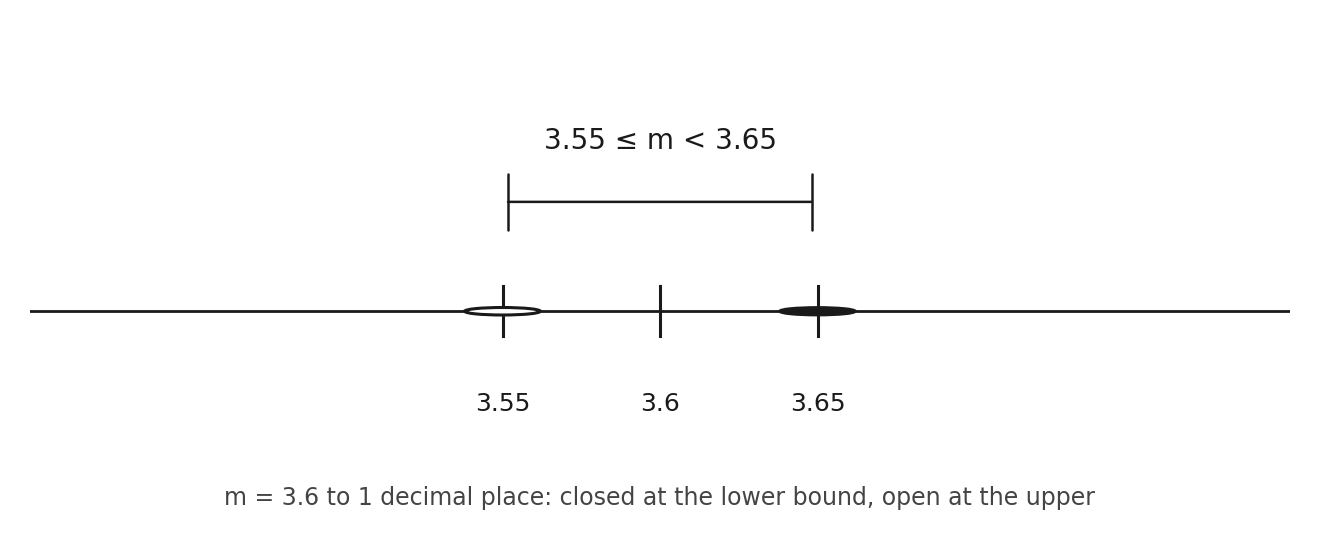
Rounding and error intervals 误差区间 (N15): to decimal places and significant figures (know not to round mid-calculation); (H) inequality notation for error intervals — 3.6 kg to 1 d.p. means 3.55 ≤ m < 3.65; truncation gives 3.6 ≤ m < 3.7.
Bounds (N16, H): upper bound 上界 of a length 9 m to the nearest metre is 9.5; in calculations, UB of × and + uses UBs, ÷ uses UB ÷ LB; give the answer to an appropriate degree of accuracy (often the bound width decides).
词汇 训练English 中文 拼音 error interval 误差区间 wù chā qū jiān upper bound/ˈʌpə baʊnd/ 上界 shàng jiè lower bound/ˈləʊə baʊnd/ 下界 xià jiè 1.2
分数、小数、百分数及单位(N5–N10)
教学大纲
分数、小数和百分数(AQA 8300 规则 N10-N13)。
- 在有限小数与分数之间进行转换;(H) 循环小数转换为分数。
- 将分数和百分数理解为运算操作符,使用乘数包括逆向百分比。
- 使用标准质量、长度、时间和货币单位,配合小数数量。
来源:Cambridge International 教学大纲
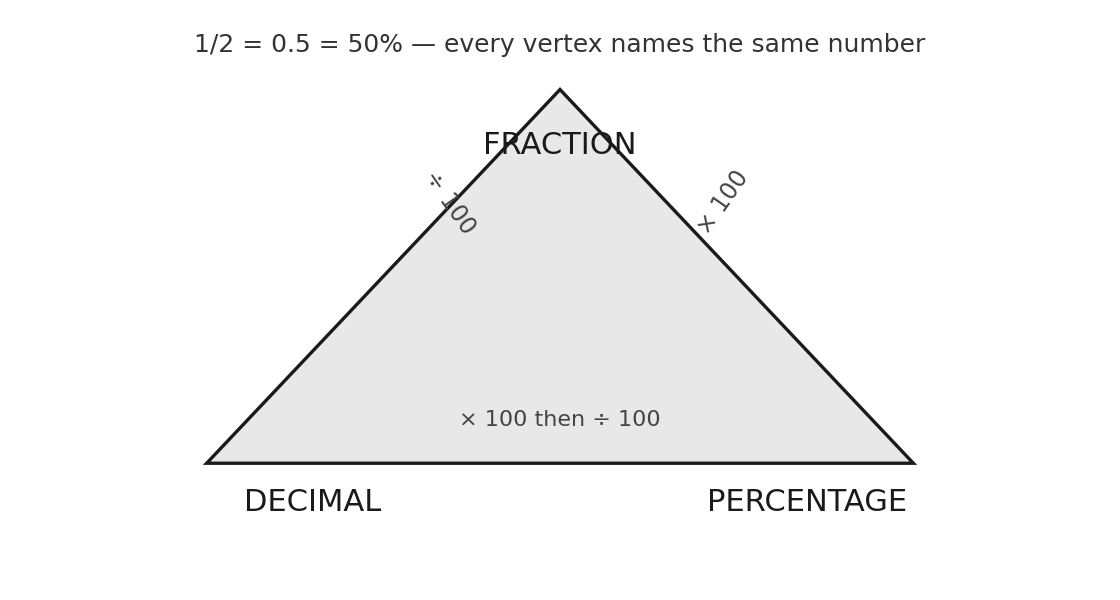
Conversions (N10): 3.5 = 7/2, 0.375 = 3/8; (H) recurring decimal 循环小数s ↔ fractions: 0.6̄ = 6/9 = 2/3; 0.4̄5̄ (pair) → 45/99 = 5/11. Method: x = 0.6̄, 10x = 6.6̄, 9x = 6.
Fractions as operators (N12): "3/5 of 40" = 40 × 3/5 = 24; percentage as multiplier 乘数 — increase by 15% = × 1.15; decrease by 20% = × 0.8; reverse percentage: find the original before the change by dividing by the multiplier.
Units (N13): metric conversions for length, area, volume, capacity; compound measures (speed, density, pressure) link to topic 3.
词汇 训练English 中文 拼音 recurring decimal/rɪˈkɜːrɪŋ ˈdesɪml/ 循环小数 xún huán xiǎo shù multiplier/ˌmʌltɪˈplaɪə/ 乘数 chéng shù 1.2
Checklist before you call this topic done
- Four operations on fractions/mixed numbers and negatives without a calculator; BIDMAS traps.
- Prime decomposition → HCF/LCM; product rule for counting (H).
- Index laws including negative and fractional; simplify and rationalise surds (H).
- Standard form arithmetic; rounding and error intervals; upper/lower bounds through a formula (H).
- FDP conversions including recurring decimals (H); percentage multipliers and reverse percentages.
-
2
代数
-
2.1 符号表示、代数式、代入、展开及因式分解(A1–A4)
学习计划即将上线
-
2.2 方程、不等式、公式及变形(A5–A7)
学习计划即将上线
-
2.3 数列,包括第n项(A24–A25)
学习计划即将上线
-
2.4 图表:线性、二次、倒数函数及实际应用(A8–A16)
学习计划即将上线
-
2.5 二次方程与联立方程——高阶(A17–A23)
学习计划即将上线
-
-
3
比率、比例及变化率
-
3.1 比与比例(R1–R5)
学习计划即将上线
-
3.2 百分比变化、增长与衰减(R9–R16)
学习计划即将上线
-
3.3 复合度量与变化率(R6–R8,R13–R14)
学习计划即将上线
-
-
4
几何与度量
-
4.1 角度、平行线与多边形(G1–G3)
学习计划即将上线
-
4.2 周长、面积与体积,含圆(G14–G17,G19)
学习计划即将上线
-
4.3 勾股定理、三角学及其图像(G6,G20–G24)
学习计划即将上线
-
4.4 变换、作图、轨迹与向量(G7–G10,G25)
学习计划即将上线
-
4.5 性质、全等与相似(G4–G5,G18)
学习计划即将上线
-